
 Posted by
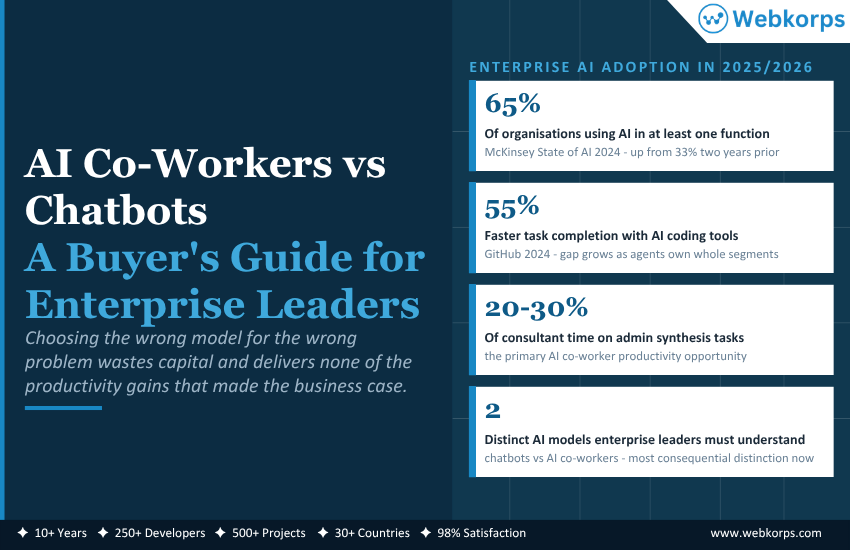
 Enterprise AI budgets are growing fast. According to McKinsey’s 2024 State of AI report, over 65% of organizations are now using AI in at least one business function, up from 33% just two years prior. Many enterprise leaders are still investing in AI tools without a clear understanding of what they are actually buying.
AI co-workers vs. chatbots is one of the most consequential distinctions in enterprise technology right now. Choosing the wrong model for the wrong problem wastes capital, frustrates employees, and delivers none of the productivity gains that made the business case in the first place.
A clear framework can cut through the marketing noise. Whether evaluating AI tools for customer operations, internal productivity, or complex workflow automation, enterprise leaders need practical clarity, not another vendor pitch.
Table of Contents
What Enterprise Buyers Are Actually Comparing
Before evaluating vendors, it’s worth establishing what these two categories actually represent in a 2025/2026 enterprise context.
Chatbots: Structured Conversation at Scale
Enterprise chatbots are software systems designed to handle defined, predictable interactions through natural language. They follow scripted or semi-scripted logic, increasingly powered by large language models (LLMs), but they operate within a bounded scope.
Chatbots excel at:
- Answering frequently asked questions
- Routing support tickets
- Collecting form data through conversation
- Providing guided self-service flows
- Handling high-volume, low-complexity interactions
Most enterprise chatbots today use retrieval-augmented generation (RAG) to pull answers from internal knowledge bases, a meaningful improvement over rule-based systems but still fundamentally reactive. A chatbot responds. It doesn’t act.
AI Co-Workers: Autonomous Task Execution
AI co-workers, sometimes called AI agents, agentic AI, or autonomous AI assistants, operate differently. Rather than responding to a query, they plan and execute multi-step tasks across systems, tools, and data sources with minimal human intervention.
An AI co-worker might:
- Draft a project proposal, pull relevant market data, schedule a stakeholder review, and update the CRM, all from a single instruction
- Monitor an engineering pipeline, identify failing tests, suggest fixes, and open a pull request
- Cross-reference procurement data, flag anomalies, generate a compliance report, and escalate to the appropriate team
Products like Microsoft 365 Copilot, Salesforce Einstein Copilot, and ServiceNow Now Assist represent early enterprise deployments of this agentic model. More specialised AI co-worker platforms are emerging rapidly across HR, finance, legal, and software engineering.
Still mapping AI tools to your business workflows? We help enterprise leaders make that call with clarity and build the architecture to back it up. Talk to Our AI Strategy Team
Core Differences at a Glance
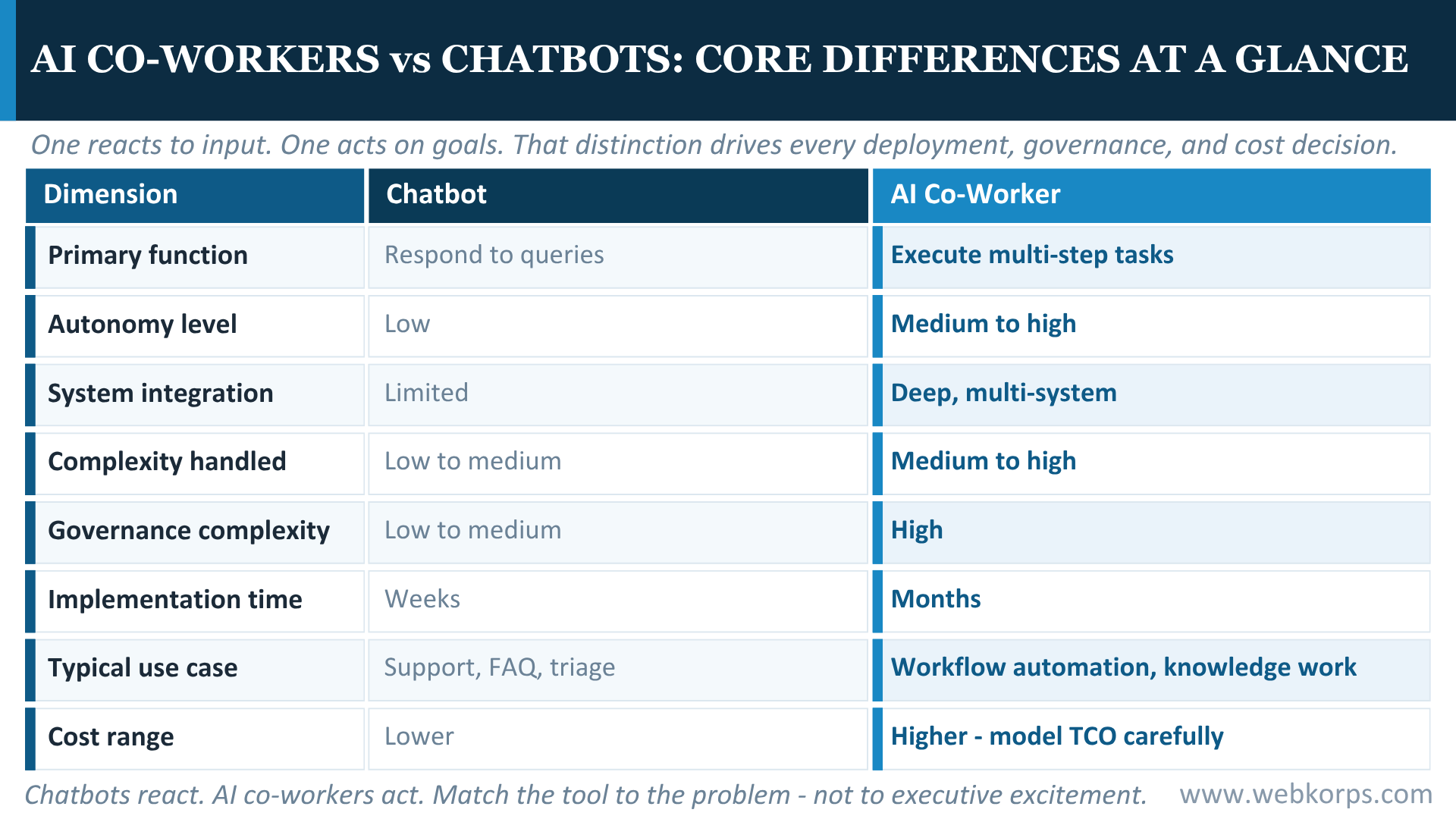
| Dimension | Chatbot | AI Co-Worker |
| Primary function | Respond to queries | Execute multi-step tasks |
| Autonomy level | Low | Medium to high |
| System integration | Limited | Deep, multi-system |
| Complexity handled | Low to medium | Medium to high |
| Human oversight required | Minimal | Varies by deployment |
| Training requirement | Moderate | Higher |
| Governance complexity | Low to medium | High |
| Typical use case | Customer support, FAQ, triage | Workflow automation, knowledge work, engineering |
| Implementation time | Weeks | Months |
| Cost range | Lower | Higher |
Where Chatbots Still Win
Despite the excitement around agentic AI, chatbots remain the right tool for a substantial portion of enterprise use cases.
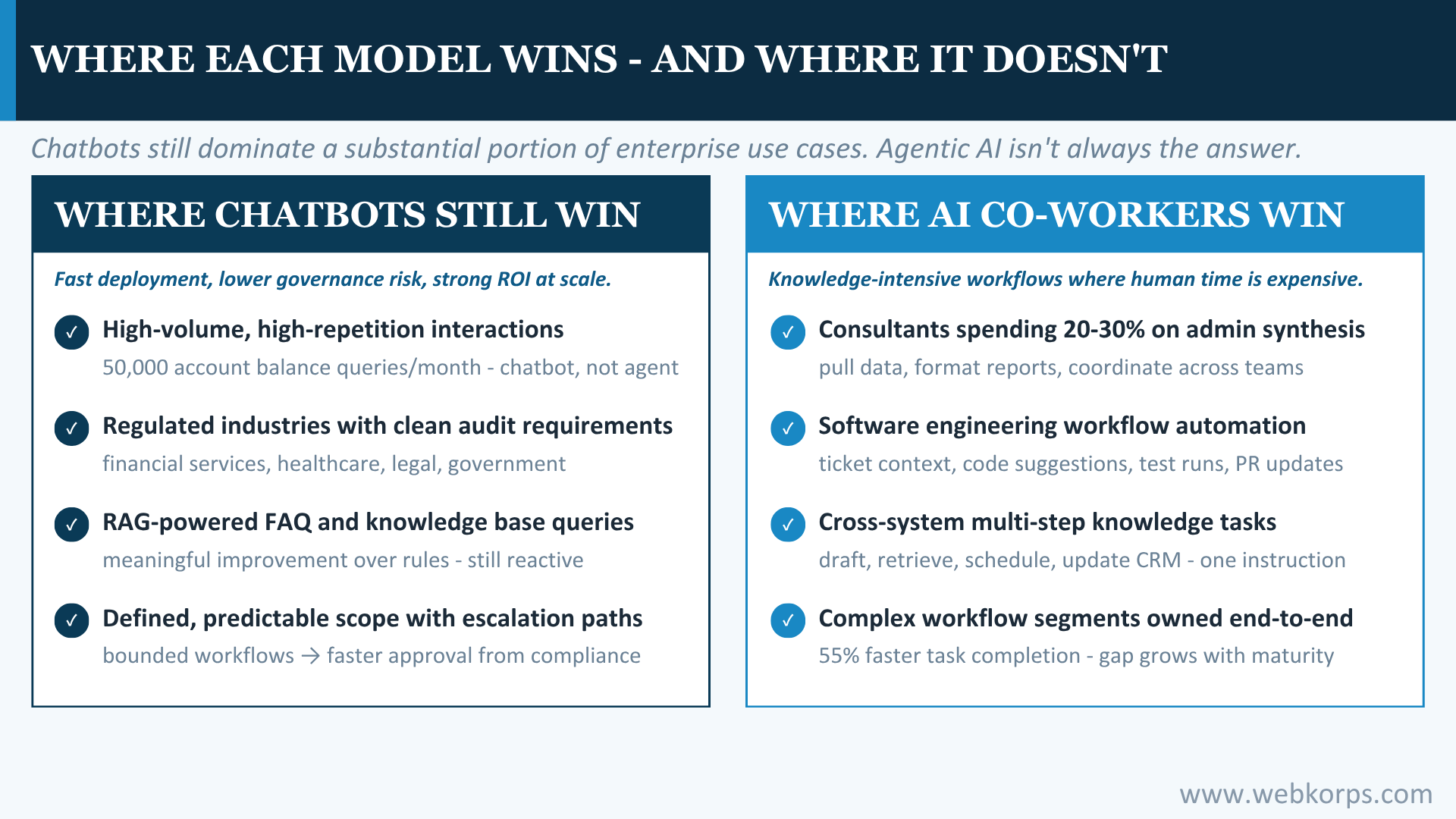
High-volume, high-repetition customer interactions are where chatbots consistently deliver strong ROI. A financial services company handling 50,000 account balance queries per month doesn’t need an AI co-worker; it needs a reliable, fast, compliant chatbot that integrates with its core banking system.
Chatbots also carry lower governance risk. When a system is designed to respond within defined parameters, audit trails are cleaner, failure modes are more predictable, and compliance teams have an easier path to approval.
For enterprise buyers in regulated industries- financial services, healthcare, legal, government- this matters considerably.
 Where AI Co-Workers Create Competitive Advantage
AI co-workers create the most value in knowledge-intensive workflows where the cost of human time is high, and the task complexity exceeds what a chatbot can handle.
Consider a global professional services firm. Consultants spend an estimated 20–30% of their time on administrative synthesis tasks, pulling data, formatting reports, coordinating across teams. An AI co-worker embedded in their workflow environment can absorb much of that burden, freeing senior talent for higher-value work.
Software engineering teams represent another high-value deployment area. AI co-workers integrated into development environments, pulling ticket context, generating code suggestions, running tests, and updating documentation, can meaningfully accelerate delivery cycles.
According to GitHub’s 2024 research, developers using AI coding tools reported completing tasks up to 55% faster. That efficiency gap grows as AI co-workers become more capable of owning entire workflow segments rather than just assisting individual steps.
Governance and Risk: What Enterprise Leaders Miss
Most buying conversations focus on capability. Fewer focus on governance, which is where enterprise AI deployments frequently break down.
Chatbot Governance
Chatbot governance is relatively mature. Define scope, test responses, monitor for drift, and establish escalation paths. Compliance teams understand the model.
AI Co-Worker Governance
AI co-workers introduce new governance challenges that enterprise buyers must address before deployment:
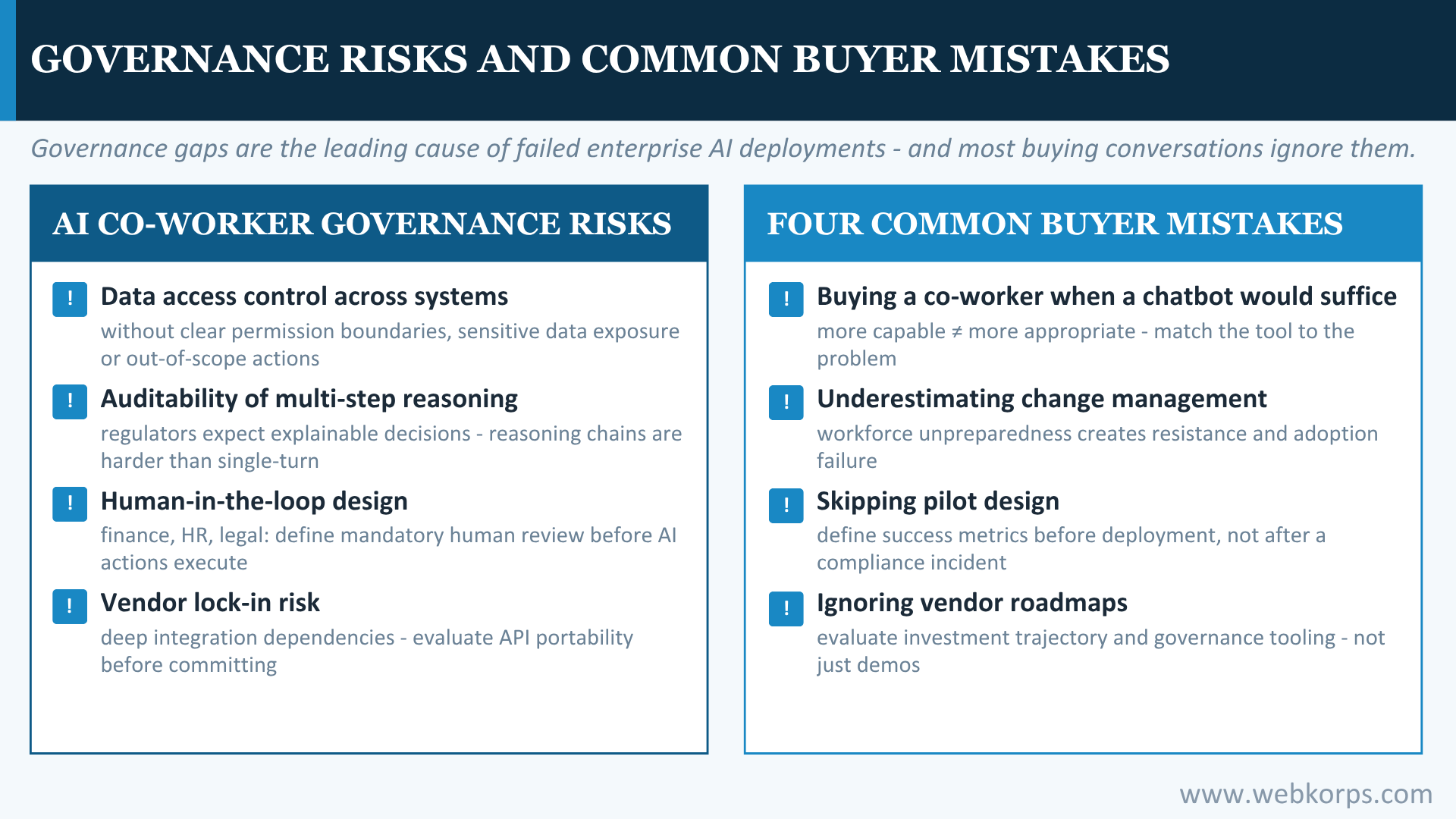
- Data access control: An AI co-worker that can act across systems needs clearly defined permission boundaries. Without them, it can inadvertently expose sensitive data or take actions beyond its intended scope.
- Auditability: Regulators increasingly expect organizations to explain automated decisions. Multi-step AI reasoning chains are harder to audit than single-turn chatbot responses.
- Human-in-the-loop design: Not every workflow should be fully autonomous. Enterprise leaders should define where human review is mandatory before AI actions are executed, particularly in finance, HR, and legal contexts.
- Vendor lock-in risk: AI co-worker platforms from major vendors often create deep integration dependencies. Evaluate portability and API flexibility before committing.
Strong AI governance enables compliant deployment without slowing innovation. Talk to Our AI Strategy Team
Decision Framework for Enterprise Leaders
Use this framework when evaluating which model fits a specific use case.
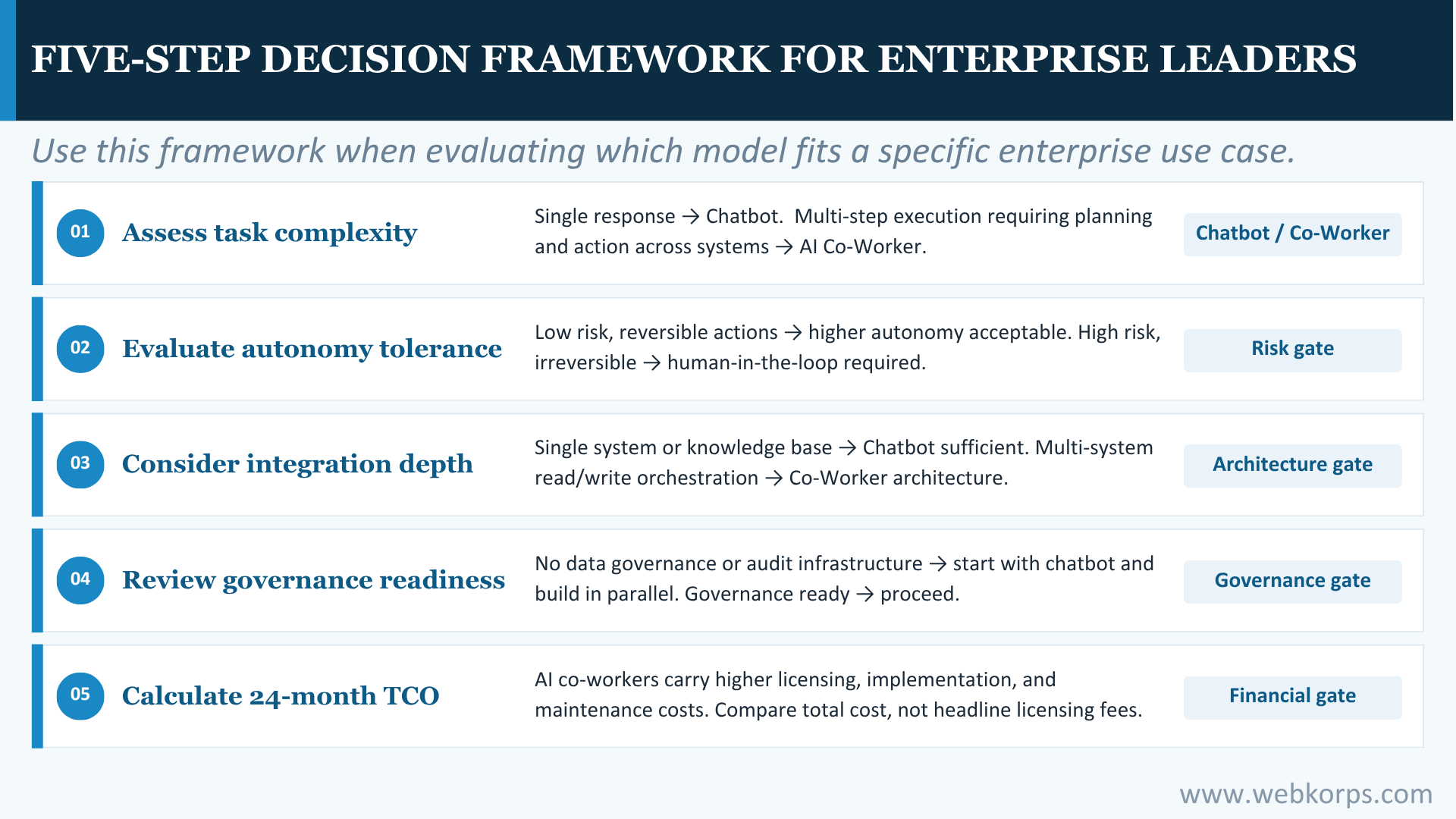
Step 1: Assess Task Complexity
Ask: Does the task require a single response, or does it require planning, sequencing, and action across multiple systems?
- Single response → Chatbot
- Multi-step execution → AI Co-Worker
Step 2: Evaluate Autonomy Tolerance
Ask: What’s the risk if the AI takes an incorrect action autonomously?
- Low risk, reversible actions → Higher autonomy is acceptable
- High risk, irreversible actions → Require human-in-the-loop checkpoints
Step 3: Consider Integration Depth
Ask: Does the workflow require the AI to read and write across multiple enterprise systems?
- Single system or knowledge base → Chatbot is sufficient
- Multi-system orchestration → AI co-worker architecture required
Step 4: Review Governance Readiness
Ask: Does your organization have the data governance, access controls, and audit capabilities to support agentic AI?
- If not → Start with chatbot deployment and build governance infrastructure in parallel
- If yes → Proceed with AI co-worker evaluation
Step 5: Calculate Total Cost of Ownership
AI co-workers carry higher implementation, training, and ongoing maintenance costs. Build a realistic 24-month TCO model before comparing headline licensing fees.
Common Mistakes Enterprise Buyers Make
- Buying an AI co-worker when a chatbot would suffice: Agentic AI is more capable, but it’s also more complex and more expensive to maintain. Match the tool to the problem.
- Underestimating change management: Deploying an AI co-worker into a workflow that employees weren’t prepared for creates resistance, workarounds, and adoption failure. Workforce readiness is not optional.
- Skipping pilot design: Enterprise AI deployments that skip structured pilots before full rollout consistently underperform. Define success metrics before deployment, not after.
- Ignoring vendor roadmaps: AI co-worker platforms are evolving rapidly. Evaluate vendor investment levels and product direction, not just current feature sets.
Practical Recommendation for Enterprise Leaders
Start with a use case audit. Map your highest-volume, highest-friction workflows and assess each against the five-step decision framework above. Most enterprise organizations will find they need both models: chatbots for customer-facing and high-volume internal support, AI co-workers for knowledge work and complex workflow automation.
Resist the temptation to deploy AI co-workers everywhere because they generate more executive excitement. Chatbots, deployed well, still deliver strong ROI with faster implementation timelines and lower governance overhead.
When AI co-workers are the right fit, invest in governance infrastructure before or during deployment, not after a compliance incident forces the issue.
Building a Sustainable AI Workforce Strategy
AI co-workers vs. chatbots is ultimately not a binary choice for enterprise organizations; it’s an architecture decision. Sophisticated enterprises are building layered AI workforce strategies: chatbots handling the edges of interaction, AI co-workers handling the core of complex knowledge work, and human judgment applied at the decision points that matter most.
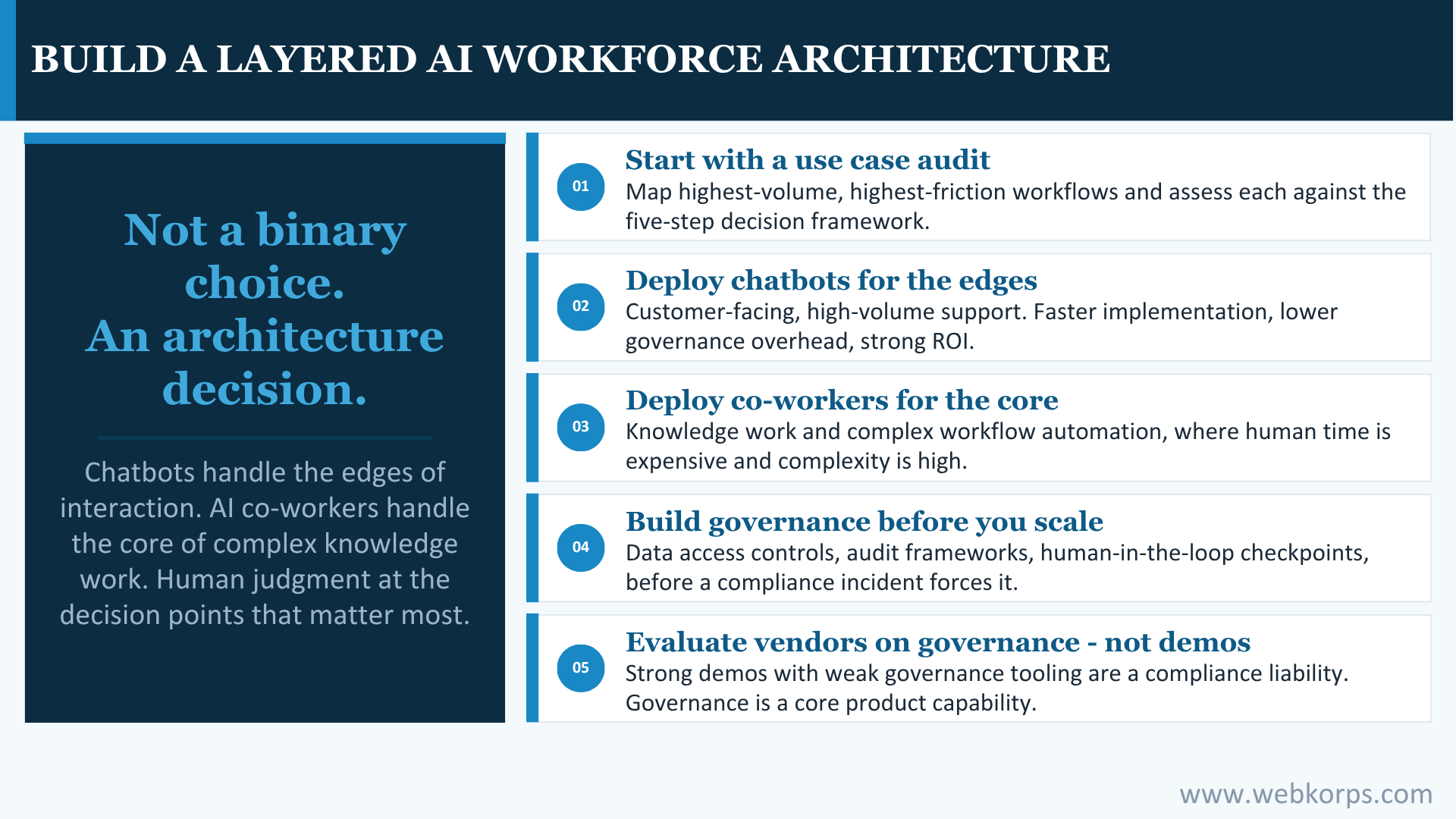
Organizations that build this architecture deliberately, with clear governance and workforce readiness programs, will pull ahead of competitors who deploy AI reactively and at random.
Ready to Build Your AI Workforce Architecture? Choosing between AI co-workers and chatbots is only the first decision. Designing the system that connects them, with the right governance, integrations, and workforce strategy, is where the real work begins.
At Webkorps, our team works with enterprise leaders and high-growth companies to design,
build, and deploy AI workforce strategies that deliver measurable business impact. Connect With Our AI Strategy Experts
FAQ
What is the main difference between AI co-workers and chatbots?
Chatbots respond to queries within a defined scope. AI co-workers plan and execute multi-step tasks autonomously across multiple systems. Chatbots react to input; AI co-workers act on goals. That distinction drives every deployment, governance, and cost decision enterprise buyers face.
When should an enterprise use a chatbot instead of an AI co-worker?
Choose a chatbot for high-volume, repetitive, low-complexity interactions, support triage, FAQ handling, internal help desk, and guided self-service. Chatbots are faster to deploy, easier to govern, and carry lower compliance risk. If the workflow is bounded and predictable, a chatbot delivers better ROI.
What are the governance risks of deploying AI co-workers?
Key risks include data access control across multiple systems, auditability of multi-step reasoning chains, and defining human-in-the-loop checkpoints for high-risk decisions. Regulated industries face the greatest exposure. Assess governance infrastructure and access control maturity before committing to any agentic AI deployment.
How much more expensive are AI co-workers compared to chatbots?
AI co-workers carry higher licensing fees, longer implementation timelines, and greater maintenance overhead. Build a 24-month total cost of ownership model rather than comparing headline subscription prices. Chatbots offer faster time-to-value; AI co-workers offer higher long-term productivity potential when deployed in the right context.
Can enterprises use both chatbots and AI co-workers at the same time?
Yes, most mature enterprise AI strategies do exactly this. Chatbots handle high-volume support interactions. AI co-workers handle complex knowledge work and multi-system workflow automation. A layered architecture with clear governance and defined handoff points between systems is how leading organizations are structuring AI deployments in 2026.
Which enterprise platforms offer AI co-worker capabilities?
Microsoft 365 Copilot, Salesforce Einstein Copilot, and ServiceNow Now Assist are among the most widely deployed. Purpose-built AI co-worker platforms are also emerging across HR, legal, finance, and engineering. Evaluate vendor roadmap strength, integration flexibility, and governance tooling, not just current feature sets.
What does a successful AI co-worker pilot look like?
Start with a tightly scoped use case, defined success metrics, and a small cross-functional team. Avoid deploying without clear evaluation criteria. Pilot scope should be narrow enough to control variables but representative enough to generate meaningful data. Most enterprise pilots run 60–90 days before a scaling decision.
How should CTOs evaluate AI co-worker vendors in 2026?
Assess five dimensions: task autonomy and reasoning capability, integration depth, governance and audit tooling, data security architecture, and vendor investment trajectory. Strong demos with weak governance tooling represent a compliance liability. Prioritise vendors who treat enterprise governance as a core product capability, not a bolt-on feature.