
 Posted by
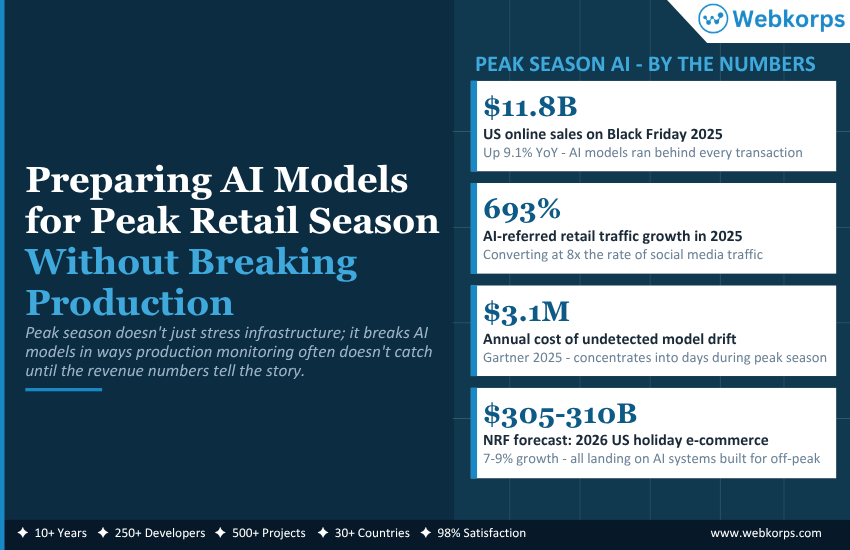
 Black Friday 2025 delivered $11.8 billion in US online sales in a single day, up 9.1% year over year. AI-referred traffic to retail sites surged 693% over the full 2025 holiday season, converting at roughly eight times the rate of social media traffic. NRF forecasts $305-310 billion in US holiday e-commerce sales for 2026, representing 7-9% growth.
Behind every one of those transactions, AI models are running. Recommendation engines. Demand forecasting models. Dynamic pricing algorithms. Fraud detection systems. Search ranking models. Each one was trained on data that looks nothing like peak season behavior, and each one is expected to perform under load conditions that dwarf the environment it was originally deployed into.
Peak season doesn’t just stress infrastructure. It breaks AI models in ways that production monitoring often doesn’t catch until the conversion numbers tell the story. Here is what retail engineering teams need to do before October, and why waiting until November is already too late.
Is your retail AI ready for peak season? Talk to Webkorps experts
Table of Contents
Peak Season Is Where Retail AI Gets Tested
Seasonal data drift is the quiet failure mode that retail AI teams underestimate consistently. Models optimized for regular purchasing cycles often fail to adapt when consumer behavior shifts during peak seasons or promotional events, input feature distributions diverge from training data, and model accuracy deteriorates without any code changes (Ekfrazo, 2026).
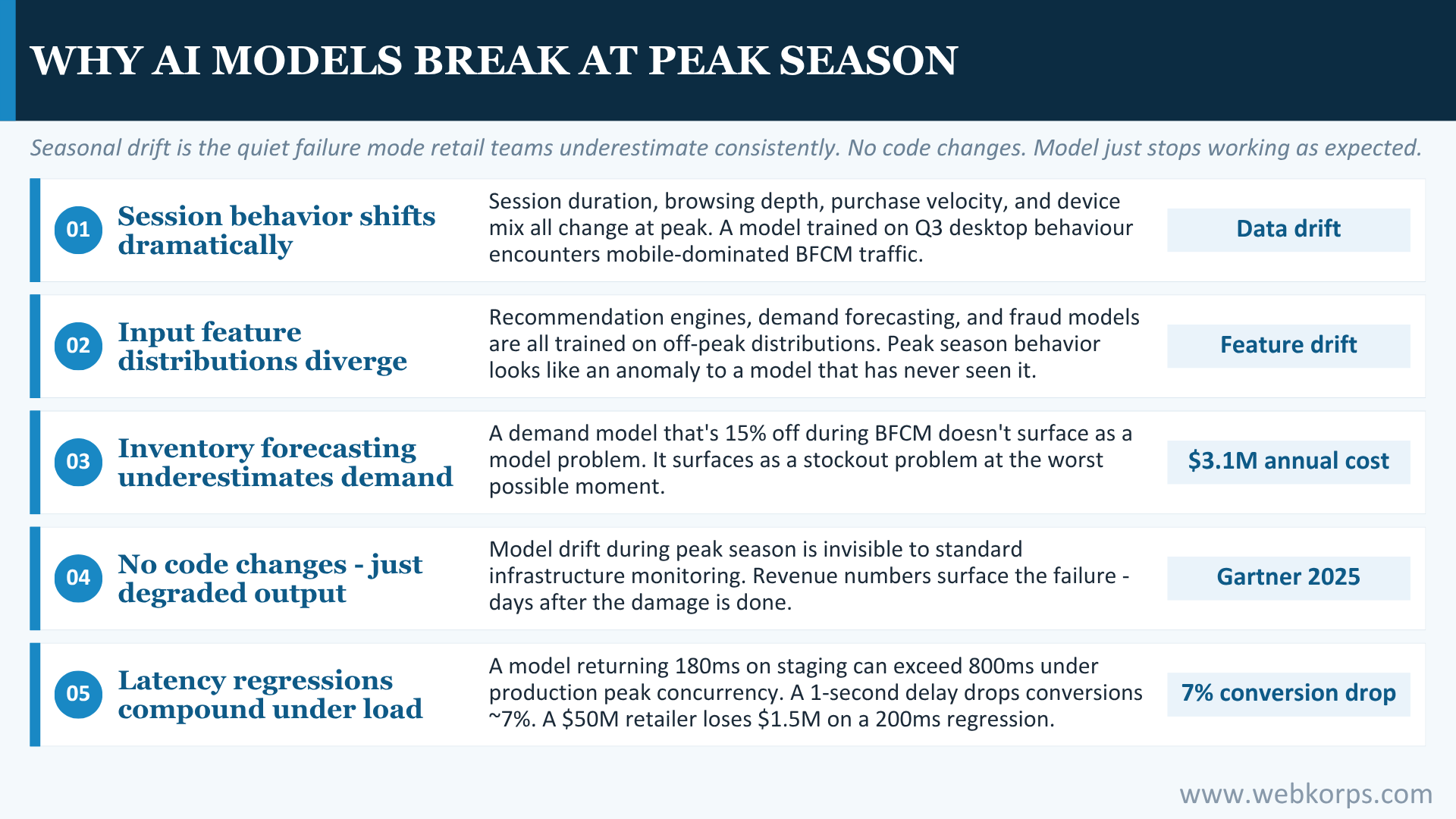
A recommendation engine that performed reliably in Q3 might produce poor conversion rates during BFCM not because of a deployment error, but because user behavior patterns, session duration, browsing depth, purchase velocity, and device mix shift dramatically during peak season. An e-commerce recommendation system trained on desktop user behavior encounters data drift when mobile traffic dominates, with different browsing patterns and purchase behaviors (Ekfrazo, 2026).
According to Gartner’s 2025 AI governance report, undetected model drift costs enterprises an average of $3.1 million annually in lost revenue, compliance violations, and customer churn. During peak retail season, that cost concentrates into days, not months. A demand forecasting model that underestimates inventory by 15% because it wasn’t trained on holiday demand patterns doesn’t surface as a model problem; it surfaces as a stockout problem at the worst possible moment.
AI models underperforming when it matters most? Talk to Webkorps Team
Seasonal Retraining Needs to Happen Before October
Retraining AI models on peak season data is not a November task. By the time Black Friday load arrives, there is no time to retrain, validate, and safely deploy a model update; the window closes weeks earlier.
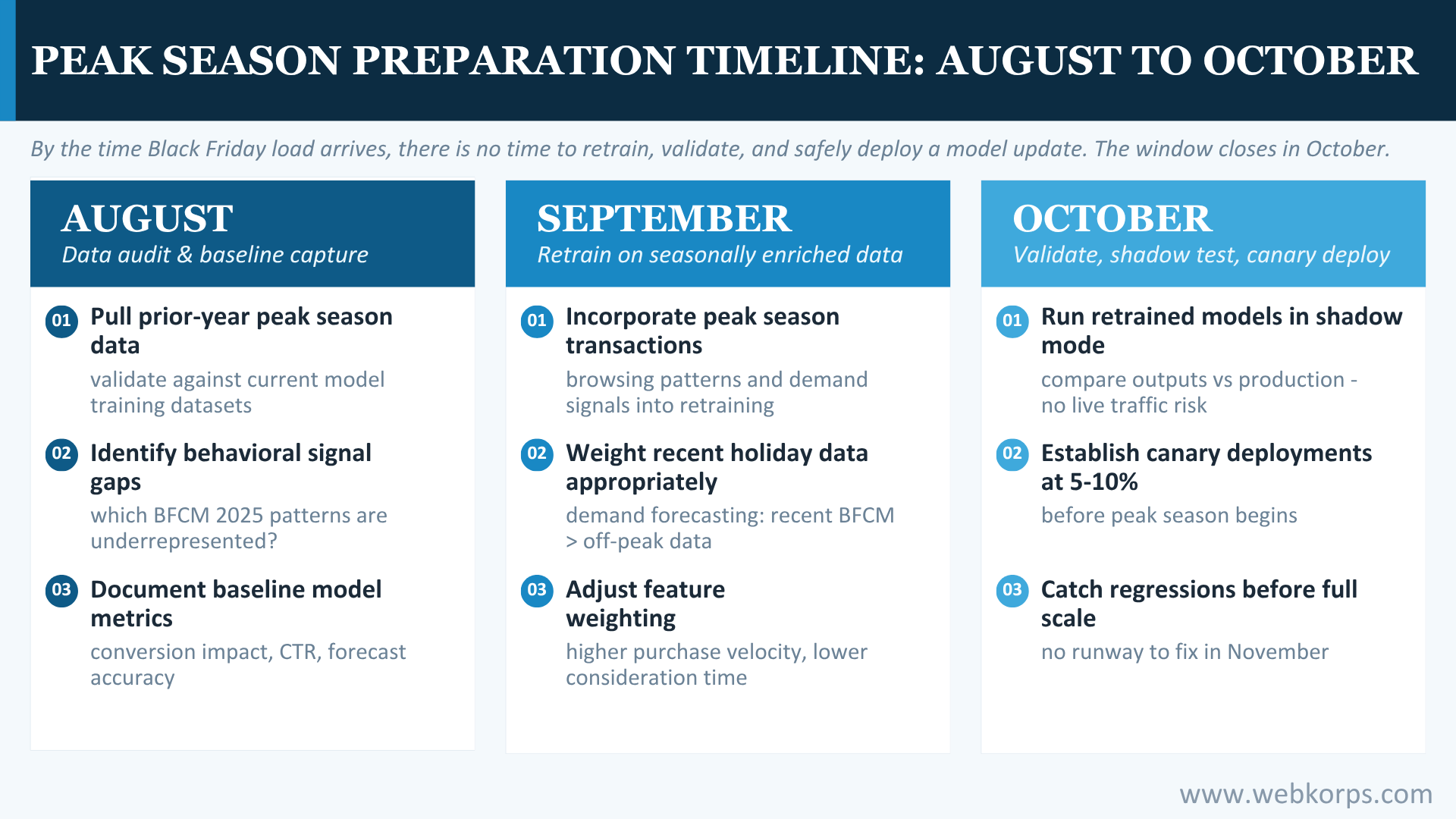
The preparation timeline that works looks like this:
- August, data audit and baseline capture: Pull prior-year peak season data and validate it against current model training datasets. Identify gaps: Which behavioral signals from BFCM 2025 are underrepresented in current training data? Document baseline model performance metrics, conversion impact, recommendation click-through rates, and forecast accuracy, so post-season analysis has a known starting point.
- September, retrain on seasonally enriched data: Incorporate prior-year peak season transactions, browsing patterns, and demand signals into retraining datasets. For demand forecasting models, weight recent holiday data more heavily than off-peak data. For recommendation engines, adjust feature weighting to reflect the higher purchase velocity and lower consideration time that characterises peak season shopping behavior.
- October, validate, shadow test, and canary deploy: Run retrained models in shadow mode alongside production models, comparing outputs without affecting live traffic. Establish canary deployments at 5-10% of traffic before peak season begins. Catch model regressions before they affect revenue at full scale.
This cadence compresses the risk window. Teams that skip August and September arrive at October with untested production models and no runway to fix what they find.
Load Testing AI Systems Is Different From Load Testing Infrastructure
Standard load testing validates that infrastructure handles traffic. Load testing AI systems requires validating something harder: that model inference latency stays within acceptable bounds as concurrency scales, and that model outputs remain consistent under load.
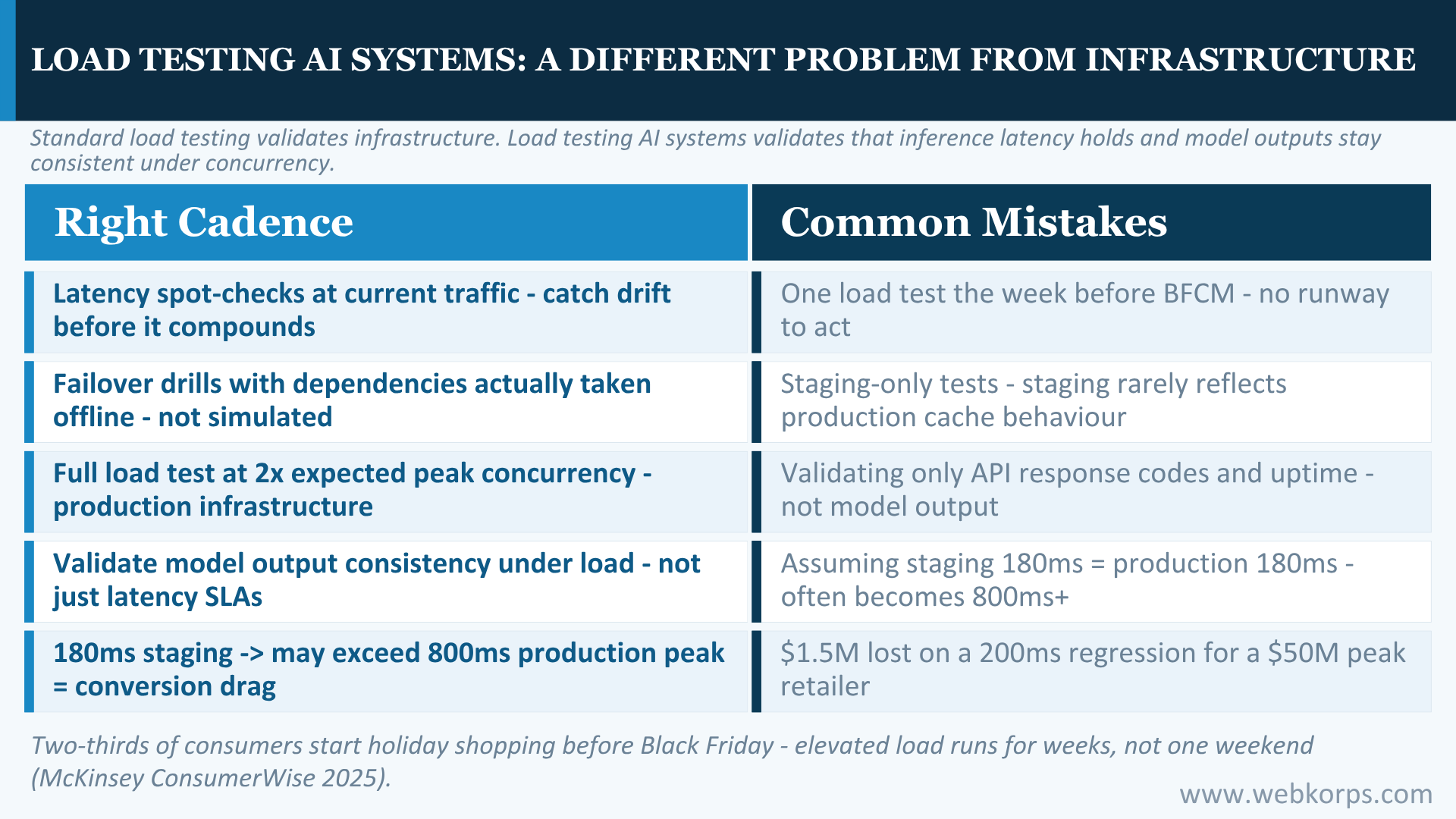
McKinsey’s 2025 ConsumerWise research found that two-thirds of consumers now start holiday shopping before Black Friday, meaning the period of elevated load runs for weeks beforehand, not one weekend (Contact Pigeon, 2026). A single load test the week before BFCM tells you almost nothing, because by then there is no time to act on what it finds.
A working load test cadence for retail AI systems:
- Monthly latency spot-checks at current traffic levels to catch drift before it compounds
- Quarterly failover drills run against dependencies that have actually been taken offline, not simulated
- Six to eight weeks before Black Friday: one full load test at twice expected peak concurrency, run against production infrastructure, not staging
That last test matters specifically because staging environments rarely reflect the actual model serving infrastructure, cache behaviour, and downstream API dependencies that affect inference latency under real load. A model that returns recommendations in 180ms on staging can easily exceed 800ms under production peak concurrency, crossing the threshold where latency becomes a measurable conversion drag.
A one-second delay is associated with roughly a 7% drop in conversions (Digital Applied, 2026). For a retailer generating $50 million in peak season revenue, a 200ms latency regression that degrades conversion by 3% is a $1.5 million problem that load testing would have surfaced in October.
Monitoring Thresholds Need to Be Reset for Peak Season Conditions
Production monitoring configured for off-peak baselines will generate noise during peak season, or worse, miss genuine model degradation because the alert thresholds were never calibrated for holiday traffic patterns.
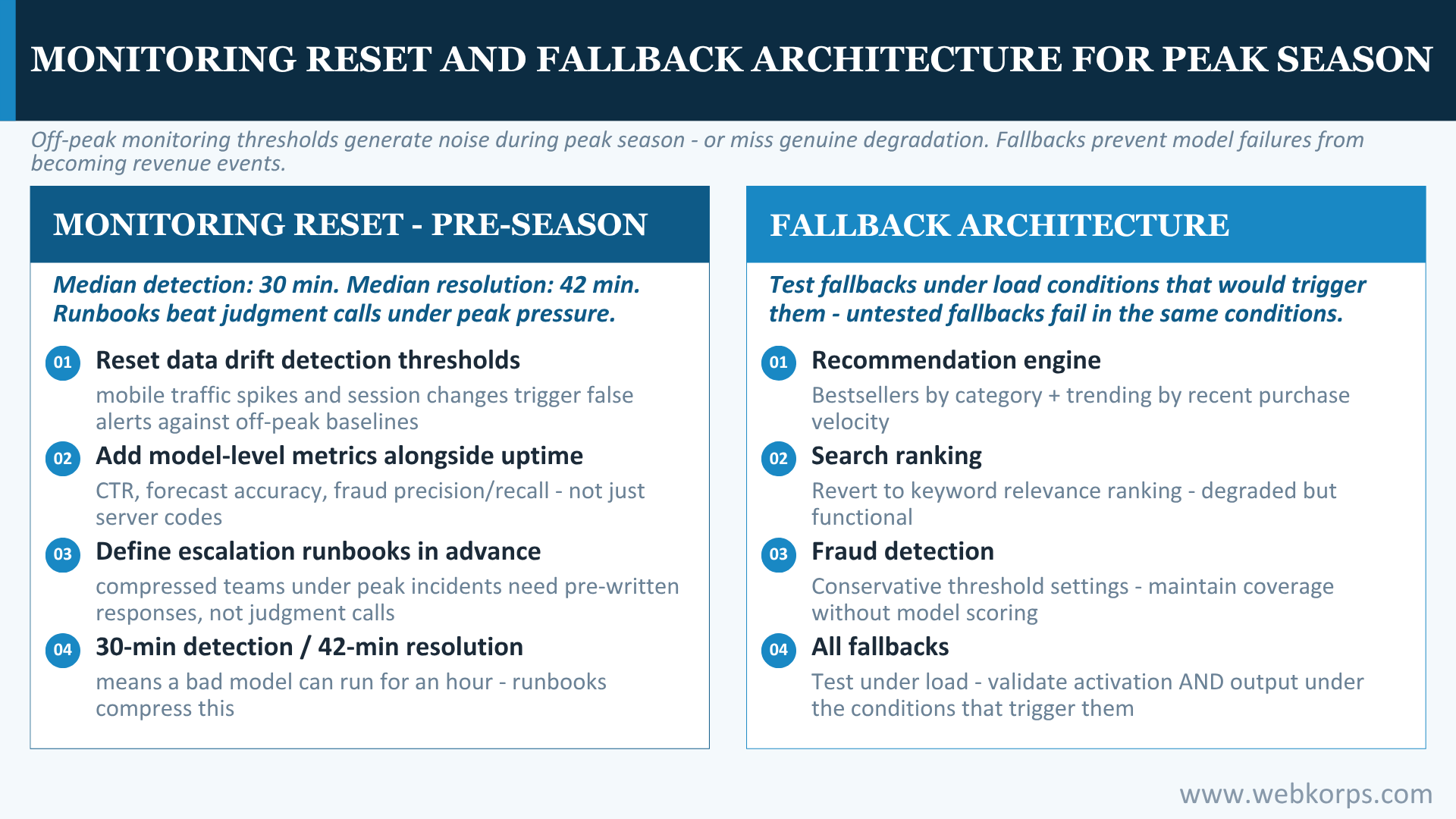
Before peak season, retail AI teams should:
- Reset data drift detection thresholds: Peak season traffic distributions look like anomalies when measured against off-peak baselines. Mobile traffic spikes, session depth changes, and purchase velocity increases will trigger false alerts in monitoring systems configured for normal operation, drowning signal in noise at exactly the moment operational attention is most critical.
- Establish model performance floors, not just infrastructure uptime metrics: Monitoring that tracks server uptime and API response codes won’t catch a recommendation engine producing irrelevant results or a fraud model with a degraded false negative rate. Model-level metrics, recommendation click-through rates, forecast accuracy against actuals, fraud detection precision and recall need to be monitored continuously with alerts that fire when outputs degrade, not just when infrastructure degrades.
- Define escalation paths before they’re needed: Median detection time for AI system issues during peak events is 30 minutes; median resolution time is 42 minutes (Contact Pigeon, 2026). With a compressed engineering team managing multiple peak season incidents simultaneously, escalation paths that require judgment calls under pressure produce slower resolution than runbooks that define the response in advance.
Peak season incidents don’t wait for judgment calls. Let Webkorps Build Your AI Runbooks Before November
Fallback Architectures Prevent Model Failures From Becoming Revenue Events
No production AI system should operate without a defined fallback for the models that directly affect revenue. Recommendation engines, search ranking models, and fraud detection systems need fallback states that maintain basic functionality when model serving degrades or produces anomalous output.
For recommendation engines, a rule-based fallback, bestsellers by category and trending items by recent purchase velocity, produces an acceptable user experience when ML recommendations aren’t available. For search ranking models, reverting to keyword relevance ranking is a degraded but functional fallback. For fraud detection, increasing conservative threshold settings rather than relying on model scoring maintains fraud prevention capability when model confidence is uncertain.
Fallback architectures should be tested alongside load testing, specifically, validating that the fallback state activates correctly and produces expected output under the load conditions that would trigger it. Fallbacks that have never been tested under load fail in the same conditions that cause the primary model to degrade.
Actionable Preparation Framework
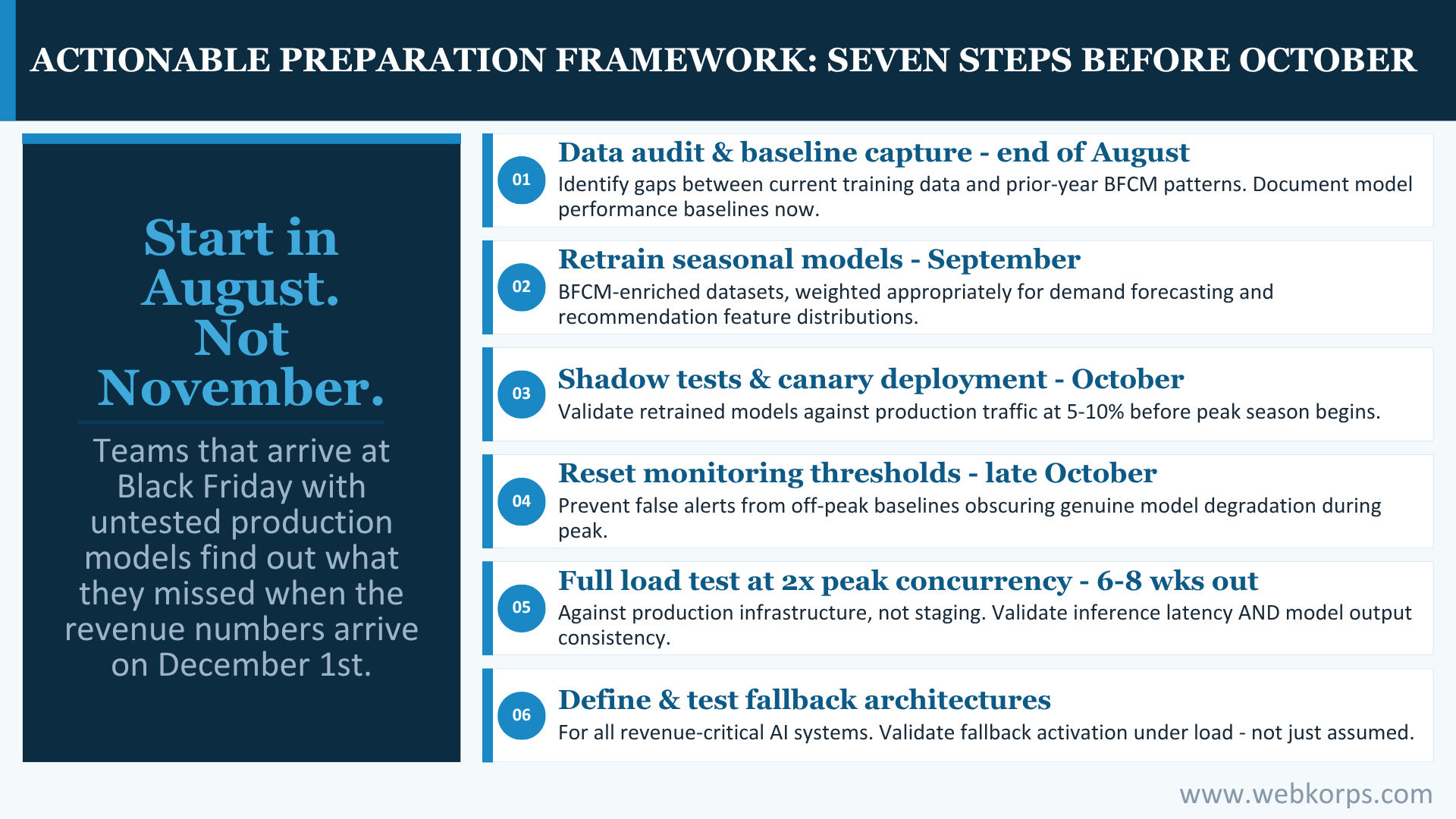
- Complete data audit and baseline metric capture by end of August; identify gaps between current training data and prior-year peak season patterns
- Retrain seasonal models in September using BFCM-enriched datasets; weight recent peak season data appropriately for demand forecasting and recommendation models
- Run shadow tests and canary deployments in October, validate retrained models against production traffic at low risk before peak season begins
- Reset monitoring thresholds for peak season traffic distributions in late October, prevent false alerts from obscuring genuine model degradation
- Conduct full load test at 2× expected peak concurrency six to eight weeks before Black Friday, against production infrastructure, not staging
- Define and test fallback architectures for all revenue-critical AI systems, validate fallback activation under the load conditions that would trigger it
- Establish model-level monitoring metrics alongside infrastructure metrics; recommendation performance, forecast accuracy, and fraud model precision need their own alert thresholds
Conclusion
AI-referred retail traffic surged 693% in 2025, while holiday e-commerce is projected to grow another 7–9% in 2026. That growth puts greater pressure on the AI systems powering recommendations, forecasting, search, pricing, and fraud detection.
Peak-season preparation isn’t simply an infrastructure exercise. It’s about model readiness, load testing, monitoring, retraining, and resilient fallback strategies before demand peaks.
Because Black Friday shouldn’t be the first time your AI discovers its limits.
Webkorps helps retail engineering teams build, optimize, and scale production AI systems designed to perform when demand is at its highest.
Prepare early. Perform at peak. Build peak-ready AI with Webkorps. Book a Discovery Call
Frequently Asked Questions
Why do AI models fail during peak retail season?
Seasonal data drift, when peak season behavior patterns differ dramatically from the off-peak data models were trained on. Session duration, purchase velocity, device mix, and browsing depth all shift during BFCM, causing models trained on normal operating data to produce degraded outputs without any code changes.
When should retailers start preparing AI models for Black Friday?
August at the latest. Data audits and baseline capture in August, seasonal retraining in September, shadow testing and canary deployment in October. By November, there is no runway to fix model regressions discovered under load.
What is seasonal model drift in retail AI?
Seasonal drift occurs when holiday shopping behavior patterns diverge from the distribution models were trained on. Demand forecasting models underestimate inventory needs; recommendation engines surface irrelevant products; fraud models see unfamiliar transaction patterns, all without any changes to the underlying code.
How should you load test retail AI systems before peak season?
Run a full load test at twice expected peak concurrency six to eight weeks before Black Friday, against production infrastructure, not staging. Monthly latency spot-checks and quarterly failover drills throughout the year catch drift before it compounds into a peak season incident.
What monitoring metrics matter most for retail AI during peak season?
Model-level metrics alongside infrastructure metrics, recommendation click-through rates, demand forecast accuracy against actuals, fraud detection precision and recall. Infrastructure uptime alone won’t catch a degraded recommendation engine or a fraud model with a rising false negative rate.
What is a fallback architecture for retail AI?
A defined degraded-but-functional state for revenue-critical AI systems when model serving fails or produces anomalous output. Bestseller-based recommendations, keyword-relevance search ranking, and conservative fraud threshold settings are common fallback states. All should be tested under peak load conditions, not assumed to work.
How does model drift affect retail revenue?
Gartner’s 2025 AI governance report estimates undetected model drift costs enterprises $3.1 million annually. During peak season, that cost concentrates into days. A 200ms latency regression that drops conversion by 3% translates to millions in lost revenue for mid-to-large retailers on a single high-volume day.
What is the difference between data drift and model drift in retail AI?
Data drift occurs when input feature distributions in production diverge from training data, for example, mobile traffic patterns during BFCM vs. desktop-dominated off-peak traffic. Model drift is declining predictive performance over time. Both occur during peak season and require different diagnostic approaches: data drift shows in input statistics; model drift shows in outcome accuracy.