
 Posted by
 Every AI/ML vendor has a polished demo. Impressive outputs, clean interfaces, confident engineers who speak fluently about transformers, fine-tuning, and retrieval-augmented generation. Demos have never been easier to produce, or more misleading.
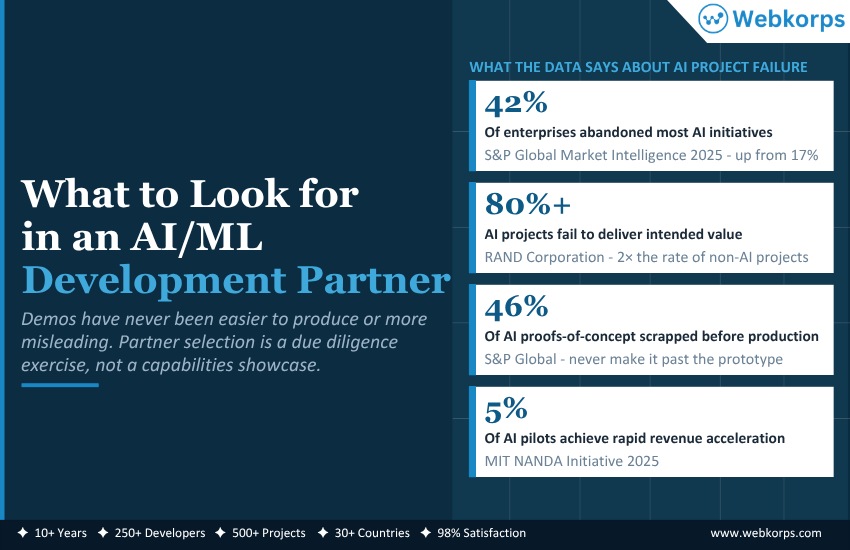
Here’s what the data says about what happens after the demo. According to S&P Global Market Intelligence’s 2025 survey of over 1,000 enterprises, 42% of companies abandoned most of their AI initiatives, up sharply from 17% the previous year. RAND Corporation found that over 80% of AI projects fail to deliver intended value, twice the failure rate of non-AI technology projects. MIT’s NANDA Initiative found that only 5% of AI pilot programmes achieve rapid revenue acceleration.
None of those failures happened during the demo.
Selecting an AI/ML development partner in 2026 is a due diligence exercise, not a capabilities showcase. Here’s what that evaluation actually looks like, and what most organisations miss until it’s expensive.
Seen enough impressive demos that went nowhere?
Webkorps shows you the production dashboard, the compliance track record, and the post-deployment team, before you sign anything. Book a Discovery Call
Table of Contents
MLOps Depth Is the Highest-Signal Criterion
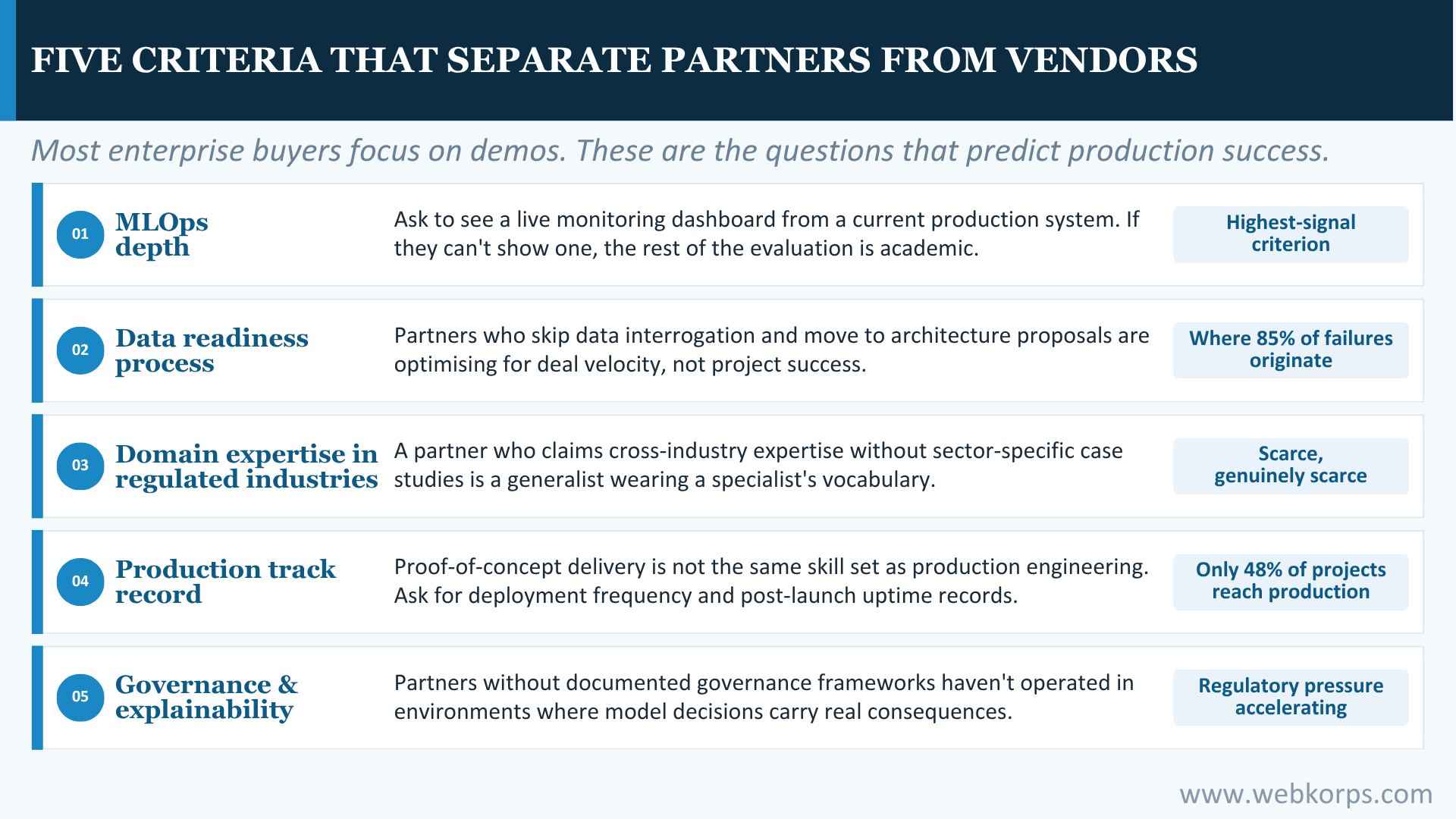
- Most AI vendor conversations focus on model selection, architecture decisions, and use-case fit. Those conversations matter. But the single most predictive indicator of a partner’s production capability is their MLOps infrastructure, and most enterprise buyers never ask to see it.
- A model deployed is not a model maintained. Production AI systems degrade over time due to data drift, upstream data changes, and prompt injection vulnerabilities. Without continuous monitoring and retraining pipelines, a model that performs well at launch quietly degrades until someone notices a business problem, not a technical one.
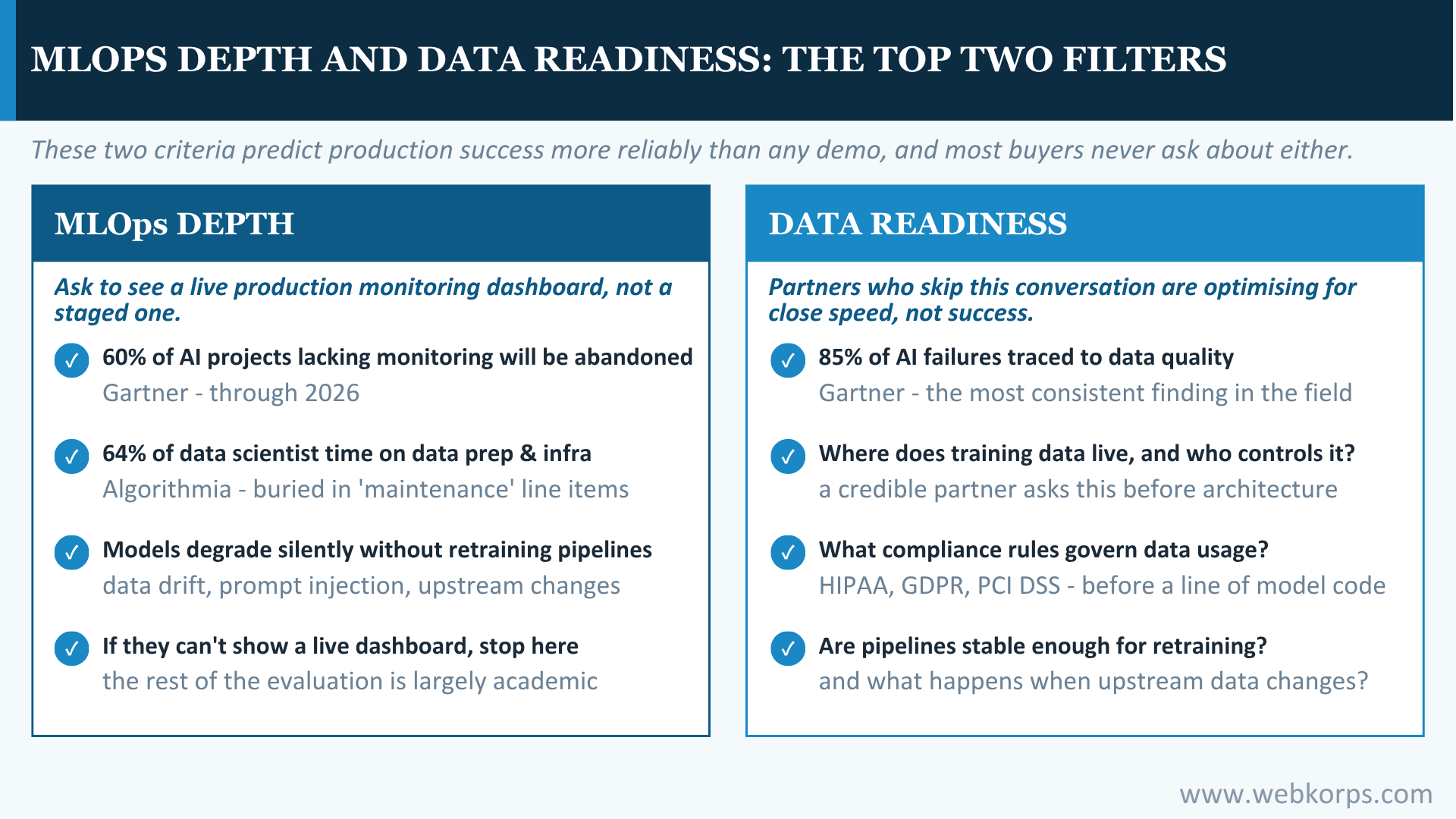
- Gartner reports that 60% of AI projects lacking AI-ready data and monitoring infrastructure will be abandoned through 2026. Algorithmia’s research found that data scientists spend an average of 64% of their time on data preparation and infrastructure, yet most vendor proposals bury this work in vague “maintenance” line items.
- Ask any prospective AI ML development partner to show a live monitoring dashboard from a system they currently maintain in production. If they cannot produce one, the rest of the evaluation is largely academic. Vendors who deliver excellent demos but have never operated AI at production scale will tell on themselves at this question.
Data Readiness Matters More Than Model Sophistication
Enterprise AI projects don’t fail because of model choice. They fail because of data. Gartner identifies poor data quality as a factor in 85% of AI project failures. McKinsey’s 2025 AI survey found that organisations reporting significant financial returns were twice as likely to have redesigned end-to-end workflows and data pipelines before selecting any modelling technique.
A credible AI/ML development partner interrogates data before writing a single line of model code. Specifically, they should be asking:
- Where does training data live, and who controls access?
- What compliance rules govern data usage: HIPAA, GDPR, PCI DSS?
- Are data pipelines stable enough to support continuous retraining?
- What’s the plan when upstream data changes break model assumptions?
Partners who skip this conversation and move straight to architecture proposals are optimising for deal velocity, not project success. Data readiness is unglamorous work. It’s also where the difference between a successful deployment and a six-figure abandoned proof-of-concept is determined.
Not sure if the data is ready for AI? Talk to Webkorps before the build begins
Domain Experience in Regulated Industries Is Non-Negotiable
Generic AI capability is increasingly common. Domain expertise in regulated environments remains genuinely scarce.
For enterprises in fintech, healthcare, and logistics, AI model deployment doesn’t exist in isolation; it operates inside compliance frameworks that carry real legal and operational risk. An AI/ML development partner who has built fraud detection models but never navigated SOC 2, SR 11-7, or HIPAA audit requirements will discover those gaps during implementation. That discovery is expensive.
Evaluation should include:
- Documented deployments in comparable regulatory environments
- Explainability frameworks for models that touch regulated decisions
- Audit trail design for model outputs subject to regulatory review
- Human-in-the-loop architecture for high-stakes decisions
BCG research shows 84% of organisations work with two or more vendors on AI initiatives, precisely because no single vendor is best-in-class across every domain. A partner who claims universal expertise across industries without sector-specific case studies is a generalist wearing a specialist’s vocabulary.
Production Track Record Separates Vendors from AI/ML Development Partners
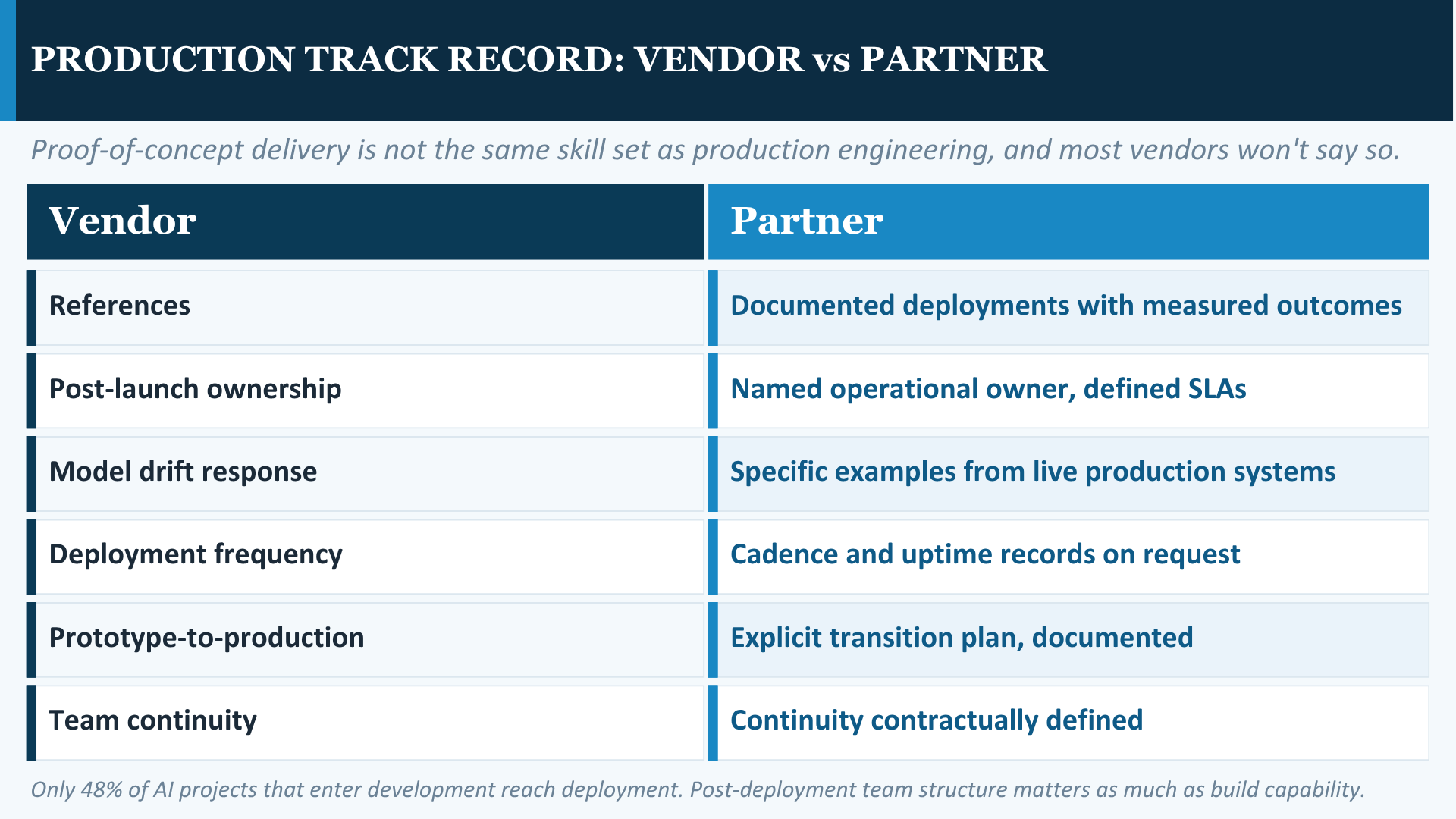
Proof-of-concept delivery is not the same skill set as production engineering. Choosing the right AI ML software development company can help businesses bridge this gap by combining technical expertise with reliable development and deployment practices.
S&P Global found the average organisation scrapped 46% of AI proofs-of-concept before reaching production. Only 48% of AI projects that enter development make it all the way to deployment. For those that do, the average time from prototype to production is eight months.
Before selecting an AI/ML development partner, ask for:
- Production deployments with measurable business outcomes, not “client references available on request”
- Deployment frequency and uptime records from comparable systems
- Specific examples of how they handled model failure or data drift in a live environment
- Team continuity, who actually maintains the system after the build team moves on
The transition from prototype to production is the moment vendors most often hand off to junior teams or offshore support arrangements that weren’t in the original proposal. Understand exactly who owns post-deployment operations before signing.
Governance and Explainability Are Not Optional
Regulatory pressure on AI systems is accelerating across every sector. In financial services, SR 11-7 requires model risk management frameworks that cover development, validation, and ongoing monitoring. Healthcare AI faces FDA guidance on clinical decision support and HIPAA constraints on model training data. GDPR’s right to explanation applies to automated decisions affecting individuals across European markets.
An AI/ML development partner without documented governance frameworks is not just a compliance risk; it’s a sign they haven’t operated in environments where model decisions carry consequences. Explainability isn’t an academic concern; it’s the capability that lets operations and compliance teams audit, override, and defend AI-driven decisions.
Evaluation questions that surface governance maturity:
- How do you document model decisions for audit purposes?
- What’s your approach to bias detection and fairness testing?
- How do you handle regulatory changes that affect model behaviour post-deployment?
- Can compliance teams access model logic without engineering involvement?
Common Mistakes in AI/ML Development Partner Evaluation
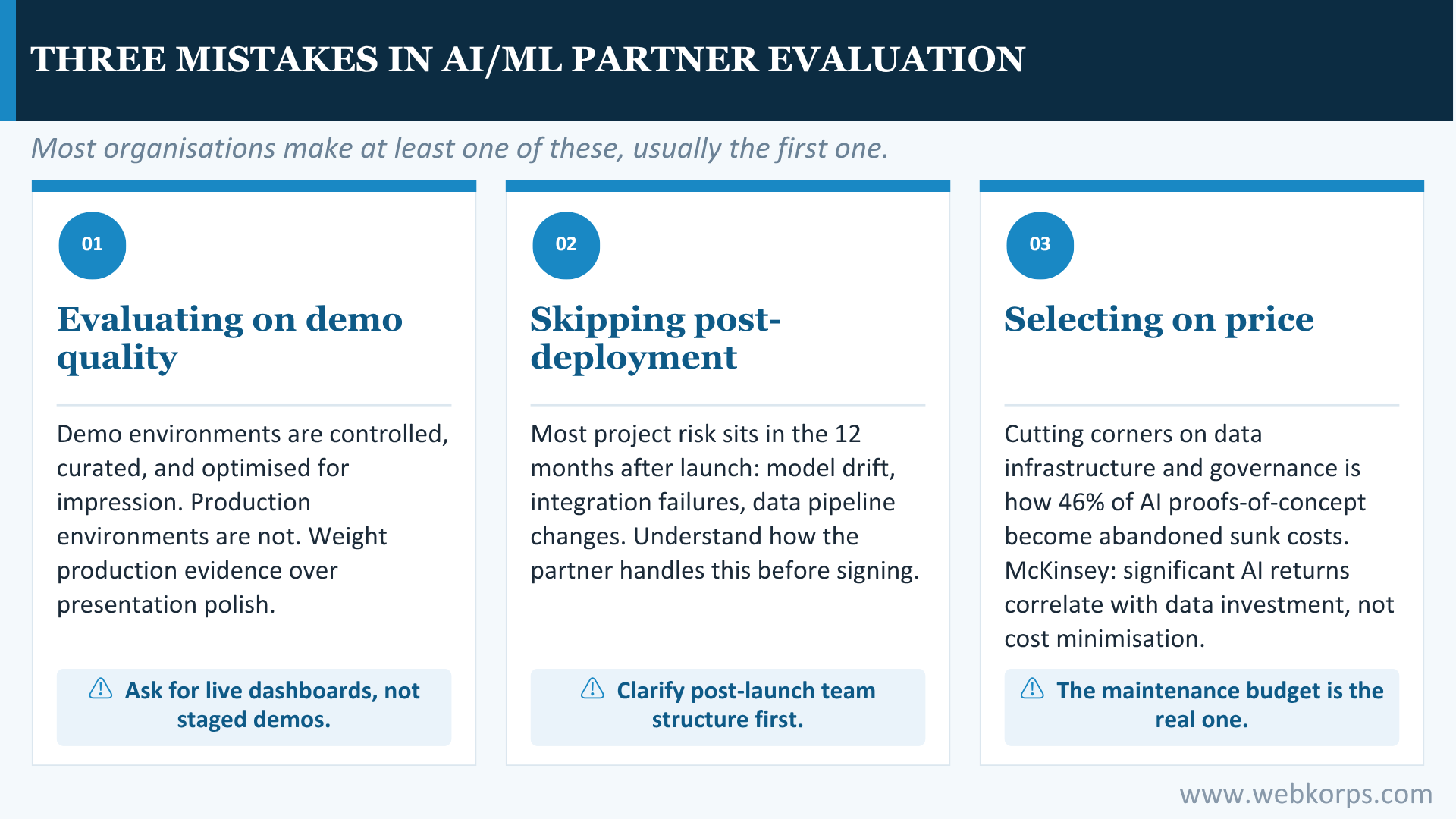
- Evaluating on demo quality. Demo environments are controlled, curated, and optimized for impression. Production environments are not. Weight production evidence over presentation polish.
- Skipping the post-deployment conversation. Most project risk sits in the 12 months after launch: model drift, integration failures, data pipeline changes. Understanding exactly how an AI/ML development partner handles this period is as important as understanding how they build.
- Selecting on price. McKinsey data shows organisations seeing significant AI returns are twice as likely to have invested in data and workflow redesign before any model work begins. Cutting corners on data infrastructure and governance to reduce vendor cost is how 46% of AI proofs-of-concept become abandoned sunk costs.
Actionable Evaluation Framework
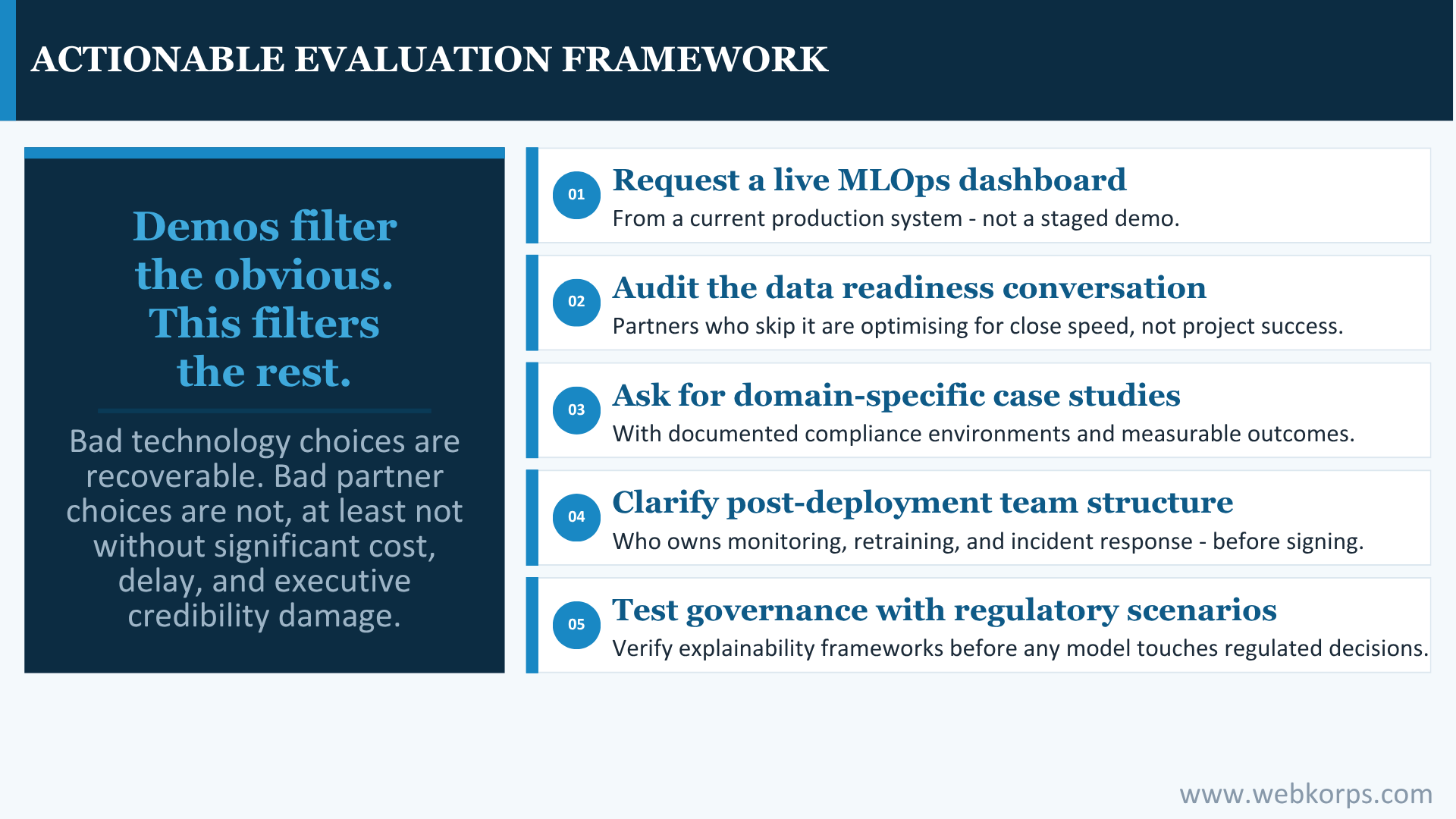
- Request a live MLOps dashboard from a current production system, not a staged demo
- Ask for domain-specific case studies with documented compliance environments and measurable outcomes
- Audit the data readiness conversation; AI ML development partners who skip it are optimising for close speed, not project success
- Clarify post-deployment team structure before signing: who owns monitoring, retraining, and incident response?
- Test governance depth with specific regulatory scenarios relevant to your industry
- Verify explainability frameworks exist before any model touches regulated decisions
Conclusion
AI/ML development partner selection is one of the highest-stakes vendor decisions an enterprise makes. Bad technology choices are recoverable. Bad partner choices are not, at least not without high cost, delay, and executive credibility damage.
Demos filter out the obvious mismatches. Production track records, MLOps depth, domain expertise, and governance maturity filter out the rest. Organisations that get this evaluation right don’t just deploy AI; they build a compounding capability that delivers measurable returns well past the initial project.
Webkorps builds production-grade AI/ML systems for enterprises in fintech, healthcare, and logistics, from data pipeline architecture through to MLOps, monitoring, and compliance-ready deployment. Our engineering squads are ISO 27001 certified, CMMI Level 3 assessed, and experienced across the regulatory environments that make AI evaluation genuinely complex.
Ready to evaluate a partner who can show you the production dashboard? Book a Discovery Call With Webkorps
Frequently Asked Questions
What is an AI/ML development partner?
An AI/ML development partner designs, builds, and deploys custom AI systems, covering data engineering, model development, integration, and post-deployment monitoring. Unlike generalist vendors, specialist partners own the full lifecycle from data readiness to production operations.
Why do most AI/ML projects fail?
Over 80% fail due to data quality issues, poor governance, and the gap between prototype and production, not bad models. RAND Corporation found AI project failure rates run twice those of non-AI technology projects.
What is MLOps and why does it matter?
MLOps covers the infrastructure for deploying, monitoring, and retraining AI models in production. Without it, models degrade silently. Ask any partner to show a live monitoring dashboard; the inability to do so signals they haven’t operated AI at production scale.
How do you evaluate an AI development partner’s domain expertise?
Ask for documented deployments in your regulatory environment with measurable outcomes. Compliance experience, HIPAA, SOC 2, SR 11-7, GDPR, must be demonstrated through case studies, not claimed in a capabilities deck.
What questions should you ask before hiring an AI/ML partner?
Ask to see live production dashboards, post-deployment team structure, data readiness assessment processes, explainability frameworks, and specific examples of handling model drift or failure in a live environment.
What is model drift and why does it matter?
Model drift occurs when real-world data changes after deployment, causing model accuracy to degrade. Without continuous monitoring and retraining pipelines, production AI systems quietly fail, often without visible errors until the business impact is significant.
How important is data readiness for AI projects?
Critical. Gartner attributes 85% of AI project failures to poor data quality. McKinsey found organisations achieving significant AI returns were twice as likely to redesign data workflows before selecting any modelling approach.
What governance frameworks should an AI partner have?
Partners should document model decisions for audit, provide bias and fairness testing, support regulatory explainability requirements, and enable compliance teams to review model logic independently, especially in fintech, healthcare, and logistics.