
 Posted by
 Proof of concept worked. Sensors returned data. Dashboards lit up. Operations leadership signed off on the pilot with real enthusiasm, and engineering teams had something to show at the quarterly review.
Then six months passed. Nothing scaled.
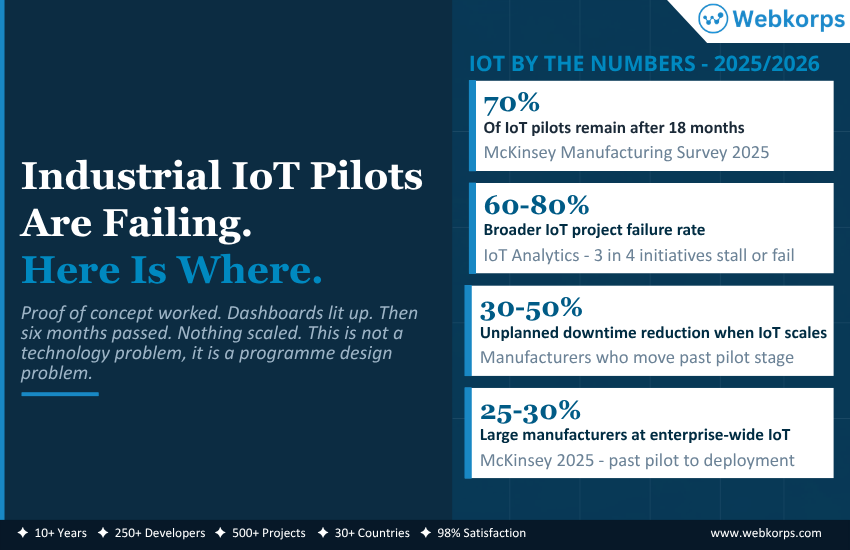
According to McKinsey’s 2025 manufacturing survey, 70% of Industrial IoT pilots remain pilots after 18 months. Only 25-30% of large manufacturers have moved IIoT beyond pilot to enterprise-wide deployment.
IoT Analytics puts the broader IoT project failure rate between 60% and 80%, meaning roughly three out of four IIoT initiatives either stall, get quietly shelved, or never deliver the operational returns that justified the investment.
Technology is not the core challenge. Sensors work. Connectivity works. Cloud platforms work. What fails is the layer between device data and operational value, and that failure point is consistent enough across industries and deployment types that it’s worth naming exactly.
Here is where Industrial IoT pilots break down, and what the organisations scaling past proof of concept are doing differently.
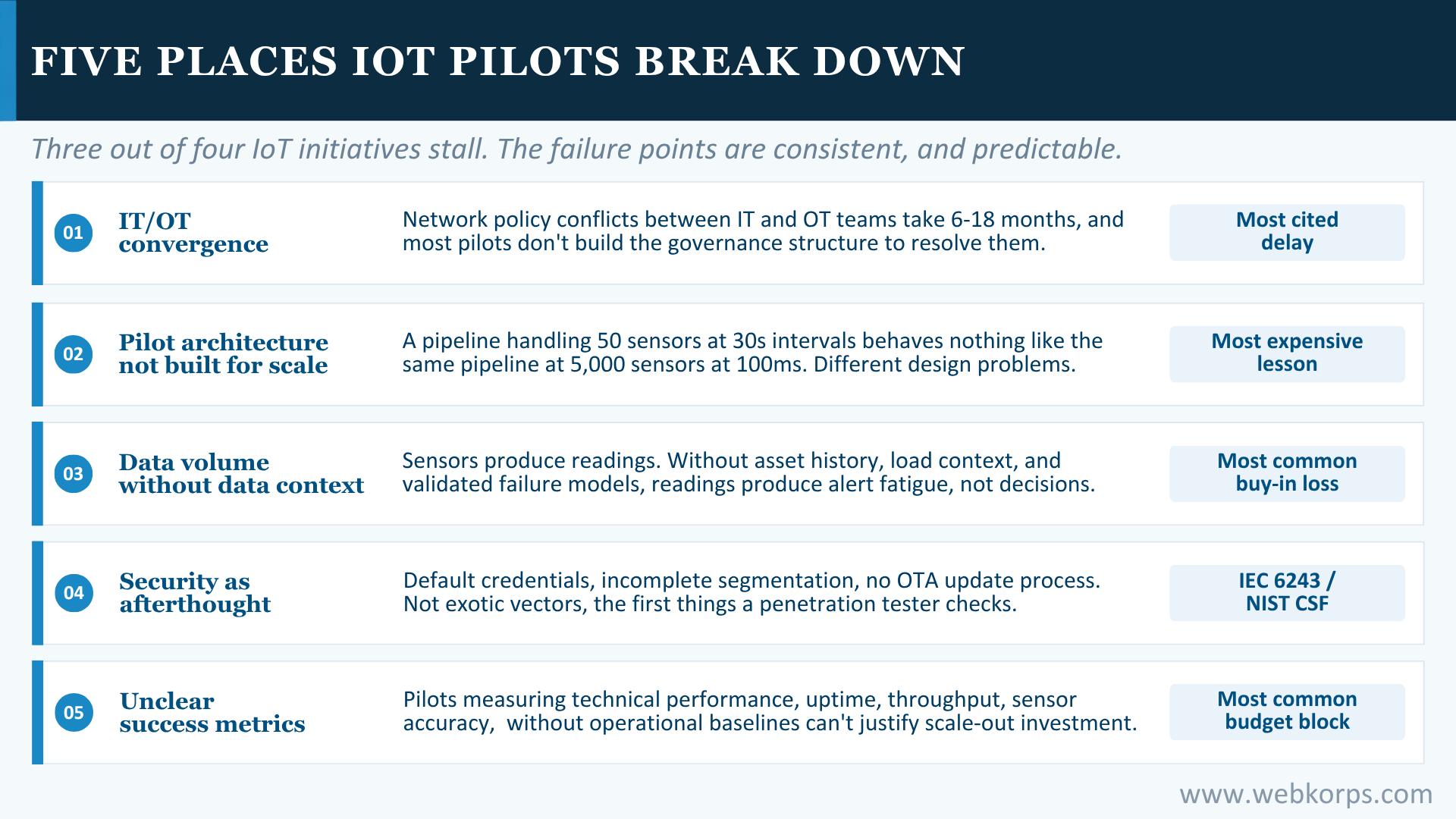
Table of Contents
Failure Point 1: IT/OT Convergence Takes Longer Than Anyone Budgets
Smart machines are only as powerful as the network connecting them. That’s where many IIoT initiatives hit their first roadblock.
Convincing IT departments to allow OT equipment on the corporate network took 6-18 months of security reviews, VLANs, firewall rules, and organizational negotiation, and that timeline isn’t shrinking. IIoT architectures require bridging two worlds that have historically operated with entirely different priorities: OT teams optimize for uptime, deterministic control, and safety; IT teams optimize for security, policy compliance, and patch cadence. Those priorities collide at the network boundary.
IIoT environments heavily utilise OPC UA for semantic interoperability, MQTT for lightweight publish-subscribe messaging, and legacy fieldbus conversions. The integration layer must seamlessly bridge OT data formats with IT business systems, ERP, EAM, CMMS, while handling massive data ingestion rates. Most pilot teams underestimate this integration surface by an order of magnitude.
Organisations that scale IIoT successfully treat IT/OT convergence as a programme management challenge, not a technical one. Dedicated cross-functional teams with explicit authority to resolve network policy disputes, and executive sponsorship to keep both sides moving, compress this timeline significantly. Pilots that don’t build this governance structure before sensor deployment typically discover it at the worst possible moment: when the first production alert fires and no one can agree on who owns the response.
Running IIoT pilots that keep stalling at the network boundary? Talk to Webkorps About Scaling Your IIoT Programme
Failure Point 2: Pilot Architecture Doesn’t Survive Scale
A pilot that works on 50 devices but collapses at 5,000 is a failure disguised as a success. This is the most expensive lesson in IIoT, and one of the most common.
Pilot architectures are built for demonstration. Production architectures are built for reliability, throughput, and cost at scale. These are different design problems. A data pipeline that handles 50 sensors polling every 30 seconds behaves nothing like the same pipeline handling 5,000 sensors at 100ms intervals. Edge compute requirements that seemed optional at pilot scale become mandatory at production scale. Data storage costs that were negligible in the proof-of-concept phase compound quickly across a multi-site deployment.
Single biggest shift in IIoT deployment patterns has been the move from plant-network-dependent architectures to cellular connectivity. Teams that built pilots on plant Wi-Fi infrastructure, often because it was the path of least resistance during proof of concept, face expensive re-architecture when they attempt to scale beyond a single facility.
Winning teams design for scale before the first sensor goes live. Device provisioning strategy, over-the-air firmware update processes, and edge-to-cloud data architecture need to be defined at pilot stage, not retrofitted during scale-out, when the cost and delay of re-architecture is at its highest.
Failure Point 3: Data Volume Without Data Context
IIoT pilots generate data. Successful IIoT deployments generate decisions.
Most programmes stall at that gap, between sensor telemetry and operational insight. A vibration sensor on a compressor produces readings. Without baseline data, maintenance history, load context, and a validated model of failure modes, those readings produce alerts. Too many alerts. Alerts that floor technicians learn to ignore. Alert fatigue is one of the most cited reasons IIoT programmes lose operational buy-in after initial deployment.
IIoT systems equip assets with smart sensors that monitor multidimensional parameters, triaxial vibration, ultrasonic acoustics, and thermal signatures. High-frequency data is contextualised with the asset’s historical workload and ingested into machine learning algorithms that detect microscopic anomalies weeks before mechanical failure occurs. That contextualisation is not automatic. It requires domain expertise in both the physical asset and the data model, expertise that most pilot teams either understaff or outsource to platform vendors who don’t have it either.
Organisations getting measurable returns from predictive maintenance and asset health programmes invest in data context before scaling sensor coverage. Asset historians, equipment specifications, and maintenance records need to be integrated into the analytics layer before machine learning models can produce reliable failure predictions.
Failure Point 4: Security Architecture as an Afterthought
IoT devices are connected to the internet, making them susceptible to hacking and cyberattacks. Industrial IoT systems can be particularly vulnerable to attacks that could disable critical infrastructure or cause safety hazards.
In consumer IoT, a security failure is an inconvenience. In industrial environments- petrochemical facilities, power grids, manufacturing lines- a security failure is a safety event with regulatory, operational, and reputational consequences that extend well beyond the immediate incident.
IIoT security failures follow a consistent pattern: devices are deployed with default credentials, network segmentation between OT and IT is incomplete, and firmware update processes don’t exist or aren’t enforced. These aren’t exotic attack vectors; they’re the first things any competent penetration tester checks.
Programmes that scale IIoT securely treat security architecture as a day-one design constraint, not a post-deployment remediation project. Device authentication, encrypted communication, network segmentation, and OTA update processes need to be defined and tested at pilot stage. NIST’s Cybersecurity Framework and IEC 62443 provide the relevant standards, and increasingly, regulated industries are treating compliance with them as a procurement requirement, not a recommendation.
Failure Point 5: Unclear Success Metrics at Pilot Stage
One of the most cited reasons for failure is unclear goals. In IIoT, this manifests specifically as pilots that measure technical performance, uptime, data throughput, and sensor accuracy without defining the operational and financial outcomes that justify the investment.
A pilot that demonstrates sensors are transmitting data reliably has proved connectivity, not value. Operations leadership approving scale-out budgets needs evidence that the IIoT programme reduces unplanned downtime by a measurable percentage, cuts maintenance costs by a defined figure, or improves OEE by a calculable amount. Programmes that can’t produce that evidence at pilot stage consistently fail to secure scale-out investment, regardless of how technically sound the underlying deployment is.
Successful IIoT programmes define success metrics before the first sensor is deployed. Baseline operational data, current downtime rates, maintenance costs, and OEE benchmarks need to be captured before the programme begins, so post-deployment performance can be measured against a known baseline, not estimated against industry benchmarks.
Most IIoT programmes fix these gaps at scale-out, when it’s already expensive. Talk to Webkorps Before Your Next Pilot
Actionable Framework for IIoT Programmes That Scale
- Resolve IT/OT convergence governance before deploying sensors; assign cross-functional ownership with executive authority to unblock network policy disputes
- Design pilot architecture for production scale from day one, cellular connectivity, edge compute strategy, and OTA update processes defined before go-live
- Integrate asset context into the analytics layer before scaling sensor coverage, maintenance history, equipment specs, and operational baselines feed the models that turn alerts into decisions
- Treat security as a design constraint, not a post-deployment checklist: device authentication, network segmentation, and firmware update processes implemented at pilot stage
- Define operational success metrics before deployment, baseline current performance so post-deployment returns can be measured, not estimated
Conclusion
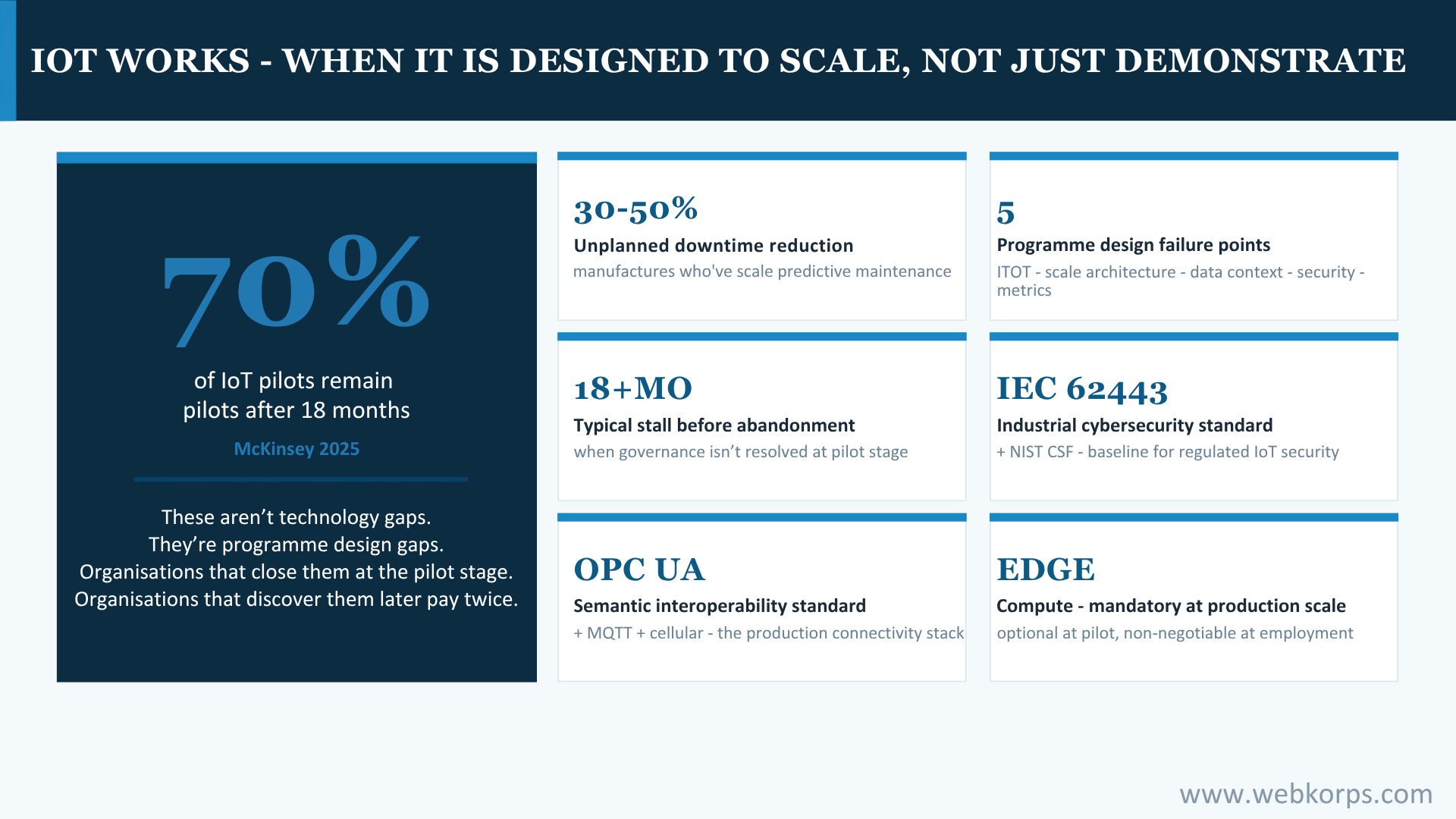
Industrial IoT works. Predictive maintenance programmes are reducing unplanned downtime by 30-50% at manufacturers who’ve scaled them successfully. Asset health monitoring is extending equipment life in sectors where replacement costs are measured in millions. Energy monitoring programmes are producing measurable ESG reporting data that’s becoming a competitive requirement in regulated markets.
But getting from pilot to production requires solving problems that are consistently underestimated: IT/OT politics, scale architecture, data context, security design, and success metric definition. These aren’t technology gaps; they’re programme design gaps. Organisations that close them at pilot stage scale. Organisations that discover them at scale-out pay for the lesson twice.
Webkorps builds Industrial IoT solutions for manufacturing, logistics, and energy operations, from sensor architecture and edge computing through to cloud integration, predictive analytics, and compliance-ready deployment. Our engineering squads are ISO 27001 certified and experienced across the OT environments where IIoT programmes either prove out or stall.
Turn IoT pilots into scalable business value. Book a Discovery Call with Webkorps
Frequently Asked Questions
Why do most Industrial IoT pilots fail to scale?
70% of IIoT pilots remain pilots after 18 months (McKinsey, 2025). Most failures trace to IT/OT integration delays, pilot architectures not built for production scale, data without operational context, and undefined success metrics, not sensor or connectivity failures.
What is IT/OT convergence in Industrial IoT?
IT/OT convergence is the integration of operational technology systems, PLCs, SCADA, and industrial equipment with IT infrastructure like ERP, cloud platforms, and enterprise networks. Network policy conflicts between IT and OT teams are the most common cause of IIoT deployment delays.
What protocols does Industrial IoT use?
IIoT environments use OPC UA for semantic interoperability, MQTT for lightweight messaging, and legacy fieldbus conversions for older equipment. Bridging these protocols with IT business systems is one of the core integration challenges in IIoT deployment.
What security standards apply to Industrial IoT?
IEC 62443 and the NIST Cybersecurity Framework are the primary standards for IIoT security architecture. Device authentication, network segmentation, encrypted communication, and OTA firmware update processes are baseline requirements, particularly in regulated industries.
How do you measure Industrial IoT success?
Define operational baselines before deployment, current unplanned downtime rates, maintenance costs, OEE benchmarks. Post-deployment returns should be measured against these baselines, not estimated against industry averages. Programmes without pre-deployment baselines consistently fail to secure scale-out investment.
What is edge computing in Industrial IoT?
Edge computing processes sensor data at or near the device rather than sending all data to the cloud. In IIoT environments with high-frequency sensor polling, edge computing reduces latency, cuts cloud data transfer costs, and enables real-time decision-making at the machine level.
What is predictive maintenance in IIoT?
Predictive maintenance uses sensor data and machine learning to detect equipment anomalies before failure occurs, typically identifying issues weeks before a breakdown. Successful predictive maintenance programmes reduce unplanned downtime by 30-50% compared to reactive or schedule-based maintenance models.
What causes alert fatigue in Industrial IoT programmes?
Alert fatigue occurs when IIoT systems generate more alerts than operations teams can meaningfully act on. The root cause is typically missing data context, sensors without baseline data, maintenance history integration, or validated failure models that produce alerts that floor technicians learn to ignore.
Great article!