
 Posted by
 Healthcare is in the middle of a quiet revolution – and electronic health records are at the center of it.
For decades, EHR systems promised to streamline clinical work. Instead, they often added burden. Physicians spend an average of 1–2 hours on EHR documentation for every hour of direct patient care. Nurses toggle between 4–6 screens per patient interaction. And critical patient data sits siloed in systems that cannot speak to each other.
Artificial intelligence changes this equation fundamentally. AI-powered EHR software doesn’t just store records – it learns from them, predicts from them, and automates the routine tasks that consume clinical time.
In 2026, organizations that have deployed intelligent EHR systems are reporting 45% reductions in documentation time, 20% improvements in diagnostic accuracy, and measurable decreases in hospital readmissions. Those still running legacy systems are falling behind – operationally, financially, and clinically.
This guide is your comprehensive blueprint for AI-powered EHR software development. Whether you’re a CTO planning a platform modernization, a healthcare startup building from scratch, or a hospital system evaluating vendors, what follows is the most detailed, data-driven resource available on the topic.
Table of Contents
What Is AI-Powered EHR Software?
AI-powered EHR (Electronic Health Record) software is a next-generation clinical platform that embeds artificial intelligence technologies – including machine learning, natural language processing, predictive analytics, and generative AI – directly into the medical records workflow. Unlike traditional EHR systems that passively store patient data, AI-powered EHR software actively analyzes data, automates documentation, surfaces clinical decision support alerts, predicts patient outcomes, and optimizes healthcare workflows in real time.
At its core, an AI-powered EHR is a clinical information system augmented by machine intelligence. The difference from a traditional EHR is not cosmetic – it’s architectural.
A conventional EHR is a database with a user interface. A clinician enters data; the system stores it. Retrieval is manual. Insights are incidental. Interoperability is painful.
An AI-powered EHR, by contrast, is a dynamic intelligence layer over that same data. It reads physician dictation and converts it to structured clinical notes. It flags a patient’s vitals before they deteriorate. It automatically suggests ICD-10 codes from free-text. It pulls relevant records from partner institutions before the patient even arrives.
The result is not just efficiency – it’s a qualitatively different kind of clinical platform.
Core Capabilities of Intelligent EHR Systems
- Automated clinical documentation via NLP and voice recognition
- Real-time clinical decision support with evidence-based alerts
- Predictive analytics for patient risk stratification
- Generative AI for SOAP notes, discharge summaries, and referral letters
- Interoperability with FHIR R4 APIs across care settings
- Ambient intelligence – passive capture of clinical encounters
- Revenue cycle automation – coding, billing, prior authorization
Why Traditional EHR Systems Fall Short
The promise of EHR adoption was efficiency. The reality has been mixed. Here is why legacy systems are no longer sufficient:
The Documentation Burden Crisis
The American Medical Association reports that for every hour of clinical time, physicians spend 1.5–2 hours on EHR documentation. Inbox management, note entry, and order reconciliation consume time that should go to patients. This is not a workflow problem – it’s a technology gap that AI directly addresses.
Data Silos and Poor Interoperability
Most healthcare organizations operate with 4–8 disparate systems that don’t communicate. Lab results live in one system, imaging in another, pharmacy in a third. Even within a single health system, a clinician may be unable to see a patient’s complete history from a different department’s EHR module.
Reactive, Not Predictive
Traditional EHRs show what happened. They don’t tell you what’s about to happen. A patient with deteriorating sepsis indicators may not trigger any alert until their vitals cross a hard-coded threshold – by which point the opportunity for early intervention has passed.
Physician Burnout
EHR-related burnout is now cited as a contributing factor in physician attrition. In a 2024 Mayo Clinic study, 63% of physicians cited EHR documentation as a primary burnout driver. AI that reduces this load is not a luxury – it’s a retention strategy.
By the Numbers: The State of Healthcare AI in 2026
These statistics underscore the urgency and scale of AI adoption in healthcare:
| Metric | Value / Finding |
| Global AI in Healthcare Market (2024) | $20.9 billion |
| Projected Market Size (2030) | $148.4 billion (CAGR: 38.5%) |
| Hospitals Planning AI EHR Investment (2025–2026) | 78% (Gartner) |
| Reduction in Documentation Time with AI NLP | 45–50% |
| Improvement in Diagnostic Accuracy with AI | 15–20% |
| EHR-Related Physician Burnout Rate | 63% (Mayo Clinic 2024) |
| Cost Savings from AI Healthcare Automation | $150B/year by 2026 (Accenture) |
| AI Imaging Diagnostic Accuracy vs. Radiologists | 94.5% vs. 88% (Stanford AI Lab) |
Key Benefits of AI in Electronic Health Records
The ROI of AI-powered EHR software manifests across clinical, operational, and financial dimensions. Here are the benefits that healthcare organizations report most consistently:
- Dramatic Reduction in Documentation Time: AI-powered NLP and ambient intelligence tools capture clinical conversations and convert them to structured notes automatically. Clinicians review and approve rather than write from scratch. Time savings of 45–50% on documentation are achievable within 90 days of deployment.
- Enhanced Clinical Decision Support: AI monitors patient data continuously, cross-referencing lab values, vitals, medications, and history against clinical evidence bases. When a drug interaction risk or sepsis indicator appears, the system alerts the care team proactively – often hours before a critical threshold would otherwise be reached.
- Predictive Patient Risk Stratification: Machine learning models trained on millions of patient records identify which patients are at elevated risk for readmission, deterioration, or non-compliance. Care coordinators receive prioritized task lists rather than undifferentiated patient rosters.
- Seamless Interoperability: HL7 FHIR R4-compliant AI systems can exchange data with any connected care setting – primary care, specialist offices, urgent care, pharmacies, and insurers. A complete patient history is available at the point of care, regardless of where prior encounters occurred.
- Revenue Cycle Intelligence: AI auto-suggests billing codes from clinical notes, flags claim errors before submission, and predicts prior authorization approval probability. Healthcare organizations using AI-driven revenue cycle tools report 25% faster claims processing and meaningful reductions in denials.
- Reduced Physician Burnout: When documentation burden decreases and administrative tasks are automated, clinician satisfaction improves. Organizations deploying AI EHR tools report a 30% reduction in EHR-related burnout scores – a critical metric as the physician shortage intensifies.
Also read: Real-World AI Use Cases in Software Development for Healthcare That Deliver Proven ROI
Core AI Technologies Used in Smart EHR Systems
Building an intelligent EHR requires a deliberate AI technology stack. These are the foundational technologies and their clinical applications:
Machine Learning (ML)
Machine learning is the backbone of predictive functionality in modern EHR platforms. Supervised learning models trained on labeled clinical datasets (e.g., past readmissions, sepsis cases, no-show patterns) generate real-time probability scores for each patient encounter.
Key ML use cases in EHR:
- Readmission risk scoring (30-day and 90-day models)
- No-show prediction for appointment scheduling optimization
- Deterioration alerts (NEWS2, MEWS score augmentation)
- Population health segmentation for chronic disease management
- Fraud detection in billing and coding
Natural Language Processing (NLP)
NLP bridges the gap between unstructured clinical language and structured data. It is arguably the most impactful AI technology in the EHR context, given that an estimated 80% of clinical data resides in unstructured text.
NLP capabilities in intelligent EHR systems:
- Voice-to-text transcription of clinical encounters (ambient documentation)
- Automatic extraction of diagnoses, procedures, and medications from free-text notes
- ICD-10 / CPT code suggestion from narrative documentation
- Sentiment analysis of patient feedback and nursing notes
- Clinical concept normalization (SNOMED CT, LOINC, RxNorm mapping)
Predictive Analytics
Predictive analytics uses historical patient data and real-time signals to forecast future health events. These models do not replace clinical judgment – they inform it, giving clinicians probabilistic context that would otherwise require hours of chart review.
Applications of predictive analytics in EHR:
- Sepsis early warning (6–12 hours of advanced detection)
- Chronic disease progression modeling (CKD, heart failure staging)
- Post-surgical complication risk scoring
- ICU length-of-stay prediction for capacity planning
- Medication adherence probability for chronic patients
Generative AI for Medical Documentation
This is the newest – and fastest-growing – AI capability in EHR platforms. Large language models fine-tuned on clinical corpora can now generate full SOAP notes, discharge summaries, referral letters, and prior authorization requests from brief voice inputs or structured data.
Generative AI clinical documentation capabilities:
- Ambient dictation: Physician speaks conversationally with a patient; AI generates a complete, structured note
- Discharge summary automation: AI compiles encounter history, diagnosis, and instructions into a patient-ready document
- Prior authorization drafting: AI generates supporting documentation for insurance submissions
- Clinical letter generation: Referral letters, specialist communications, care plan summaries
Models currently being deployed in healthcare settings include fine-tuned variants of GPT-4, Llama 3, and purpose-built clinical LLMs such as Google’s Med-PaLM 2 – trained on clinical guidelines, medical literature, and de-identified EHR data.
Important: LLM Safety in Clinical Settings
Generative AI in clinical documentation requires human-in-the-loop review before any output is finalized in the patient record. AI-generated notes must be reviewed and approved by the responsible clinician. No AI documentation system should operate without clinician sign-off. Anthropic’s Constitutional AI and similar alignment frameworks are increasingly being adapted for clinical LLM safety.
Architecture of AI-Powered EHR Platforms
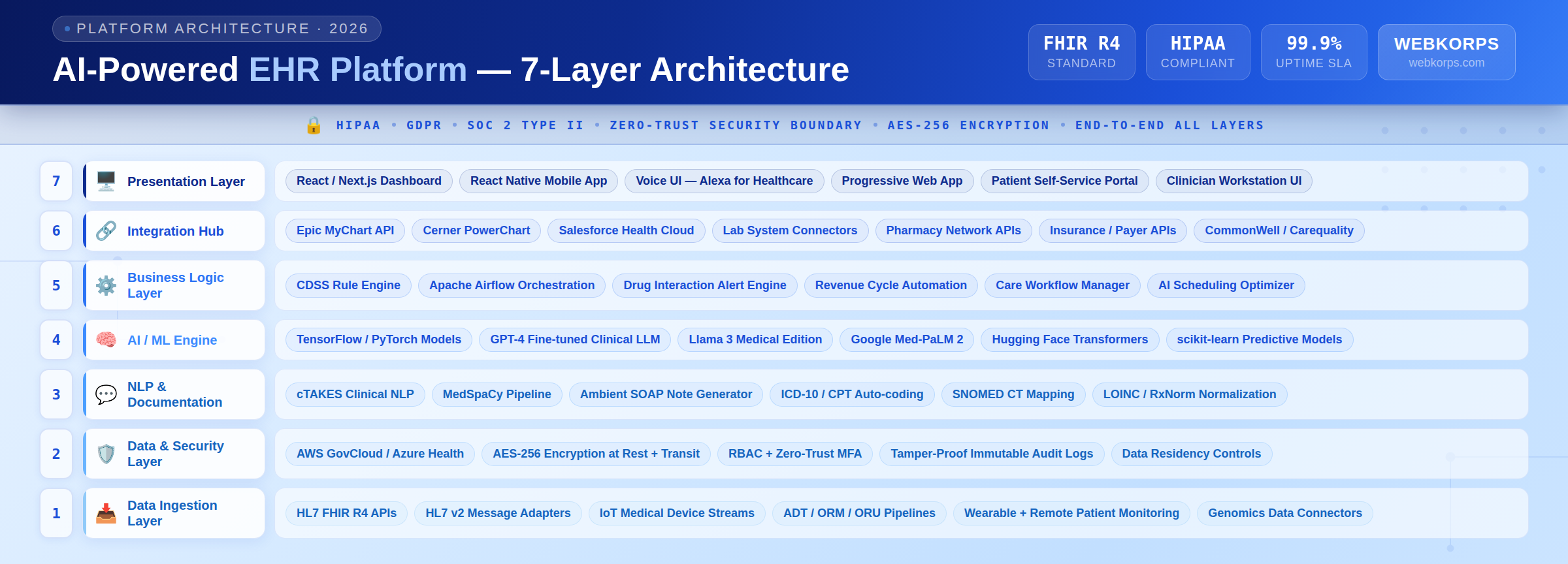
Building an enterprise-grade AI EHR system requires a layered, cloud-native architecture that balances clinical functionality, AI capabilities, security, and interoperability. The following architecture is Webkorps’s reference model for intelligent healthcare platforms:
| Layer | Components / Technologies |
| Data Ingestion Layer | HL7 FHIR APIs, HL7 v2 adapters, IoT device connectors, EHR import pipelines (ADT, ORM, ORU messages) |
| Data & Security Layer | HIPAA-compliant cloud (AWS GovCloud / Azure Health), end-to-end AES-256 encryption, RBAC |
| NLP & Documentation | Clinical NLP (cTAKES, MedSpaCy), GPT-4 / Llama 3 fine-tuned for medical notes, SOAP note generators |
| AI/ML Engine | TensorFlow / PyTorch models, Hugging Face LLMs (fine-tuned on clinical data), scikit-learn for predictive analytics |
| Business Logic Layer | CDSS rule engine, workflow orchestration (Apache Airflow), drug–interaction alert engine |
| Integration Hub | Epic MyChart API, Cerner PowerChart, Salesforce Health Cloud, lab system connectors |
| Presentation Layer | React / Next.js dashboards, mobile (React Native), voice UI (Alexa for Healthcare, Google CCAI) |
This architecture follows a microservices model, allowing individual components (e.g., the NLP engine, the CDSS rule engine) to be updated independently without system-wide deployment risk. All layers communicate via a secure API gateway with OAuth 2.0 authentication and HIPAA-compliant audit logging.
How to Develop AI-Powered EHR Software: Step-by-Step
Developing an AI-powered EHR is a complex, multi-phase undertaking. The following 10-phase methodology is based on Webkorps delivery framework for healthcare AI platforms:
| S No. | Phase | Key Deliverables |
| 1 | Discovery & Compliance Assessment | Workflow audit, HIPAA/GDPR gap analysis, patient journey mapping, data classification |
| 2 | Architecture Design | Microservices blueprint, AI/ML stack selection, FHIR data model, security architecture |
| 3 | Data Pipeline & AI Model Development | ETL pipelines, ML model training (clinical datasets), NLP fine-tuning, CDSS rule engine |
| 4 | Core EHR Module Development | Patient records, scheduling, billing, e-prescribing, lab integration |
| 5 | AI Feature Integration | Predictive analytics dashboard, NLP documentation assist, anomaly detection alerts |
| 6 | Interoperability & APIs | HL7 FHIR R4 APIs, Epic/Cerner connectors, pharmacy & insurance APIs |
| 7 | Security Hardening & Compliance Audit | Penetration testing, HIPAA BAA execution, audit log implementation, encryption validation |
| 8 | QA, UAT & Clinical Validation | Clinical pilot with 50–100 users, workflow testing, AI model accuracy benchmarking (≥90%) |
| 9 | Deployment & Go-Live Support | Cloud provisioning (AWS/Azure), CI/CD pipelines, staff training, 24/7 monitoring |
| 10 | Continuous Improvement | Model retraining, performance analytics, and feature iteration based on clinical feedback |
Critical Development Considerations
- Use de-identified training data – never train AI models on identifiable patient data without explicit consent and BAA coverage
- Implement AI explainability from the start – clinicians need to understand why an AI made a recommendation
- Plan for model drift – AI models in healthcare degrade over time as patient populations and care patterns shift; schedule quarterly retraining cycles
- Engage clinical champions early – physician and nursing involvement in design reduces post-launch resistance and improves adoption
Also read: How Much Does It Cost to Build an AI-Powered Healthcare App
Key Features of Intelligent EHR Platforms in 2026
When evaluating or building an AI-powered EHR, these are the features that define a best-in-class platform:
Core Clinical Features
- AI-assisted clinical documentation with ambient voice capture
- Real-time clinical decision support with evidence-linked alerts
- Automated ICD-10/CPT coding and charge capture
- Predictive risk scoring dashboards (sepsis, readmission, fall risk)
- Drug-drug and drug-allergy interaction checking (AI-enhanced)
Patient Engagement & Care Coordination
- AI-personalized patient portal with health literacy adaptation
- Automated appointment reminders with no-show prediction
- Care gap identification and outreach automation
- Remote patient monitoring integration with IoT alerts
- Multilingual NLP for patient communication
Administrative & Revenue Cycle AI
- Prior authorization automation with approval probability scoring
- Claims scrubbing and denial prediction before submission
- AI-powered scheduling optimization based on provider capacity and patient acuity
- Automated eligibility verification and benefits checking
Interoperability & Data Features
- HL7 FHIR R4 compliant APIs for any-to-any data exchange
- Care Everywhere / CommonWell Health Alliance connectivity
- Social determinants of health (SDOH) data integration
- Genomics and biomarker data integration for precision medicine
Security & Compliance Features
- Role-based access control (RBAC) with multi-factor authentication
- End-to-end AES-256 encryption (at rest and in transit)
- HIPAA-compliant audit trails with tamper-evident logging
- AI bias monitoring and model fairness auditing
- Data residency controls for GDPR compliance
AI Use Cases in Hospitals and Clinics
The following are validated, production-deployed AI EHR use cases – not theoretical applications:
Ambient Clinical Intelligence (Major Health Systems)
Health systems, including Vanderbilt University Medical Center and Sutter Health have deployed ambient documentation tools that record, transcribe, and structure patient encounters in real time. Physicians report saving 1.5–2 hours per shift on documentation, and patient-facing time has increased measurably.
Sepsis Early Warning (ICU & ED)
Predictive AI models monitoring vital sign trends, lab values, and medication changes now identify sepsis risk 6–12 hours before traditional clinical criteria are met. Early interventions enabled by these alerts have been shown to reduce sepsis mortality by up to 20% in published studies.
Radiology AI Triage
AI imaging analysis tools integrated into EHR workflows automatically prioritize urgent findings (pneumothorax, intracranial hemorrhage) in radiology worklists. Turnaround time for critical findings has been reduced by 60–70% in institutions using these tools.
Population Health Management (ACOs)
Accountable Care Organizations use AI-powered EHR analytics to identify care gaps across their attributed population – flagging patients overdue for preventive screenings, stratifying high-risk chronic disease patients, and automating outreach for care coordination.
AI-Driven Revenue Cycle (Large Hospital Systems)
Hospital systems have reduced clean claim rates from 82% to 97%+ by deploying AI coding and claims scrubbing tools that identify errors and missing documentation before submission. The financial impact at scale is significant – millions of dollars in recovered revenue per year.
Mental Health & Behavioral Health AI
AI NLP tools can detect linguistic patterns associated with depression, anxiety, and suicidal ideation in clinical notes and patient portal messages, triggering care team review. Early detection programs using this technology have shown meaningful improvements in crisis intervention rates.
Ambient Clinical Intelligence (Major Health Systems)
Health systems, including Vanderbilt University Medical Center and Sutter Health have deployed ambient documentation tools that record, transcribe, and structure patient encounters in real time. Physicians report saving 1.5–2 hours per shift on documentation, and patient-facing time has increased measurably.
Sepsis Early Warning (ICU & ED)
Predictive AI models monitoring vital sign trends, lab values, and medication changes now identify sepsis risk 6–12 hours before traditional clinical criteria are met. Early interventions enabled by these alerts have been shown to reduce sepsis mortality by up to 20% in published studies.
Radiology AI Triage
AI imaging analysis tools integrated into EHR workflows automatically prioritize urgent findings (pneumothorax, intracranial hemorrhage) in radiology worklists. Turnaround time for critical findings has been reduced by 60–70% in institutions using these tools.
Population Health Management (ACOs)
Accountable Care Organizations use AI-powered EHR analytics to identify care gaps across their attributed population – flagging patients overdue for preventive screenings, stratifying high-risk chronic disease patients, and automating outreach for care coordination.
AI-Driven Revenue Cycle (Large Hospital Systems)
Hospital systems have reduced clean claim rates from 82% to 97%+ by deploying AI coding and claims scrubbing tools that identify errors and missing documentation before submission. The financial impact at scale is significant – millions of dollars in recovered revenue per year.
Mental Health & Behavioral Health AI
AI NLP tools can detect linguistic patterns associated with depression, anxiety, and suicidal ideation in clinical notes and patient portal messages, triggering care team review. Early detection programs using this technology have shown meaningful improvements in crisis intervention rates.
Compliance, Security, and Data Privacy (HIPAA/GDPR)
Regulatory compliance is non-negotiable in healthcare AI development. Non-compliant systems expose organizations to penalties of up to $1.9 million per HIPAA violation category per year, plus reputational damage that is difficult to recover from.
HIPAA Compliance Requirements for AI EHR Systems
- Business Associate Agreements (BAA) – All AI vendors and cloud providers must execute BAAs before accessing PHI
- Minimum Necessary Standard – AI systems must access only the PHI required for the specific function
- Audit Controls – All AI model access to PHI must be logged with user identity, timestamp, and action
- Breach Notification – AI-generated breach risk assessment tools must comply with the 60-day notification requirement
- De-identification Standards – AI training data must meet Safe Harbor or Expert Determination de-identification standards
FDA SaMD (Software as a Medical Device) Considerations
AI clinical decision support tools that cross the SaMD threshold (i.e., that inform, influence, or make clinical decisions) require FDA oversight. The FDA’s Digital Health Center of Excellence has issued guidance for AI/ML-based SaMD that includes:
- Pre-market submissions for high-risk AI (De Novo, 510(k), or PMA pathways)
- Post-market performance monitoring requirements
- Algorithm change protocols for AI model updates
- Real-world performance reporting
Ethical AI in Healthcare: Bias, Explainability & Fairness
This is a topic almost entirely absent from competing blogs – and it is critical. AI systems trained on biased datasets can perpetuate and amplify health disparities.
- Train on demographically diverse datasets – underrepresentation of minority populations in training data leads to inferior model performance for those groups
- Implement fairness auditing – regularly evaluate AI model performance across race, gender, age, and socioeconomic subgroups
- Require explainability – clinicians should receive a human-readable rationale for AI recommendations (SHAP values, LIME explanations, attention visualization)
- Maintain human oversight – no AI system should make final clinical decisions without clinician confirmation
- Document AI decision logic – for regulatory and liability purposes, AI reasoning must be traceable
Also read: HIPAA-Compliant AI Software Development: The Complete Guide for Healthcare Companies
Challenges in AI Healthcare Software Development
Forewarned is forearmed. These are the challenges healthcare AI software development teams face most consistently:
Data Quality and Quantity
AI models are only as good as the data they are trained on. Clinical data is notoriously messy – inconsistent coding, missing values, transcription errors, and legacy format incompatibilities. A significant portion of AI healthcare project budgets (often 30–40%) goes to data preparation and quality improvement before model training begins.
Interoperability Complexity
Despite HL7 FHIR standards, real-world interoperability remains technically challenging. Different EHR vendors implement FHIR differently. Legacy systems may not support FHIR at all, requiring custom integration layers. Budget for interoperability to take longer and cost more than initial estimates.
Clinician Adoption
Technical excellence means nothing if clinicians don’t trust or use the AI features. Successful deployment requires clinical champion programs, thorough training, transparent communication about AI limitations, and iterative feedback loops that improve the product based on real clinical use.
Regulatory Uncertainty
The regulatory landscape for healthcare AI is evolving rapidly. FDA guidance on AI/ML SaMD continues to develop. International deployments face additional complexity from GDPR, UK MHRA, and country-specific health data regulations. Build regulatory monitoring into your development roadmap.
AI Model Maintenance
Healthcare AI models degrade over time as patient populations change, new treatment protocols are adopted, and disease patterns shift (as COVID-19 demonstrated). Unlike traditional software, AI systems require ongoing maintenance – regular retraining, performance monitoring, and model versioning – to remain clinically valid.
ROI for Healthcare Organizations: What the Data Shows
Investment in AI-powered EHR software is significant. So is the return. Here is the evidence:
| ROI Driver | Improvement | Source / Benchmark |
| Clinical Documentation Time | 45–50% reduction | AMA / JAMIA 2024 |
| Physician Burnout (EHR-related) | 30% decrease | NEJM Catalyst 2024 |
| Diagnostic Accuracy | +15–20% | Stanford HAI Report 2024 |
| Hospital Readmissions | 20% reduction | CMS Innovation Center |
| Administrative Cost per Visit | $8–$12 savings | McKinsey Health 2024 |
| Revenue Cycle Efficiency | 25% faster claims | HFMA 2024 |
Total 3-Year ROI Projection: For a 200-bed hospital deploying a comprehensive AI EHR platform, analysts estimate a 3-year ROI of 180–240%, driven primarily by documentation efficiency, clinical outcome improvements, and revenue cycle optimization. Payback periods typically range from 18–30 months.
Future of AI-Powered Healthcare Systems in 2026 and Beyond
The next wave of AI EHR innovation is already in development. These are the trends shaping the next 3–5 years:
Multimodal AI for Holistic Patient Understanding
Next-generation clinical AI will process text, speech, imaging, genomics, and wearable data simultaneously – creating a 360-degree patient model that no single modality can provide alone. Multimodal AI has already shown diagnostic accuracy gains of 25–35% over single-modality approaches in early trials.
Ambient Clinical Intelligence at Scale
The ambient documentation use case – AI passively listening and documenting clinical encounters – is rapidly moving from pilot to standard of care. By 2027, industry analysts predict that ambient AI will be deployed in more than 50% of US healthcare encounters.
Federated Learning for Privacy-Preserving AI
Federated learning allows AI models to be trained across multiple hospital systems without centralizing patient data. Each institution trains the model locally; only model weights (not patient data) are shared. This approach dramatically expands the available training data while maintaining data sovereignty and HIPAA compliance.
Agentic AI in Clinical Workflows
Agentic AI – systems that can take sequences of actions to complete complex multi-step tasks – is beginning to appear in healthcare. Early examples include AI agents that manage the entire prior authorization process end-to-end, or that coordinate care transitions by communicating with multiple systems and stakeholders autonomously.
AI-Powered Precision Medicine Integration
The integration of genomic data, proteomics, and biomarker profiles directly into EHR AI engines is enabling true precision medicine at scale – treatment recommendations tailored not just to diagnosis but to each patient’s genetic and molecular profile.
Why Healthcare Organizations Partner with Webkorps for AI Software Development
Building AI-powered healthcare software requires a development partner that combines deep technical expertise with genuine healthcare domain knowledge. Webkorps brings both.
| Custom AI Healthcare Solutions | We don’t use generic templates. Every AI model, NLP pipeline, and CDSS feature is engineered to your specific clinical workflows and patient population. |
| Secure Software Development (by Design) | Security is embedded from day one – HIPAA BAA compliance, end-to-end encryption, zero-trust network architecture, and third-party penetration testing before every release. |
| Scalable Healthcare Platforms | Our cloud-native architecture scales from a single clinic to a 200-hospital network without re-platforming. Built on AWS / Azure health data lakes with auto-scaling AI inference endpoints. |
| Regulatory Compliance Expertise | Our team includes certified HIPAA compliance officers, FDA SaMD advisors, and HL7 FHIR integration specialists – eliminating costly compliance rework post-launch. |
| End-to-End Development Partnership | From discovery to post-go-live support, Webkorps is your single point of accountability. No handoffs, no finger-pointing – just delivery. |
| Proven Healthcare AI Track Record | Webkorps has delivered AI-powered clinical platforms, patient portal solutions, and interoperability engines for healthcare organizations across the US, UK, and APAC. |
| Ready to Build Your AI-Powered EHR Platform? |
| Webkorps’s healthcare technology team is ready to help you design, build, and deploy an AI-powered EHR system that delivers measurable clinical and financial outcomes. |
Conclusion
AI-powered EHR software development is not a future aspiration for healthcare organizations – it is a present competitive necessity. The gap between organizations leveraging intelligent EHR systems and those still operating legacy platforms is widening every quarter: in clinical outcomes, operational efficiency, financial performance, and clinician experience.
Building the right AI EHR system requires more than selecting the right AI models. It demands a disciplined development approach: deep clinical understanding, rigorous compliance architecture, responsible AI practices, and a technology partner who has navigated the complexity before.
The organizations that invest in intelligent EHR platforms in 2025–2026 will be positioned to deliver measurably better patient care at meaningfully lower cost. Those who defer will face a compounding disadvantage that becomes harder to close with each passing year.
Webkorps is building the AI healthcare platforms of the next decade. If you’re ready to join that work, we’d like to hear from you.
Frequently Asked Questions
How is AI used in electronic health records?
AI is used in EHR systems in several ways: natural language processing converts clinical dictation into structured notes, machine learning models predict patient risk (readmission, sepsis, deterioration), clinical decision support engines surface drug interaction alerts and evidence-based recommendations, generative AI drafts discharge summaries and prior authorizations, and predictive analytics power population health dashboards. The net effect is a system that doesn’t just store data – it actively helps clinicians make faster, better-informed decisions.
What are the benefits of AI in healthcare software?
The primary benefits are:
- 45–50% reduction in documentation time via NLP and ambient intelligence
- Improved diagnostic accuracy (15–20%) through AI-augmented decision support
- Reduced hospital readmissions (up to 20%) via predictive risk models
- Revenue cycle efficiency gains – 25% faster claims processing
- Reduced physician burnout (30% decrease in EHR-related burnout scores)
- Better care coordination through interoperability and AI-driven identification of care gaps.
Can AI improve EHR efficiency?
Yes – and the evidence is strong. AI improves EHR efficiency across three dimensions: clinical (faster documentation, better decisions), operational (automated scheduling, prior auth, billing), and interoperability (automated data exchange). In production deployments, organizations consistently report 30–50% efficiency gains in documentation-heavy roles within the first 6 months.
Is AI-powered EHR software secure?
AI-powered EHR software can and must be highly secure. Best-practice implementations include HIPAA-compliant cloud infrastructure (AWS GovCloud, Azure Health Data Services), end-to-end AES-256 encryption, zero-trust network architecture, role-based access controls, multi-factor authentication, and comprehensive audit logging. The key is choosing a development partner with healthcare security expertise and embedding security from the architecture phase – not as an afterthought.
How much does it cost to develop AI-powered EHR software?
Cost varies widely depending on scope, but general benchmarks are: a mid-complexity AI EHR for a specialty practice: $300K–$800K; a hospital-grade platform with full AI feature set: $1.2M–$3.5M; an enterprise health system platform with custom AI models: $3.5M–$8M+. The largest cost variables are AI model development and training (30–40% of total), data infrastructure, and regulatory compliance work. Cloud-based deployments on AWS or Azure can reduce infrastructure costs significantly versus on-premise builds.
What is clinical decision support in AI EHR systems?
Clinical Decision Support (CDS) in AI EHR systems refers to AI-driven alerts, recommendations, and guidance delivered to clinicians at the point of care. Examples include drug-drug interaction warnings, sepsis early warning alerts, evidence-based treatment suggestions, diagnostic differentials suggested by AI pattern recognition, and care gap notifications. Modern AI-powered CDSS goes beyond simple rule-based alerts – it uses machine learning to personalize recommendations to individual patient contexts and risk profiles.
What compliance standards apply to AI EHR development?
In the United States, AI EHR systems must comply with HIPAA (patient data privacy and security), HITECH (breach notification and expanded HIPAA enforcement), and potentially FDA SaMD regulations if the AI makes or influences clinical decisions. Internationally, GDPR applies in Europe, with similar frameworks in the UK (MHRA), Canada (PIPEDA), and Australia (Privacy Act). Additionally, HL7 FHIR R4 compliance is increasingly required for CMS Interoperability Rule compliance.
What is the difference between traditional EHR and AI-powered EHR?
Traditional EHR systems are essentially sophisticated databases – they store and retrieve clinical data based on manual input. AI-powered EHR systems are intelligent platforms: they analyze data as it is entered, predict outcomes, automate documentation, surface contextual recommendations, and learn from use patterns over time. The operational difference is profound: AI EHR users report spending significantly less time on data entry and administrative tasks, and significantly more time on direct patient care.