
 Posted by
 Table of Contents
Key Takeaways
Before you read, here’s what you’ll learn:
- Building an AI-powered healthcare app in 2026 costs between $30,000 for a basic MVP and $500,000+ for an enterprise-grade platform – the final number depends on 7 critical variables covered in this guide.
- HIPAA compliance alone adds 20–30% to your total development budget when built correctly from Day 1. Retrofitting it after launch costs 2–3x more.
- EHR/EMR integration (Epic, Cerner, athenahealth) is typically the single most expensive line item – ranging from $15,000 to $80,000 per system.
- The #1 budget mistake: scoping features before scoping compliance. The regulatory layer must define your architecture – not be added to it.
- The AI in healthcare market is projected to reach $188 billion by 2030 at 37% CAGR. Companies that build with scalable AI architecture now will have a 3–5 year competitive head start.
The Question Every Healthcare Founder Asks First
We had a client – a Series A healthcare startup – who budgeted $80,000 for their AI-powered patient engagement app. The final invoice was $310,000. Not because anyone was dishonest. Not because the scope ballooned out of control. Three critical cost drivers were never discussed during the initial scoping call: HIPAA compliance architecture, EHR integration complexity, and the cost of training a custom AI model on de-identified clinical data.
This scenario plays out dozens of times every year across the healthcare technology industry. Founders and CTOs search online for “healthcare app development cost,” find wildly inconsistent estimates ranging from $30,000 to $1 million, and make budget decisions based on incomplete information.
The truth is that both numbers can be correct – depending entirely on what you’re building. A symptom-checker app with a pre-built AI chatbot and no EHR integration genuinely can be built for $35,000. A diagnostic AI platform with medical imaging capabilities, multi-EHR integration, and FDA SaMD pathway requirements genuinely can cost $600,000 or more.
This guide will give you the complete picture. By the end, you will know exactly which variables determine where your project falls on that spectrum, how to build a realistic budget before your first vendor call, and which costs most development companies deliberately omit from their initial quotes.
Healthcare AI App Cost at a Glance – The 2026 Summary
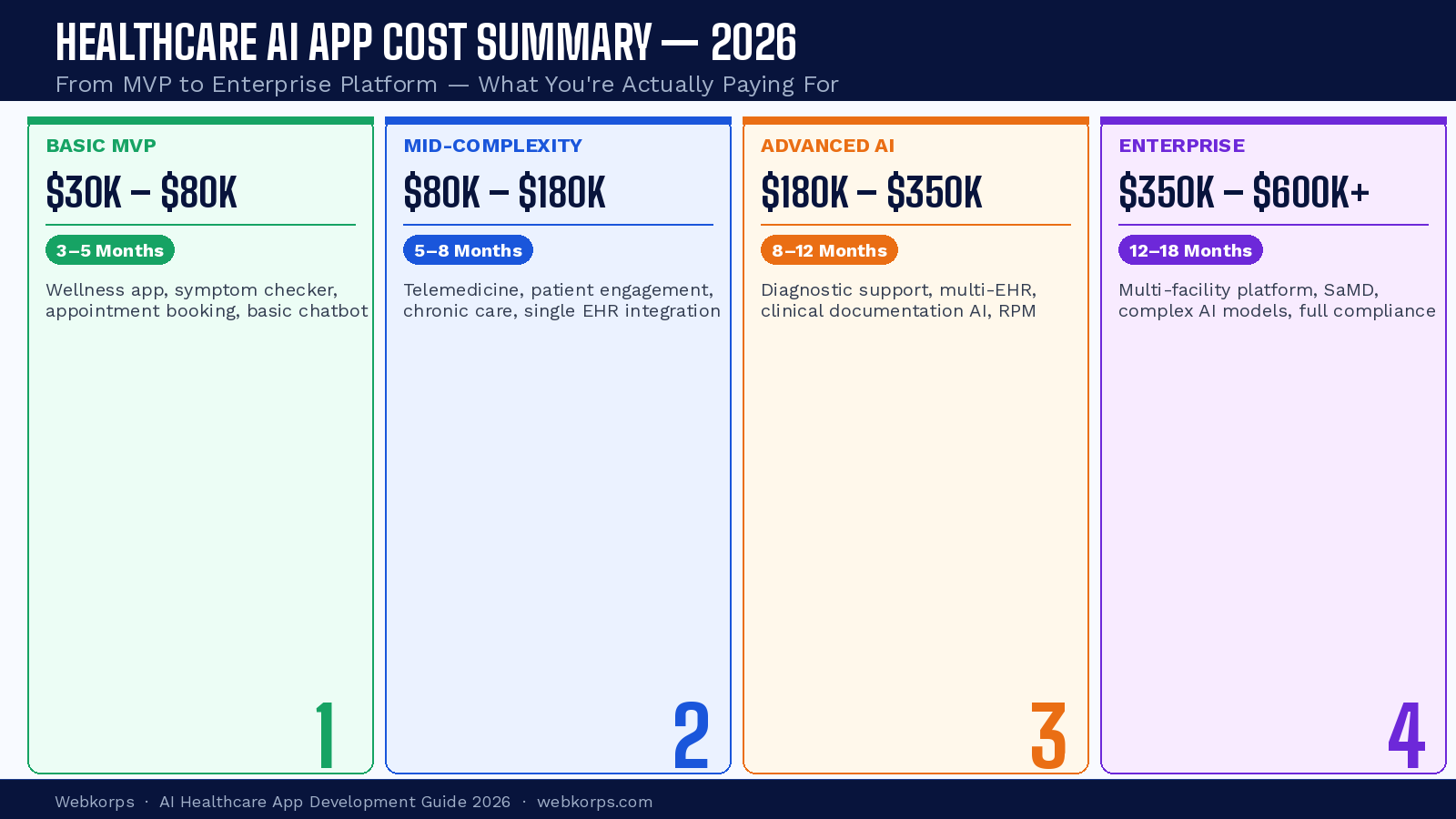
Before diving into the full breakdown, here is the cost-at-a-glance table that most readers are looking for. Use this to quickly identify which tier your project falls into, then read the relevant sections for a detailed breakdown.
| App Type | Cost Range | Timeline | Best For |
| Basic AI Health App (MVP) | $30,000 – $80,000 | 3–5 Months | Wellness, symptom checker, appointment booking |
| Mid-Complexity Platform | $80,000 – $180,000 | 5–8 Months | Telemedicine, chronic care, patient engagement |
| Advanced AI Healthcare App | $180,000 – $350,000 | 8–12 Months | Diagnostic support, EHR-integrated, RPM |
| Enterprise-Grade AI Platform | $350,000 – $600,000+ | 12–18 Months | Multi-facility, SaMD, complex AI models |
Important: These ranges are starting points – not fixed quotes. The 7 factors in the next section are what move your project up or down this scale. Read all 7 before setting your budget.
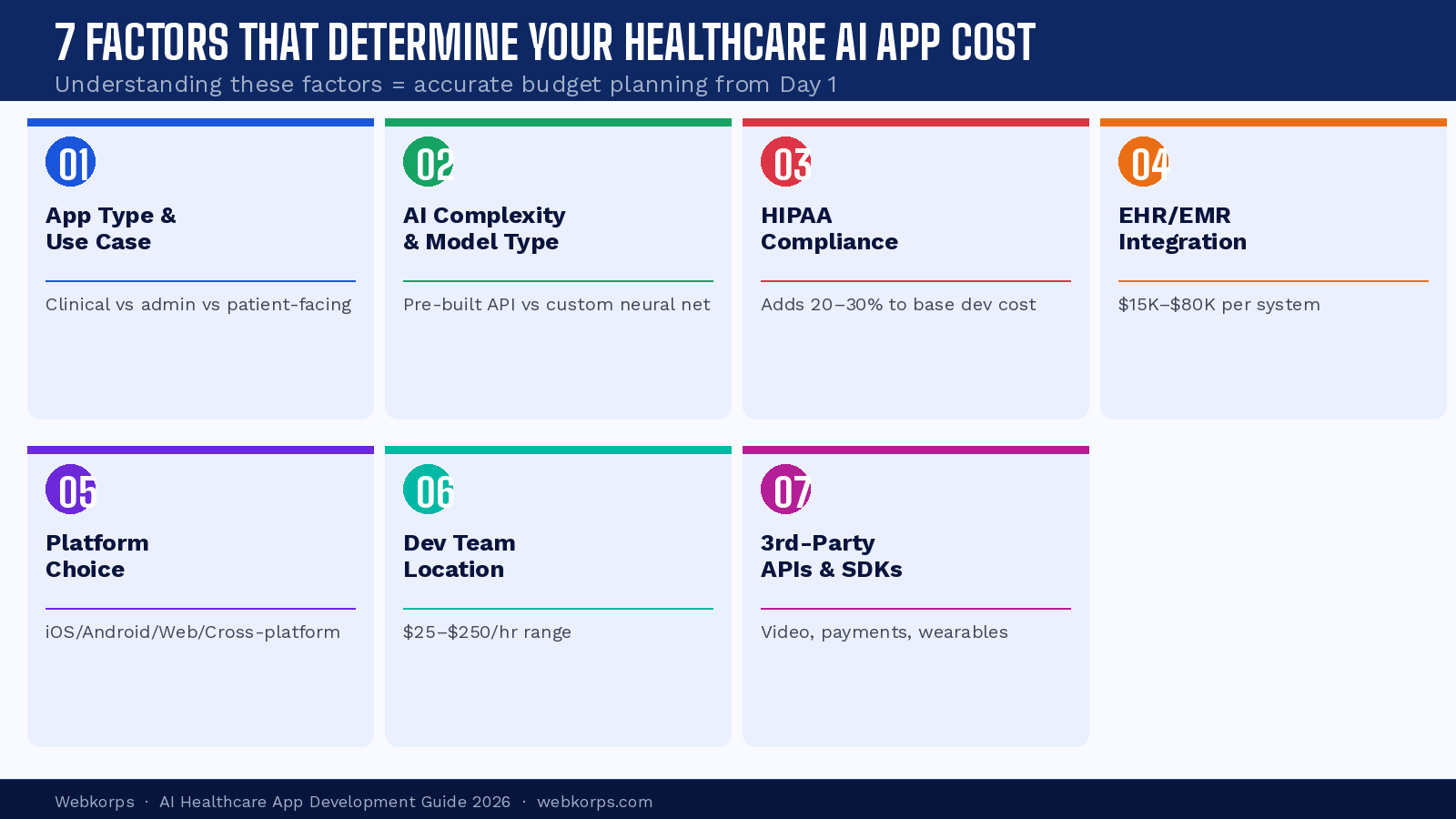
7 Factors That Determine the Real Cost of Your Healthcare AI App
Understanding these seven variables is the difference between a budget that holds and one that blows up at month four. Every cost estimate you receive from a development partner should be traceable back to specific decisions in each of these areas.
Factor 1 – App Type & Clinical Use Case
The single biggest cost driver is what your app actually does clinically. Healthcare AI applications broadly fall into five categories, and the cost difference between them is dramatic.
| App Category | AI Complexity | Compliance Burden | Typical Cost Range |
| Patient-Facing Wellness | Low | Low–Medium | $30K – $80K |
| Telemedicine Platform | Medium | High (HIPAA) | $80K – $200K |
| Clinical Documentation AI | High (NLP) | Very High | $120K – $300K |
| Diagnostic AI (Medical Imaging) | Very High (CV) | Extreme (FDA) | $200K – $600K+ |
| Revenue Cycle / RCM AI | Medium–High | Medium–High | $80K – $200K |
| Remote Patient Monitoring | High (IoT + AI) | Very High | $100K – $280K |
Patient-facing wellness apps – step tracking, medication reminders, general health tips – carry the lowest compliance burden and the simplest AI requirements. Diagnostic AI applications that process medical images (radiology, pathology, dermatology) sit at the opposite end: they require deep learning model training on large medical datasets, clinical validation, and potentially FDA Software as a Medical Device (SaMD) clearance – a process that can add $50,000 to $200,000 on top of development costs alone.
Factor 2 – AI Complexity & Model Type
Not all AI is equal in cost. The approach you choose to deliver AI functionality has an enormous impact on both development cost and ongoing operational expenses.
- Pre-built AI APIs (AWS Comprehend Medical, Google Healthcare NLP, Microsoft Azure Health Bot): Integration cost $10,000–$30,000. Fastest to deploy, but limited customization, and you are dependent on the vendor’s model quality and pricing changes.
- Fine-tuned AI models on your own healthcare data: Training cost $40,000–$100,000. Better accuracy for your specific use case requires de-identified training data, 2–4 months additional timeline.
- Custom neural networks and deep learning models: Development cost $80,000–$200,000+. Maximum performance and IP ownership require significant dataset curation, dedicated ML engineering, and ongoing model governance.
Key Insight: Most healthcare AI projects are best served by fine-tuned models built on top of foundation models – not fully custom architectures. This balances performance, cost, and time-to-market. Reserve custom neural networks for truly specialized clinical tasks where no existing model comes close.
Factor 3 – HIPAA Compliance & Security Architecture
This is the cost driver that surprises founders most – especially those coming from consumer tech backgrounds, where compliance is minimal. HIPAA compliance is not a feature you add at the end. It is an architectural requirement that shapes every technical decision from database design to API structure to third-party vendor selection.
When built correctly from Day 1, HIPAA compliance typically adds 20–30% to your base development cost. Here is what that budget actually pays for:
- PHI data pipeline design and implementation (encryption at rest with AES-256, TLS 1.3 in transit)
- Role-Based Access Control (RBAC) architecture
- Comprehensive audit logging system for all PHI access
- Business Associate Agreement (BAA) management with all vendors
- Security Risk Analysis documentation (required by HIPAA Security Rule)
- Penetration testing: $15,000–$40,000
- Third-party HIPAA compliance audit: $10,000–$30,000
⚠️ The Retrofit Cost Warning: Organizations that skip proper HIPAA architecture and attempt to add compliance after launch consistently spend 2–3x more on remediation than they would have spent building it in from the start – plus face potential regulatory exposure during the gap period.
Factor 4 – EHR/EMR Integration
Electronic Health Record integration is frequently the most underestimated and most expensive line item in a healthcare AI project budget. Every hospital and clinic runs on one or more EHR systems, and your AI app needs to exchange data with those systems to be clinically useful.
| EHR System | Integration Approach | Typical Cost | Timeline |
| Epic | SMART on FHIR / Epic API | $40,000 – $80,000 | 3–5 months |
| Oracle Cerner | FHIR R4 / Millennium API | $30,000 – $60,000 | 2–4 months |
| athenahealth | athenahealth REST API | $20,000 – $40,000 | 2–3 months |
| Meditech / Allscripts | HL7 v2 / Custom | $15,000 – $35,000 | 2–4 months |
| Multiple EHR Systems | FHIR Aggregation Layer | $60,000 – $120,000 | 4–8 months |
The cost variation stems from API quality, documentation availability, and sandbox environment access. Epic – which powers roughly 37% of US hospital beds – has a mature but complex API ecosystem that requires significant investment to integrate correctly. Smaller systems often rely on legacy HL7 v2 messaging formats that require custom parsing and transformation layers.
Factor 5 – Platform Choice
The platforms your app needs to support directly affect both development cost and timeline. Cross-platform frameworks have matured significantly and are now the recommended starting point for most healthcare AI applications.
| Platform Strategy | Cost Multiplier | Timeline Impact | Best For |
| iOS Only (Native Swift) | Baseline | Baseline | Apple-focused clinical tools |
| Android Only (Native Kotlin) | Baseline | Baseline | Enterprise/custom device deployments |
| Cross-Platform (React Native/Flutter) | 1.1x – 1.3x | +20% | Most patient-facing healthcare apps |
| Web Application Only | 0.8x | -15% | Administrative AI tools, B2B platforms |
| iOS + Android Native | 1.8x – 2.0x | +70% | Max performance apps, specialized medical devices |
| Web + Mobile (Full Coverage) | 1.6x – 1.8x | +50% | Enterprise multi-stakeholder platforms |
For most healthcare AI applications, React Native or Flutter cross-platform development delivers 35–45% cost savings versus native iOS + Android while achieving 90%+ of native performance. The remaining 10% of the performance gap matters for computationally intensive applications like real-time medical imaging processing, where native development remains the correct choice.
Factor 6 – Development Team Location & Model
Team cost is the most visible variable in any development quote – but it is frequently misunderstood as the most important one. In healthcare AI development, compliance expertise and domain knowledge matter far more than hourly rate. A $25/hour team that mishandles PHI architecture will cost far more in remediation than a $100/hour team that gets it right.
| Team Model | Hourly Rate | $150K Budget Delivers | HIPAA Expertise |
| US-Based In-House Team | $150 – $250/hr | ~700–1,000 hours | Varies |
| US-Based Agency | $120 – $200/hr | ~750–1,250 hours | High (if specialized) |
| Eastern Europe Agency (Top Tier) | $50 – $90/hr | ~1,700–3,000 hours | Medium–High |
| India-Based Agency (Top Tier) | $25 – $50/hr | ~3,000–6,000 hours | High (if specialized) |
| IT Staff Augmentation | $30 – $80/hr | Flexible, scalable | Depends on team composition |
Factor 7 – Third-Party Integrations & APIs
Modern healthcare AI apps rarely run on a single codebase. They integrate with video SDKs for telemedicine, payment processors for billing, pharmacy APIs for e-prescribing, lab systems for result delivery, and wearable device platforms for RPM. Each integration adds cost and complexity.
- Video consultation SDKs (Twilio Video, Agora, Daily.co): $5,000–$20,000 integration cost + ongoing usage fees
- Payment and insurance processing (Stripe, payer APIs): $8,000–$25,000
- Wearable device integration (Apple HealthKit, Google Health Connect, custom IoT): $15,000–$50,000
- Pharmacy and e-prescribing APIs (Surescripts, DrFirst): $10,000–$30,000
- Lab data and results integration (Quest, LabCorp, hospital lab systems): $8,000–$25,000
- Push notifications, in-app messaging, analytics infrastructure: $5,000–$15,000
Detailed Cost Breakdown by Healthcare AI App Type
Each healthcare AI application type has a distinct cost profile driven by its specific AI requirements, compliance burden, and integration complexity. Here is what you are actually paying for in each category.
AI-Powered Telemedicine App ($80,000 – $250,000)
| Component | Cost Range | Notes |
| Frontend (iOS + Android, cross-platform) | $20K – $45K | Video UI, scheduling, chat |
| Backend & Infrastructure | $18K – $35K | HIPAA-compliant cloud, APIs |
| AI Layer (triage chatbot + scheduling) | $15K – $40K | Pre-built NLP API + fine-tuning |
| Video SDK Integration | $8K – $20K | Twilio/Agora + HIPAA BAA |
| EHR Integration (1 system) | $20K – $50K | FHIR-based data sync |
| HIPAA Compliance & Security | $15K – $40K | Architecture + audit + pentest |
| QA, Testing & Launch | $8K – $20K | Clinical workflow validation |
Timeline: 4-9 months. The AI component in telemedicine is typically an intelligent triage chatbot that routes patients to the appropriate care level, combined with AI-powered scheduling optimization. For most telemedicine platforms, pre-built NLP APIs are sufficient – custom model training is only justified if you have specialized clinical workflows not covered by existing solutions.
AI Clinical Documentation App ($120,000 – $300,000)
This is the fastest-growing healthcare AI category in 2026. Ambient clinical intelligence – AI that listens to patient-physician conversations and automatically generates clinical notes, codes diagnoses, and populates EHR fields – is demonstrating extraordinary ROI in early deployments. The technology is complex, and the cost reflects that.
- NLP model with medical vocabulary: $40,000–$80,000 for fine-tuned speech-to-text + clinical NLP
- EHR write-back integration: $25,000–$60,000 for bidirectional FHIR integration
- Real-time audio processing infrastructure: $15,000–$30,000
- PHI handling in audio streams: Specialized compliance architecture adds 25–35% premium
- Total realistic range: $120,000–$300,000, depending on EHR complexity and AI sophistication
AI Diagnostic Support App / Medical Imaging ($200,000 – $600,000+)
Medical imaging AI – radiology screening, pathology analysis, dermatology classification – is the most technically complex and most expensive category. The cost is driven by deep learning model development that requires large, carefully curated, expert-labeled medical image datasets.
FDA SaMD Warning: If your diagnostic AI application makes clinical recommendations that influence treatment decisions, it likely qualifies as Software as a Medical Device (SaMD) under FDA regulations. The 510(k) clearance pathway alone adds $50,000–$200,000 to the total project cost and 12–24 months to the timeline. This must be assessed before development begins – not after.
- Medical image dataset curation and labeling: $20,000–$80,000 (requires clinical expert annotators)
- Deep learning model development and training: $60,000–$150,000
- Clinical validation study: $30,000–$80,000
- FDA regulatory pathway: $50,000–$200,000+ (if applicable)
- Total realistic range (without FDA): $200,000–$350,000 | With FDA pathway: $350,000–$600,000+
Remote Patient Monitoring (RPM) App with AI ($100,000 – $280,000)
RPM applications combine IoT hardware integration, real-time data streaming, and predictive AI to monitor patients between clinical encounters. The technical complexity lies in the real-time data pipeline – ingesting continuous streams from wearables, detecting anomalies with AI, and triggering care team alerts when thresholds are crossed.
- IoT device SDK integration (Apple Watch, Fitbit, custom biosensors): $15,000–$50,000
- Real-time data pipeline and stream processing: $20,000–$40,000
- Predictive AI model (deterioration prediction, anomaly detection): $25,000–$60,000
- Alert and care team notification system: $10,000–$20,000
- Total realistic range: $100,000–$280,000 over 6–12 months
AI Healthcare Chatbot / Virtual Health Assistant ($30,000 – $180,000)
Healthcare chatbots span a massive range – from basic appointment schedulers using pre-built NLP APIs to sophisticated clinical assistants powered by custom large language models with medical knowledge. Budget accordingly.
| Chatbot Type | Cost Range | AI Approach | HIPAA Burden |
| Appointment Booking Bot | $30K – $50K | Pre-built NLP API | Medium |
| Symptom Checker Bot | $40K – $80K | Pre-built + fine-tuned | High |
| Medication Adherence Bot | $50K – $90K | Fine-tuned LLM | High |
| Clinical Decision Support Bot | $80K – $180K | Custom/fine-tuned LLM | Very High |
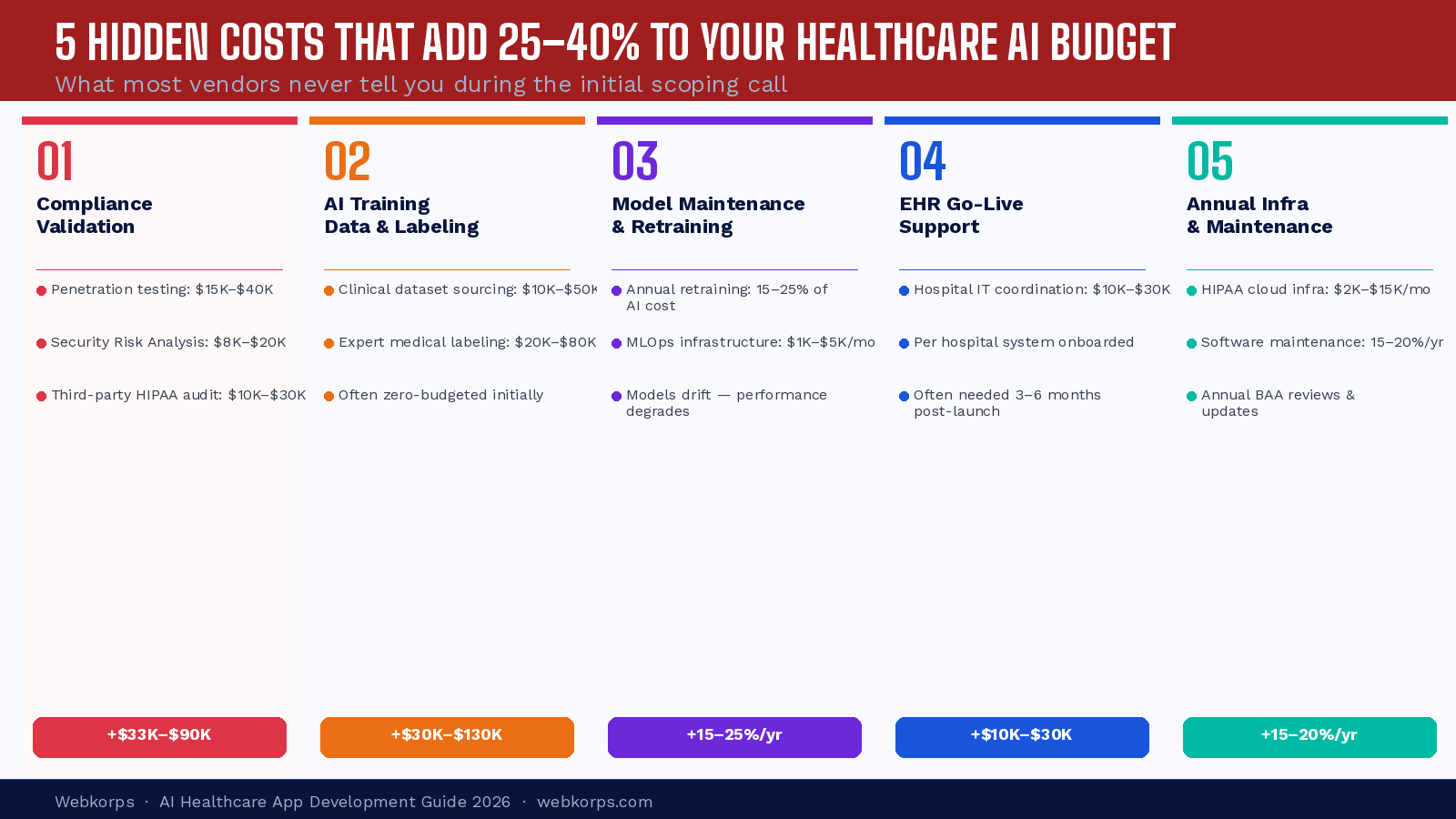
Hidden Costs That Add 25–40% to Your Healthcare AI Budget
These are the costs that consistently appear in the final invoice but rarely appear in the initial quote. Understanding them before you start can save you from the budget shock that derails a significant percentage of healthcare AI projects.
Hidden Cost 1 – Compliance Validation (Not Just Compliance Development)
Building a HIPAA-compliant architecture is one cost. Proving it is compliant is a separate – and often higher – cost that most founders discover only when they are trying to sign their first hospital contract.
- Penetration testing by a healthcare-specialized security firm: $15,000–$40,000
- Security Risk Analysis documentation (HIPAA-required): $8,000–$20,000
- Third-party HIPAA compliance audit: $10,000–$30,000
- SOC 2 Type II certification (increasingly required by enterprise customers): $30,000–$80,000
Hidden Cost 2 – AI Training Data Acquisition & Labeling
This is the single most commonly zero-budgeted item in initial healthcare AI scoping. The AI models powering your application need to be trained on high-quality, de-identified medical data. Sourcing that data is neither free nor simple.
- De-identified clinical dataset licensing or acquisition: $10,000–$50,000
- Medical expert annotation and labeling (physicians, nurses, coders): $20,000–$80,000 depending on volume and specialty
- Data preprocessing and de-identification pipeline: $8,000–$20,000
- Total: $38,000–$150,000 – often discovered mid-project after initial budget is set
Hidden Cost 3 – AI Model Maintenance & Retraining
AI models are not static software. They degrade over time as patient population characteristics change, medical coding standards update, and new drugs and procedures enter clinical practice. Planning for ongoing model maintenance is essential for any serious healthcare AI deployment.
- Annual model retraining budget: 15–25% of the original AI development cost
- MLOps infrastructure (model monitoring, drift detection, CI/CD for models): $1,000–$5,000/month
- Clinical performance monitoring and re-validation: $10,000–$30,000/year
Hidden Cost 4 – EHR Go-Live Support
EHR integration does not end when development does. Hospital IT departments require extensive support during the go-live period – a reality that catches many development partners off guard and often becomes a significant out-of-scope expense.
- Dedicated integration engineer during hospital go-live: $10,000–$30,000 per hospital system
- HL7 message troubleshooting and interface optimization: $5,000–$15,000
- End-user training and clinical workflow optimization: $8,000–$20,000
Hidden Cost 5 – Annual Infrastructure & Compliance Maintenance
HIPAA compliance is not a one-time achievement. It is an ongoing operational obligation that requires continuous investment.
- HIPAA-compliant cloud infrastructure (AWS HIPAA-eligible services): $2,000–$15,000/month depending on data volume and query load
- Annual software maintenance and bug fixes: 15–20% of development cost per year
- Annual BAA reviews and vendor compliance audits: $5,000–$15,000/year
- Annual team HIPAA training (required by HIPAA): $2,000–$8,000/year
Build vs. Buy vs. Partner vs. Augment – The Strategic Decision
Before engaging any healthcare app development partner, every healthcare CTO and founder needs to make a fundamental strategic decision about how they will build. Each approach has dramatically different cost profiles, timelines, risk levels, and customization ceilings.
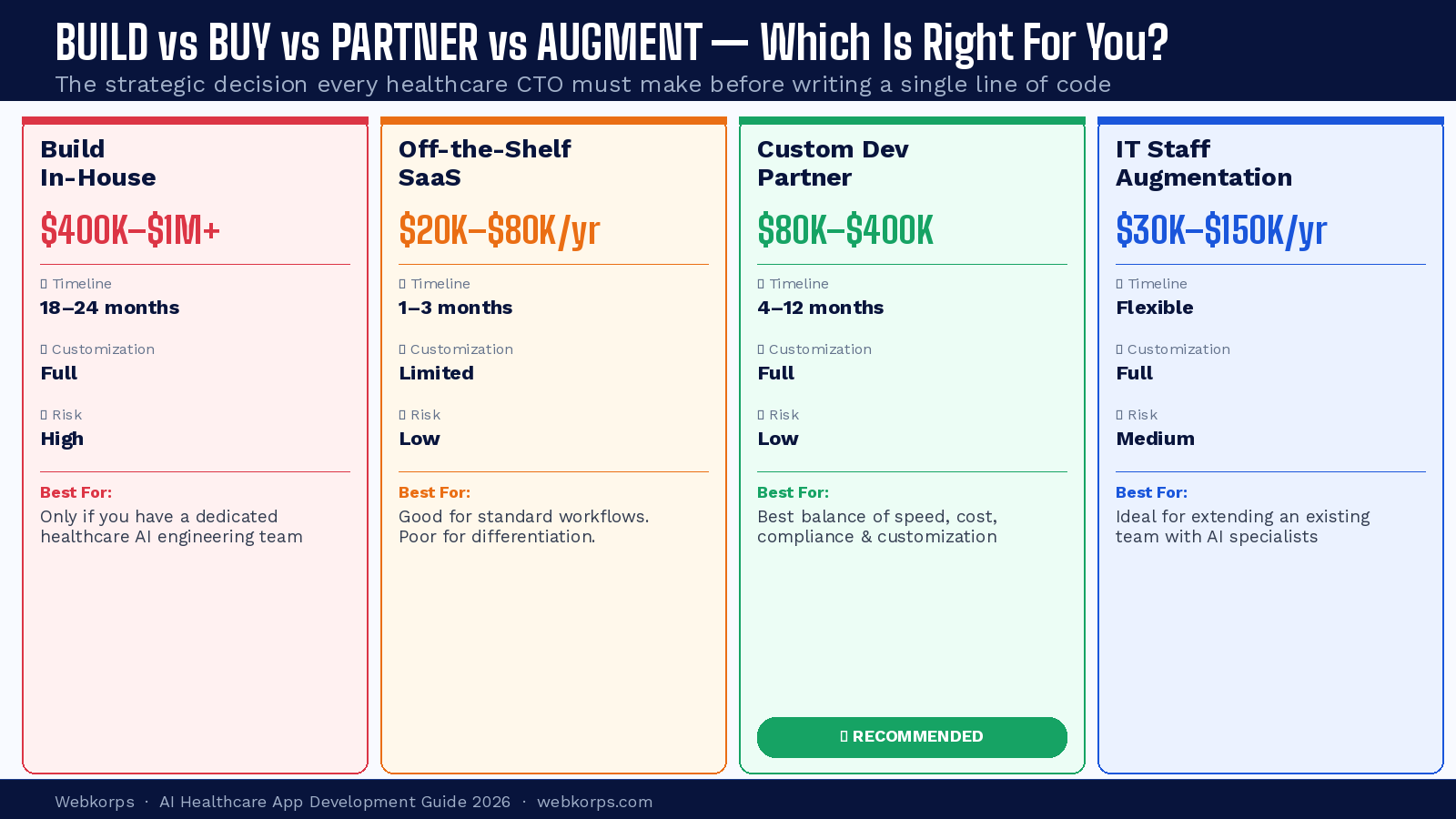
| Approach | Upfront Cost | Time to Market | Customization | Compliance Risk | Best Scenario |
| Build In-House | $400K–$1M+ | 18–24 months | Full | High* | Large health systems with dedicated engineering teams |
| Off-the-Shelf SaaS | $20K–$80K/yr | 1–3 months | Limited | Low | Standard workflows, limited differentiation needed |
| Custom Dev Partner | $80K–$400K | 4–12 months | Full | Low | Best balance – most healthcare startups & mid-market |
| IT Staff Augmentation | $30K–$150K/yr | Flexible | Full | Medium | Extending the existing team with specialized AI expertise |
Build in-house carries a high compliance risk, not because in-house teams are less capable, but because healthcare AI compliance requires specialized expertise in HIPAA engineering, clinical data governance, and medical AI validation that most general engineering teams have not developed.
The Webkorps Recommendation: For healthcare startups and mid-market providers, a custom development partner with demonstrated healthcare AI experience delivers the best combination of speed, compliance expertise, and cost efficiency. The keyword is “demonstrated” – always ask for specific HIPAA-compliant healthcare AI projects in their portfolio, not just general healthcare experience.
How to Budget a Healthcare AI App: The Phased Investment Approach
One of the most common and most damaging mistakes in healthcare AI development is committing full budget before clinical and technical assumptions have been validated. A phased investment approach dramatically reduces risk while maintaining development momentum.
Phase 1 – Discovery & Architecture ($15,000–$30,000 | 4–6 weeks)
- Technical architecture design with HIPAA compliance framework
- AI model strategy: pre-built vs. fine-tuned vs. custom – decision with cost implications documented
- EHR integration assessment: which systems, which APIs, realistic cost, and timeline
- Data strategy: training data sources, labeling requirements, de-identification approach
- Regulatory assessment: Does your application qualify as SaMD?
- Output: Full technical specification, validated cost estimate, project plan
Why Phase 1 pays for itself: A proper discovery phase typically identifies $30,000–$100,000 in scope changes that would have been discovered mid-project at 3–5x the cost to fix. Every hour spent in discovery saves 3–5 hours in development.
Phase 2 – MVP Build ($50,000–$150,000 | 3–6 months)
- Core clinical workflow – the single most important user journey
- One AI feature (the primary value proposition)
- HIPAA-compliant infrastructure from Day 1
- Single EHR integration (your primary customer’s system)
- Output: Working application ready for clinical pilot with real users
Phase 3 – Market Validation & Iteration ($20,000–$60,000 | 2–3 months)
- Clinical feedback incorporation from pilot users
- AI model performance analysis and retraining if needed
- Additional AI feature layer based on validated clinical demand
- Performance optimization and scalability improvements
- Output: Validated product with evidence of clinical value
Phase 4 – Scale & Enterprise Expansion ($80,000–$200,000 | 4–8 months)
- Multi-EHR integration for enterprise customer requirements
- Advanced AI model upgrades and additional use cases
- Multi-facility or multi-tenant architecture
- Compliance documentation for enterprise sales (SOC 2, BAA templates, security questionnaire responses)
- Output: Enterprise-ready product with documented compliance posture
What ROI Can You Expect? Is the Investment Worth It?
The most important question for any healthcare organization evaluating AI development is not “how much does it cost?” but “what return does it generate?” The evidence from 2025–2026 healthcare AI deployments is compelling.
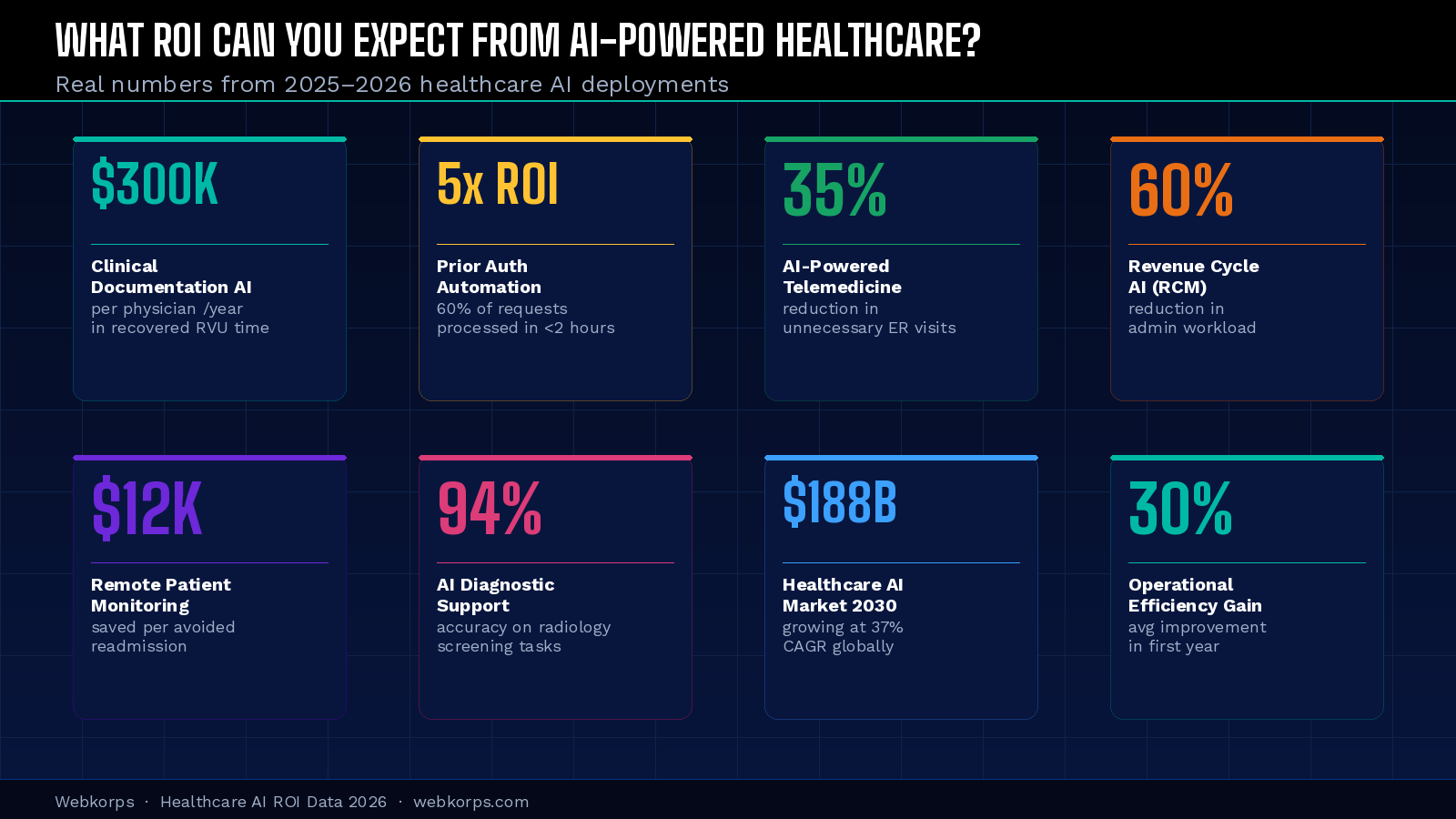
| AI Application Type | Key ROI Metric | Payback Period |
| Clinical Documentation AI | $300K/physician/year in recovered RVU time | 4–8 months |
| Prior Auth Automation | 5x ROI, 60% processed in <2 hours | 6–12 months |
| AI Telemedicine Triage | 35% reduction in unnecessary ER visits | 8–14 months |
| Revenue Cycle (RCM) AI | 60% reduction in administrative workload | 6–10 months |
| Remote Patient Monitoring | $8K–$12K saved per avoided readmission | 10–18 months |
| AI Diagnostic Support | 94% accuracy on radiology screening tasks | 12–24 months |
Market Context: The AI in healthcare market is projected to reach $188 billion by 2030, growing at 37% CAGR. Healthcare organizations that build proprietary AI capabilities now – rather than relying on off-the-shelf solutions – will have a meaningful competitive advantage in 3–5 years that is very difficult for competitors to replicate.
Why Healthcare Organizations Choose Webkorps for AI App Development
At Webkorps, we have been building healthcare technology for enterprise clients, hospital systems, and healthcare startups for over 8 years. Our approach to healthcare AI development is compliance-first – meaning HIPAA architecture is not an afterthought we add before launch, it is the foundation we build every healthcare project on from Day 1.
- Compliance-first development: HIPAA compliance architecture built into every technical decision from project kickoff
- Healthcare AI expertise: Experience across telemedicine, clinical documentation AI, RPM, RCM automation, and diagnostic support
- EHR integration depth: Proven integrations with Epic, Oracle Cerner, athenahealth, and major HL7 v2 systems
- Transparent phased pricing: No hidden costs, no scope creep surprises – full cost breakdown before development begins
- End-to-end delivery: AI model + application + HIPAA compliance + EHR integration + ongoing support
- 8+ years experience | 350+ clients | 30+ countries | 500+ products delivered
| Tell us what you’re building – get a detailed cost estimate within 48 hours.
No generic quotes. No sales pitch. Just honest numbers based on your specific requirements. |
Conclusion
Building an AI-powered healthcare app in 2026 is one of the highest-leverage investments a healthcare organization or health tech startup can make – but only if the budget is built on accurate, complete information.
The cost range of $30,000 to $600,000+ is real, and every number in that range is correct for the right project. What determines where your project lands is a specific combination of seven factors: app type and clinical use case, AI model complexity, HIPAA compliance architecture, EHR integration requirements, platform choice, development team model, and third-party integrations.
The most important takeaway from this guide: compliance and architecture decisions made in the first four weeks of a project determine 70% of the total cost. A proper discovery phase – where these decisions are made deliberately, with full cost implications documented – is the single highest-ROI investment in any healthcare AI project.
If you are still uncertain about where your project falls on the cost spectrum, the right next step is a scoping conversation with a development partner who can give you a detailed, line-item estimate based on your actual requirements – not a range copied from a blog post.
Frequently Asked Questions
How much does it cost to build a basic AI healthcare app MVP?
A basic AI healthcare app MVP – covering a single core workflow with pre-built AI APIs, HIPAA-compliant infrastructure, and no EHR integration – typically costs $30,000 to $80,000 and takes 3–5 months to build. This is appropriate for wellness apps, basic symptom checkers, and appointment booking platforms. If you need EHR integration or a custom AI model, budget $80,000–$150,000 for the MVP phase.
What is the single most expensive component of a healthcare AI app?
For most healthcare AI applications, EHR/EMR integration is the most expensive single component – ranging from $15,000 for simpler systems to $80,000+ for Epic integration. For diagnostic AI applications (medical imaging, pathology), the AI model training and validation cost typically exceeds the EHR integration cost. For compliance-heavy applications, HIPAA architecture and third-party compliance auditing can also be the dominant cost.
How much does HIPAA compliance add to development cost?
When built correctly from Day 1, HIPAA compliance adds approximately 20–30% to base development cost. On a $150,000 application, that is $30,000–$45,000. This covers PHI data pipeline architecture, encryption implementation, access controls, audit logging, BAA management, security risk analysis, penetration testing, and third-party compliance audit. Attempting to retrofit compliance after launch consistently costs 2–3x this amount.
Can I build a clinically useful healthcare AI app on a $50,000 budget?
Yes – but with specific constraints. A $50,000 budget is realistic for a patient-facing wellness app, an intelligent appointment booking system, or a medication adherence chatbot using pre-built NLP APIs. It is not realistic for an app requiring EHR integration, a custom AI model, or advanced clinical decision support. The key is matching your budget to an MVP scope that validates your core clinical hypothesis – then expanding in subsequent phases.
How long does it take to build a HIPAA-compliant AI healthcare app?
Timeline depends on complexity. A basic AI health app MVP takes 3–5 months. A mid-complexity telemedicine platform with single EHR integration takes 5–8 months. An advanced diagnostic AI platform takes 8–12 months. Enterprise-grade multi-facility platforms take 12–18+ months. Add 2–4 months if your application requires FDA SaMD clearance.
What is the difference between a wellness app and a Software as a Medical Device (SaMD)?
A wellness app helps users track general health metrics, manage appointments, or access health education – it does not make clinical recommendations that influence treatment decisions. A Software as a Medical Device (SaMD) uses software to perform a medical function – diagnosing conditions, recommending treatments, or analyzing clinical data to inform clinical decisions. SaMD requires FDA regulatory clearance in the US (and CE marking in Europe), adding $50,000–$200,000 to project cost and 12–24 months to the timeline. This assessment must be made before development begins.
Build in-house vs. hire a development partner – which saves more money?
For most healthcare organizations outside of large health systems with established engineering teams, a specialized development partner saves money when you account for the total cost of ownership. Building in-house requires hiring healthcare AI engineers ($150,000–$250,000/year each), HIPAA compliance experts, ML engineers, and QA specialists – a team that realistically costs $800,000–$1.5 million annually. A development partner delivers the same expertise for a fraction of that cost, with no long-term headcount commitment, and with domain knowledge accumulated across dozens of prior healthcare projects.