
 Posted by
 In 2026, mobile apps are no longer an extension of a business; they are the business.
From digital banking and telemedicine to food delivery and enterprise workflow automation, mobile applications now drive customer engagement, revenue growth, operational efficiency, and brand loyalty. As consumer expectations continue to rise, businesses are under increasing pressure to deliver seamless, intelligent, and high-performing mobile experiences.
That’s why choosing a top mobile app development company is one of the most strategic decisions an organization can make.
But what truly defines the best mobile app development company? Is it the cost? A strong portfolio? Deep technical expertise? Industry specialization? Or the ability to scale? The truth is, it’s never just one factor. The best mobile app development companies combine strategic thinking, technical excellence, and business alignment. They don’t simply build apps; they build digital products that solve real business problems, create measurable impact, and scale with growth.
In this comprehensive guide, we’ll explore:
- What makes a mobile app development company truly “top-tier”
- How to evaluate and compare service providers
- A look at leading mobile app development companies in 2026
- Mobile app development costs and pricing factors
- Future trends shaping the mobile ecosystem
- How to choose the right long-term technology partner
Let’s dive in.
Table of Contents
The Rise of the Mobile-First Economy
We are living in a mobile-first world. Global smartphone penetration has crossed billions of users, and mobile apps account for the majority of digital time spent by consumers. Whether it’s shopping, streaming, booking services, or managing finances, mobile applications dominate user behavior.
For businesses, this shift means:
- Customers expect instant access
- Experiences must be personalized
- Performance must be flawless
- Security must be airtight
A poorly built mobile application can result in low ratings, high uninstall rates, and brand damage. A well-built application, on the other hand, can:
- Increase user retention
- Boost lifetime customer value
- Enable new revenue models
- Improve operational efficiency
- Strengthen competitive positioning
This is where partnering with a top mobile app development company becomes critical.
What Defines a Top Mobile App Development Company?
Not every company that develops mobile applications can be considered a top mobile app development company. Building an app is one thing; building a scalable, high-performing, and future-ready digital product is another.
The true distinction lies in strategic vision, flawless execution, architectural scalability, and the ability to deliver long-term business value, not just functional code. A top-tier company approaches mobile app development as a growth initiative, aligning technology with business objectives, user experience, and market positioning. It’s not about launching an app. It’s about launching a product that evolves, adapts, and drives measurable impact over time.
Let’s break this down in detail.
Strategic Thinking Beyond Coding
A truly top mobile app development company does far more than write code; it builds digital products that are strategically aligned with business objectives.
The difference between a basic mobile app development vendor and a long-term technology partner lies in mindset. While some companies focus solely on delivering features, top-tier firms begin by understanding the bigger picture: revenue goals, user behavior, competitive positioning, operational efficiency, and long-term scalability.
Before writing a single line of code, experienced teams invest time in comprehensive product discovery. This typically includes:
- Conducting in-depth discovery workshops to clarify business goals and technical requirements
- Analyzing competitors to identify gaps, opportunities, and differentiation strategies
- Defining detailed user personas to understand behavior, motivations, and pain points
- Establishing clear KPIs such as acquisition cost, retention rate, engagement metrics, and revenue targets
- Creating structured product roadmaps that outline feature prioritization, release phases, and scalability plans
This structured approach minimizes risk and prevents costly rework later in the development cycle.
Strategic planning also ensures that every feature serves a purpose. Instead of building a bloated application filled with unnecessary functionality, top mobile app development companies focus on delivering value-driven features that directly impact business performance. In short, they approach mobile app development as a strategic business initiative, not just a technical project. And that distinction is what separates good developers from truly great mobile app development partners.
Strong Technical Expertise Across Platforms
A leading mobile app development company must demonstrate deep, cross-platform technical expertise, not just in writing code, but in architecting robust, scalable, and high-performing digital ecosystems.
Modern mobile applications are no longer standalone products. They are connected systems that integrate with cloud infrastructure, APIs, third-party services, analytics engines, and enterprise platforms. This complexity requires a team that understands both front-end user experience and backend engineering at scale.
A top-tier company should have proven expertise in:
- Native iOS development using Swift, ensuring optimal performance, security, and seamless integration within the Apple ecosystem.
- Native Android development using Kotlin, delivering smooth functionality across diverse Android devices and screen sizes.
- Cross-platform frameworks such as Flutter and React Native enable faster development cycles while maintaining near-native performance.
- Backend development using scalable technologies like Node.js, .NET, Python, or Java to power secure APIs and business logic.
- Cloud platforms, including AWS, Microsoft Azure, or Google Cloud to ensure scalability, reliability, and cost optimization.
- Database management systems such as PostgreSQL, MongoDB, or Firebase for structured and real-time data handling.
- DevOps and CI/CD pipelines to automate testing, deployment, and performance monitoring.
However, technical expertise is not just about familiarity with tools; it’s about knowing when and why to use them.
The best mobile app development companies carefully evaluate:
- Performance requirements
- User traffic projections
- Data sensitivity
- Future feature expansion
- Integration complexity
They select technologies based on long-term sustainability, not short-term convenience.
In an increasingly competitive digital landscape, technical depth ensures that your application is not only functional at launch but remains adaptable, secure, and scalable as your business evolves.
Focus on User Experience (UX) and Design Thinking
A mobile app’s success is rarely determined by its code alone; it is defined by how users feel when they interact with it.
Even the most technically advanced application will fail if it is confusing, slow, or unintuitive. That’s why a top mobile app development company places user experience (UX) and design thinking at the center of the development process.
Great mobile experiences are not accidental. They are the result of research, iteration, and intentional design decisions grounded in user psychology and behavior. Leading companies invest heavily in:
- User Research and Behavioral Analysis: Before designing screens, they study the audience. This includes understanding user goals, pain points, device usage habits, and contextual behaviors. Data-driven insights ensure the app is built around real user needs, not assumptions.
- Wireframing and prototyping: Wireframes map the app’s structure and information hierarchy, while interactive prototypes simulate real-world usage. This allows stakeholders to validate flows and functionality before development begins, reducing costly revisions later.
- Interaction design: Interaction design focuses on how users move through the app, how buttons respond, how animations guide attention, and how transitions feel natural. Subtle micro-interactions often make the difference between a good app and a delightful one.
- Usability Testing: Top mobile app development companies conduct iterative usability testing with real users. Observing how users navigate the app reveals friction points that might not be visible internally. Continuous refinement ensures intuitive navigation and higher engagement.
- Accessibility compliance: Inclusive design is no longer optional. Accessibility standards ensure that users with disabilities can interact with the app effectively. This includes readable typography, proper color contrast, screen reader compatibility, and logical navigation flows.
Ultimately, strong UX is about clarity, simplicity, and emotional connection. Users should not have to “figure out” how your app works. Every action should feel natural. Every screen should serve a purpose. Every interaction should guide users toward their goal with minimal effort. Top mobile app development companies understand a critical truth: No matter how powerful the backend architecture is, it becomes irrelevant if users abandon the app due to frustration. Exceptional design is not decoration; it is a growth strategy.
Agile Development and Transparency
Modern mobile app development is dynamic. Market conditions shift, user expectations evolve, and product requirements often change during the development lifecycle. That’s why leading mobile app development companies adopt Agile methodology, a flexible, iterative approach designed to deliver high-quality results efficiently.
Unlike traditional development models that follow a rigid, linear process, Agile focuses on adaptability, collaboration, and continuous improvement.
A top mobile app development company typically structures its workflow around:
- Sprint-Based Development Cycles: Work is divided into short, focused development phases called sprints (usually 1-2 weeks). Each sprint delivers specific features or improvements, allowing stakeholders to see tangible progress throughout the project rather than waiting months for a final release.
- Regular Demo Sessions: At the end of each sprint, development teams conduct review sessions to showcase completed features. This ensures alignment with expectations and allows business stakeholders to provide immediate input.
- Continuous Feedback Integration: Instead of treating feedback as a post-launch activity, Agile teams incorporate it throughout the development process. Early feedback reduces risk, prevents costly revisions, and ensures the product remains aligned with user needs and business objectives.
- Adaptive Feature Prioritization: As market demands change or new insights emerge, feature priorities may shift. Agile allows teams to reallocate focus efficiently, ensuring that high-impact functionalities are delivered first.
- Clear Communication Channels: Transparency is fundamental. Leading companies establish structured communication systems -including project management tools, progress reports, milestone tracking, and dedicated points of contact – to keep stakeholders informed at every stage.
Agile is not just a development framework; it is a mindset rooted in collaboration and accountability. Transparency builds trust. When clients understand timelines, challenges, and progress in real time, confidence increases. More importantly, transparency ensures that the final product reflects the original vision, refined by ongoing insight rather than rigid assumptions.
In a competitive digital landscape, the ability to adapt quickly without compromising quality is what separates average vendors from truly top mobile app development companies.
Scalability and Security by Design
In today’s digital landscape, mobile applications are expected to grow alongside your business. A simple, static app may work initially, but as user numbers increase, feature sets expand, and integrations multiply, the system can quickly become slow, unstable, or vulnerable.
Top mobile app development companies adopt a long-term perspective, designing applications that are not only functional at launch but also resilient, adaptable, and secure over time.
Designing for Scalability
Scalable apps are built to handle growth without compromising performance. Leading development teams focus on:
- Handling Increasing User Loads: Applications are architected to accommodate spikes in traffic and concurrent users. This includes load balancing, optimized database queries, and cloud-native infrastructure that scales automatically.
- Seamless Feature Integration: New features, third-party integrations, and platform updates can be added without disrupting existing functionality. Modular code structures and microservices architectures enable this flexibility.
- Maintaining High Performance Under Stress: Top companies conduct performance testing to ensure the app remains fast, responsive, and reliable even under high traffic or intensive processing demands.
Designing for Security
Security is no longer optional; it is a core expectation. Mobile apps often handle sensitive user data, including financial information, personal health records, and private communications. A leading mobile app development company ensures robust protection through:
- Data Encryption: Both in-transit and at-rest data are encrypted to prevent unauthorized access.
- Secure APIs: Any external integrations are secured with authentication protocols, encryption, and validation to prevent breaches.
- Regulatory Compliance: Apps are designed to comply with relevant regulations such as HIPAA for healthcare, GDPR for data privacy in Europe, or PCI DSS for payment processing.
- Multi-Factor Authentication (MFA): Advanced user authentication methods add an extra layer of security, protecting sensitive accounts from unauthorized access.
Scalability and security are intertwined. An app that cannot handle growth efficiently or protect its data risks losing users, credibility, and business value. Top-tier mobile app development companies treat these considerations as foundational elements, integrated into the architecture from day one rather than as afterthoughts.
By combining robust scalability with airtight security, these companies ensure that your mobile app is future-ready, reliable, and trusted by users, giving you a significant competitive advantage in a mobile-first world.
Leading Mobile App Development Companies in 2026
The mobile app development landscape is highly competitive, with hundreds of companies offering a wide range of services across industries and technologies. However, only a select few consistently deliver high-quality, scalable, and innovative mobile solutions that drive measurable business results and long-term growth.
The list below has been curated based on strong industry recognition, verified client reviews, portfolio strength, and consistent performance across leading B2B research and review platforms such as GoodFirms, Clutch, TopDevelopers, and other reputable technology ranking directories. These platforms evaluate companies based on client feedback, market presence, technical expertise, and delivery capabilities, making them reliable indicators of credibility and performance. The following companies have established themselves as leaders in 2026, demonstrating excellence across strategy, technology, design, and long-term partnership:
Webkorps
Webkorps is a global IT solutions provider with over eight years of experience in delivering end-to-end mobile app development, enterprise solutions, and digital transformation services.
Why They Stand Out:
- Expertise across iOS, Android, and cross-platform frameworks
- AI-powered app development for smarter user experiences
- Strong UI/UX design capabilities and human-centric product design
- Agile methodology ensures faster delivery and transparency
- Enterprise-grade scalability and cloud-native solutions
Industries Served: Healthcare, Fintech, E-commerce, SaaS, Logistics, Real Estate, Retail, Travel & hospitality, Warehouse.
Webkorps combines technical excellence with business strategy, making it an ideal partner for startups and enterprises seeking growth-focused mobile applications.
Tibicle
Tibicle is a technology company specializing in scalable, high-performance mobile app development for startups and businesses. With expertise in Flutter, Android, and iOS, Tibicle delivers user-focused applications tailored to business goals, from concept and UI/UX design to development, deployment, and ongoing support.
Web Panel Solutions
Web Panel Solutions is a trusted technology company offering mobile app development services for startups, SMEs, and enterprises. The company specializes in custom iOS, Android, and cross-platform applications with a strong focus on scalability, performance, and user experience. Their agile approach and business-driven solutions help clients accelerate digital growth.
Aalpha Information Systems
Aalpha Information Systems is a mobile app development company with over 20 years of software development experience. The company builds custom mobile applications for startups, SMEs, and enterprises, focusing on performance, security, and scalability. Its team develops native Android and iOS apps, cross-platform solutions, and enterprise applications tailored to business needs. Aalpha also provides end-to-end services, including strategy, design, development, testing, deployment, and ongoing maintenance.
Ontik Technology
Ontik Technology is a trusted mobile app development company in the USA, delivering scalable, high-performance mobile solutions tailored to business needs. With expertise in backend architecture, mobile app development, and technology consulting, the company helps organizations build secure, future-ready applications that drive digital growth.
ScienceSoft
ScienceSoft is a US-based IT consulting and software development company with over 30 years of experience. They specialize in custom mobile app development, AI-powered solutions, and enterprise-grade software. Known for delivering reliable and scalable applications, ScienceSoft serves industries ranging from healthcare to retail and finance.
Goji Labs
Goji Labs is a design-driven mobile app development company that focuses on creating consumer-facing apps with exceptional user experiences. They combine strategy, UX/UI design, and cutting-edge technology to deliver apps that engage and retain users. Their agile approach ensures timely delivery and high-quality products.
Fueled
Fueled is a premium mobile app and web development agency recognized for building high-quality digital experiences. They cater to startups and enterprises, focusing on mobile apps that drive engagement, retention, and business growth. Fueled emphasizes design-first development combined with robust technical architecture.
Codiant
Codiant specializes in mobile app development, web development, and digital transformation services. They focus on delivering innovative and scalable solutions for startups and enterprises alike. With expertise across iOS, Android, and cross-platform technologies, Codiant helps clients launch apps quickly without compromising quality.
AppMakers USA
AppMakers USA provides end-to-end mobile app development services, helping businesses build feature-rich and scalable applications. Their expertise includes native, hybrid, and cross-platform development, as well as UI/UX design and app maintenance. They serve industries like healthcare, retail, and logistics.
Appinventiv
Appinventiv is a global mobile app development company that focuses on creating innovative solutions for startups and enterprises. They specialize in mobile app strategy, design, development, and post-launch support. Appinventiv is known for delivering apps with strong functionality, performance, and security.
ValueCoders
ValueCoders is an India-based outsourcing company offering mobile app development, web development, and software consulting services. They provide scalable and cost-effective solutions to startups and SMEs worldwide. With expertise in emerging technologies, ValueCoders emphasizes quality, agility, and timely delivery.
WillowTree
WillowTree is a digital product agency that builds mobile apps, websites, and connected devices for enterprises. They focus on user-centered design, strategy, and engineering to create applications that enhance engagement and drive measurable business results. Their enterprise-grade solutions are highly scalable and secure.
Intellectsoft
Intellectsoft is an enterprise software development company that specializes in mobile app development, blockchain, AI, and IoT solutions. They focus on delivering high-performance applications for large-scale enterprises. Their services include mobile strategy, custom development, and post-launch support.
Hyperlink InfoSystem
Hyperlink InfoSystem is a global mobile app development company delivering iOS, Android, and cross-platform applications. They cater to startups, SMEs, and enterprises, offering end-to-end services including UI/UX design, development, and app maintenance. They are known for scalable, cost-effective, and innovative mobile solutions.
Brainvire Infotech Inc.
Brainvire Infotech is a global technology consulting and mobile app development company. They deliver custom solutions for industries like retail, healthcare, finance, and logistics. Known for combining strategy, design, and development, Brainvire creates scalable, secure, and innovative mobile applications.
Mobile App Development Services Explained in Detail
A top mobile app development company does much more than just write code; it provides a full spectrum of services that guide an idea from concept to a fully functional, scalable, and market-ready mobile application. The best companies understand that successful mobile apps are not built in isolation; they are the result of strategy, design, technology, and ongoing optimization. Here’s a closer look at the key services offered by leading mobile app development companies:
Custom Mobile App Development
Custom mobile app development focuses on building applications tailored to the unique needs of a business. Unlike off-the-shelf solutions, custom apps allow organizations to:
- Implement unique workflows specific to their industry
- Create a distinctive user experience aligned with brand identity
- Integrate seamlessly with existing systems and APIs
- Ensure flexibility for future feature expansion
Custom apps provide a competitive edge by addressing specific challenges and delivering functionality that off-the-shelf solutions cannot.
Enterprise Mobile App Development
Enterprise mobile apps are designed to improve internal operations, streamline processes, and increase employee productivity. These applications often include:
- Workforce management systems
- Inventory and supply chain management
- Customer Relationship Management (CRM) integrations
- Data analytics dashboards for informed decision-making
Enterprise mobile apps require robust security, high scalability, and seamless integration with legacy systems. Top development companies have the expertise to deliver complex, large-scale applications that meet enterprise standards.
Minimum Viable Product (MVP) Development
For startups or businesses testing new ideas, an MVP is a cost-effective approach to validate concepts in the market. Mobile app development companies help define:
- Core features necessary for initial launch
- Lean architecture to reduce development time and cost
- Rapid development cycles to get products to market quickly
- Feedback loops to incorporate user insights for future improvements
MVP development reduces risk and accelerates decision-making while providing real-world validation of an idea.
UI/UX Design Services
Exceptional user experience is central to a successful mobile app. Leading companies offer design services that include:
- User research to understand target audiences
- Wireframing and prototyping for early visualization
- Interaction design to ensure intuitive navigation
- Usability testing to refine interfaces and flows
Design-focused development ensures the app is not only functional but also engaging, easy to use, and visually appealing.
Mobile App Testing & Quality Assurance
A top mobile app development company ensures that apps are robust, reliable, and bug-free. QA services typically include:
- Functional testing to validate features
- Performance testing for speed and stability
- Security testing to identify vulnerabilities
- Compatibility testing across devices and OS versions
Rigorous QA reduces post-launch issues and ensures a seamless experience for end-users.
App Maintenance and Support
Mobile apps are never truly “finished.” Ongoing maintenance is critical to keep apps secure, updated, and aligned with evolving user expectations. Maintenance services often include:
- OS updates and feature upgrades
- Performance monitoring and optimization
- Security patching
- Analytics-driven improvements based on user behavior
Continuous maintenance ensures long-term success and enhances user retention.
Emerging Technology Integration
Top mobile app development companies leverage the latest technologies to make apps smarter and more engaging. This may include:
- AI and Machine Learning: Personalized recommendations, predictive analytics, and smart automation
- AR/VR: Immersive experiences for gaming, retail, and education
- IoT Integration: Connecting apps with smart devices for real-time monitoring and control
- Blockchain: Enhanced security, transparent transactions, and decentralized applications
Integrating emerging technologies ensures apps remain competitive and future-ready.
By offering these comprehensive services, a top mobile app development company becomes more than just a vendor; it becomes a strategic technology partner capable of delivering end-to-end mobile solutions that drive business growth, engagement, and long-term success.
Also read: Top Mobile App Development Services to Boost Your Business Growth
Mobile App Development Cost in 2026
One of the most frequently searched questions by businesses looking to hire a mobile app development company is: “How much will it cost to build my app?”
While there is no fixed answer, understanding the factors that influence cost can help businesses budget effectively and choose the right mobile app development partner. Costs vary based on complexity, features, platform choice, location of the development team, and technology stack.
Factors Influencing Mobile App Development Cost
- App Complexity:
- Simple apps with basic features like content display, forms, or a calculator typically cost less.
- Moderate apps with features like social integration, payment gateways, and push notifications require more development effort.
- Complex apps with AI integration, IoT connectivity, real-time messaging, AR/VR, or enterprise-level requirements demand the highest investment.
- Platform Choice:
- iOS or Android (Native) development may cost more due to separate codebases.
- Cross-platform apps using frameworks like Flutter or React Native can reduce development time and cost, but may require additional optimization for native-like performance.
- UI/UX Design: A highly interactive and visually appealing design adds to cost but is critical for user engagement and retention.
- Integration with Third-Party Services: Connecting your app to APIs, cloud services, payment systems, or enterprise software increases complexity and cost.
- Backend Infrastructure: Apps with cloud integration, analytics, and complex database requirements need a stronger backend architecture, which adds to the overall budget.
- Maintenance and Updates: Ongoing maintenance, bug fixes, OS updates, and new feature additions are essential for long-term success and should be included in the cost planning.
Approximate Cost Ranges
While actual costs vary by region, company reputation, and project scope, here’s a general guide for 2026:
| App Type | Estimated Development Cost (USD) | Typical Development Timeline |
| Simple App | $5,000 – $20,000 | 1 – months |
| Moderate App | $20,000 – $60,000 | 3 – 6 months |
| Complex App | $60,000 – $250,000+ | 6 – 12+ months |
Enterprise-grade solutions or apps with advanced AI, AR/VR, or blockchain features can exceed $250,000 depending on scale and requirements.
Regional Cost Comparison
| Region | Hourly Rate (USD) | Notes |
| North America | $100 – $200/hr | High-quality development; premium rates for experienced teams |
| Western Europe | $70 – $150/hr | Established talent pools; strong design and technical expertise |
| Eastern Europe | $40 – $100/hr | Cost-effective with high-quality output; popular for enterprise apps |
| India / Southeast Asia | $20 – $60/hr | Highly cost-efficient; large talent pool for startups and SMEs |
Cost vs. Value
While budget is a key consideration, choosing the lowest-cost option can be risky. Top mobile app development companies deliver:
- Strategic guidance beyond coding
- High-quality, scalable apps
- Post-launch maintenance and updates
- Security and compliance assurance
Investing in quality development ensures that your mobile app not only works at launch but delivers business growth, user engagement, and ROI over time.
In-House vs Outsourcing Mobile App Development
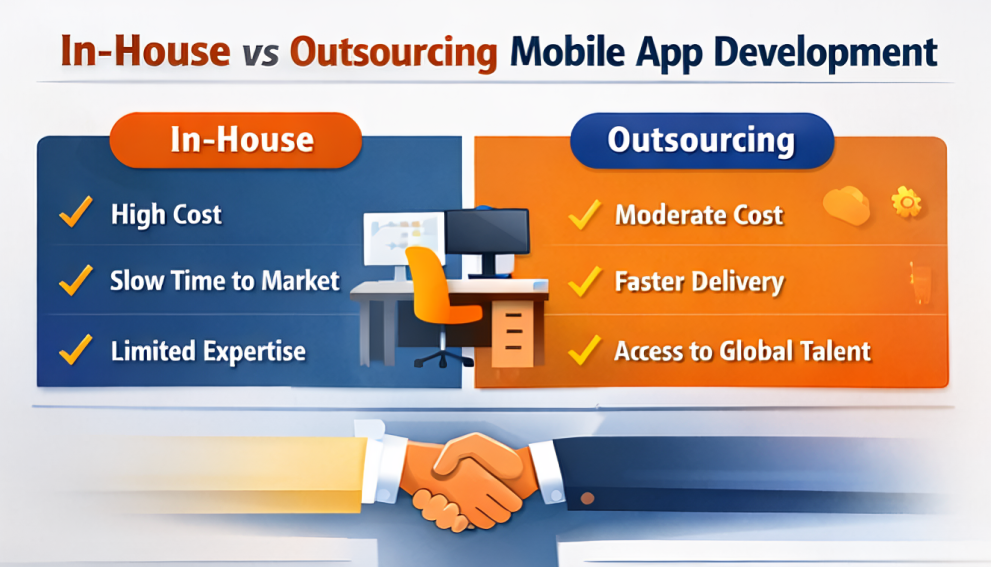
When planning a mobile app, many organizations face a critical decision: Should they build an in-house team or outsource development to a specialized mobile app development company? Each approach has its pros and cons, and understanding them can help businesses make the right strategic choice.
In-House Development
Building an internal team means having employees dedicated solely to your project.
Advantages:
- Full Control: Direct oversight of every aspect of development and design.
- Immediate Communication: Real-time collaboration without time zone or third-party barriers.
- Dedicated Focus: The team works exclusively on your projects, aligning with company culture and goals.
Challenges:
- High Hiring Costs: Recruiting experienced developers, designers, and testers is expensive.
- Infrastructure Expenses: Hardware, software licenses, office space, and other resources add to the budget.
- Talent Acquisition Delays: Finding skilled professionals can take months, delaying project timelines.
- Limited Scalability: Expanding the team for larger projects is slow and costly.
Outsourcing to a Mobile App Development Company
Outsourcing involves partnering with an external company to manage app development.
Advantages:
- Access to Diverse Expertise: Tap into specialized skills in design, AI, cloud, and cross-platform development.
- Faster Time to Market: Experienced teams follow proven processes and can scale quickly.
- Reduced Operational Cost: No need to hire, train, or maintain a full in-house team.
- Scalable Resources: Teams can expand or shrink based on project requirements.
- Exposure to Global Best Practices: Leverage knowledge from working with international clients and industries.
For most organizations, outsourcing provides greater flexibility, faster innovation cycles, and lower risk, especially for startups or projects requiring specialized skills.
Comparative Overview
| Factor | In-House In-House Development | Outsourcing |
|---|---|---|
| Cost | High | Moderate |
| Time to Market | Slower | Faster |
| Scalability | Limited | High |
| Expertise | Depends | Specialized and diverse |
While in-house development works for companies with long-term, ongoing tech needs, outsourcing to a top mobile app development company often reduces risk, accelerates results, and provides access to world-class expertise. This approach allows businesses to focus on strategy and growth while leaving technical execution to experienced professionals.
Future Trends in Mobile App Development
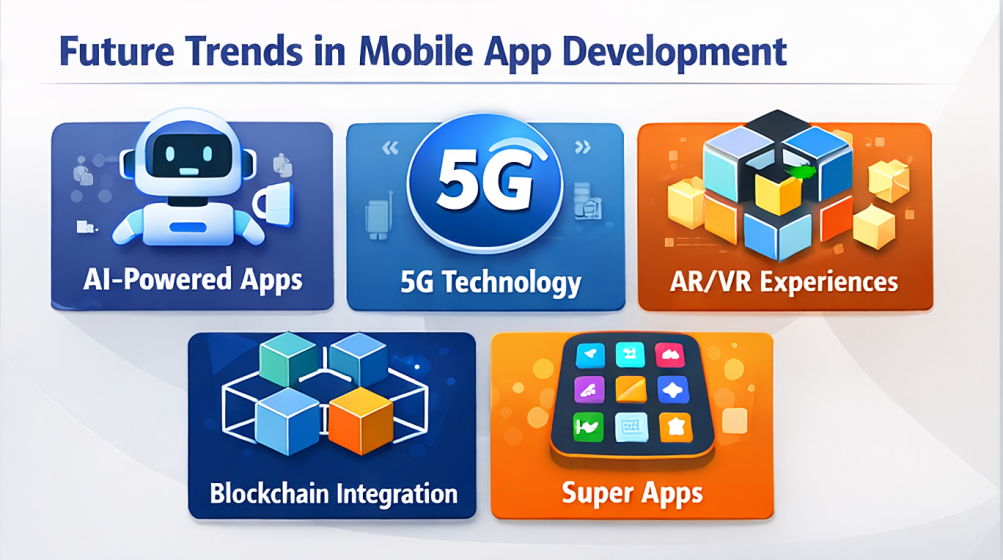
The mobile app landscape is evolving faster than ever. Businesses and developers must stay ahead of emerging trends to deliver innovative, engaging, and future-proof applications. Here are the key trends shaping mobile app development in 2026 and beyond:
AI-Powered Applications
Artificial Intelligence (AI) is transforming how mobile apps interact with users. AI integration is no longer a luxury; it is becoming an expectation for modern apps.
Key capabilities enabled by AI include:
- Smart Chatbots: Offering instant customer support and personalized responses, reducing operational costs.
- Personalized Recommendations: Tailoring content, products, or services based on user behavior and preferences.
- Predictive Analytics: Anticipating user needs, improving retention, and increasing engagement.
- Behavioral Insights: Analyzing patterns to optimize app features, marketing campaigns, and UX.
By embedding AI, apps can deliver smarter, context-aware experiences that drive user satisfaction and business outcomes.
5G-Optimized Applications
The rollout of 5G networks is a game-changer for mobile apps, offering ultra-fast connectivity, low latency, and high bandwidth.
Opportunities unlocked by 5G include:
- Real-Time Gaming: Smooth, lag-free multiplayer experiences with richer graphics.
- High-Definition Streaming: Seamless video streaming without buffering, even in mobile environments.
- Augmented Reality (AR) Features: More responsive and immersive AR applications in retail, education, and healthcare.
- IoT Connectivity: Faster and more reliable connections for smart devices and wearable integrations.
Apps optimized for 5G will provide faster performance and enable innovative experiences that were previously impossible on slower networks.
(AR) & Virtual Reality (VR)
AR and VR are reshaping how users engage with mobile apps, particularly in industries such as retail, education, gaming, and real estate.
Use cases include:
- Retail: Virtual try-ons and interactive product demos to improve purchase confidence.
- Education: Immersive learning environments for better engagement and retention.
- Gaming: Realistic, interactive gaming experiences that blur the line between physical and digital worlds.
Integrating AR/VR enhances engagement, drives app adoption, and creates memorable user experiences.
Blockchain Integration
Blockchain is increasingly being adopted in mobile apps for its ability to provide transparency, security, and decentralization.
Applications include:
- Transaction Transparency: Secure and verifiable financial transactions within apps.
- Digital Identity Management: Protecting user identities and personal data with immutable records.
- Decentralized Payments: Enabling peer-to-peer transactions without intermediaries.
Blockchain adoption is particularly relevant for fintech, supply chain, healthcare, and digital marketplaces.
Super Apps
Super apps are single mobile applications that combine multiple services into one ecosystem, improving convenience and engagement.
Key characteristics:
- Integrates messaging, payments, shopping, food delivery, and more.
- Offers a seamless and centralized user experience.
- Drives higher engagement through cross-service interaction.
Companies are increasingly exploring super apps as a strategy to retain users and increase lifetime value, especially in markets with high mobile adoption.
The future of mobile app development will be defined by AI, 5G, AR/VR, blockchain, and super apps. Businesses that embrace these trends early will gain a competitive edge, deliver exceptional user experiences, and remain relevant in an increasingly mobile-first world.
How to Choose the Best Mobile App Development Company
Selecting the right mobile app development partner is a critical decision that can determine the success of your project. The “cheapest option” is rarely the best; instead, you should focus on finding a company that aligns with your vision, technical needs, and long-term growth goals. Here’s a step-by-step framework to guide your decision:
- Define Your Business Objectives Clearly: Before approaching any development company, clarify your goals:
-
- What problem is your app solving?
- Who is your target audience?
- What are your expected KPIs (downloads, engagement, revenue)?
A clear understanding of your objectives ensures that potential partners can propose solutions that are aligned with your business strategy rather than just coding features.
- Evaluate Company Portfolios Thoroughly: A company’s portfolio reveals its experience, technical capabilities, and industry expertise. Look for:
-
- Projects similar to your app in complexity and industry
- Diversity in platforms (iOS, Android, cross-platform)
- Evidence of UI/UX design quality and innovation
Portfolios help you assess whether the company can deliver apps that meet your standards.
- Check Client Testimonials and Case Studies: Client feedback and case studies provide insight into a company’s delivery reliability and collaboration style:
-
- How did they handle project challenges?
- Were timelines and budgets respected?
- Did the delivered app meet client expectations?
Strong testimonials indicate a trustworthy, client-focused partner.
- Assess Technical Stack and Scalability Approach: A top mobile app development company should be transparent about the technologies they use and how they ensure scalability:
-
- Programming languages, frameworks, and tools (React Native, Flutter, Swift, Kotlin, etc.)
- Cloud infrastructure for scalability and performance
- Security and compliance measures (GDPR, HIPAA, PCI DSS)
This ensures that your app is future-ready, secure, and adaptable to growth.
- Understand Pricing Transparency: Avoid hidden costs by asking for a clear pricing structure:
-
- Detailed breakdown of development, testing, and maintenance costs
- Hourly rates or fixed-price models
- Policies for scope changes or additional features
Transparent pricing reduces surprises and fosters trust.
- Discuss Long-Term Support and Maintenance: Mobile apps are never “finished.” Ask potential partners about post-launch support:
-
- Regular updates and OS compatibility fixes
- Performance monitoring and optimization
- Feature enhancements based on user feedback
Long-term support ensures your app remains competitive and reliable.
- Evaluate Communication and Cultural Alignment: Strong communication and cultural fit are often underrated but critical for successful collaboration:
-
- How frequently do they provide updates and demos?
- Are time zones and language barriers managed effectively?
- Do their values align with your business culture?
A company that communicates clearly and aligns culturally is easier to work with and reduces project risks.
The best mobile app development company is not necessarily the cheapest or the largest; it’s the one that:
- Understands your business objectives
- Offers proven technical expertise and design excellence
- Provides transparent pricing and long-term support
- Aligns culturally and communicates effectively
By following this framework, you can select a partner capable of transforming your app idea into a scalable, engaging, and high-performing product that drives real business results.
Also read: How to Choose the Right Android App Development Company for Your Startup
Also read: 7 Powerful Tips to Choose the Right iOS App Development Company for Your Project
Also read: How to Choose a Mobile App Development Company
Final Thoughts
In 2026, mobile applications are no longer optional; they are foundational to business growth, customer engagement, and operational efficiency. Choosing a top mobile app development company is about more than just building an app; it’s about creating a scalable digital product that delivers measurable business results.
The right development partner will help you:
- Align technology with business strategy to ensure every feature supports your goals
- Deliver exceptional user experiences through intuitive design and UX best practices
- Build secure and scalable systems capable of handling growth and high traffic
- Integrate emerging technologies like AI, AR/VR, blockchain, and 5G for a competitive advantage
- Provide long-term optimization and support to keep your app relevant and high-performing
As digital competition intensifies, organizations that invest in professional, future-ready mobile solutions will be the ones that lead their industries.
If your goal is to build a high-performance, intelligent, and scalable mobile application, partnering with an experienced mobile app development company like Webkorps can transform your idea into a powerful, revenue-driving digital asset. Their expertise across iOS, Android, cross-platform frameworks, AI-powered solutions, and enterprise-grade architecture makes them an ideal partner for businesses aiming to thrive in a mobile-first world.
FAQ
How do I choose the best mobile app development company?
To select the right partner, evaluate their portfolio, technical expertise, industry experience, development methodology, and post-launch support. The best company aligns with your business objectives, provides scalable solutions, and communicates effectively throughout the project.
Which is the best mobile app development company?
The “best” mobile app development company depends on your project requirements, budget, and long-term business goals. However, Webkorps stands out as a strong choice for businesses seeking end-to-end mobile app development, AI-powered solutions, and enterprise-grade scalability.
With expertise across iOS, Android, and cross-platform frameworks, along with a strong focus on UX design, Agile methodology, and long-term support, Webkorps delivers high-performance, secure, and growth-oriented mobile applications tailored to modern business needs.
How much does it cost to develop a mobile app?
Mobile app development costs vary based on complexity, features, and platform:
- Basic apps: $15,000 – $30,000
- Moderate apps: $30,000 – $60,000
- Complex or enterprise apps: $60,000 – $300,000+
Factors like UI/UX design, integrations, security, and ongoing maintenance also influence the final cost.
How long does mobile app development take?
Development timelines depend on app complexity and feature set:
- Simple apps: 1 – 3 months
- Moderate apps: 3 – 6 months
- Complex or enterprise apps: 6 – 12+ months
Using Agile methodology and working with experienced teams can help speed up delivery without compromising quality.
Which is better: native or cross-platform development?
- Native apps (iOS or Android) offer better performance, smoother UX, and access to device-specific features.
- Cross-platform apps (Flutter, React Native) reduce development time and cost by allowing a single codebase to run on multiple platforms.
The choice depends on your business goals, budget, and performance requirements.
Do mobile app development companies provide maintenance?
Yes. Leading companies offer long-term maintenance and support, including:
- Performance monitoring and optimization
- Bug fixes and OS updates
- New feature additions
- Security updates and compliance management
Ongoing support ensures your app remains secure, scalable, and competitive over time.
I used to be able to find good info from your blog posts.
A motivating discussion is worth comment. There’s no doubt that that
you need to write more about this subject matter,
it may not be a taboo matter but generally folks don’t discuss these issues.
To the next! Many thanks!!
I’ve been surfing on-line more than 3 hours as of
late, yet I by no means found any interesting article like yours.
It is pretty worth sufficient for me. Personally, if all website owners and bloggers made excellent content material
as you probably did, the net might be much more useful than ever before.
Hi there, I check your new stuff on a regular basis.
Your humoristic style is awesome, keep doing what you’re doing!
When someone writes an post he/she keeps the plan of a user in his/her mind that
how a user can understand it. Therefore that’s why this post is
outstdanding. Thanks!
Hi there outstanding blog! Does running a blog such as this
require a massive amount work? I have very
little understanding of computer programming but I was hoping to start my
own blog in the near future. Anyway, should you have
any recommendations or tips for new blog owners please share.
I know this is off topic however I simply wanted to ask.
Thanks a lot!
Amazing! This blog looks exactly like my old one!
It’s on a entirely different topic but it has pretty much the same page layout and design.
Great choice of colors!
Pretty section of content. I just stumbled upon your
site and in accession capital to assert that I acquire actually
enjoyed account your blog posts. Any way I will be subscribing to your feeds and even I
achievement you access consistently quickly.
Do you mind if I quote a couple of your posts as long as I provide credit and sources back to your blog?
My blog is in the very same niche as yours and my visitors would certainly
benefit from a lot of the information you present here.
Please let me know if this alright with you. Thank you!
I do agree with all of the ideas you’ve offered on your post.
They are really convincing and can certainly work. Still, the posts
are too brief for newbies. May just you please lengthen them a little from next time?
Thank you for the post.