
 Posted by
 A port in Rotterdam has just announced a 48-hour closure. Your logistics team has 200 affected shipments, 40 carriers rebooking, and a TMS flooding with alerts. Three people are on the phone simultaneously. Six hours later, you’ve rerouted most shipments, but the damage is done: two missed delivery windows, one contract penalty, and a customer escalation.
Now ask a different question: what if the system had already rerouted, rebooked, and notified affected customers before your team saw the first alert?
This isn’t a hypothetical. It’s happening in logistics networks that have deployed agentic AI in logistics, and the gap between those organisations and everyone else is growing wider every quarter.
62% of supply chain leaders say AI agents embedded in operational workflows accelerate decision-making speed and improve response quality (IBM, 2025). But most organisations are still using AI that recommends. The shift that matters, the one that changes competitive position permanently, is moving from AI that tells you what to do to AI that does it.
In this guide, we break down exactly what agentic AI is, how it differs from every other AI technology already in your stack, the six logistics use cases delivering the clearest ROI in production deployments right now, a phased implementation roadmap with milestone-level returns, and the governance model that makes autonomous deployment safe.
Table of Contents
What Is Agentic AI, and How Is It Different From Every Other AI You’ve Already Tried?
Agentic AI refers to AI systems that independently perceive operational signals, reason across multiple data sources, and execute multi-step decisions, without requiring human approval at each step. It is not a chatbot, not a dashboard. It is not predictive analytics with a better interface. It is a fundamentally different class of technology, one that shifts AI from an advisory function to an operational one.
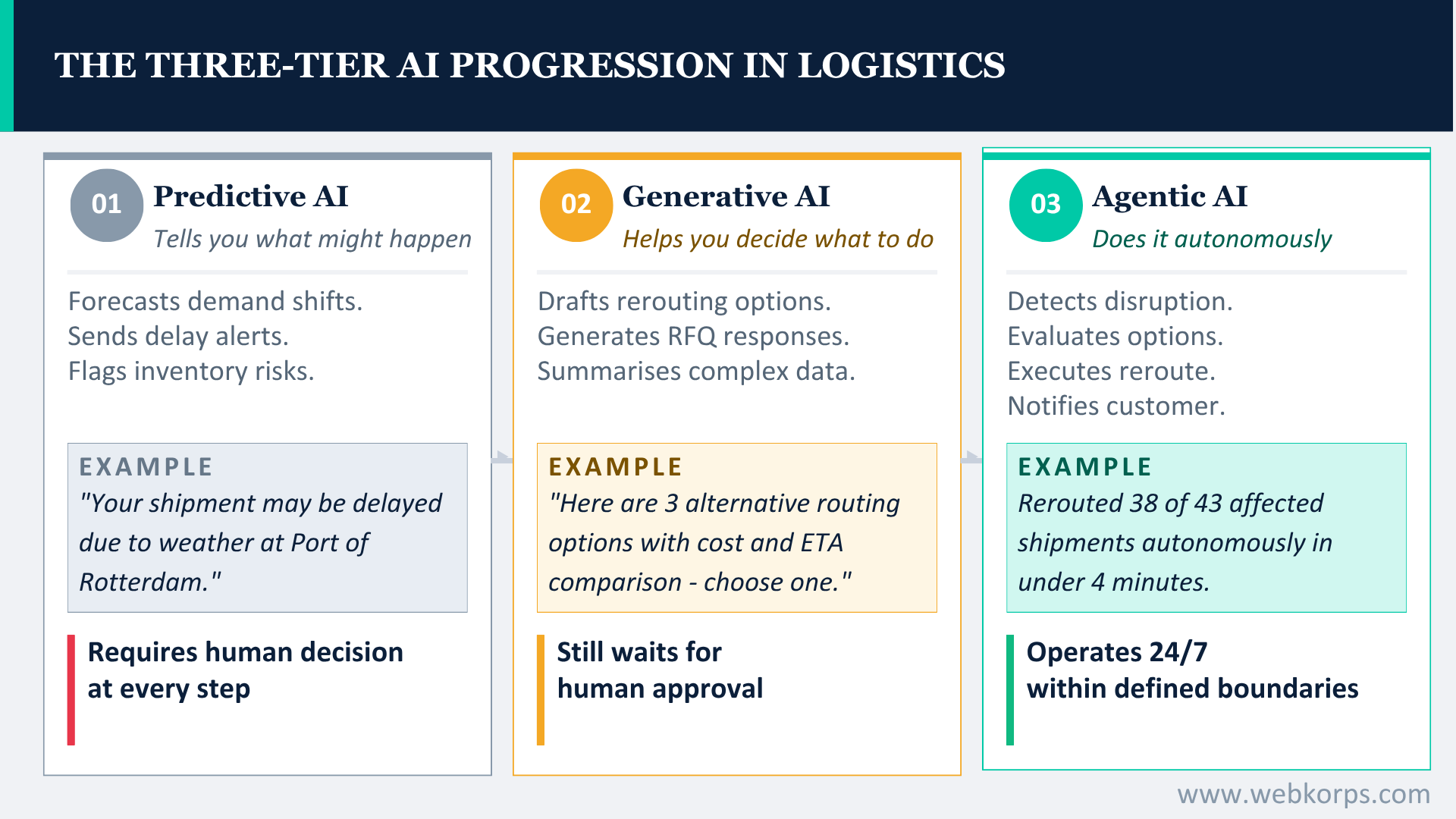
The clearest way to understand it is through the three-tier progression that every logistics technology investment has followed:
AI in Logistics: The Three-Tier Progression
| Capability | Predictive AI | Generative AI | Agentic AI |
|---|---|---|---|
| What it does | Forecasts & alerts | Recommends options | Decides & executes |
| Human approval needed | Every decision | Every decision | Only above thresholds |
| Operates across systems | Single system | Single system | Multi-system |
| Learns from outcomes | Static models | Limited | Continuous |
| Response speed | Minutes-hours | Minutes-hours | Seconds |
| Best suited for | Forecasting & monitoring | Analysis & drafting | End-to-end operations |
The multi-agent architecture, how it actually works
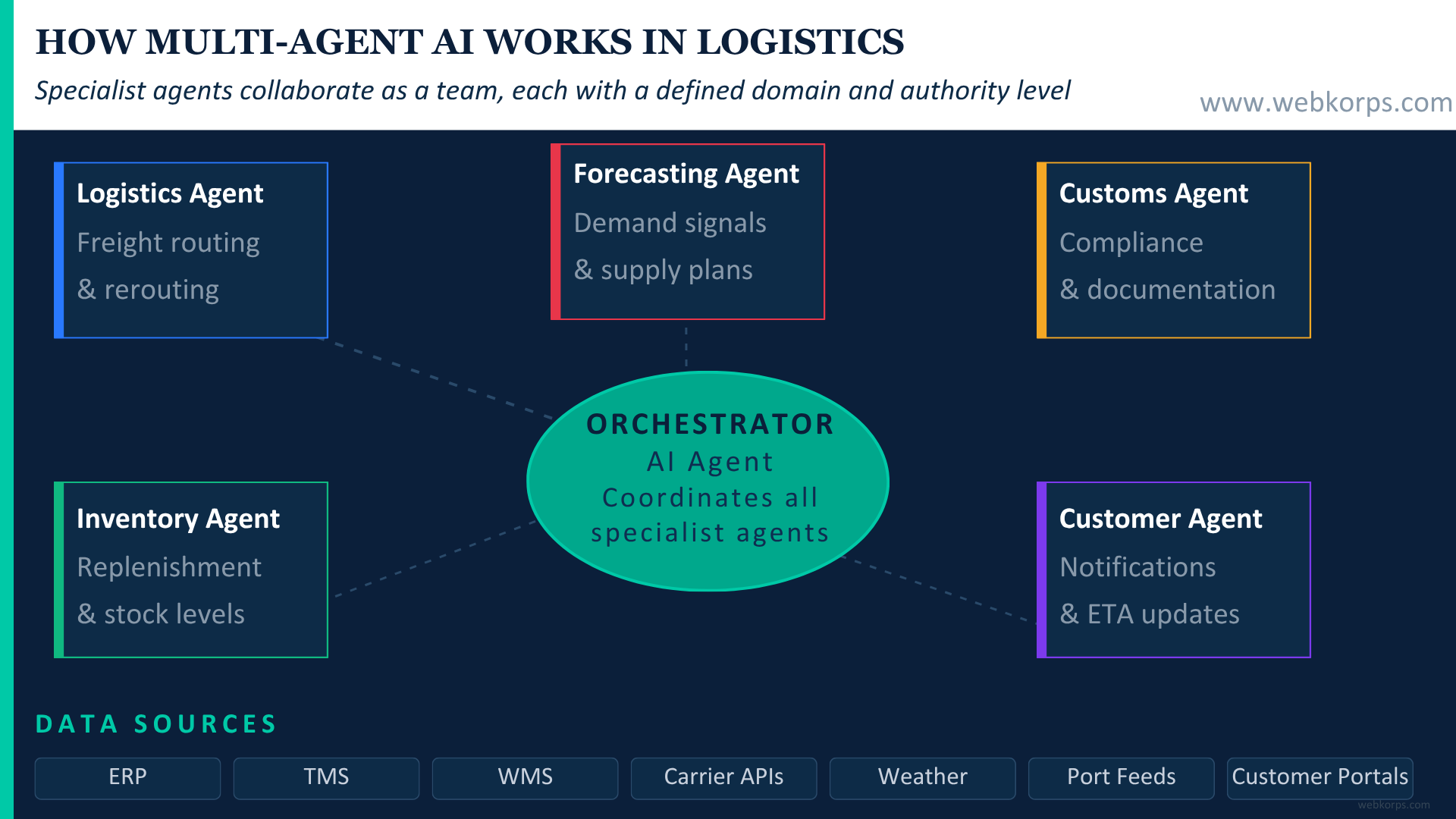
Agentic AI deployments in logistics don’t operate as a single AI. They operate as a team of specialist agents, each with a defined domain and authority level, that collaborate to solve complex operational problems.
Think of it as the difference between having one generalist employee who handles everything slowly versus a fully staffed operations centre: a Logistics Agent handling shipment exceptions, an Inventory Agent managing replenishment, a Customs Agent monitoring compliance, and a Customer Experience Agent managing communications, all working together, 24/7, at zero marginal cost per decision. The same multi-agent framework is increasingly being adopted in manufacturing environments, where agentic AI for factory automation enables autonomous coordination of production scheduling, quality control, maintenance planning, and operational decision-making across factory systems.
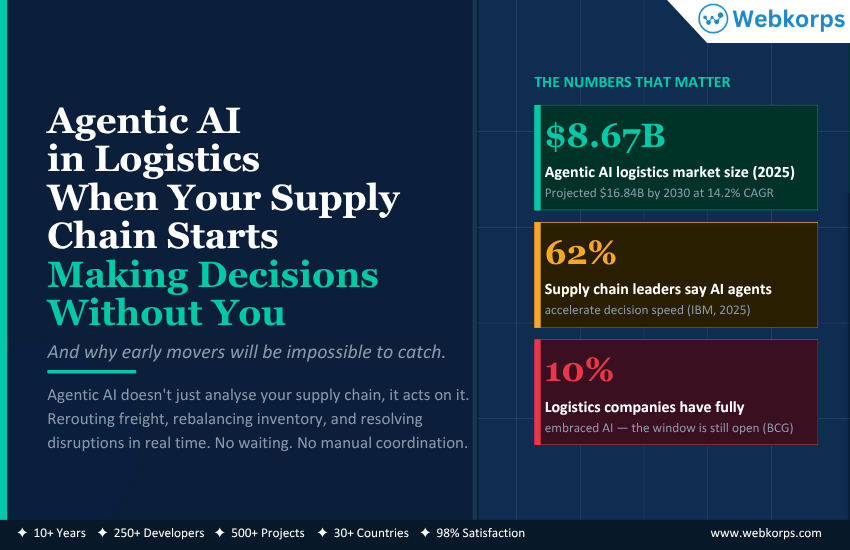
The market reflects this shift: the agentic AI segment specific to supply chain and logistics is estimated at $8.67B in 2025, projected to reach $16.84B by 2030 at a 14.2% CAGR (ICRON, 2025). This is not an experimental R&D budget. This is infrastructure investment.
Bounded autonomy – the governance model that makes deployment safe
Bounded autonomy is the answer, and it’s the governance architecture that separates production-grade agentic AI from risky experimentation. It works as follows:
- Below the threshold: the agent executes automatically. Routine rerouting, standard replenishment orders, and carrier selection within the preferred network; these decisions happen in seconds without human involvement.
- Above the threshold: the agent escalates with a recommendation, the reasoning behind it, and the relevant data. A human makes the final call. The agent doesn’t wait for permission to think, only to act on decisions that exceed its defined authority.
- Full audit trail: every decision, executed or escalated, is logged with complete reasoning, data inputs, and outcomes. Every outcome feeds back into the model, improving future decision quality automatically.
Why Traditional Logistics Operations Can’t Keep Pace, and What It’s Costing You Right Now
Modern supply chains generate millions of data signals per day, port status updates, carrier delay alerts, weather events, demand spikes, customs holds, inventory shortfalls, and geopolitical disruptions. Human operations teams can process a fraction of these signals at the speed they require. The gap between data generation speed and human decision speed is where losses accumulate.
The numbers are specific. Supply chain disruptions can reduce company revenue by up to 20% in extreme cases (World Economic Forum), and disruptions are no longer episodic events. They are the default operating condition of 2025. Red Sea rerouting, Panama Canal constraints, US-China tariff volatility, port labour actions, every quarter brings a new disruption that requires the same slow, expensive, human-coordinated response.
Visibility compounds the problem. Companies with low supply chain visibility experience 30% higher inventory costs compared to digitally advanced peers (MIT Research), carrying excess stock as a buffer against the uncertainty that better data would eliminate.
The human-speed bottleneck is the root cause. A routing decision that flows through three system handoffs and two human approvals takes hours. During those hours, alternative capacity closes, customer commitments are missed, and emergency freight spend accumulates. Agentic AI compresses this to seconds, within defined governance limits. That latency compression is where the largest source of operational cost reduction lives.
The competitive urgency is real: organisations with higher AI investment in supply chain operations report revenue growth 61% greater than peers (IBM). With only 10% of logistics companies fully embracing AI (BCG), early movers are building a structural advantage that compounds over time. The window to move first is narrowing, but it is still open.
| THE 2026 INFLECTION POINT |
| More than 40% of organisations surveyed are not actively exploring agentic AI, choosing instead to stabilise existing AI foundations first (Supply & Demand Chain Executive). Nearly a quarter of the plan pilots within 12 months. The organisations that move in 2025 will be a year ahead of competitors who start in 2026. In logistics, a year of compounding operational advantage is significant. |
6 Agentic AI Use Cases Delivering Measurable ROI in Logistics Right Now
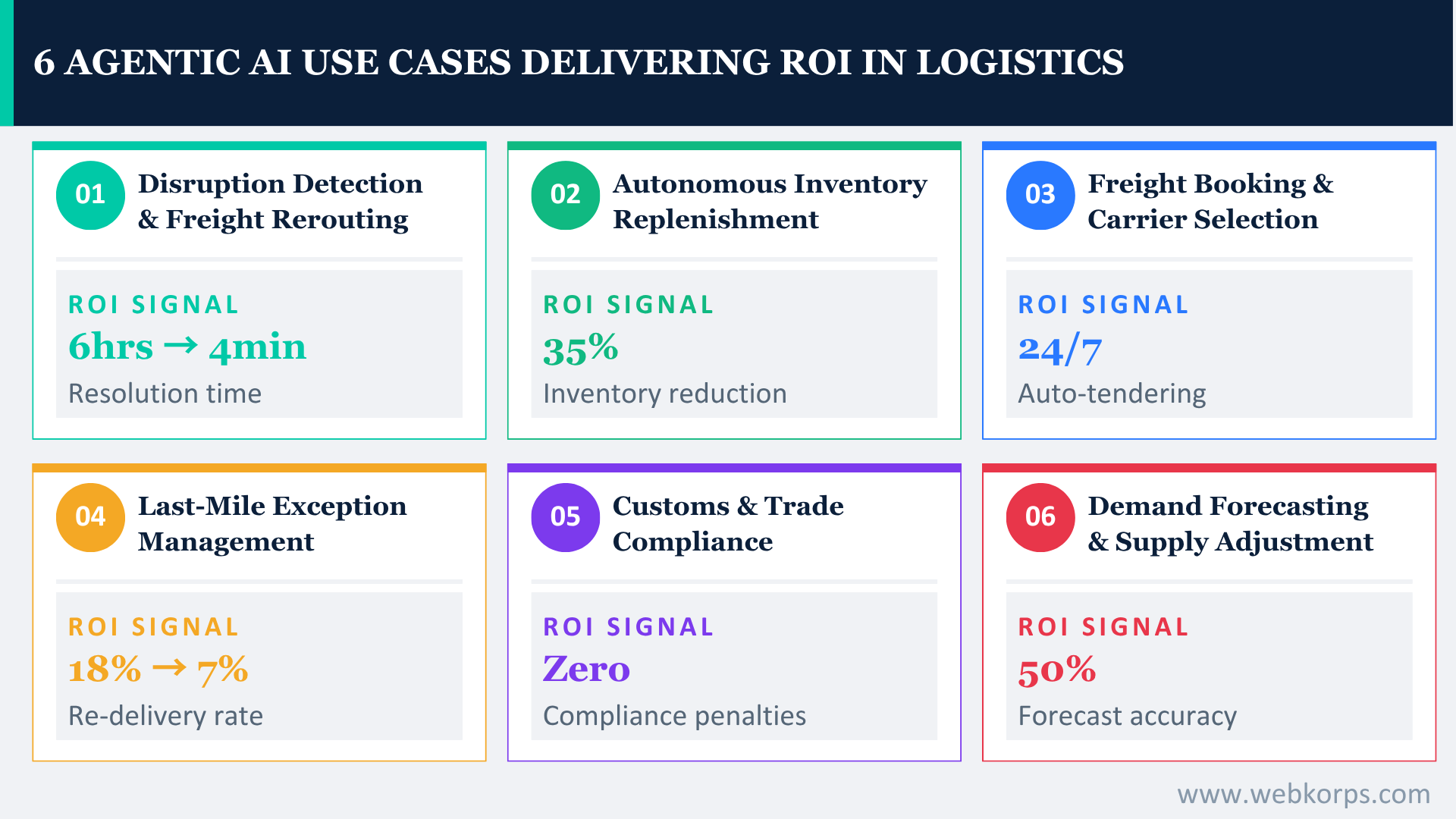
USE CASE 1: Real-time disruption detection and autonomous freight rerouting
An agent continuously monitors port telemetry, carrier API feeds, weather data, geopolitical alerts, and traffic patterns. When a disruption is detected, a port closure, a vessel delay, or a carrier capacity withdrawal, it instantly evaluates alternative routing options, compares costs, checks carrier availability, verifies customer contract terms, and executes the optimal reroute for shipments within its authority threshold. Shipments above the threshold are escalated with a complete recommendation package. The difference from current operations: the decision happens in seconds, before the disruption cascades into missed delivery commitments, emergency freight spend, and customer escalations that take days to resolve.
ROI SIGNAL: Eliminates the 4-6 hour human coordination cycle following disruption events. Reduces emergency freight spend and customer penalty exposure.
Real-world result: response time from disruption detection to rerouting execution dropped from 6 hours to under 4 minutes in documented deployments.
USE CASE 2: Autonomous inventory replenishment and supplier management
An agent monitors inventory levels in real time against rolling sales forecasts, seasonality signals, supplier lead times, and safety stock policies. When replenishment thresholds are crossed, it selects the optimal supplier from a pre-qualified pool, generates and transmits the purchase order, monitors order confirmation, and updates inventory projections, without waiting for the weekly planning cycle. For multi-SKU, multi-location operations, this means continuous optimisation across thousands of inventory decisions simultaneously, a task that human planning teams can only approximate through batch processes.
ROI SIGNAL: AI-powered inventory optimisation reduces inventory levels by 35% and boosts service levels by 65% (Microsoft). Eliminates both stockout risk and excess inventory carrying costs. Direct impact on working capital efficiency.
USE CASE 3: Intelligent freight booking and carrier selection
An agent evaluates carrier performance history, current capacity availability, rate structures, delivery commitments, and compliance requirements in real time, then books the optimal carrier without manual tendering. For load consolidation opportunities, it identifies them and executes the consolidation automatically. For carrier performance monitoring, it tracks commitments against actuals and adjusts future booking preferences based on outcomes. This shifts freight procurement from a reactive, relationship-dependent process to a data-driven, continuously optimising one, without removing the ability for operations leaders to override or adjust carrier preferences at any time.
ROI SIGNAL: Eliminates manual tender-and-response cycles that consume dispatcher time. Improves carrier performance through data-driven selection and continuous feedback. Reduces procurement cost through better load consolidation and rate optimisation.
USE CASE 4: Last-mile exception management
An agent monitors final-mile delivery events in real time. When a failed delivery attempt occurs, customer not home, incorrect address, access restriction, it immediately evaluates resolution options: reschedule, redirect to a nearby parcel locker, reassign to an alternate carrier, or escalate to a human dispatcher for complex cases. Customer communications are triggered automatically at each decision point. For high-volume last-mile networks, this eliminates the backlog of exceptions that dispatchers currently process manually, often the following morning, after the re-delivery opportunity window has closed.
ROI SIGNAL: Logistics AI routing agents improve delivery efficiency by 10–15% (SQ Magazine). Failed-attempt re-delivery rate documented reduction from 18% to 7% in 90 days in comparable deployments. Direct impact on cost-per-delivery and customer satisfaction scores.
USE CASE 5: Customs and trade compliance automation
An agent monitors tariff rule changes across relevant trade jurisdictions continuously. For every shipment, it validates documentation against current compliance requirements, identifies gaps before goods move, generates required customs documentation, and flags anomalies for human review. In the current environment, with US-China tariffs shifting, reciprocal tariff structures under legal challenge, and EU customs digitisation mandates accelerating, customs compliance AI is no longer a process efficiency tool. It is a financial risk management function. A single misclassification or documentation gap on a high-value shipment can generate penalties that dwarf the annual cost of the system managing compliance.
ROI SIGNAL: Eliminates border holds, duty miscalculations, and compliance penalties. Especially high-value in the current tariff volatility environment, where manual compliance tracking cannot keep pace with rule changes. Free trade compliance specialists to focus on strategic cases rather than routine documentation.
USE CASE 6: Demand forecasting with autonomous supply plan adjustment
An agent continuously ingests IoT sensor data, social signals, search trend data, weather patterns, promotional calendars, and historical demand to generate rolling 14-28 day forecasts. When forecast signals shift, it automatically adjusts supply plans, triggers procurement actions, updates production schedules, and books carrier capacity, without waiting for the weekly planning cycle that allows demand signals to age before action is taken. For perishable goods, seasonal products, and promotional inventory, this continuous adjustment eliminates the forecast-to-action latency that drives both stockout events and over-supply write-offs.
ROI SIGNAL: AI-driven supply chain solutions improve forecast accuracy by up to 50% (Gartner). AI-enabled automation reduces logistics costs by nearly 15% (Stanford). Stockout events reduced by 60% in the first quarter post-deployment in comparable implementations.
How to Implement Agentic AI in Logistics – A Phased Roadmap That Doesn’t Require Betting Your Operations on a Single Deployment
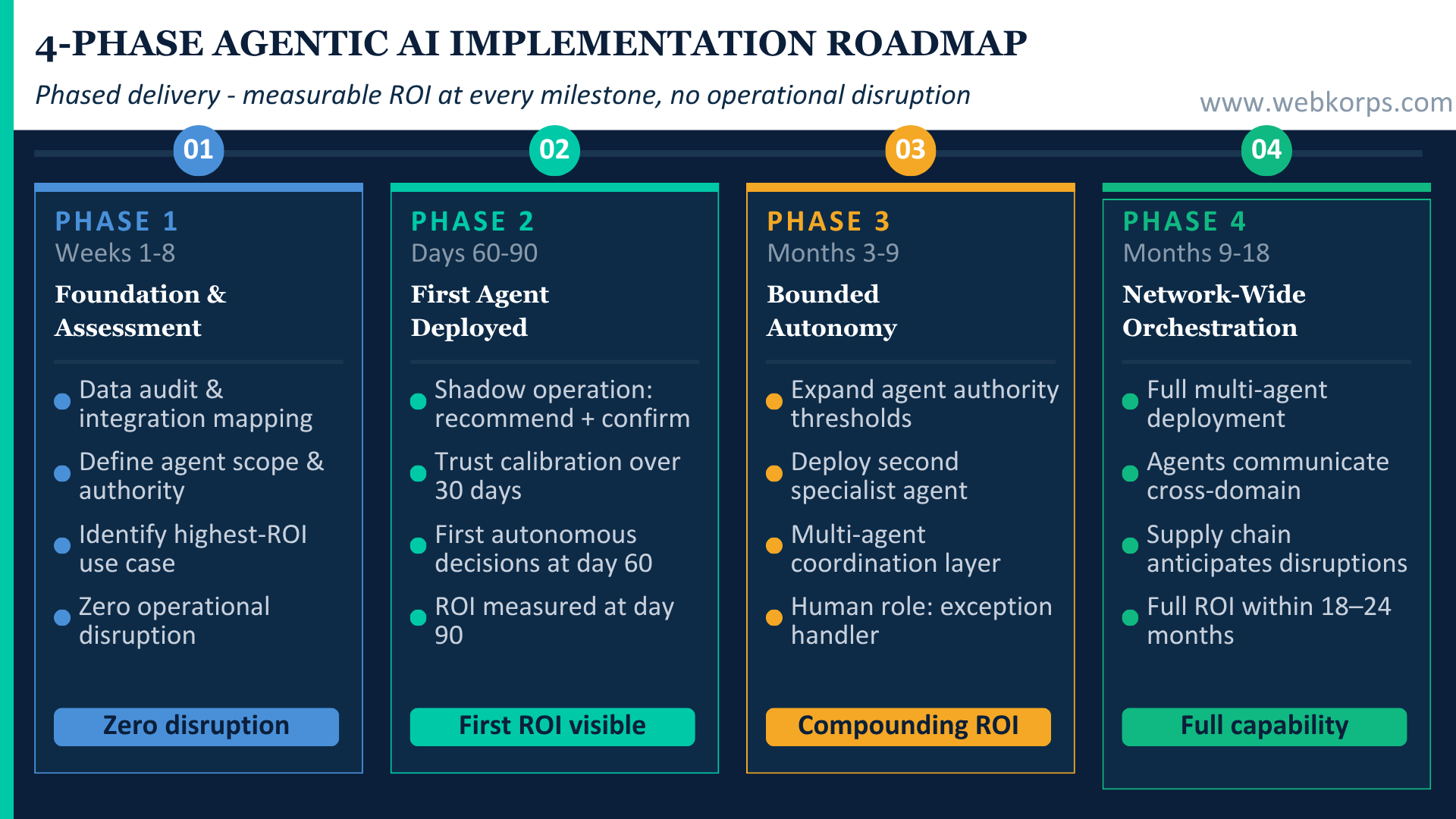
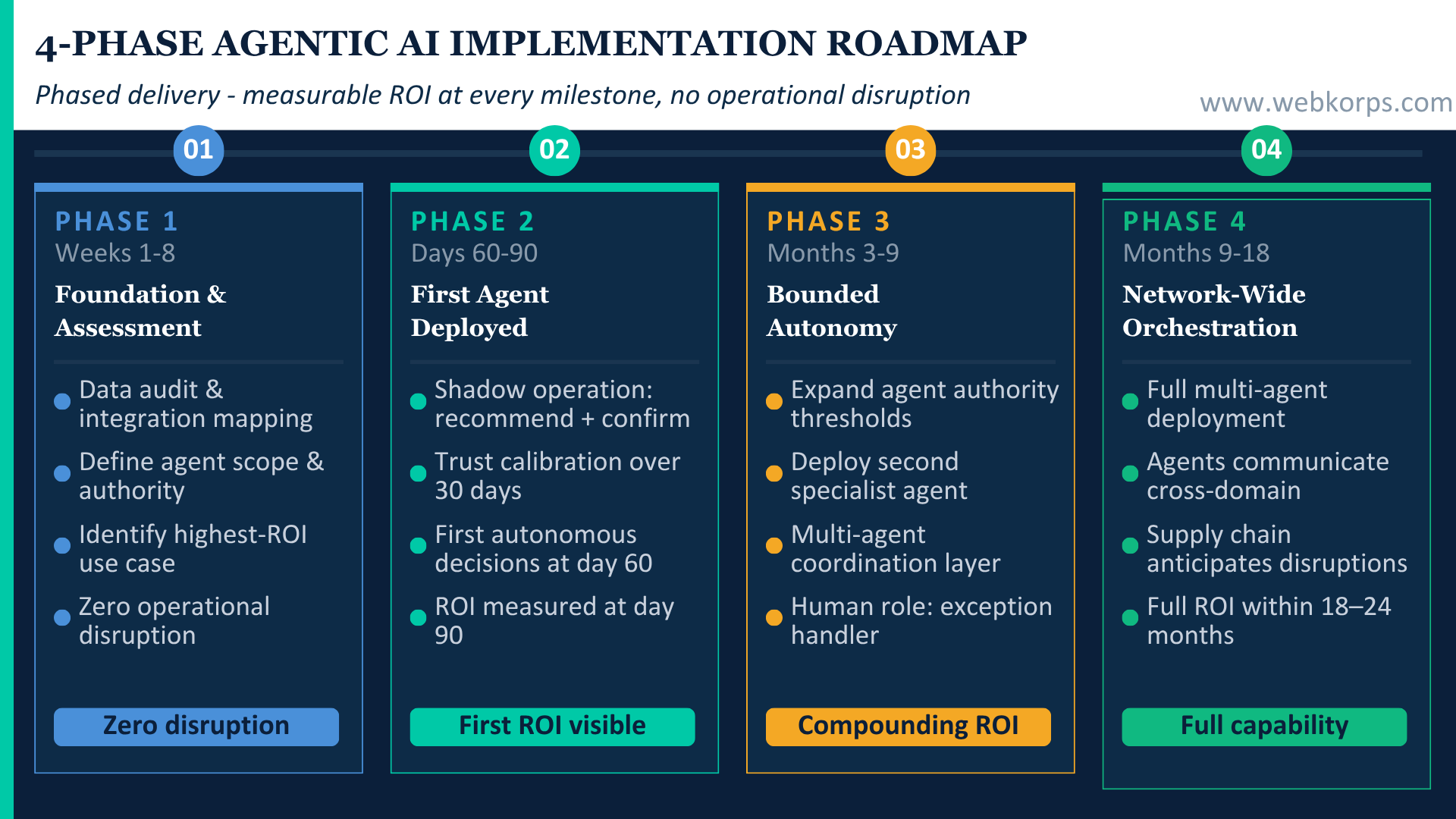
The phased approach delivers ROI at every milestone and builds the data, integration, and governance foundation that makes each subsequent phase faster and lower-risk. Industry research confirms the pattern: organisations most likely to succeed target specific use cases where data is strongest, and impact is easiest to measure first, with first-and-final-mile route scheduling and exception management consistently emerging as the highest-confidence entry points (Supply & Demand Chain Executive).
Foundation: Data audit, integration mapping, and use case prioritisation
Before a single agent is deployed, the foundation must be solid. Phase 1 maps your existing ERP, TMS, and WMS data quality and accessibility. It identifies the highest-friction decision workflows, where human coordination latency creates the most measurable cost. It defines the first agent’s scope, authority boundaries, and escalation triggers. And it establishes the data pipelines that will feed the agent’s decision-making. No operational changes. No system modifications. No disruption to clinical operations.
Deliverable: a prioritised deployment plan with projected ROI at each milestone.
First agent: “Recommend and confirm” mode before bounded autonomy
Deploy one focused agent on the highest-impact, lowest-risk use case identified in Phase 1, typically exception monitoring or carrier performance tracking. The agent operates initially in “recommend and confirm” mode: it surfaces decisions with full reasoning, but a human approves each one. This phase is not about automation. It is about trust calibration, giving operations teams visibility into the agent’s decision logic before authority thresholds are set. After 30 days of shadow operation, authority thresholds are calibrated based on observed decision quality. By day 90, the agent is executing routine decisions autonomously. First ROI measurement at day 90: decisions per hour, human time freed, exception resolution speed.
Bounded autonomy: Expanding agent authority as trust accumulates
The agent’s authority expands incrementally as decision quality data accumulates. A second agent is deployed for an adjacent use case. The multi-agent coordination layer is built, enabling AI Agents to hand off context between domains and work together across different operational workflows. Each agent’s decision log is reviewed monthly to identify authority expansion opportunities and cases that should remain human-reviewed. Human roles shift during this phase: dispatchers and planners transition from making routine decisions to managing exceptions, reviewing agent performance, and handling the complex judgment calls that benefit from human relationship knowledge and contextual understanding that agents don’t yet have.
Network-wide orchestration: Multi-agent deployment across all core logistics workflows
Full multi-agent deployment across freight management, inventory, customs compliance, and last-mile. Agents communicate and hand off decisions between domains. The inventory agent’s replenishment signal triggers the freight booking agent’s carrier selection, which triggers the customs agent’s documentation preparation, which triggers the customer experience agent’s delivery ETA notification. The supply chain doesn’t just respond to events. It anticipates and prepares for them. Human roles at full deployment: strategic orchestrators who set policy boundaries, manage carrier and supplier relationships, handle regulatory and customer escalations, and continuously refine the governance framework as operations scale. BCG data confirms: logistics firms adopting AI typically achieve full ROI within 18–24 months. The phased approach front-loads the return curve.
The Three Concerns Every Logistics COO Raises
Every serious evaluation of agentic AI surfaces the same objections. Most content on this topic pretends they don’t exist. We’d rather address them directly, because the answers are the reason production deployments succeed.
OBJECTION: “What if it makes the wrong decision?”
This is the right question, and it’s why bounded autonomy is not an optional feature. It is the deployment architecture. Agents execute within defined thresholds only. Every decision is logged with full reasoning and data inputs. Humans review and approve at escalation points. Critically, the system improves with every decision, including flagged ones. The governance model doesn’t constrain the system. It is the system.
REFRAME: The question to ask instead: what is the error rate of your current human decision-making at 2 am when a port closure alert comes through? Agentic AI with bounded autonomy makes faster decisions with more data and logs every reasoning step. Human decisions are slower, based on less data, and largely unauditable.
OBJECTION: “Our data is too fragmented for agents to work reliably.”
Data fragmentation is the most frequently cited barrier to adoption, and it’s exactly what Phase 1 exists to address. Agents don’t require perfect data across all systems. They require connected data in the domain of the first deployment. Phase 1 maps integration priorities and identifies where data quality is already sufficient to support the first agent. The integration layer built for Phase 2 becomes the foundation that progressively connects additional data sources as each phase expands.
REFRAME: The organisations that start with a Phase 1 data audit consistently discover that they have more high-quality, connected data than they assumed. The fragmentation problem is almost always a connection problem, not a data quality problem.
OBJECTION: “40% of AI projects fail. Why would this be different?”
Projects fail when the scope is undefined, and ROI is diffuse across an 18-month single-deliverable programme. The phased approach counters this structurally: Phase 2 has a specific ROI target at day 90. If it doesn’t hit the target, the deployment pauses, and the Phase 1 assessment is revisited before additional investment is committed. The financial risk is bound to the Phase 2 investment, not the entire transformation. Each subsequent phase requires the previous phase to have demonstrated measurable returns before expansion is approved.
REFRAME: The 40% failure rate reflects projects that were scoped as enterprise transformations from day one. The phased model funds and validates each stage independently. Failure at Phase 2 is a learning, not a sunk cost.
What Agentic AI Looks Like in Production: Three Logistics Scenarios
The organisations deploying agentic AI come from different starting points, different network scales, and different operational priorities. Here’s what the journey looks like across three archetypes that cover most of the logistics industry’s decision-maker landscape.
ENTERPRISE FREIGHT FORWARDER
Global network, 200+ active shipments, 40+ countries
A global freight forwarder managing 200+ active shipments across 40 countries deployed a logistics agent integrated with its TMS, ERP, carrier APIs, and port authority data feeds. When a Red Sea rerouting event occurred, the agent identified 43 affected shipments, evaluated three alternative routing options for each, and executed the lowest-cost compliant reroute for 38 of them within the defined authority threshold, escalating 5 for human review due to customer-specific contract clauses that required account manager judgment. No dispatcher made a routing call. No carrier was called to check availability manually. No customer was left waiting for an update.
RESULT: Resolution time dropped from 6 hours to under 4 minutes. Two contract penalties avoided. Customer communications were sent proactively before any shipper enquiry was received. The dispatcher team redeployed from reactive rerouting to proactive network monitoring for the duration of the event.
REGIONAL 3PL PROVIDER
Last-mile network, 8,000+ daily delivery attempts, 12 cities
A regional third-party logistics provider running last-mile operations across 12 cities deployed an exception management agent across its delivery network. The agent monitored every delivery attempt in real time. Failed attempts triggered automatic evaluation of four resolution options: reschedule for the next available slot, redirect to the nearest parcel locker, assign to an alternate carrier, or escalate to a dispatcher for complex cases (apartment access codes, delivery instructions conflicts, customer-specific requirements). Customer communications were sent automatically at each decision point. Dispatcher workload shifted from processing the exception backlog each morning to managing the 8–12% of cases the agent escalated as genuinely requiring human judgment.
RESULT: Failed-attempt re-delivery rate reduced from 18% to 7% within 90 days of deployment. Customer complaint tickets fell 34%. Dispatcher capacity is freed for customer relationship management and carrier performance oversight rather than mechanical exception processing.
E-COMMERCE LOGISTICS PLATFORM
Digital-native, high-SKU, demand-volatile
A digital-native e-commerce logistics platform with a high SKU count and significant demand volatility deployed a demand forecasting and autonomous supply adjustment agent. The agent ingested 22 data streams, including social sentiment signals, search trend data from relevant categories, weather patterns, promotional calendars, competitor pricing signals, and historical demand data. Rolling 14-day forecasts were generated continuously, not weekly. When forecast signals shifted, the agent automatically adjusted replenishment orders, updated production schedule inputs, and booked carrier capacity ahead of the demand spike, before the spike was visible in sales data.
RESULT: Forecast accuracy reached 91% against a previous 73% baseline. Stockout events reduced by 60% in the first quarter post-deployment. Excess inventory write-offs reduced by 28%. Planning team redeployed from weekly data reconciliation to strategic supplier relationship management and promotional planning.
What to Look for in an Agentic AI Development Partner for Logistics
Choosing the wrong partner for agentic AI deployment doesn’t just produce a failed project. It produces a failed project that has touched your production TMS, your carrier relationships, and your customer-facing systems, at a cost in time, money, and operational credibility that is difficult to recover.
These are the evaluation criteria that distinguish a genuinely capable agentic AI partner from one that has rebranded an existing automation offering:
- Logistics domain depth: ask for references specifically in TMS, WMS, and carrier API integration contexts. A generic enterprise AI experience does not transfer directly to logistics operational environments. The partner should understand freight booking logic, customs compliance workflows, and last-mile exception handling, not just AI architecture.
- Integration capability: agentic AI is worthless if it cannot connect to your existing systems. Evaluate the partner’s integration portfolio for ERP (SAP, Oracle, Microsoft), TMS (Oracle TMS, SAP TM, MercuryGate, Shipwell), WMS (Manhattan, Blue Yonder, Infor), and carrier API connectivity before evaluating their AI capability.
- Governance-first architecture: Any partner proposing a fully autonomous deployment without a bounded autonomy model and explicit authority threshold framework is presenting an unacceptably risky deployment model. Bounded autonomy is not optional; it is the production architecture. A partner who doesn’t lead with it hasn’t deployed agents in production logistics environments.
- Phased delivery model: look for milestone-based delivery with a specific, measurable ROI target at Phase 2. A partner proposing a 12–18 month programme with a single delivery point before any measurable return is misaligning incentives and ignoring the most consistent failure mode in enterprise AI programmes.
- Post-deployment optimisation: agent performance improves over time as decision data accumulates. A partner who treats delivery as the engagement endpoint is leaving the majority of the long-term value on the table. Clarify what post-deployment monitoring, authority expansion, and continuous improvement look like before signing
At Webkorps, our AI and ML team has deployed custom logistics intelligence systems for clients across 30+ countries, from regional 3PLs modernising last-mile operations to global freight forwarders building network-wide disruption response capabilities. Our 250+ developers include specialists in logistics domain architecture, ERP and TMS integration, and agentic AI governance frameworks designed for production operational environments.
The Supply Chain of 2027 Is Being Built in 2025, The Question Is Whether You’re Building It
Return to the opening scenario: a port closure in Rotterdam, 200 affected shipments, a six-hour coordination scramble. The organisations that resolved it in four minutes weren’t smarter, better-staffed, or more experienced. They had a different system architecture. One that acts on operational signals at the speed they arrive, not at the speed of human coordination.
The competitive window is real but not permanent. Only 10% of logistics companies have fully embraced AI (BCG). The 90% who haven’t are creating a gap that early movers are turning into a structural advantage, in cost per shipment, in service reliability, in carrier relationships, and in the data flywheel that makes each subsequent AI deployment faster and more accurate than the last.
The risk of inaction is no longer theoretical. Red Sea rerouting, US-China tariff volatility, port labour actions, last-mile cost inflation, every disruption that requires a human coordination cycle is a disruption that an agentic system would have resolved before your team’s first call. The question is not whether to deploy agentic AI in logistics. It is whether you move now, while the competitive window is still open, or later, when catching up costs twice as much.
| Ready to See What Agentic AI Can Do for Your Supply Chain? |
| Book a free agentic AI readiness assessment. We map your TMS, ERP, and data infrastructure, identify your highest-ROI first deployment use case, and deliver a phased roadmap with milestone-level ROI projections, no commitment required. |
| Book a Free Assessment |
Also Read:
Why Agentic AI Makes Current Software Services Obsolete in 2026
Off the Shelf vs Custom Software for TMS: Which Is Right for Your Logistics Business in 2026?
How AI Is Transforming Logistics Operations in 2026
Top Challenges in Logistics Management and How Technology Solves Them in 2026
FAQ’s
What is agentic AI in logistics?
Agentic AI in logistics refers to AI systems that independently perceive operational signals, port delays, inventory shortfalls, and carrier disruptions and execute multi-step decisions without requiring human approval at each step. Unlike predictive AI (which forecasts) or generative AI (which recommends), agentic AI acts: rerouting freight, triggering replenishment orders, and managing customs compliance autonomously, within defined governance boundaries.
How is agentic AI different from traditional supply chain automation?
Traditional automation follows fixed rules and breaks when conditions deviate. Agentic AI reasons across variable conditions, querying live data from ERP, TMS, WMS, and carrier APIs simultaneously, and executes complete multi-step decisions. It adapts to new situations rather than routing every exception to a human. The result: decisions that previously took hours of human coordination are executed in seconds.
What are the highest-ROI agentic AI use cases for logistics companies?
The six use cases delivering the clearest measurable ROI in production deployments are:
- Real-time disruption detection and freight rerouting
- Autonomous inventory replenishment
- Intelligent carrier selection and booking
- Last-mile exception management
- Customs and trade compliance automation
- Demand forecasting with autonomous supply plan adjustment.
Disruption response and last-mile exceptions consistently deliver the fastest payback.
Is agentic AI safe to deploy in logistics operations? What if it makes the wrong decision?
Production agentic AI uses a bounded autonomy model: agents execute decisions automatically only within pre-defined authority thresholds. Decisions above the threshold are escalated with a full recommendation and reasoning log for human review. Every decision, executed or escalated, is fully auditable. The governance model is not an optional feature; it is the deployment architecture that makes production use safe.
How long does it take to implement agentic AI in a logistics operation?
A phased implementation for a mid-size logistics operation typically runs 14–18 months to full deployment, but the first ROI is visible within 60–90 days. Phase 1 (weeks 1–8) is a data audit and architecture design with zero operational disruption. Phase 2 deploys the first agent in recommend-and-confirm mode. Phase 3 activates bounded autonomy. Phase 4 achieves full multi-agent network-wide orchestration.
What data infrastructure does agentic AI require to work in logistics?
Agents require connected data rather than perfect data. The most important prerequisite is API-accessible integration between your core systems, ERP, TMS, WMS, and carrier portals. Phase 1 of any implementation maps existing data quality and identifies the highest-quality data pockets for the first deployment. Most logistics organisations have more workable data than they assume; the challenge is usually connectivity, not quality.
What ROI can logistics companies expect from agentic AI investment?
ROI varies by use case, but production data shows: disruption response time reduced from hours to minutes, last-mile re-delivery rates dropping from 18% to 7%, inventory levels optimised by up to 35% (Microsoft), and forecast accuracy improvements of up to 50% (Gartner). BCG data shows logistics firms adopting AI achieve full ROI within 18–24 months. The phased approach front-loads returns with Phase 2 ROI visible at day 90.
How do we choose the right agentic AI partner for our logistics operation?
Evaluate five things:
- Logistics domain depth – references in TMS, WMS, and carrier API contexts specifically
- integration capability across ERP, TMS, and carrier systems
- governance-first architecture with a bounded autonomy model
- phased delivery with measurable ROI at Phase 2, not an 18-month single-deliverable programme
- post-deployment optimisation commitment, not a build-and-hand-off engagement model.