
 Posted by
 Picture this: a physician is mid-consultation. She needs to cross-reference a patient’s medication history before writing a new prescription. The EHR is loading. And loading. Then it freezes. She switches to paper again.
This isn’t a worst-case scenario. It’s a Tuesday at hundreds of hospitals across the US and UK that are still running electronic health record systems built before the iPhone existed.
The uncomfortable truth is that 96% of hospitals have adopted certified EHRs, but most of those systems haven’t fundamentally changed since implementation. What was cutting-edge in 2009 is now a compliance liability, a cybersecurity vulnerability, a clinical productivity drain, and in some cases, a direct patient safety risk.
The hospitals pulling ahead in 2026, clinically, financially, and operationally, made one critical strategic shift: they stopped adapting to their software and started building software that adapts to them.
Table of Contents
The Real Cost of Running a Legacy EHR System, It’s Not What You Think
Most hospital leadership teams look at their legacy EHR and see a familiar, functional system. What they don’t see is the financial haemorrhage happening beneath the surface, quietly, consistently, every single day.
According to Gartner, healthcare organisations spend up to 75% of their IT budgets maintaining legacy EHR systems. That’s not a software line item; that’s three-quarters of your innovation capacity locked in a maintenance contract for technology that cannot scale, cannot integrate, and cannot comply with where healthcare is heading.
The clinical cost is just as staggering. Physicians using legacy EHR systems spend 2.3 additional hours per day on EHR-related administrative tasks compared to those on modern platforms. Multiply that by a 200-physician hospital, and you’ve lost over 170,000 productive clinical hours per year, not to burnout, not to understaffing, but to bad software.
Nurses aren’t immune either. Legacy EHR friction adds 1.8 additional hours per shift to the documentation burden. The annual productivity loss per hospital ranges from $3.2M to $8.7M, depending on size.
The “Stability Illusion”: Why Hospitals Hold On Longer Than They Should
Healthcare leaders often justify deferring EHR modernisation with the same three words: “It still works.” And technically, it does. The system processes records, stores data, and generates reports. But stability and adequacy are not the same thing.
65% of healthcare systems now identify legacy technology as their single biggest IT challenge, yet the majority of their budgets still fund maintenance over modernisation.
| THE REAL COST OF “DO NOTHING”
Maintaining legacy EHR infrastructure doesn’t just consume budget; it actively prevents investment in telehealth, AI-assisted diagnostics, predictive analytics, and value-based care capabilities that determine competitive position and CMS reimbursement rates over the next five years. |
Legacy EHR Failure Is No Longer Just an IT Problem, It’s a Patient Safety Crisis
In 2025, federal regulators have made something unambiguous: outdated technology is no longer just an operational issue. It’s a regulatory liability with direct patient safety implications.
On legacy EHR systems, the average delay from a critical lab result to clinical action is 4.7 days. On modern platforms, that drops to 1.2 days. For sepsis, stroke, or cardiac events, that gap isn’t an inconvenience; it’s the difference between intervention and irreversible damage.
| “Your hospital’s legacy EHR system is a ticking time bomb. The time to act is now, before the next preventable event occurs.”
, Artezio Healthcare Safety Report, 2025 |
Ascension Health’s 2024 ransomware attack disrupted operations across 140 hospitals and is expected to cost between $1.1B and $1.6B in recovery and lost revenue. The entry point? Unsupported legacy infrastructure.
On the compliance front, CMS can impose penalties of up to $1M per violation for organisations that block patient data access through non-compliant systems. EHRs built before 2015 largely cannot meet the FHIR standard natively.
Legacy vs. Off-the-Shelf vs. Custom Healthcare Software, At a Glance
| Dimension | Legacy EHR | Off-the-shelf EHR | Custom Healthcare Software |
|---|---|---|---|
| Workflow customisation | ✘ No | ▲ Partial | ✔ Yes |
| FHIR-native compliance | ✘ No | ▲ Partial | ✔ Yes |
| AI / ML integration | ✘ No | ▲ Partial | ✔ Yes |
| Data ownership | ✘ No | ✘ No | ✔ Yes |
| Licensing cost (ongoing) | ✘ High ongoing | ▲ Medium | ✔ None after build |
| Scalability | ✘ No | ▲ Partial | ✔ Yes |
| Cybersecurity posture | ✘ No | ▲ Partial | ✔ Yes |
| 5-year TCO | ✘ Highest | ▲ High | ✔ Lowest |
What Custom Healthcare Software Actually Means, And How It Differs From “Just Another EHR”
Let’s dispel the most common misconception first: custom healthcare software development is not buying a different off-the-shelf product. A truly custom EHR is defined by one principle: the technology is built around how your organisation delivers care, not the other way around.
Monolithic vs. Modular Architecture: Why It Matters More Than Any Feature
Legacy EHR systems are built on monolithic architecture. Every component is tightly coupled. Change the medication module, and you risk breaking the billing system. Add a telehealth integration, and you’re looking at a 12-month vendor roadmap request.
Custom healthcare software is built on a modular, microservices architecture. Individual components work independently and together. You can upgrade AI scribing without touching billing. You can add predictive analytics without a system freeze.
What Custom EHR Architecture Enables That Legacy Cannot
- FHIR-native interoperability: Built to HL7 FHIR R4/R5 from the ground up, ONC/CMS compliant, 21st Century Cures Act ready. No costly bolt-on adapters required.
- Workflow-first clinical design: Every screen, every click path, every documentation template designed around how your clinicians actually work, not how a vendor thinks they should.
- AI and analytics readiness: Clean, structured, standards-based data architecture means AI scribing, predictive risk scoring, and population health tools plug in as modules, not multi-year retrofits.
- True data ownership: Your patient data belongs to you. No licensing restrictions, no vendor data-sharing agreements, no barriers to switching infrastructure providers.
- Cloud-native security posture: Modern encryption, zero-trust architecture, identity access management, and automated HIPAA audit trails, embedded, not appended.
| WHY THIS MATTERS FOR YOUR 2026 TECHNOLOGY STRATEGY
The global EHR market was valued at $32.44B in 2025 and is growing at 5.61% CAGR toward $52.6B by 2034. The health systems capturing market position during this window are those investing in data infrastructure that enables AI, value-based care, and real-time analytics, not those patching 15-year-old monoliths. |
The Measurable ROI of Custom Healthcare Software: What the Data Shows
The most common objection to EHR modernisation is cost. It’s also the most financially backwards argument a healthcare executive can make.
Financial Returns You Can Model Before You Build
- IT budget reallocation: Hospitals that modernise stop spending 75% of their IT budget on maintenance. That capital redirects toward AI, analytics, and telehealth, capabilities that directly drive revenue in a value-based care model.
- Clinician productivity recovery: At a 200-physician hospital, recovering 2.3 hours/day per physician = 170,000+ clinical hours/year returned to patient care.
- Breach cost reduction: Organisations implementing security AI in modern platforms reduce breach costs by an average of $2.2M per incident (IBM, 2024). One avoided breach can fund the modernisation project entirely.
- Licensing elimination: A custom EHR removes recurring vendor fees of $1,200–$1,500 per physician per month. ROI keeps improving as the system matures.
- Revenue cycle efficiency: Even a 2% improvement in claims denial rate at a $500M revenue hospital is a $10M annual recovery.
Clinical Outcomes That Translate Directly to Reimbursement
- Lab result response time down from 4.7 days to 1.2 days, reducing adverse events and malpractice exposure
- Hospital readmission rate reductions of 20–30% through predictive discharge risk scoring
- HCAHPS patient satisfaction improvements are directly tied to CMS quality bonus payments
- No-show reduction through AI-powered scheduling, improving throughput without adding capacity
| THE LONG-TERM COST PICTURE
A custom EHR development project for a mid-size hospital system typically runs $500K–$2M, depending on scope. A full Epic or Oracle Cerner replacement for the same organisation costs $50M–$200M over 3–5 years, with the same operational disruption risk. The economics are not even close when modelled over a 5-year horizon. |
How to Modernise Your EHR Without Disrupting Patient Care: The Phased Approach
The single biggest reason hospital leadership delays modernisation isn’t budget, it’s the fear of clinical disruption. This is why the best healthcare technology partners don’t do “rip and replace”; they execute progressive modernisation: a phased, non-disruptive approach that delivers measurable value at every stage.
| 1 | Weeks 1-8 · Zero operational disruption
Assessment, Architecture Design & Compliance Gap Analysis Map existing clinical workflows, data structures, integration dependencies, and compliance gaps against current ONC/CMS requirements. Define target architecture: FHIR-native, cloud-native, modular. No system changes. No downtime. Clinical operations continue uninterrupted. Deliverable: a phased roadmap with ROI at each milestone. |
| 2 | Days 60-90 · First value delivered
FHIR API Integration Layer & Data Standardisation Wrap the existing legacy system with a modern FHIR API facade using the Strangler Fig architectural pattern. Standardise data structures without replacing the legacy core. This immediately enables telehealth integration, analytics platforms, and patient portal access, while the legacy system continues running. First measurable ROI at day 90. |
| 3 | Months 3-12 · Module-by-module transition
Progressive Module Replacement, Highest Impact First Replace legacy modules one at a time, starting with clinical documentation (AI scribe), medication management (drug interaction checking, e-prescribing), and revenue cycle (claims automation). Each module is delivered as a standalone improvement. Staff trains on one module at a time. No 18-month blackout period before value is seen. |
| 4 | Months 12-18 · Full capability unlock
Full Migration, AI Layer Activation & Continuous Optimisation Legacy system fully retired. AI-powered predictive analytics, real-time patient risk scoring, and population health management tools are activated as native modules. Continuous performance monitoring, compliance update cycle, and enhancement roadmap managed as an ongoing partnership. |
| REAL-WORLD PRECEDENT: MAYO CLINIC
Mayo Clinic executed a $1.5B phased EHR modernisation programme, migrating from Cerner and GE systems using exactly this prioritised, phased approach , targeting smaller clinics first before scaling to major facilities. Result: specialist access to collaborative care systems and state-of-the-art clinical decision support tools across the entire network. |
The Three Objections Every Hospital CTO Raises, And Why They Don’t Hold Up in 2026
| OBJECTION: “Custom EHR development is too expensive” |
| This is the most common objection, and the most financially backwards one. Maintaining a legacy EHR already consumes up to 75% of your annual IT budget. A large hospital system spending $20M/year on IT is spending $15M maintaining infrastructure that cannot scale, integrate, or comply with federal mandates.
↳ REFRAME: A phased custom EHR programme delivers first-phase ROI inside 90 days. Over a 5-year horizon, the total cost of ownership is a fraction of a comparable Epic or Cerner implementation, and without the $1,200–$1,500 per-physician-per-month licensing cost that never ends. |
| OBJECTION: “It will take too long, we can’t afford the disruption” |
| The “rip and replace” fear is based on an outdated implementation model. Full EHR replacements using old methodology took 18–36 months with significant operational disruption during go-live. Progressive modernisation is architecturally designed to avoid this.
↳ REFRAME: Phase 1 delivers a compliance gap analysis and architecture blueprint with zero operational disruption. Phase 2 activates the FHIR integration layer and first new capabilities within 60–90 days. You’re seeing improvement inside the first quarter. |
| OBJECTION: “We’ll lose decades of institutional data and workflow knowledge” |
| This is the most technically grounded concern. FHIR-standardised data migration preserves complete clinical record histories, including structured data, clinical notes, lab results, imaging references, and medication histories.
↳ REFRAME: The workflow knowledge embedded in your legacy system is a design input for the custom build, not something lost in translation. The first phase explicitly maps and captures institutional workflows before a single line of new code is written. |
What Custom EHR Modernisation Looks Like in Practice, Three Real-World Scenarios
The organisations making this transition come from very different starting points. Here’s what the journey looks like across three common archetypes:
| ENTERPRISE HEALTH SYSTEM
Multi-site hospital network, 12 locations, disconnected legacy systems A regional health system operating 12 hospital locations was running on different legacy EHR systems at different sites, some on version updates from 2012, others with active vendor support but zero interoperability between facilities. Physicians transferring patients between sites were working without complete medical histories. IT was managing three different support contracts and paying $2.4M annually in combined licensing fees. ▶ OUTCOME: After a 14-month phased modernisation: unified data layer across all 12 sites, single patient record accessible system-wide, licensing costs eliminated, and IT budget redirected to AI-assisted triage and remote monitoring, deployed across the network within 6 months of go-live. |
| REGIONAL HOSPITAL, MID-MARKET
400-bed hospital with a 15-year-old EHR flagged three times for replacement A 400-bed regional hospital had deferred EHR replacement for three consecutive budget cycles. Compliance audit flagged growing HIPAA Security Rule gaps. Clinician satisfaction surveys showed EHR friction as the primary driver of staff attrition. The legacy system had no FHIR API support and no viable integration path for the telehealth programme leadership had committed to launching. ▶ OUTCOME: Phase 1 compliance gaps closed within 8 weeks, avoiding estimated regulatory exposure of $4.2M. The AI scribing module reduced documentation time by 35% per physician. The telehealth programme was launched 11 weeks ahead of the board’s original timeline. |
| DIGITAL HEALTH STARTUP
Series A healthtech company, outgrowing its off-the-shelf EHR infrastructure A digital health startup offering specialist chronic care management had launched on a commercially licensed EHR. By Series A, the platform’s inflexibility was the primary constraint on product differentiation. Investor diligence was increasingly focused on data infrastructure ownership and scalability. ▶ OUTCOME: A custom headless EHR architecture, built modular, FHIR-native, and cloud-deployed, gave the team full product ownership, specialty-specific clinical documentation, and an investor-grade data infrastructure. Series B closed four months post-launch, with data architecture cited as a differentiation factor in the term sheet. |
What to Look for in a Custom Healthcare Software Development Partner
Choosing the right custom healthcare software development partner for EHR modernisation is as consequential as the technical decisions themselves. The wrong partner, one with strong development capability but limited healthcare domain expertise, will build you something technically functional and clinically wrong.
| ✔ Healthcare domain expertise
HIPAA, HITECH, HL7 FHIR, and ONC certification, not just as acronyms, but as embedded design constraints that the team works within daily. |
✔ Phased delivery capability
Can they demonstrate value in 60–90 days without a multi-year commitment? Milestone-based, agile delivery is non-negotiable. |
| ✔ Deep integration experience
Can they connect lab systems, pharmacy, billing, imaging, telehealth, and HIEs into a unified FHIR-native data layer? |
✔ Scalable architecture design
Modular, cloud-native, FHIR-ready from the architecture level, not a custom skin on a legacy foundation. |
| ✔ Post-launch partnership model
24/7 monitoring, continuous compliance updates, and a long-term enhancement roadmap, not a build-and-abandon engagement. |
✔ Multi-industry healthcare delivery
Experience across hospitals, payers, digital health startups, and specialty clinics for context-appropriate architectural decisions. |
At Webkorps, we’ve built and modernised healthcare software for clients across 30+ countries, from regional hospitals managing HIPAA compliance transitions to digital health startups building investor-ready clinical infrastructure. Our 250+ developers include specialists in HL7 FHIR, cloud-native healthcare architecture, AI/ML integration, and clinical workflow design.
Our approach to EHR modernisation is phased, milestone-driven, and built around one commitment: your clinical operations don’t stop, and your team sees measurable improvement before Phase 2 begins.
Your Legacy EHR System Has a Cost. The Question Is Whether You Choose to See It
Return to the scenario we opened with: a physician frozen at a loading screen, waiting for a system that should have been replaced years ago, while a patient waits in the consultation room.
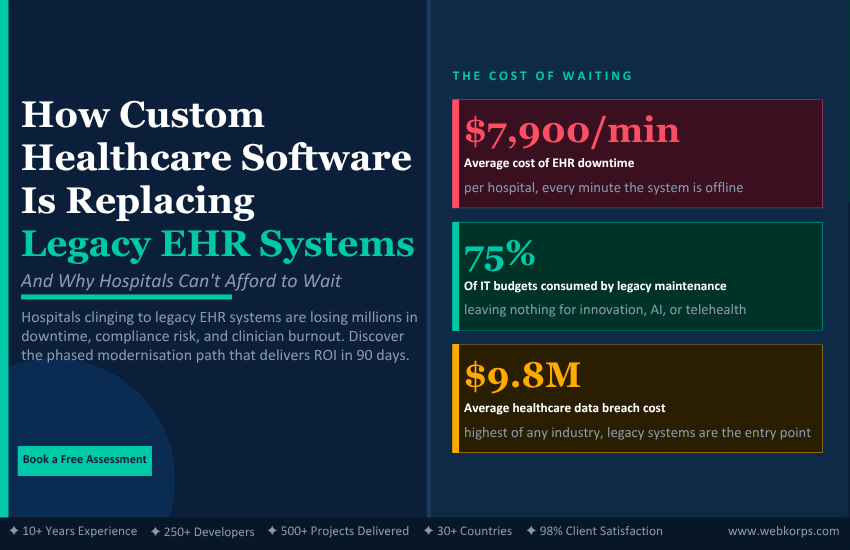
That scenario isn’t an edge case. It’s a measurable, compounding cost, $7,900/minute in downtime exposure. $9.8M in average breach cost. 2.3 hours of wasted clinician time per physician, per day.
The health systems that will define clinical and operational leadership in the next five years are the ones building data infrastructure today that can natively support AI diagnostics, predictive population health, and value-based care reimbursement models, without rebuilding from scratch every time the technology landscape shifts.
The question isn’t whether to modernise. That decision has already been made by the regulatory environment, the cybersecurity threat landscape, and the clinical quality data. The question is: who do you trust to execute the transition without disrupting what you’ve built?
|
Ready to See What Modernisation Actually Looks Like for Your System? Book a free healthcare software assessment with our team. We’ll map your current system, identify your highest-impact modernisation opportunities, and deliver a phased roadmap with ROI projections at each milestone, no obligation. |
Frequently Asked Questions
How much does it cost to replace a legacy EHR with custom healthcare software?
Custom EHR development for a mid-size hospital typically ranges from $500K to $2M, depending on scope and integrations. Compare this to a full Epic or Oracle Cerner replacement at $50M–$200M over 3–5 years, plus $1,200–$1,500 per physician per month in perpetual licensing. On a 5-year total cost of ownership basis, custom is almost always the more cost-efficient path for organisations with complex or multi-site needs.
What is the real hidden cost of keeping a legacy EHR running?
Legacy EHR maintenance consumes up to 75% of IT budgets (Gartner). On top of that: $7,900 per minute in downtime cost, $9.8M average breach cost, and 2.3 extra hours per physician per day in administrative drag. The annual productivity loss per hospital runs $3.2M–$8.7M. Inaction isn’t the safe option; it’s the expensive one.
How quickly can a hospital expect ROI from a custom EHR project?
Faster than most expect. Phase 2 (FHIR integration layer) delivers measurable results within 60–90 days, enabling telehealth and analytics before the legacy core is replaced. By Phase 3, AI scribing reduces documentation time by up to 35% per physician. Most mid-size hospitals break even between months 18 and 24, with compounding ROI every year thereafter as licensing costs disappear.
What is HL7 FHIR, and why is it critical for EHR modernisation?
HL7 FHIR (Fast Healthcare Interoperability Resources) is the federal standard for healthcare data exchange, mandated by the 21st Century Cures Act. Legacy EHR systems built before 2015 largely cannot support it natively. Non-compliance exposes organisations to CMS penalties up to $1M per violation. Custom EHR systems are built FHIR-native from day one, compliant by design, not by patch.
Can we modernise our EHR without disrupting patient care?
Yes. The phased modernisation approach, using the Strangler Fig architectural pattern, wraps the legacy system with a modern FHIR API layer while clinical operations continue uninterrupted. Modules are replaced one at a time. Staff trains on one change at a time. There is no big-bang go-live, no mass downtime, and no moment where clinicians lose access to patient records.
How does custom healthcare software handle HIPAA compliance?
Custom systems built by a qualified partner are HIPAA-by-design, not HIPAA-by-patch. This means AES-256 encryption at rest and in transit, zero-trust access architecture, role-based permissions, automated audit trails, and BAA-governed third-party integrations, all embedded at the architecture level. The 2025 HIPAA Security Rule update introduces new requirements that legacy systems on unsupported infrastructure will struggle to meet. Modern custom systems are built to these updated standards.
How long does a full EHR modernisation project take?
A phased modernisation for a mid-size hospital typically runs 14–18 months from assessment to full legacy retirement: Weeks 1–8 for assessment and architecture design, Phase 2 (FHIR layer) live at day 60–90, module-by-module replacement through months 3–12, full migration and AI layer activation by month 18. Critically, each phase delivers standalone value. You are not waiting 18 months to see results.
What happens to decades of existing patient data during migration?
All historical patient records are preserved. FHIR-standardised migration maps legacy data to structured HL7 resources, validated against the source in parallel before any cutover. The legacy system stays live throughout, and clinical staff can reference it until every department confirms data integrity in the new system. No records are moved to production until validation passes. Nothing is lost; it’s restructured into a format modern systems can actually use.
How do we manage staff training and clinical adoption?
The phased approach makes adoption manageable by design. Staff learn one new module at a time, not an entirely new system overnight. Clinicians co-design their own workflows in Phase 1, which significantly reduces resistance. Role-specific training covers only what each user encounters daily. At-the-elbow support is deployed during each module go-live. Issues are resolved in the next sprint, not deferred to a vendor roadmap.
Is custom EHR development right for all hospital sizes?
Not always, and a trustworthy partner will tell you that honestly. Custom EHR is the right choice for multi-specialty hospitals, fast-scaling health networks, organisations with legacy vendor lock-in, digital health startups, and specialty clinics with unique workflows. For small independent practices with standard needs and straightforward compliance, a well-selected off-the-shelf EHR may be more practical. The decision should follow the clinical and operational analysis, not the other way around.
What should we look for when evaluating a custom healthcare software partner?
Six non-negotiables:
- Proven HIPAA, FHIR, and ONC compliance experience, not claimed, evidenced.
- Phased delivery with milestone-level ROI, not a 24-month single deliverable.
- Deep integration references: lab, pharmacy, imaging, and payer systems.
- Modular, cloud-native architecture, not a custom skin on a monolith.
- Post-launch SLA: uptime, security patches, and compliance updates.
- Reference clients of comparable size, ask what went wrong, not just what went right.
What’s our first step if we’re considering replacing our legacy EHR?
Start with a structured technology and compliance assessment before selecting any vendor or committing any budget. A well-executed assessment maps your current system’s architecture, quantifies your regulatory exposure as a financial number, and produces a phased roadmap with projected ROI at each milestone. It gives your CFO the business case and your board the confidence to act. The assessment is not the commitment; it’s what makes the commitment possible with full information.