
 Posted by
 A SaaS startup we worked with spent three years shipping features fast. By year four, their competitor shipped the same features in days. Simple additions that once took a week now took six. They lost market share. They couldn’t raise their Series B. They sold at 40% of their projected valuation. The codebase that had seemed so productive for so long had become the thing that killed them.
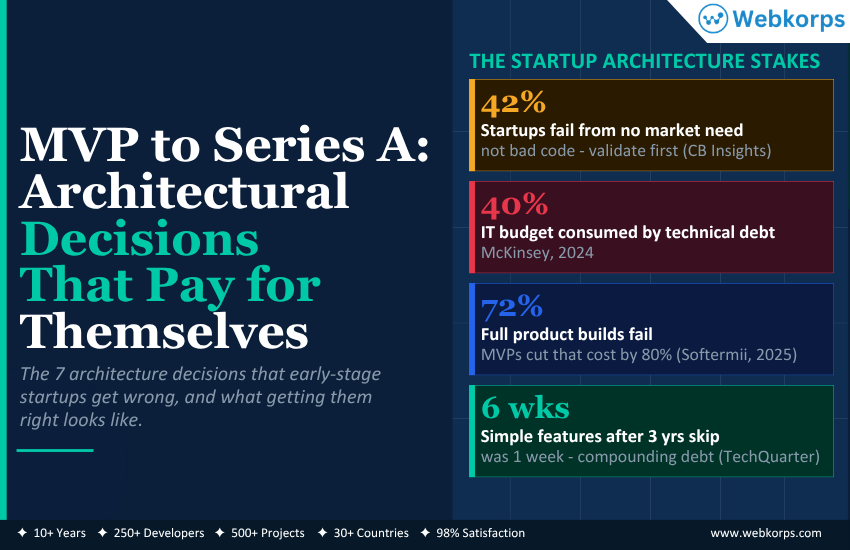
The story is documented. A 2024 survey found that for more than 50% of companies, technical debt accounts for more than a quarter of their total IT budget, blocking otherwise viable innovations. McKinsey estimates that technical debt amounts to up to 40% of a company’s entire technology estate. And the worst of it, the architectural debt, rooted in decisions made years prior, is the hardest kind to fix.
The paradox every startup founder lives inside: you need to move fast to survive, but the way you move can determine whether you live to scale. The architectural choices you make at the MVP stage are not neutral. Some create debt that compounds quietly and explodes at the worst possible moment, in a Series A due diligence room. Others pay for themselves: they enable the velocity you need now and the scale you’ll need later, without requiring a rebuild at either transition.
This guide is written for startup founders and CTOs who are somewhere between product-market fit and Series A. It draws on Y Combinator’s foundational advice on startup speed, First Round Review’s engineering leadership research, Lenny’s Newsletter on product and growth infrastructure, and the hard-learned patterns from 500+ custom software development engagements. The goal: help you identify which architectural decisions can be deferred and which ones, if made carelessly now, will extract payment at exactly the wrong time.
Table of Contents
The Core Tension: Speed Now vs. Scale Later
Y Combinator’s core advice to founders is unambiguous: do things that don’t scale. Ship the MVP. Talk to users. Iterate fast. Don’t over-engineer. This is correct. 42% of startups fail because there is no market need for their product (CB Insights). Building perfect architecture for a product nobody wants is not a virtue; it is a waste.
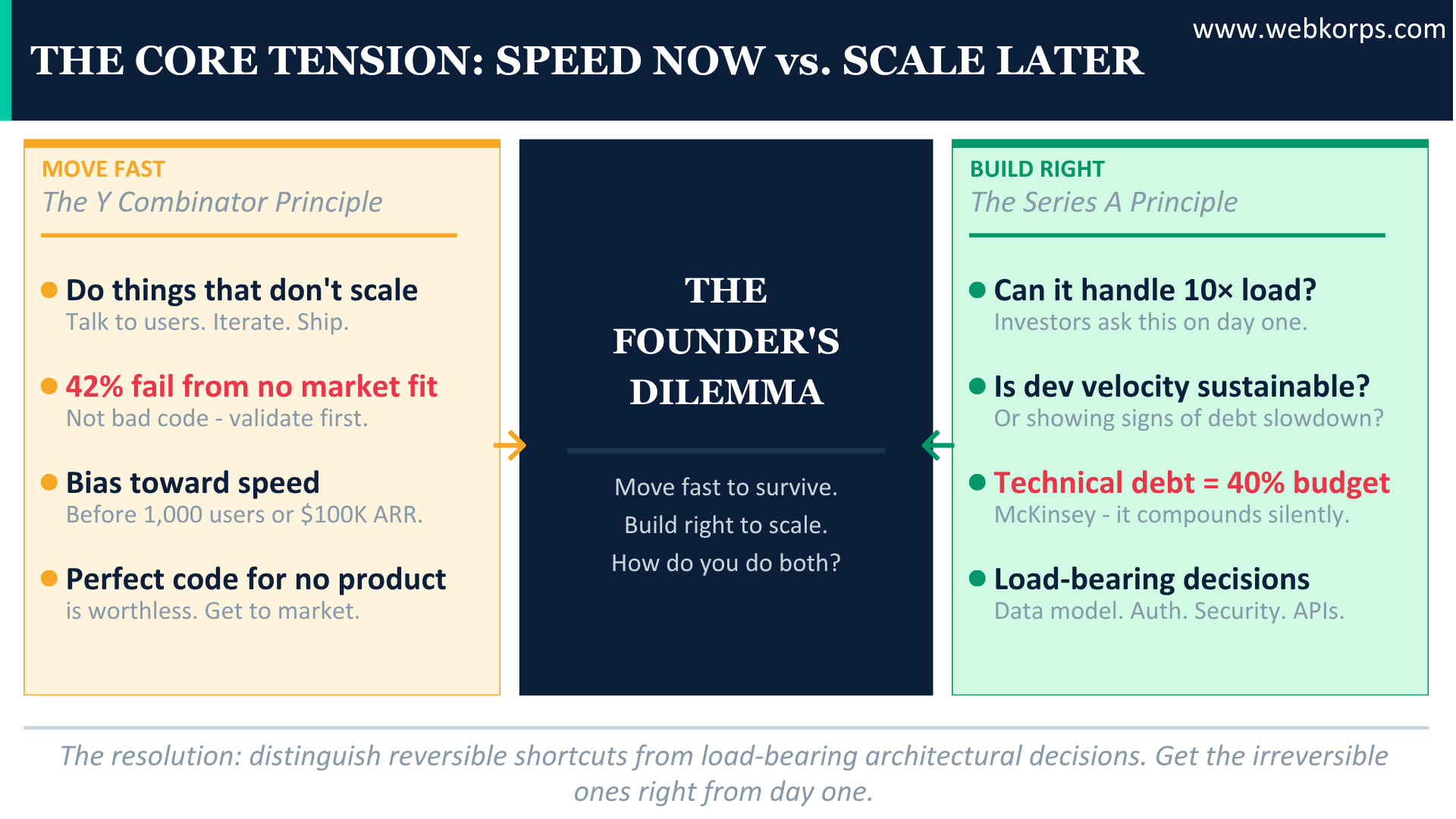
But there is a category of architectural decision that is not cleanly reversible, where the cost of fixing it later is not linear with the cost of getting it right early. These are the decisions that technical due diligence surfaces at Series A. Sphere Partners’ due diligence guide is direct: at Series A, investors ask tougher questions, can your architecture handle 10× growth? Is your development velocity sustainable? A poorly prepared founder loses leverage when technical due diligence uncovers issues they should have addressed months earlier.
The distinction matters enormously: there is a vast difference between strategic technical debt, deliberate shortcuts that buy speed now with a known future cost, and accidental architectural debt that compounds invisibly until it becomes the dominant constraint on everything the company wants to do.
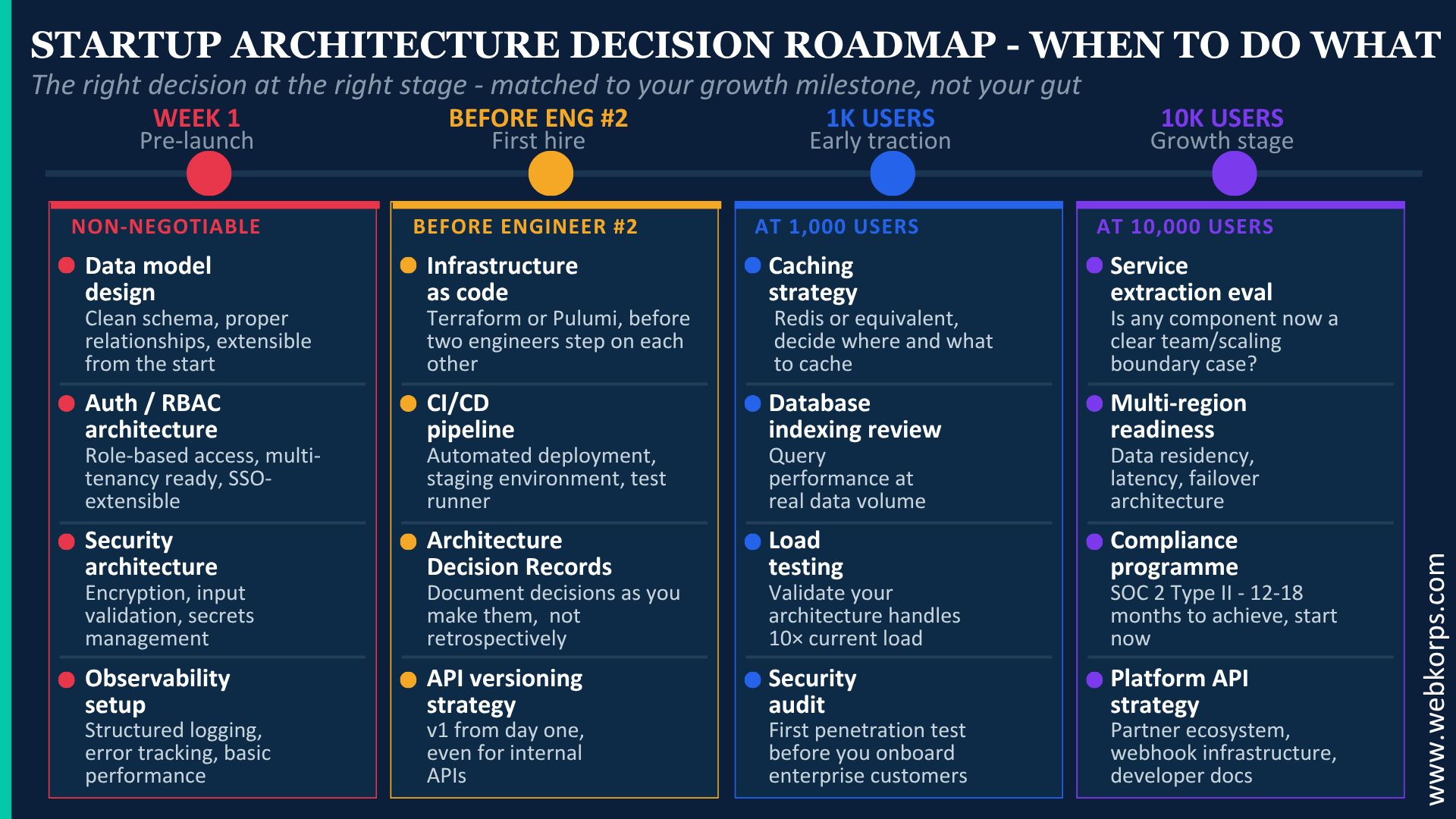
“Before 1,000 active users or $100K ARR, bias toward speed. After that threshold, the architectural decisions you’ve deferred start extracting compound interest.”
— Sikdar Technologies, Technical Debt Framework, 2026
What Series A investors actually look for in technical due diligence
Series A due diligence in 2025–2026 is more thorough on technical fundamentals than at any prior point. Investors are evaluating:
- Whether your architecture can handle 10× the current load without a fundamental rebuild
- Whether your development velocity is sustainable or already showing signs of debt-induced slowdown
- Whether your codebase is modular enough for the engineering team to grow without stepping on each other’s toes
- Whether your security and data handling comply with the standards required for enterprise customers or regulated markets
- Whether your infrastructure costs scale predictably or will create a margin problem at growth-stage volumes
| THE SERIES A DUE DILIGENCE SIGNAL MOST FOUNDERS MISS |
| Technical due diligence has become part of M&A and fundraising due diligence in 2025–2026. Potential acquirers and investors now assess ‘technical baggage’ as a direct risk factor impacting valuation. The startup that lets simple features take 6 weeks instead of 1, because they prioritised features over code quality for three years, cannot tell a convincing 10× growth story to a Series A investor who is looking at their deployment frequency. |
7 Architectural Decisions That Pay for Themselves
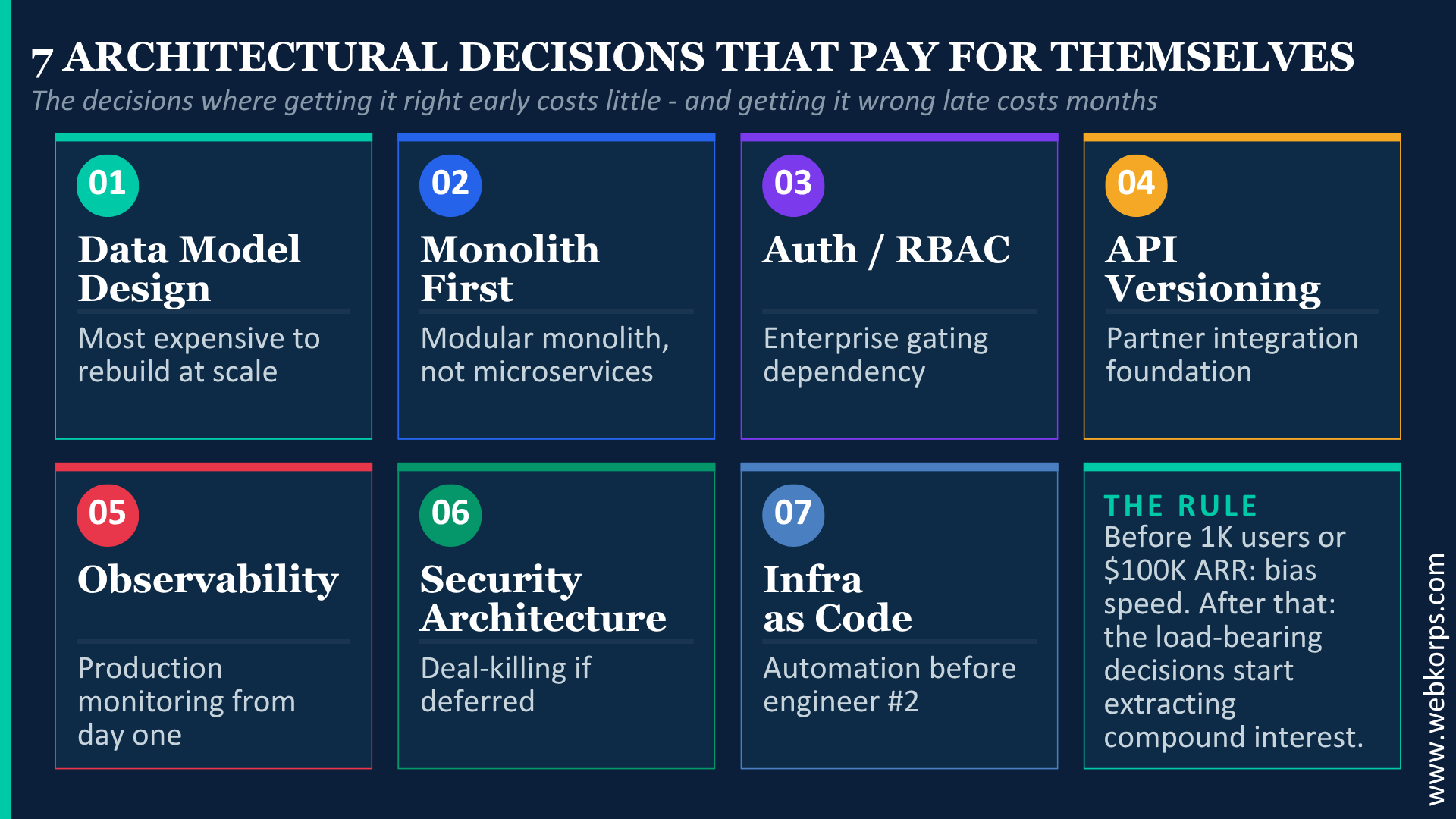
These are the decisions where the asymmetry of cost is most pronounced, where getting them right early costs little incremental effort and getting them wrong late costs months of engineering time, investor confidence, and occasionally the company. Each is structured as follows: the common mistake, the decision that pays, and why it matters in fundraising.
01 · Data Model Design – The Most Expensive Thing to Rebuild
| The Common Mistake | The Decision That Pays |
|---|---|
| Ship whatever data model gets the feature out fastest. Normalise later when you have time. | Spend an extra day designing a clean, extensible data model with proper relationships, indexes, and constraints before you write the first migration. |
▶ WHY IT MATTERS: Your data model is the most expensive architectural decision to change at scale. Every feature you build on top of a poorly designed schema inherits its constraints. By the time you have 10× the data volume and 5× the feature complexity, a bad data model means every new feature requires navigating years of workarounds. Series A investors reviewing your database architecture will find this quickly, and a messy schema signals an undisciplined engineering culture, not just technical debt.
02 · Monolith vs. Microservices – The Most Over-Engineered Early Mistake
| The Common Mistake | The Decision That Pays |
|---|---|
| Build microservices from day one because you’ll need to scale individual components independently later, and you don’t want to refactor. | Start with a well-structured modular monolith. Separate concerns cleanly within it. Extract services only when you have a specific scaling or team boundary reason to do so. |
▶ WHY IT MATTERS: Martin Fowler’s documented pattern is definitive: almost all successful microservice architectures started as monoliths that got too big. Almost all systems built as microservices from scratch ended up in serious trouble. Y Combinator-backed Gauge was founded specifically to solve this problem. The modular monolith gives you the simplicity you need at MVP speed with the architectural clarity that makes extraction possible when you actually need it. Premature microservices add operational complexity, service discovery, distributed tracing, and network latency, which slows a 5-person team to a crawl.
03 · Authentication and Authorisation Architecture
| The Common Mistake | The Decision That Pays |
|---|---|
| Use a simple auth system that works for your current user model. Add roles and permissions later when enterprise customers ask for them. | Implement RBAC with extensible permission scopes from the beginning. Build for multi-tenancy even if you’re single-tenant today. |
▶ WHY IT MATTERS: Auth refactors are among the most dangerous late-stage changes you can make; they touch every endpoint, require migration of existing user data, and carry significant security risk during transition. Enterprise customers at Series A and beyond require SSO, granular permission controls, and audit logs as baseline requirements. If your auth system cannot support these without a rebuild, you are gating your enterprise’s go-to-market behind an engineering project. First Round Review’s engineering research consistently cites auth architecture as the hidden gating factor in enterprise sales velocity.
04 · API Design and Versioning Strategy
| The Common Mistake | The Decision That Pays |
|---|---|
| Build internal APIs as you need them. Version them later if you ever have external developers or need to change them. | Design your APIs with clear versioning from v1. Document them. Treat internal APIs with the same discipline as external ones. |
▶ WHY IT MATTERS: Lenny’s Newsletter’s coverage of successful B2B product growth consistently shows that platform extensibility, APIs that partners, enterprise customers, and your own team can build on reliably, is a growth multiplier that requires no rebuild if designed well early. An API designed without versioning in mind becomes a liability the moment a customer builds an integration, and you need to change the underlying behaviour. At Series A, any enterprise customer requiring integrations will surface this immediately.
05 · Observability and Logging Infrastructure
| The Common Mistake | The Decision That Pays |
|---|---|
| Add monitoring and logging properly once the product is stable. It slows down early development, and you can see errors in the console for now. | Instrument your application with structured logging, error tracking, and basic performance monitoring from week one. This is a one-day investment. |
▶ WHY IT MATTERS: Production incidents without an observability infrastructure are investigated by reading logs line by line. At 1,000 users, this is painful. At 10,000 users, it is impossible. Series A investors examining your engineering operations will look for evidence of mature monitoring practices; without them, any claim about 99.9% uptime is unverifiable. First Round Review’s engineering leadership research notes that observability is the single fastest signal of engineering team maturity to external reviewers.
06 · Security Posture and Data Handling
| The Common Mistake | The Decision That Pays |
|---|---|
| Implement security properly once you have customers who require it. It adds complexity, and you’re not a target yet. | Implement encryption at rest and in transit, input validation, dependency scanning, and secrets management from day one. These are architectural patterns, not features. |
▶ WHY IT MATTERS: Security in fintech, healthtech, and any SaaS handling personal data must be done right from day one; this is not a decision that can be deferred and fixed later without material risk. Technical due diligence at Series A will examine your security posture. A single critical vulnerability found during due diligence has killed deals. Beyond due diligence, enterprise customers increasingly require SOC 2 compliance before signing. Building security-conscious architecture from the start is dramatically cheaper than retrofitting it under the time pressure of a deal closing.
07 · Infrastructure as Code and Deployment Automation
| The Common Mistake | The Decision That Pays |
|---|---|
| Deploy manually or with simple scripts until the product is stable. Automate deployment properly once the team grows. | Commit your infrastructure definition to code (Terraform, Pulumi) and implement a CI/CD pipeline before you have your second engineer. |
▶ WHY IT MATTERS: Manual deployment is the first thing that breaks when you hire your second engineer. Two engineers deploying to the same environment without automation creates conflicts, environments that differ between development and production, and incidents that are impossible to reproduce. Infrastructure as code dramatically reduces onboarding time for new engineers, a measurable velocity metric that First Round Review identifies as a compounding advantage in fast-scaling teams. At Series A, any investor examining your DevOps practices will ask about deployment frequency and mean time to recovery.
The Debt vs. Investment Framework: How to Classify Your Architectural Decisions
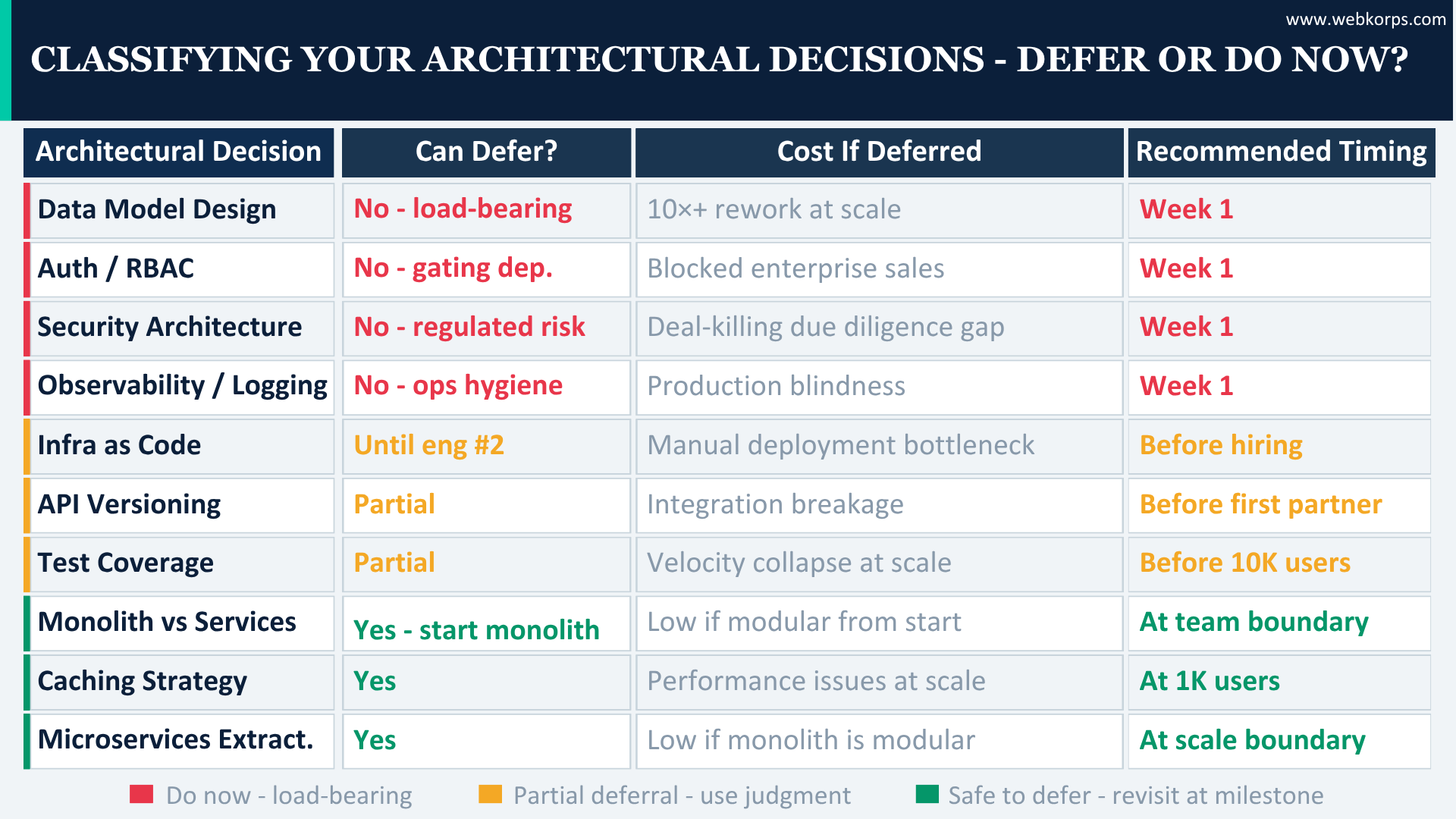
Not all architectural shortcuts are created equal. Before making any architectural shortcut, ask three questions:
- Is this decision reversible before the 10× scale? If changing it requires migrating live data or touching every API endpoint, it is structurally load-bearing and should not be shortcut.
- Does this decision create a blocking dependency for enterprise customers? Auth, security, API design, and data handling frequently gate enterprise sales. Deferring them is deferring revenue.
- Will this decision appear in a Series A due diligence checklist? Architecture scalability, security posture, observability, and deployment practices are explicitly evaluated. Build for the room you will eventually be in.
Classifying Your Architectural Decisions
| Decision | Can Defer Safely? | Cost of Deferred | Recommended Timing |
|---|---|---|---|
| Data model design | No – load-bearing | 10×+ rework at scale | Week 1 |
| Monolith vs. microservices | Yes – start monolith | Low if modular from the start | At the team/scale boundary |
| Auth / RBAC architecture | No – gating dependency | Blocked enterprise sales | Week 1 |
| API versioning | Partial | Integration breakage | Before the first API partner |
| Observability/logging | No – ops hygiene | Production blindness | Week 1 |
| Security architecture | No – regulated risk | Deal-killing due diligence gap | Week 1 |
| Infrastructure as code | Until engineer #2 | Manual deployment bottleneck | Before hiring |
| Test coverage | Partial | Velocity collapse at scale | Before 10K users |
| Microservices extraction | Yes | Low if monolith is modular | At a clear team boundary |
| Caching strategy | Yes | Performance issues at scale | At 1K users |
What Investors See When They Open Your Codebase
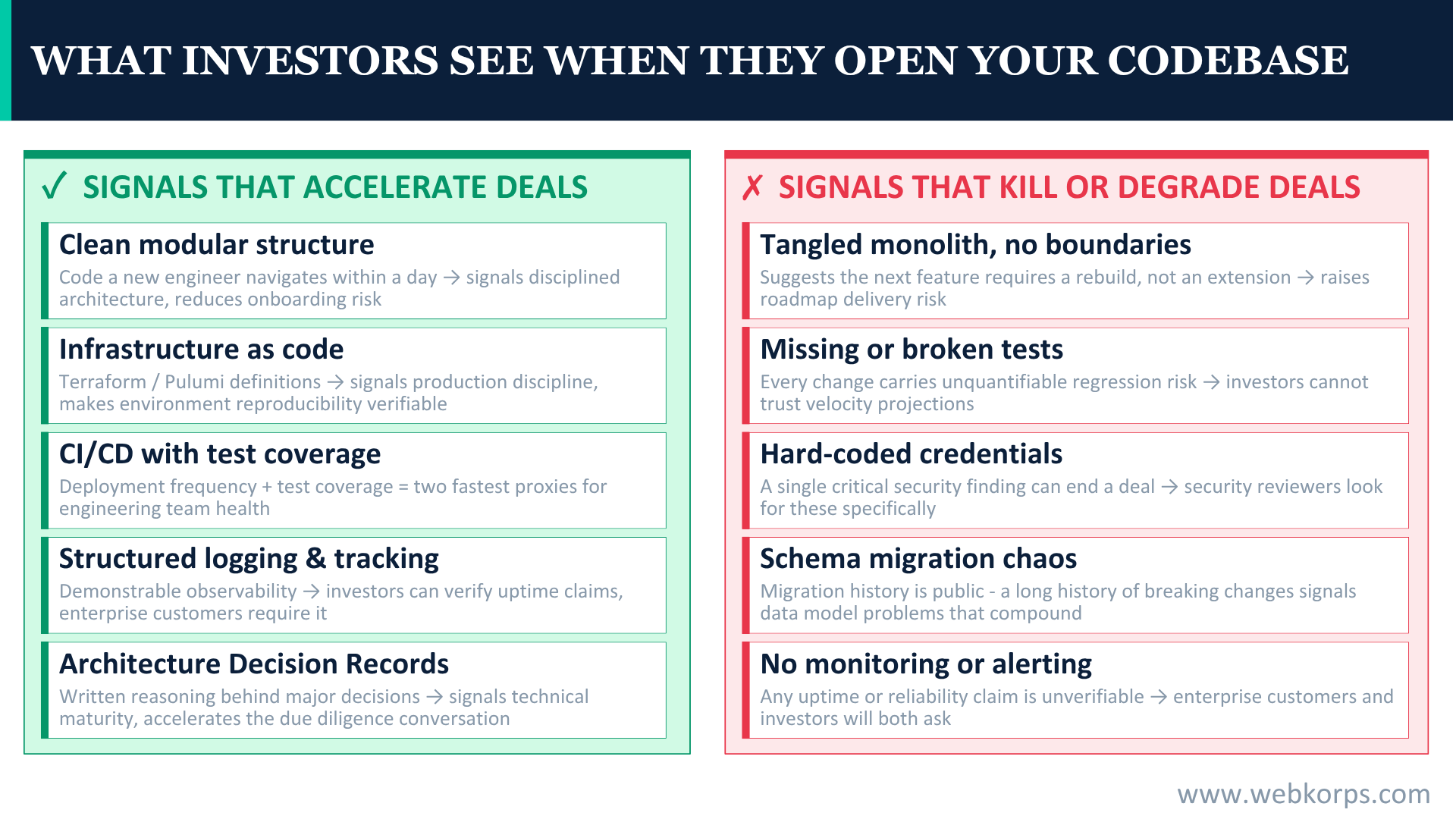
Series A technical due diligence in 2025–2026 is more structured and more thorough than at any prior point. The rapid adoption of AI/ML technologies, cloud-native architectures, and increasingly strict data privacy regulations means investors are scrutinising technical foundations more carefully than ever.
The Signals That Accelerate Deals
- Clean modular structure – code that a new engineer can navigate within a day signals disciplined architecture and reduces onboarding risk
- Infrastructure as code – Terraform or Pulumi definitions signal production discipline and make environment reproducibility verifiable
- CI/CD pipeline with test coverage – deployment frequency and test coverage are the two fastest proxies for the engineering team’s health
- Structured logging and error tracking – demonstrable observability infrastructure signals that you can diagnose and resolve production incidents systematically
- Documented ADRs (Architecture Decision Records) – written reasoning behind major architectural decisions signals technical maturity and makes the due diligence conversation dramatically easier
The Signals That Kill or Degrade Deals
- Tangled monolith with no clear boundaries – suggests the next major feature will require a rebuild, not an extension
- Missing or broken tests – suggests that every change carries unquantifiable regression risk
- Hard-coded credentials or security antipatterns – a single critical finding can end a deal; security reviewers look for these specifically
- Database migrations that suggest schema chaos – migration history is public; a long history of breaking schema changes signals data model problems that will compound
- No monitoring or alerting infrastructure – any uptime or reliability claim is unverifiable without it, and enterprise customers will ask
How Custom Software Development Services Change This Equation
Many founders face this challenge at exactly the wrong time: they have achieved product-market fit, but their MVP codebase is not the right foundation for the next phase. The engineering team that built the MVP was optimising for speed. The engineering challenge now is different: build a system that can handle 10× the load, support an enterprise sales motion, and be maintained by a team that will triple in size over the next 18 months.
This is the moment where a custom software development company with specific startup architecture experience changes the outcome. Not a generalist agency that builds to spec. A partner with documented experience in the specific architectural transitions, from MVP to growth-stage infrastructure, that startup founders need to navigate before their Series A.
The value of a well-chosen custom software development partner at this stage:
- Architectural review – identifying the load-bearing decisions that need to be addressed before the debt compounds further
- Prioritised refactoring – distinguishing between the 20% of technical debt that blocks your Series A and the 80% that can wait
- Production infrastructure – implementing the observability, CI/CD, and infrastructure-as-code foundations that investors examine
- Security architecture – addressing the security posture gaps that most frequently create due diligence problems in regulated or enterprise-facing products
- Knowledge transfer – ensuring your internal team can maintain and extend everything that is built, so the engagement builds capability rather than dependency
Webkorps startup engineering track record: 500+ delivered projects across 30+ countries · ISO 27001 · CMMI Level 3 · Startup engineering specialists from MVP through Series A and beyond. Our custom software development services are built around the specific architectural challenges that startup founders face between product-market fit and institutional funding.
The Decisions You Make When You’re Moving Fast Are the Ones You Live With
The startup that lost its Series B – the one that spent three years shipping fast and then watched a competitor ship the same features in days while they needed six weeks, made a completely rational set of decisions. Speed was the right priority. The architectural shortcuts were individually defensible. The problem was not any single decision but the cumulative effect of a hundred small ones that were never revisited.
The seven architectural decisions in this guide are the ones where the asymmetry of cost is most pronounced. Getting them right at MVP costs, in most cases, an extra day of thought and perhaps a week of additional implementation. Getting them wrong costs months of engineering time, investor confidence at fundraising, and in documented cases, the company itself. Strategic technical debt is a legitimate tool. Accidental architectural debt is a silent killer.
The Y Combinator’s advice to do things that don’t scale is one of the most valuable things ever written for early-stage founders. But it applies to go-to-market, to manual processes, to customer success. Applied blindly to your data model, your auth architecture, or your security posture, it will cost you. The founders who build from MVP to Series A cleanly are the ones who learned to distinguish between the decisions that should scale with the company and the ones that should be built for scale from day one.
Ready to build a startup architecture that survives Series A? Book a free architecture review with Webkorps. We’ll audit your current decisions, flag the ones that will cost you at fundraising, and map a roadmap to fix them, before your investors find them first.
Book a Free Architecture Review
Explore Custom Software Development Services
Frequently Asked Questions
Q1: What is the most important architectural decision for an early-stage startup?
Data model design is the single most expensive decision to reverse at scale. Every feature built on top of a poorly designed schema inherits its constraints, and migrating a production database at 10× data volume is one of the highest-risk, most time-consuming engineering projects a startup can face. Spend an extra day on it before you write the first migration. Everything else can be refactored; your core data model cannot be without high cost and risk.
Q2: Should startups use microservices or a monolith for their MVP?
Start with a well-structured modular monolith. Martin Fowler’s documented pattern is definitive: almost all successful microservice architectures started as monoliths that got too big, while almost all systems built as microservices from scratch ended up in serious trouble. The modular monolith gives you MVP delivery speed with the internal structure that makes service extraction possible when you actually need it, typically when you have a clear team or scaling boundary reason to separate a component.
Q3: What do Series A investors look for in technical due diligence?
Series A technical due diligence in 2025–2026 examines: whether your architecture can handle 10× current load without a rebuild, whether your development velocity is sustainable or declining, codebase modularity, security posture, observability infrastructure, and deployment practices. The fastest positive signals are clean modular code, infrastructure as code, CI/CD with test coverage, structured logging, and documented Architecture Decision Records. The fastest deal-killing signals are hard-coded credentials, missing tests, schema chaos, and no monitoring.
Q4: How much technical debt is acceptable for a startup raising Series A?
Strategic technical debt, deliberate shortcuts with a known future cost, is acceptable and often necessary before Series A. The distinction that matters is between reversible shortcuts (monolith instead of microservices, manual processes, limited test coverage) and load-bearing decisions (data model, auth architecture, security posture, API design). The former can be addressed post-funding; the latter compounds invisibly and surfaces in due diligence at the worst possible time. A useful rule: any architectural decision that would require touching every endpoint, migrating live data, or a security remediation project is load-bearing and should not be shortcut.
Q5: What does a custom software development company do for startups at the MVP-to-Series-A stage?
At this stage, a custom software development company’s value is not writing code faster than your internal team, it is architectural judgment. Specifically: identifying which technical debt will appear in Series A due diligence and prioritising its resolution; implementing the production infrastructure (observability, CI/CD, infrastructure as code) that investors examine; addressing security architecture gaps before they become deal blockers; and building with a knowledge transfer model that leaves your internal team able to extend everything independently. The engagement should build your engineering capability, not create vendor dependency.
Q6: When is the right time to hire a custom software development company for startup architecture work?
The highest-leverage moment is between product-market fit and Series A fundraising, typically when you have traction, but your MVP codebase is starting to constrain development velocity. At this point, the investment in architecture remediation has a clear ROI: a clean technical foundation accelerates Series A due diligence, unlocks enterprise sales motions that depend on security and auth capabilities, and increases development velocity for the 18-month roadmap you’ll present to investors. Earlier (pre-PMF), the priority should be market validation speed. Later (post-Series-A), the cost of architectural remediation is significantly higher.