
 Posted by
 An examiner sits across the table and points at a single declined loan from last quarter. “Explain this decision.” A model scored the applicant, a notice went out, and now a compliance lead has ninety seconds to connect that specific denial to specific, accurate reasons, or generate a finding that touches every decision the model has ever made. That moment, not the model’s accuracy, is where explainable AI fintech compliance is won or lost.
Most coverage of this topic explains what SHAP and LIME are. Far fewer explain what an examiner actually pulls from an audit packet, and why technically sound models still fail. Here is the version a Head of Risk needs before the next exam cycle.
Table of Contents
Why explainability is now a hard requirement, not a nice-to-have
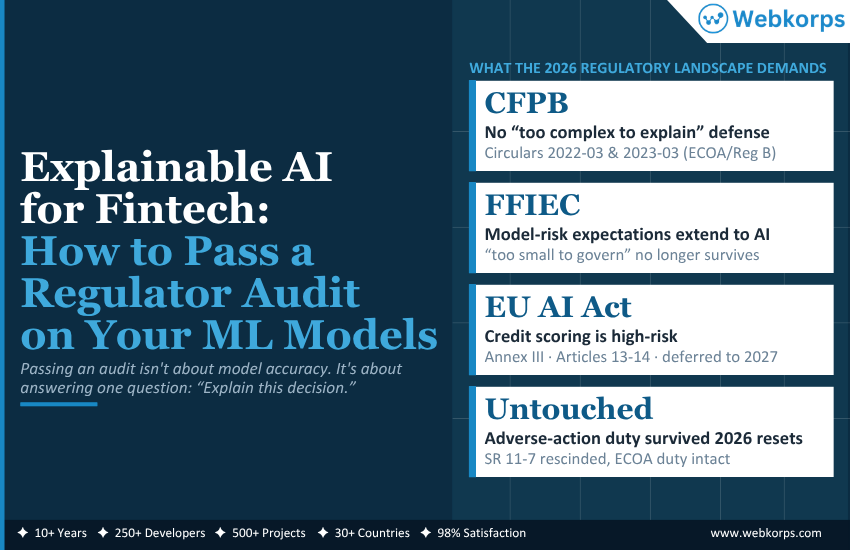
Regulators have closed every version of the “our model is too complex to explain” defense. CFPB Circular 2022-03 established that creditors cannot use algorithms they are unable to explain; Circular 2023-03 went further, stating that generic checklist reasons drawn from sample forms do not satisfy the Equal Credit Opportunity Act when those reasons fail to specifically identify what a model actually scored. Under ECOA and Regulation B, a declined applicant is owed the principal reasons for that decision, in language they can understand and act on.
A common misreading circulates that 2026’s regulatory resets ended this obligation. That reading is expensive. Federal agencies rescinded the long-cited SR 11-7 model-risk guidance in April 2026 and replaced it with a risk-based, principles-driven successor, but adverse-action duty under ECOA was untouched. FFIEC’s interagency stance already extends model-risk expectations to smaller institutions using AI, so “too small to govern” has not survived recent examinations either. Across the Atlantic, EU AI Act Annex III classifies creditworthiness assessment of natural persons as high-risk, and Articles 13 and 14 require interpretable documentation and genuine human oversight. High-risk obligations were deferred from August 2026 toward late 2027, giving teams a runway, not amnesty.
Turn explainability from audit risk into audit advantage. Talk to us!
What examiners actually pull from an audit packet
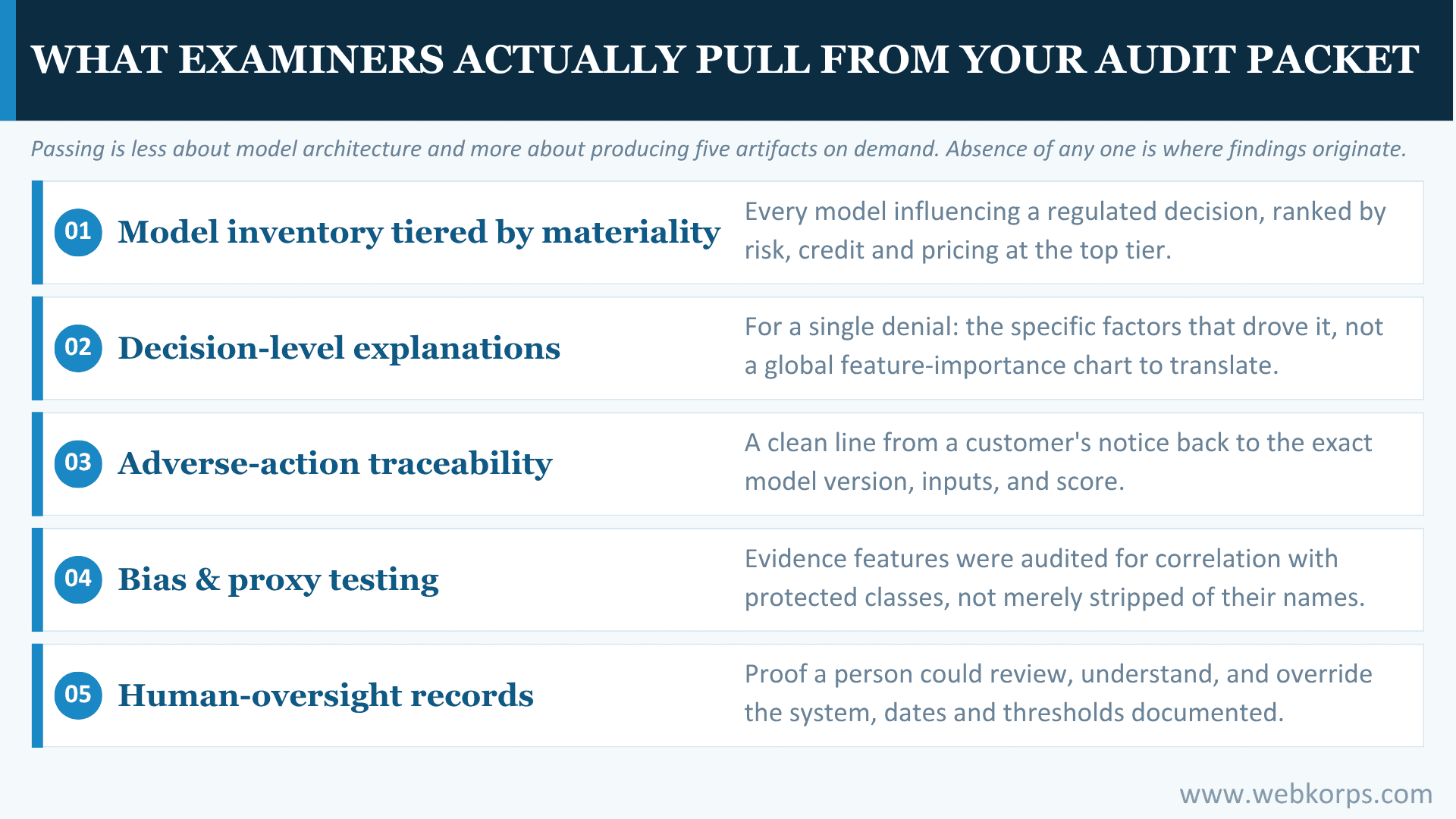
Passing an audit is less about model architecture and more about producing five artifacts on demand:
- Model inventory tiered by materiality: Every model that influences a regulated decision, ranked by risk, with credit and pricing models at the top tier.
- Decision-level explanations: For any single denial, the specific factors that drove it, debt-to-income ratio, credit history length, recent inquiries, not a global feature-importance chart that needs translating.
- Adverse-action traceability: A clean line from a customer’s notice back to the exact model version, inputs, and score that produced it.
- Bias and proxy testing: Evidence that features were audited for correlation with protected classes, not merely stripped of their names.
- Human-oversight records: Proof that a person could review, understand, and override the system, with dates and thresholds documented.
Absence of any one of these is where findings originate.
Where technically sound models fail the audit
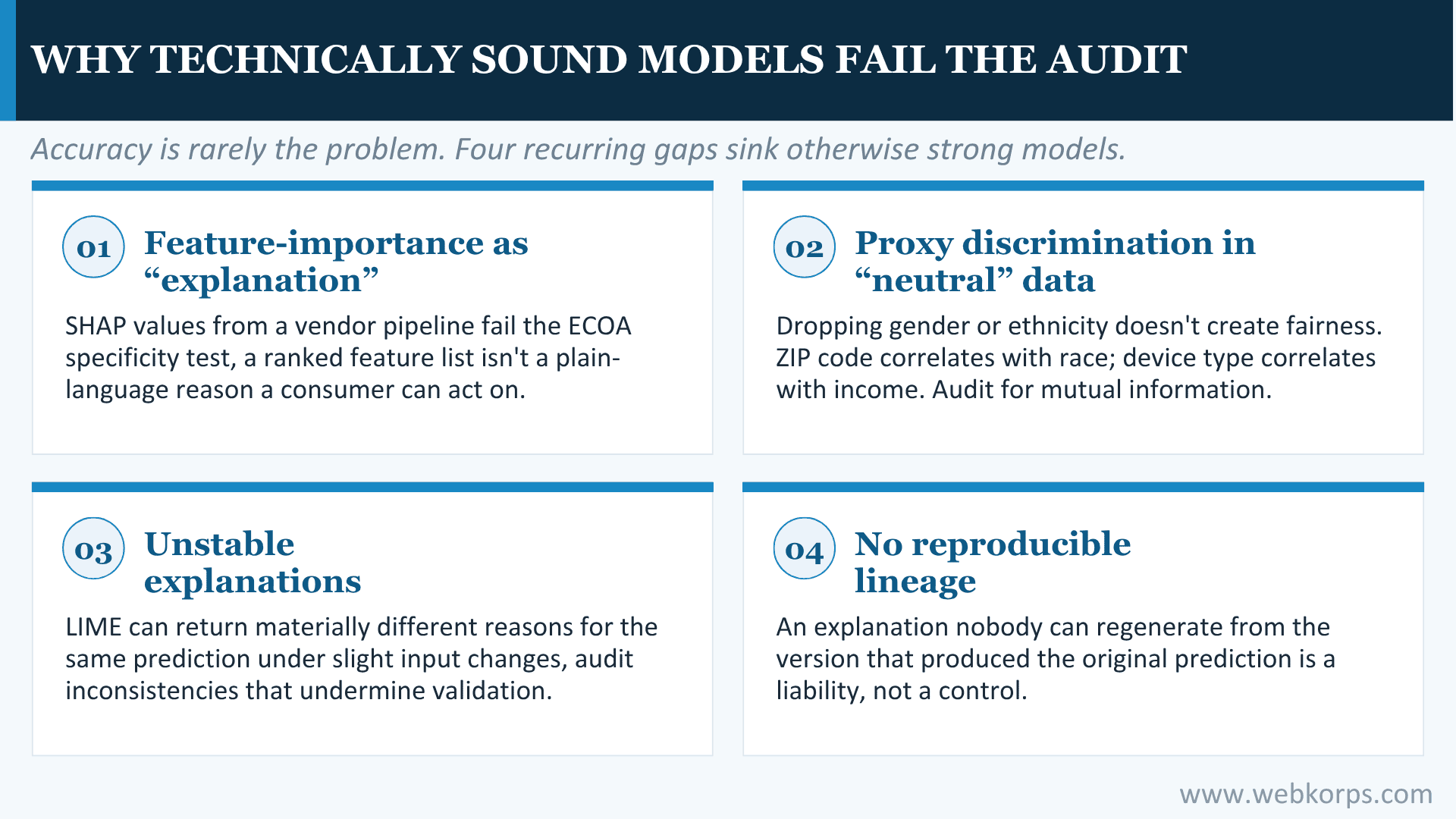
Accuracy is rarely the problem. Four recurring gaps sink otherwise strong models.
- First, feature-importance dressed up as an explanation. SHAP values from a vendor pipeline frequently fail the ECOA specificity test; a ranked list of features is not a plain-language principal reason a consumer can act on. Translation from attribution to notice must be faithful, documented, and reproducible.
- Second, proxy discrimination hides in “neutral” data. Dropping gender or ethnicity does not create fairness. ZIP code correlates with race in most cities; device type and phone operating system correlate with income. Auditing features for mutual information with protected classes, not just their labels, is what examiners increasingly probe.
- Third, unstable explanations. LIME can return materially different reasons for the same prediction under slight input changes, creating audit inconsistencies that undermine independent validation. Consistency matters as much as plausibility.
- Fourth, no reproducible lineage. An explanation nobody can regenerate from the version that produced the original prediction is a liability, not a control.
How to build an audit-ready explainability layer
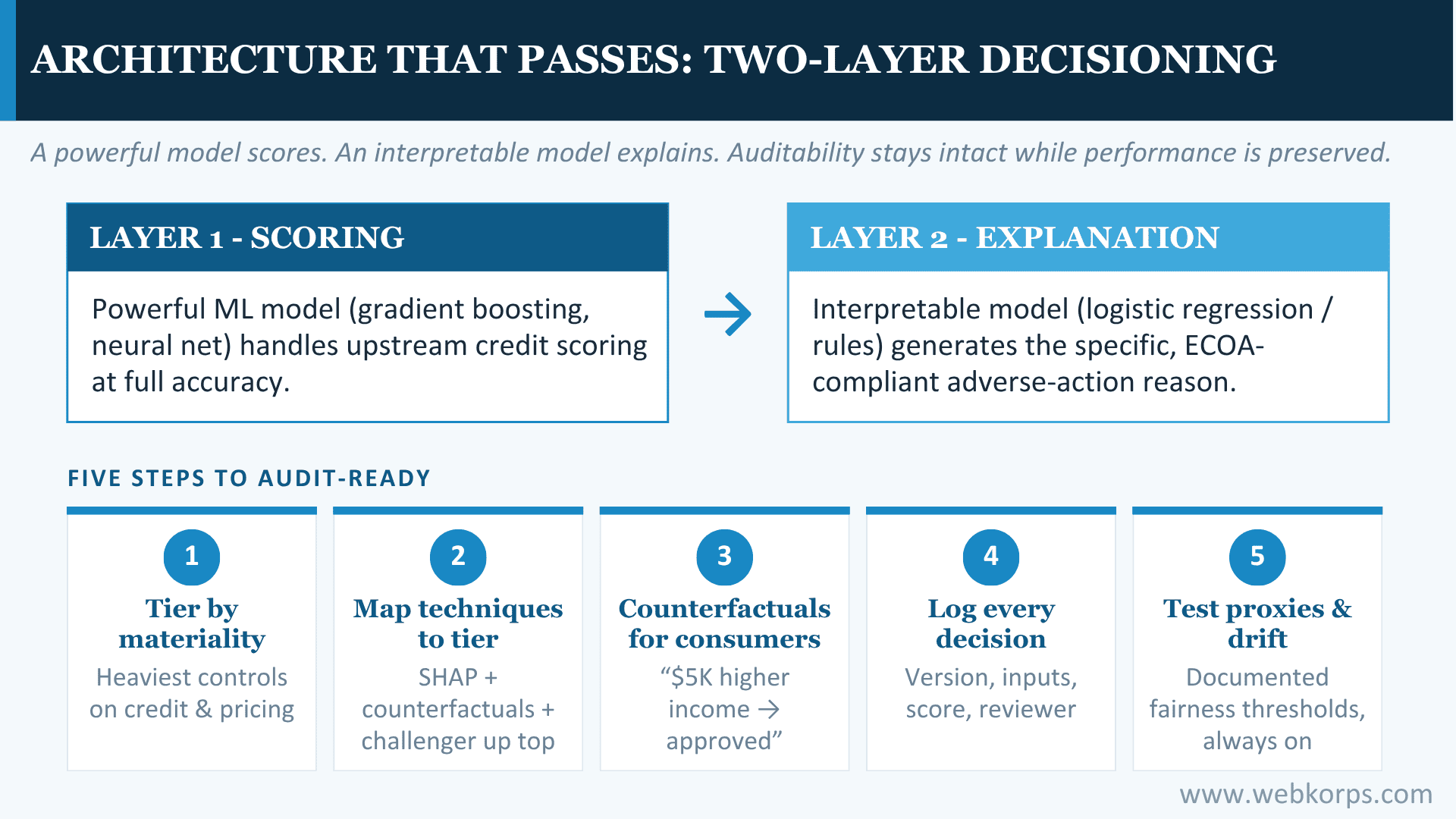
A pattern that consistently survives scrutiny is a two-layer architecture: a powerful ML model handles upstream scoring, while an interpretable model, logistic regression, or a rule-based layer generates the adverse-action explanation. Auditability stays intact while performance is preserved, and an examiner’s favorite question always has an answer.
Practical steps that move a program toward audit-readiness:
- Tier models by materiality: then apply the heaviest explainability controls to credit and pricing decisions.
- Map techniques to tier: Top-tier models get SHAP plus counterfactuals plus an interpretable challenger run in parallel; lower tiers get proportionate treatment.
- Generate counterfactuals for consumers: “approval would have followed with $5,000 higher income and 10% lower utilization” is the most actionable explanation format, and it aligns with EU AI Act best practice.
- Log every decision: with version, inputs, score, explanation, and reviewer, so any notice traces back in seconds.
- Test for proxies and drift continuously: with documented fairness thresholds rather than one-time checks.
Framing explainability this way turns it from an audit liability into a control that reduces audit work: an explanation validated once flows into adverse-action notices, model-risk reports, and examiner packets without rework.
Read Also: How AI Is Revolutionizing FinTech Software Development
Turn compliance into a competitive advantage
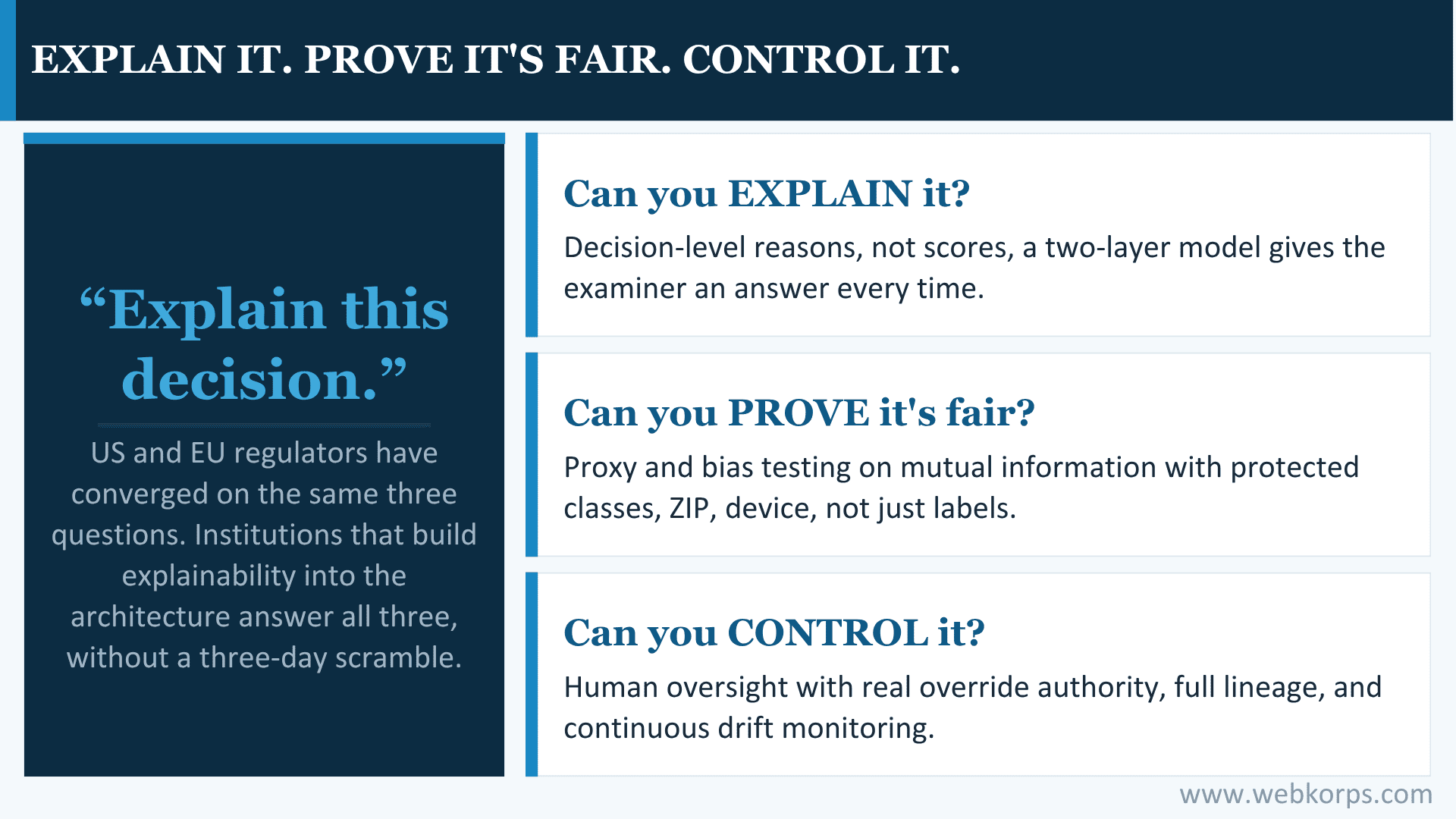
Institutions treating explainability as a checkbox keep discovering it at the worst possible moment: mid-exam, one declined loan at a time. Institutions building it into the architecture pass audits faster, launch products more confidently, and answer “explain this decision” without a three-day scramble. Given how far US and EU regulators have converged on the same three questions- can you explain it, can you prove it’s fair, can you control it, that difference compounds every cycle.
Webkorps builds explainable, audit-ready ML systems for fintech, two-layer decisioning, adverse-action traceability, bias testing, and human-oversight tooling aligned to CFPB, FFIEC, and EU AI Act expectations.
Book a Model Audit-Readiness Review
Frequently Asked Questions
Q: What is explainable AI in fintech compliance?
Explainable AI means ML systems producing clear, auditable, decision-level reasons, not just a score. It matters most in credit decisioning, where ECOA and the EU AI Act require specific, understandable justifications.
Q: Does the CFPB require AI explainability?
Yes. CFPB Circulars 2022-03 and 2023-03 confirm model complexity is no defense; a declined applicant is owed specific, accurate principal reasons. This duty survived the 2026 regulatory resets untouched.
Q: Is SHAP enough to pass an adverse action audit?
Often not alone. SHAP feature attributions fail the ECOA specificity test; a ranked list isn’t a plain-language reason. Passing usually needs a two-layer architecture with an interpretable explanation model.
Q: What does the EU AI Act require for credit scoring?
Annex III classifies credit scoring as high-risk. Articles 13 and 14 require interpretable documentation and genuine human oversight. High-risk obligations were deferred toward late 2027; runway, not an exemption.
Q: Why do technically sound ML models fail regulatory audits?
Accuracy is rarely the issue. Models fail on four gaps: feature-importance passed off as explanation, hidden proxy discrimination, unstable explanations, and no reproducible lineage linking notice to model version.
Q: How do you make an ML model audit-ready?
Tier models by materiality, use a two-layer architecture for adverse-action explanations, add consumer counterfactuals, log every decision with full lineage, and test continuously for proxies and drift.