
 Posted by
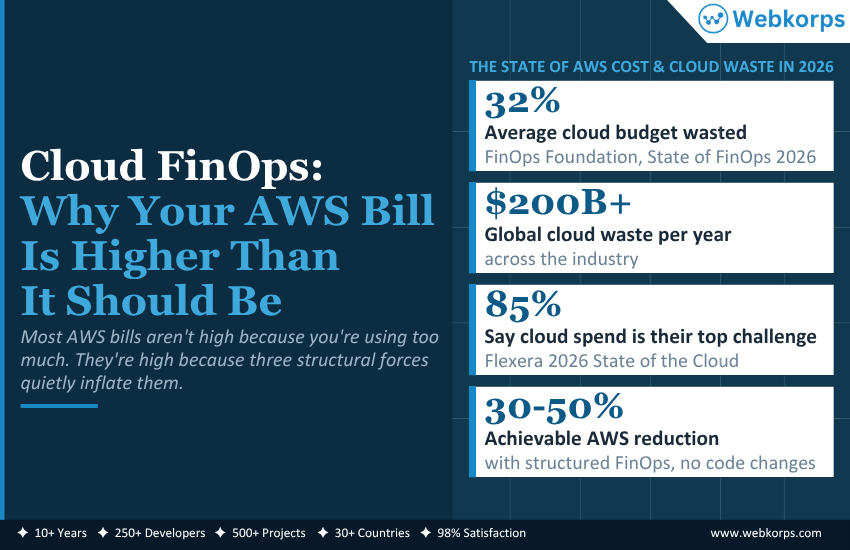
 The State of AWS Cost & Cloud Waste in 2026
| Metric | Figure | Source |
|---|---|---|
| Average share of cloud budget wasted | 32% | FinOps Foundation, State of FinOps 2026 |
| Estimated global cloud waste annually | $200B+ | Industry analyses 2026 |
| Organisations naming cloud spend as their top challenge | 85% | Flexera 2026 State of the Cloud |
| Achievable AWS reduction with structured FinOps (no code changes) | 30–50% | Industry benchmarks 2026 |
The bill arrives on the 2nd, 18% higher than last month. No launch shipped. Traffic was flat. The VP of Infrastructure forwards it to the platform team with one word: “Why?” The honest answer takes three days of Cost Explorer digging: nothing broke. A dev cluster didn’t scale to zero. A workload spun up in a second region, untagged. A Savings Plan quietly expired. Cross-AZ transfer crept up as a service got chattier. No single mistake anyone would get fired for, but together, that’s why the bill is higher than it should be.
This is the shape of AWS overspend in 2026. The FinOps Foundation’s State of FinOps 2026 report finds organisations waste 32% of their cloud budget on average, on idle resources, over-provisioning, and poor visibility. Global cloud waste tops $200 billion a year, and Flexera finds 85% of organisations name cloud spend as their biggest challenge. Far from niche, it’s the default state of an unmanaged AWS account.
Most guides miss the real cause. An AWS bill isn’t high because engineers are careless; it’s high because structural forces inflate spend automatically unless something counteracts them. That “something” is FinOps: not a tool or a one-time cleanup, but an operating model. What follows diagnoses the three structural causes, maps the five places the bill leaks, and shows how two authoritative frameworks, the FinOps Foundation Framework and the AWS Well-Architected Cost Optimization Pillar, fix it for good.
Table of Contents
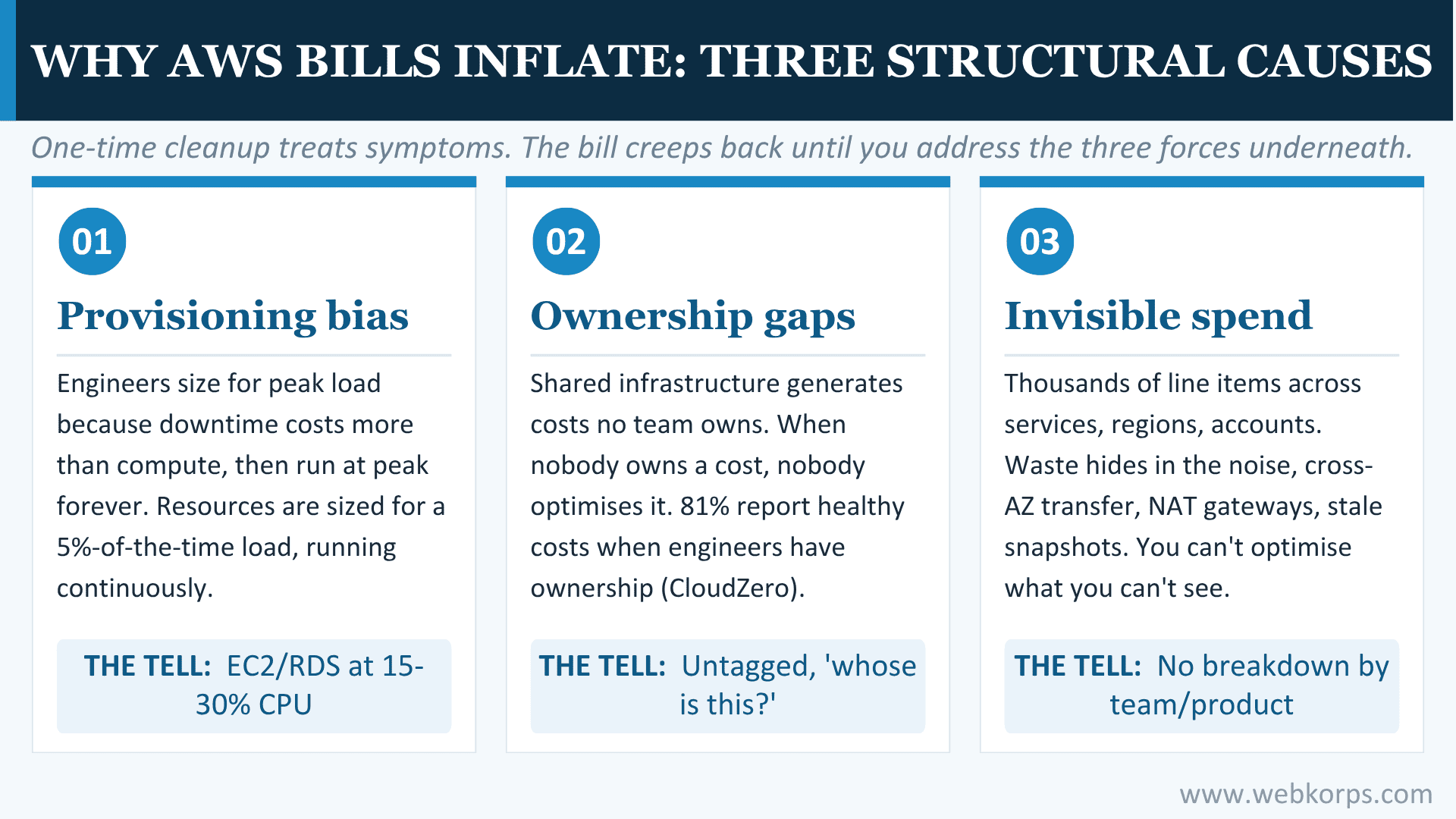
Why AWS Bills Inflate: Three Structural Causes
1. Provisioning Bias – Engineers Rationally Size for Peak, Then Run at Peak Forever
Engineers provision for the worst case because downtime costs more than compute, rational, not careless. As AWS Well-Architected puts it, teams “overcompensate just in case,” and over-provisioning becomes the baseline.
- The tell: EC2 and RDS fleets running at 15–30% average CPU, Kubernetes nodes scaling on overstated requests, not real usage.
- Why cleanup fails: rightsizing once doesn’t change the instinct that created the oversizing; the next workload is provisioned for peak too.
2. Ownership Gaps: Costs Nobody Owns, Nobody Optimises
Shared infrastructure generates costs no single team owns, and when nobody owns a cost, nobody optimises it. CloudZero found 81% report healthy costs when engineers share ownership.
- The tell: untagged resources, “whose is this?” threads in every budget review, costs that finance can see but no engineer feels responsible for.
- Why cleanup fails: a central team can delete an orphaned volume, but it can’t make a thousand weekly architecture decisions cost-aware. Only owners can.
3. Invisible Spend – You Can’t Optimise What You Can’t See
AWS bills hide waste in thousands of line items: cross-AZ transfer, NAT Gateway charges, stale snapshots. AWS Well-Architected and the FinOps Foundation agree, you cannot optimise what you cannot see.
- The tell: the bill can’t be broken down by team, product, or feature; “other” and “data transfer” are among your largest line items.
- Why cleanup fails: without attribution, cost-cutting eliminates spend that was generating value alongside spend that wasn’t; you cut blind.
Ready to optimize your AWS costs? Let’s talk
Where the Money Actually Goes: Five Biggest AWS Leaks
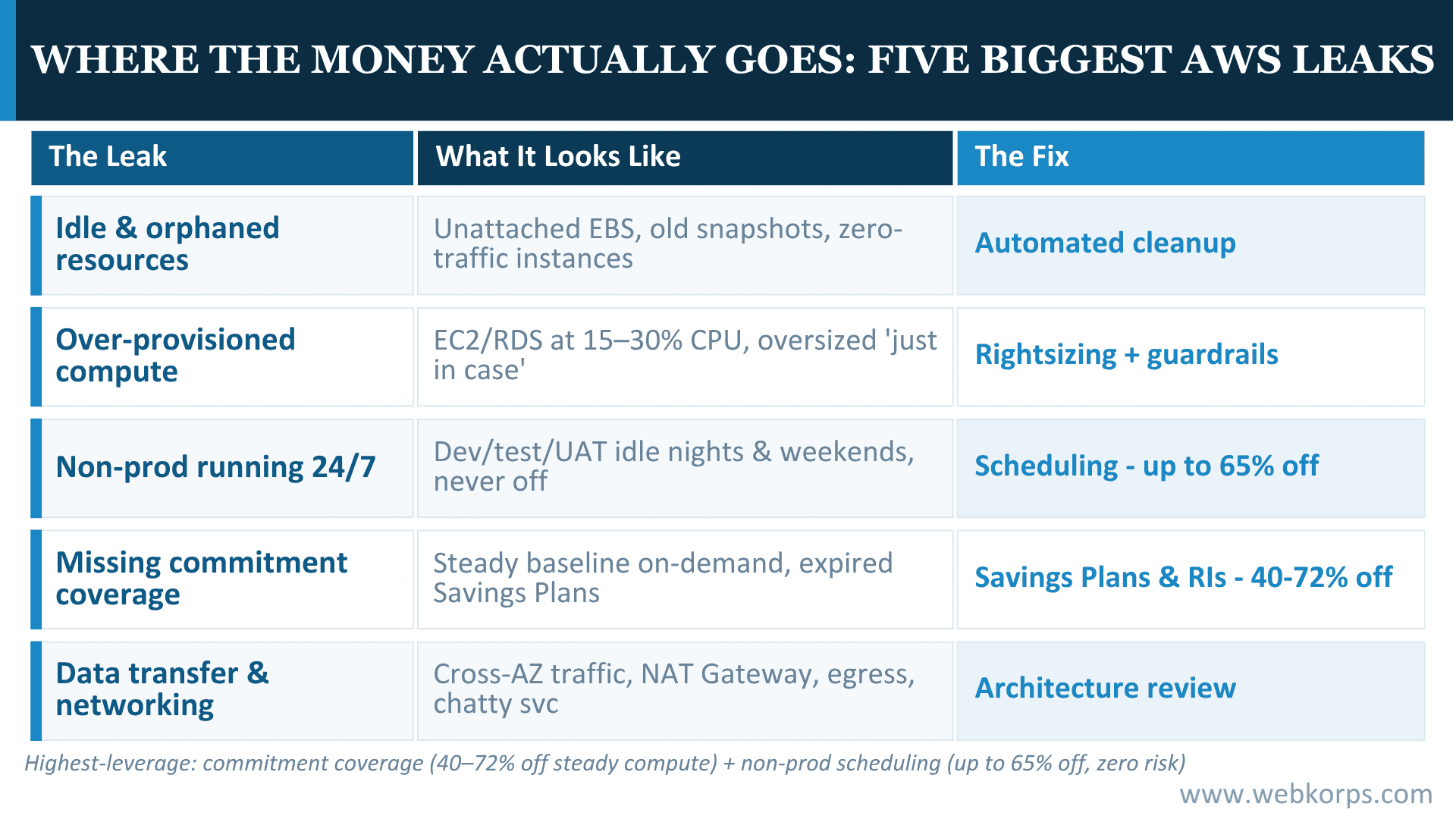
The three forces show up as concrete, recurring line items. Across a hundred AWS accounts, the same five leaks account for most recoverable waste.
| The Leak | What It Looks Like | The Fix (Framework Area) |
|---|---|---|
| Idle & orphaned resources | Unattached EBS, old snapshots, zero-traffic instances, forgotten dev | Automated cleanup, Optimize phase |
| Over-provisioned compute | EC2/RDS at 15–30% CPU; oversized ‘just in case’ | Rightsizing with guardrails, Cost-effective resources |
| Non-prod running 24/7 | Dev/test/UAT idle nights & weekends but never switched off | Scheduling, up to 65% off non-prod |
| Missing commitment coverage | Steady baseline on on-demand; expired/underused Savings Plans | Savings Plans & RIs, Manage demand & supply |
| Data transfer & networking | Cross-AZ traffic, NAT Gateway processing, egress, chatty services | Architecture review, Optimize over time |
Two levers deserve special note. Commitment coverage (Reserved Instances and Savings Plans) is the single biggest lever, cutting compute costs 40-72% versus on-demand for steady workloads, yet it routinely drifts as coverage lapses. Non-production scheduling is the fastest, lowest-risk win: dev, test, and UAT sit idle every night and weekend, so switching them off after hours cuts their compute cost up to 65% with zero impact.
A Fix That Isn’t a Cleanup: FinOps as an Operating Model
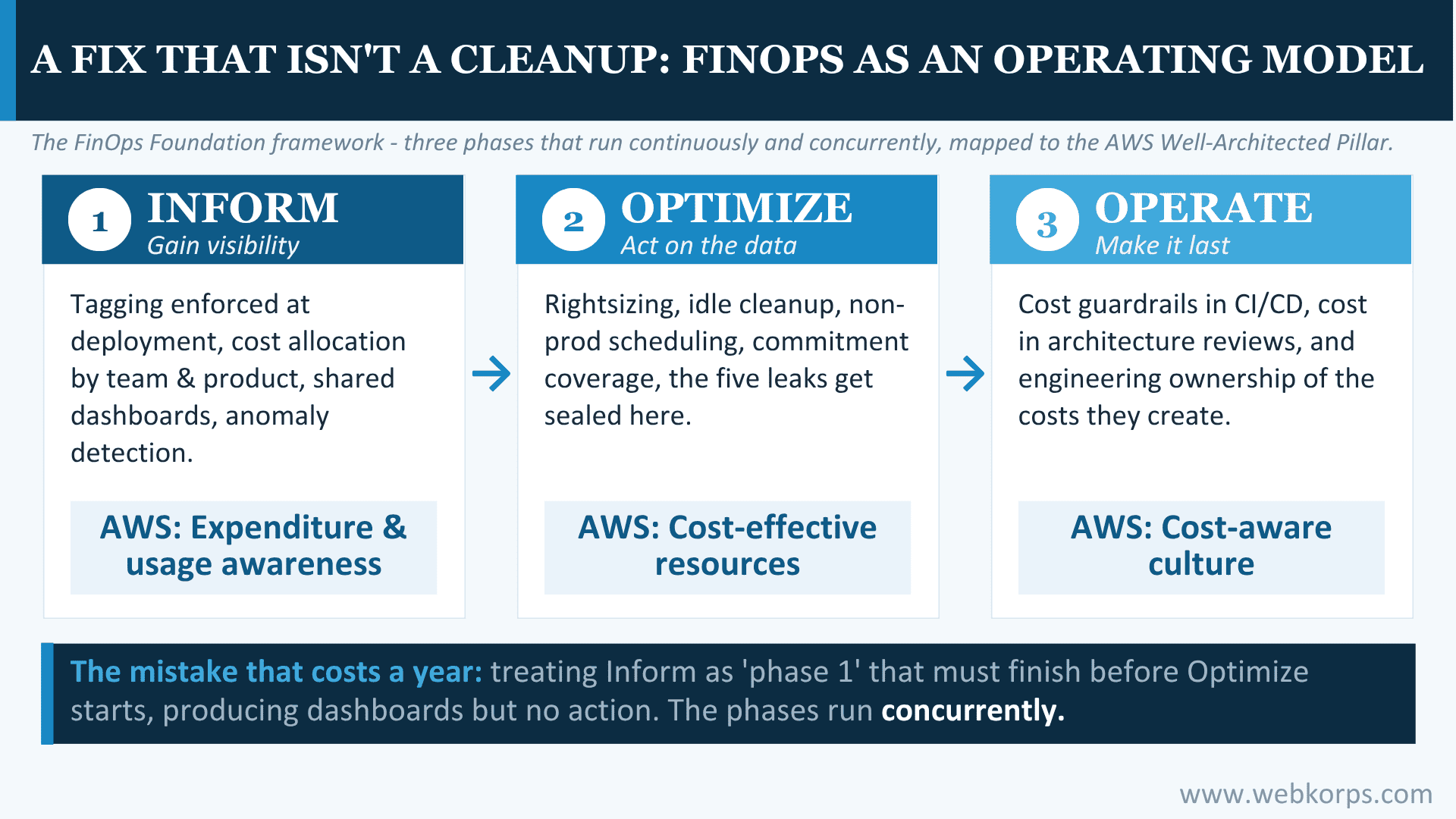
One reframing separates teams who fix their AWS bill from teams who fight it forever: cost optimization is not a project with an end date; it’s a continuous practice. FinOps Foundation, the Linux Foundation body maintaining the de facto standard for cloud financial management, with over 12,000 certified practitioners, defines that practice as a loop of three phases that run concurrently, not sequentially.
- Inform – you can’t optimise what you can’t see: Tagging enforced at deployment, cost allocation by team and product, shared dashboards, anomaly detection. Maps to AWS Well-Architected’s “expenditure and usage awareness.” Without it, every downstream action is guesswork.
- Optimize – act on what the data reveals: Rightsizing, idle cleanup, non-prod scheduling, commitment coverage, where the five leaks get sealed. AWS Well-Architected frames this as “cost-effective resources” and “manage demand and supply.” Optimise with performance guardrails, so engineering trusts the recommendations enough to act.
- Operate – make it continuous and cultural: Cost estimates in architecture reviews, guardrails in CI/CD, monthly commitment reviews, and engineers owning the costs they create. That last point is the FinOps Foundation’s central principle: everyone owns their usage, and what AWS Well-Architected calls a “cost-aware culture.” Optimisation that isn’t owned doesn’t last.
“The most common implementation mistake is treating Inform as ‘phase 1’ that must complete before Optimize starts. That produces a year of building dashboards without ever taking action.”
– On the FinOps Foundation Framework
Both frameworks agree: AWS Well-Architected opens with “practice cloud financial management” as a capability you build like security or operations, and the FinOps Foundation insists the three phases run concurrently, engineering optimising while finance informs while leadership operates. Organisations stuck at 32% waste treat cost as a quarterly fire drill; the ones down at 15% run the loop every week.
| THE ONE DISTINCTION THAT REFRAMES EVERYTHING |
| A cleanup deletes idle resources and buys one cheaper month. A FinOps practice changes how provisioning, ownership, and visibility work, so the waste stops regenerating. Gartner and the FinOps Foundation put the gap between ad-hoc cost-cutting (35-40% waste) and a structured program (15-20%) at roughly half your recoverable spend. Which tool you buy matters far less than whether you run the loop. |
Read also: How Cloud Application Development Drives Digital Transformation
A Starting Sequence for Infrastructure Leaders
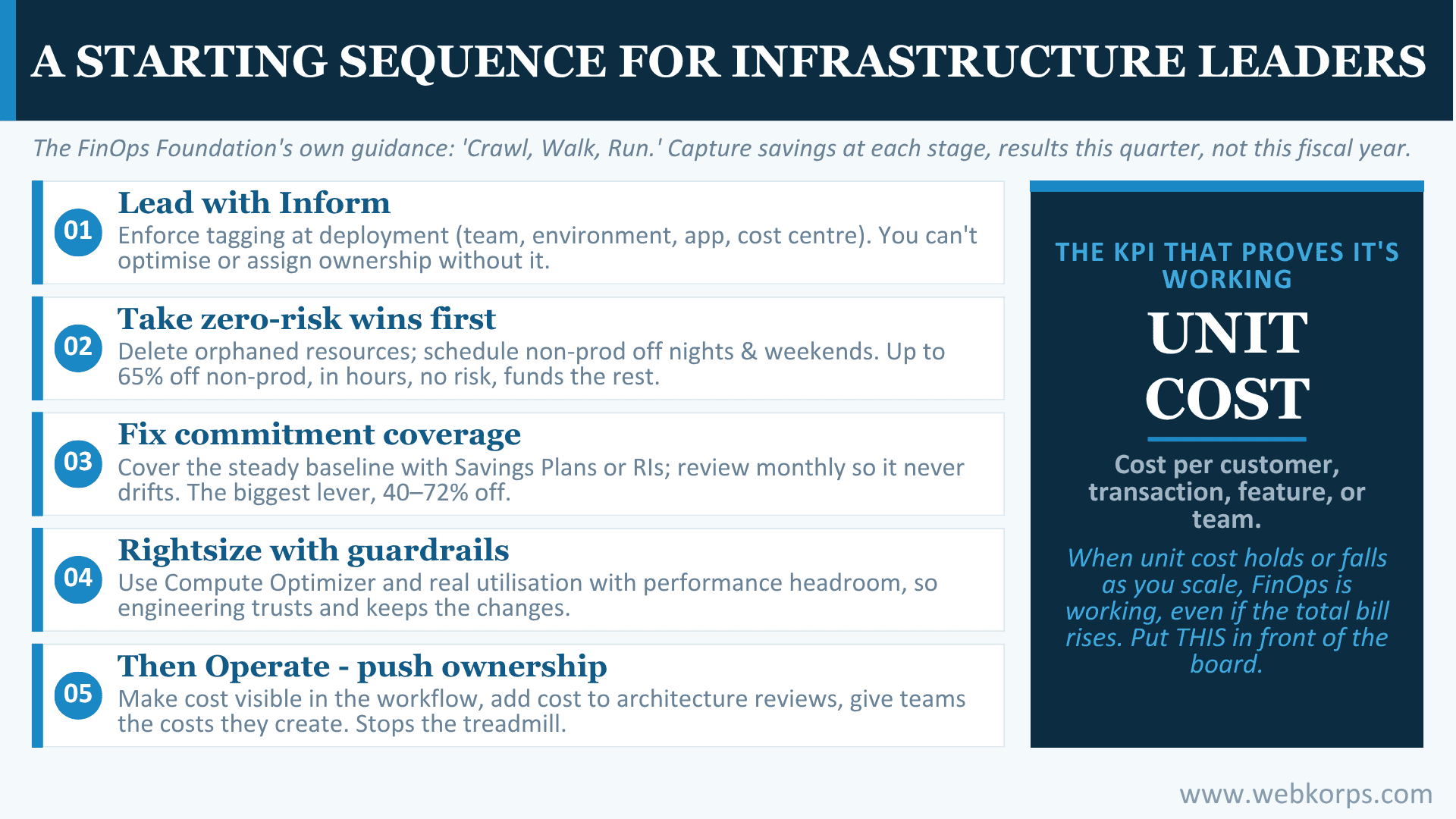
The FinOps Foundation’s guidance is “Crawl, Walk, Run”: start small, capture savings at each stage.
- Lead with Inform – get one shared, attributed dashboard. Enforce tagging at deployment (team, environment, application, cost centre). No optimisation or ownership is possible without it.
- Take the zero-risk wins first. Delete orphaned resources; schedule non-production off nights and weekends, up to 65% off, in hours, and it funds the rest.
- Fix commitment coverage. Cover the steady baseline with Savings Plans or RIs, reviewed monthly; the single biggest lever, 40-72% off.
- Rightsize with guardrails. Use AWS Compute Optimizer and real utilisation with performance headroom, so engineering keeps the changes.
- Then Operate – push ownership to engineers. Make costs visible in the workflow and give teams the costs they create. That stops the treadmill.
| KPI THAT TELLS YOU IT’S WORKING |
| Rising total spend may just mean the business is growing. The efficiency metric is unit cost, cost per customer, transaction, feature, or team. When unit cost holds or falls as you scale, FinOps is working. That’s the number for the board, not the raw invoice. |
How Webkorps Runs FinOps for AWS
Most teams don’t have an AWS pricing problem; they have a structural one that inflates the bill faster than manual cleanup can cut it. Webkorps runs FinOps the way the two frameworks prescribe: the continuous Inform-Optimize-Operate loop that keeps savings from creeping back: tagging governance and cost attribution (Inform); automated cleanup, guardrail-based rightsizing, scheduling, and commitment management (Optimize); and CI/CD guardrails plus engineering ownership (Operate). Framework-aligned to the FinOps Foundation and AWS Well-Architected Cost Optimization Pillar, delivered by an ISO 27001, CMMI Level 3 partner, and measured on unit cost, so you prove efficiency to the board even as you scale.
Stop Cutting the Bill. Start Running the Loop
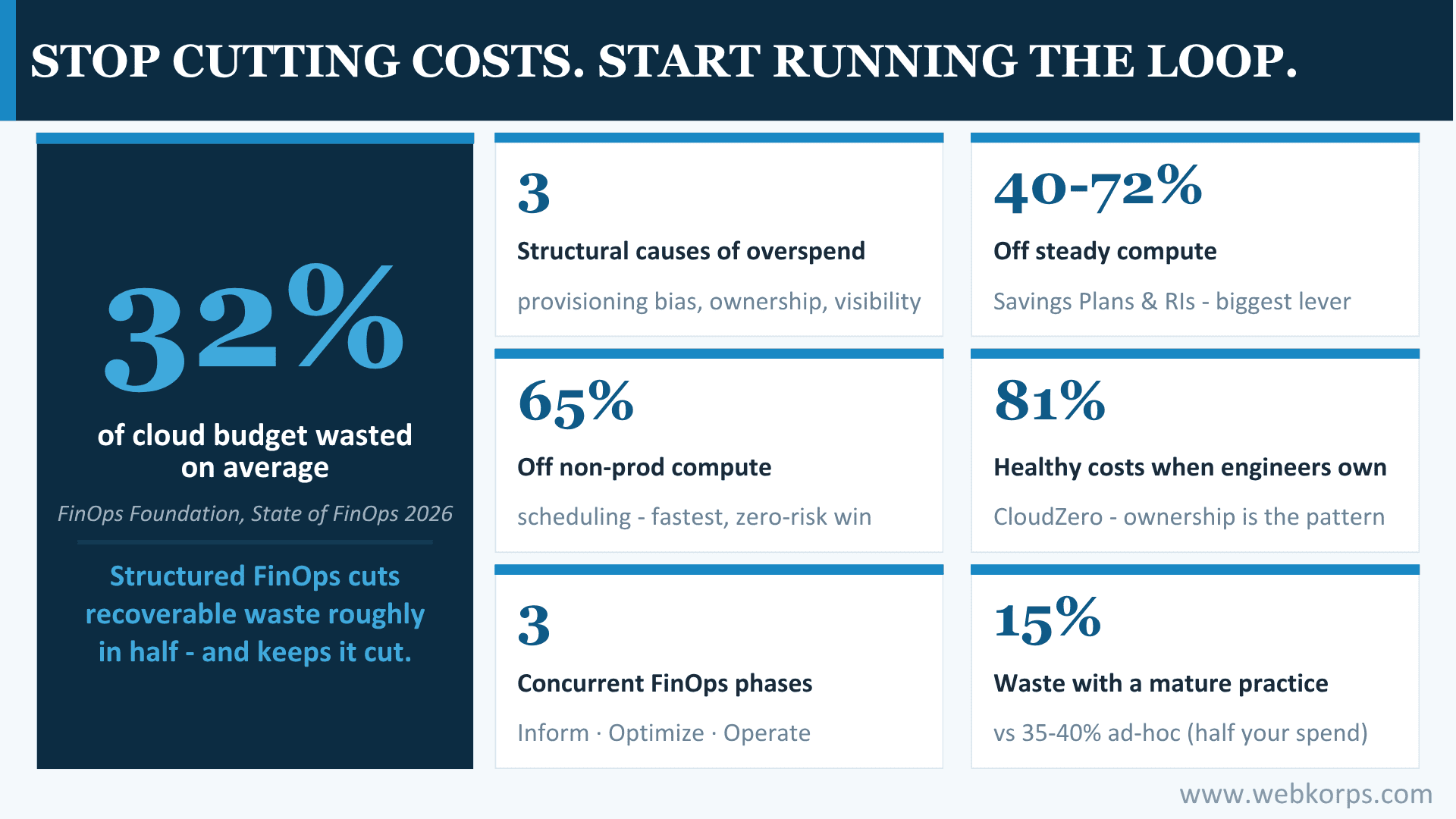
VP who forwarded that 18%-higher bill was asking the right question about the wrong thing. The why was never a single runaway resource; it was provisioning bias, ownership gaps, and invisible spend doing what they always do: delete every idle volume tonight, and the bill drifts right back up, because the forces that inflated it are still running. AWS cost optimization is not a task you complete; it’s a loop you run: Inform, so you can see; Optimize, so you can act; Operate, so it lasts. The FinOps Foundation and the AWS Well-Architected Cost Optimization Pillar describe the same operating model, and organisations that adopt it don’t just get a cheaper month; they cut recoverable waste roughly in half, and keep it cut. Do that, and next time the bill arrives, “Why?” has an answer on a dashboard before finance ever asks.
| Find Out Exactly Where Your AWS Bill Is Leaking |
| Webkorps runs FinOps and cloud cost optimization the way the FinOps Foundation and the AWS Well-Architected Cost Optimization Pillar prescribe: not a one-time cleanup, but a continuous Inform-Optimize-Operate practice that keeps the savings from creeping back. ISO 27001 certified. CMMI Level 3. 250+ engineers across 30+ countries. |
| Book an AWS Cost Assessment |
| Explore Our Cloud & DevOps Practice |
Read also: Why Cloud Solutions Are Essential for Modern Businesses
Frequently Asked Questions
Q: Why is my AWS bill so high?
Three structural forces inflate it automatically: provisioning bias, ownership gaps, and invisible spend. The FinOps Foundation finds organisations waste 32% of cloud budget on average, and one-time cleanups don’t stop it regenerating.
Q: What is FinOps and how does it reduce AWS costs?
FinOps is an operating model uniting engineering, finance, and business around cost accountability. It cuts AWS spend through a continuous Inform-Optimize-Operate loop, reducing waste from 35-40% to 15-20%.
Q: What are the FinOps Inform, Optimize, and Operate phases?
Three concurrent phases of the FinOps Foundation framework: Inform establishes visibility, Optimize acts on the data, and Operate makes it continuous. The common mistake is treating Inform as a gate that must finish first.
Q: How much can I realistically save on AWS with FinOps?
Structured FinOps cuts waste from 35-40% to 15-20%, roughly half your wasted spend. Benchmarks put achievable AWS reductions at 30-50% with no code changes; commitment coverage alone saves 40-72%.
Q: What is the AWS Well-Architected Cost Optimization Pillar?
AWS’s framework for running workloads at the lowest price point, defined by five focus areas: cloud financial management, expenditure and usage awareness, cost-effective resources, managing demand and supply, and optimizing over time. These map onto the FinOps Foundation’s phases.
Q: Is AWS cost optimization a one-time project or an ongoing practice?
Ongoing. A cleanup buys one cheaper month, but structural forces regenerate the waste. Both the FinOps Foundation and AWS Well-Architected frame it as a continuous Inform-Optimize-Operate loop, not a one-time project.