
 Posted by
 The Real Cost of Hiring a Senior Engineer in 2026
| Metric | Figure | Source |
|---|---|---|
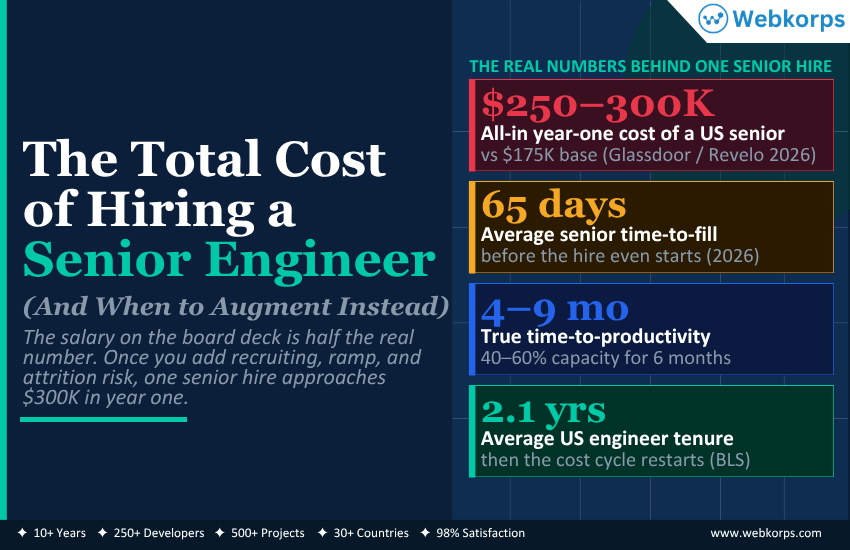
| All-in year-one cost of a US senior engineer | $250K-$300K | Glassdoor / Revelo 2026 |
| Average time-to-fill for a senior engineer | 65 days | TechHiringCost 2026 |
| True time-to-productivity on a real codebase | 4-9 months | First Round / Onboarding Cost |
| Average US engineer tenure, then the cycle restarts | 2.1 years | BLS |
A VP of Engineering approves a senior hire at $175,000. That is the number that goes in the board deck, the number Finance models, the number everyone agrees on. Eleven months later, the actual cost of that one engineer has crossed $270,000, and the role still has another month before the new hire is fully productive. The salary was never the cost. It was the down payment.
This is the gap every VP of Engineering and Head of Talent Acquisition is managing in 2026, whether or not it appears in their budget model. The all-in, year-one cost of a single US senior software engineer now lands between $250,000 and $300,000 once you add employer taxes, benefits, equity, recruiter fees, and ramp, against an average base of $175,559 (Glassdoor 2026). The headline salary captures barely 60% of what the hire actually costs.
None of this means hiring senior engineers is wrong. For the right roles, a full-time senior hire is the best investment an engineering org can make. But the decision is only rational if the real number is on the table, and for a large class of work, the math points somewhere else entirely. This guide breaks down the complete, sourced cost of a senior hire in 2026, then gives VPEng and TA leaders a clear framework for the question that follows: when do you hire, and when do you augment instead?
Table of Contents
The Full Cost Breakdown: What a Senior Hire Actually Costs
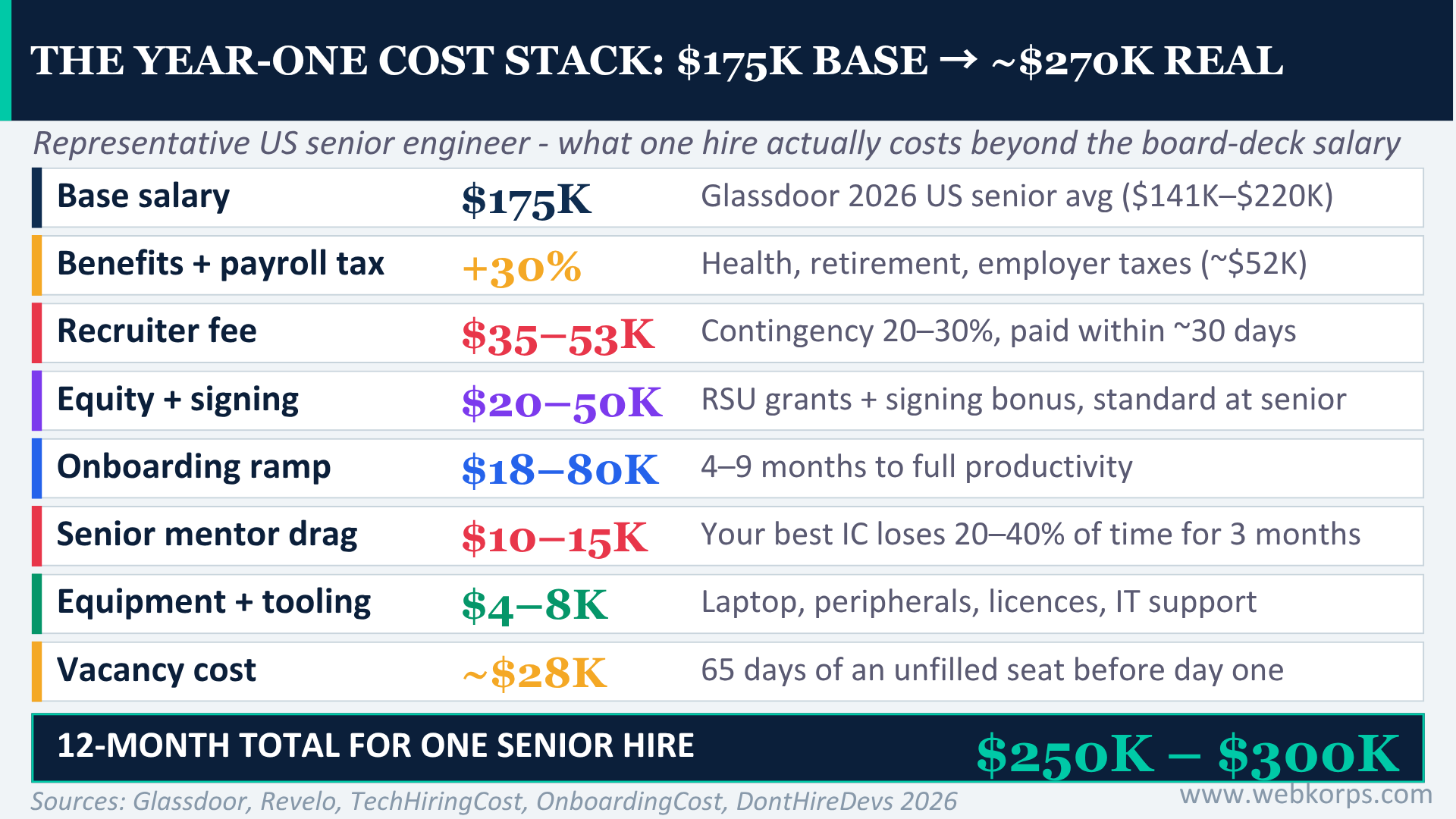
Compensation data from Levels.fyi shows just how wide the senior band runs: a Senior Software Engineer at a top employer like LinkedIn carries a median total compensation of around $295,000-$318,000 in major markets, while Glassdoor’s broader 2026 market average for senior base sits at $175,559. But base, wherever it lands in that range, is only the first line. Here is the full stack of costs for a representative $175K senior hire.
Year-one cost stack, representative US senior engineer ($175K base)
| Base salary | $175K | Glassdoor 2026 US senior average ($141K-$220K range) |
| Benefits + payroll tax | +30% | Health, retirement, employer taxes, roughly $52K |
| Recruiter fee | $35K-$53K | Contingency 20-30% of first-year salary, paid in ~30 days |
| Equity + signing | $20K-$50K | RSU grants and signing bonuses are standard at the senior level |
| Onboarding ramp | $18K-$80K | 4-9 months to full productivity; 40-60% capacity for 6 months |
| Senior mentor drag | $10K-$15K | Your best IC loses 20-40% of their time for the first 3 months |
| Equipment + tooling | $4K-$8K | Laptop, peripherals, software licences, IT support |
| Vacancy cost | ~$28K | 65 days of an unfilled seat before the hire even starts |
Add it up, and the picture is unambiguous. Multiple independent 2026 analyses converge on the same range: a single senior hire runs a 12-month total of $220,000-$300,000, with the first three months alone contributing $60,000-$80,000 before a single fully-productive sprint is delivered. As one breakdown put it, the real monthly cost of a senior engineer in year one is $18,000=$19,800, ‘$50,000-$70,000 more than the number in the board deck.’
“The first three months contribute roughly $60,000-$80,000 of the total, before you see a single fully-productive sprint from the new engineer.”
– The Real Cost of Hiring a Software Engineer in 2026
Also read: IT Staff Augmentation vs Managed Services
The Costs That Don’t Appear in the Budget Model
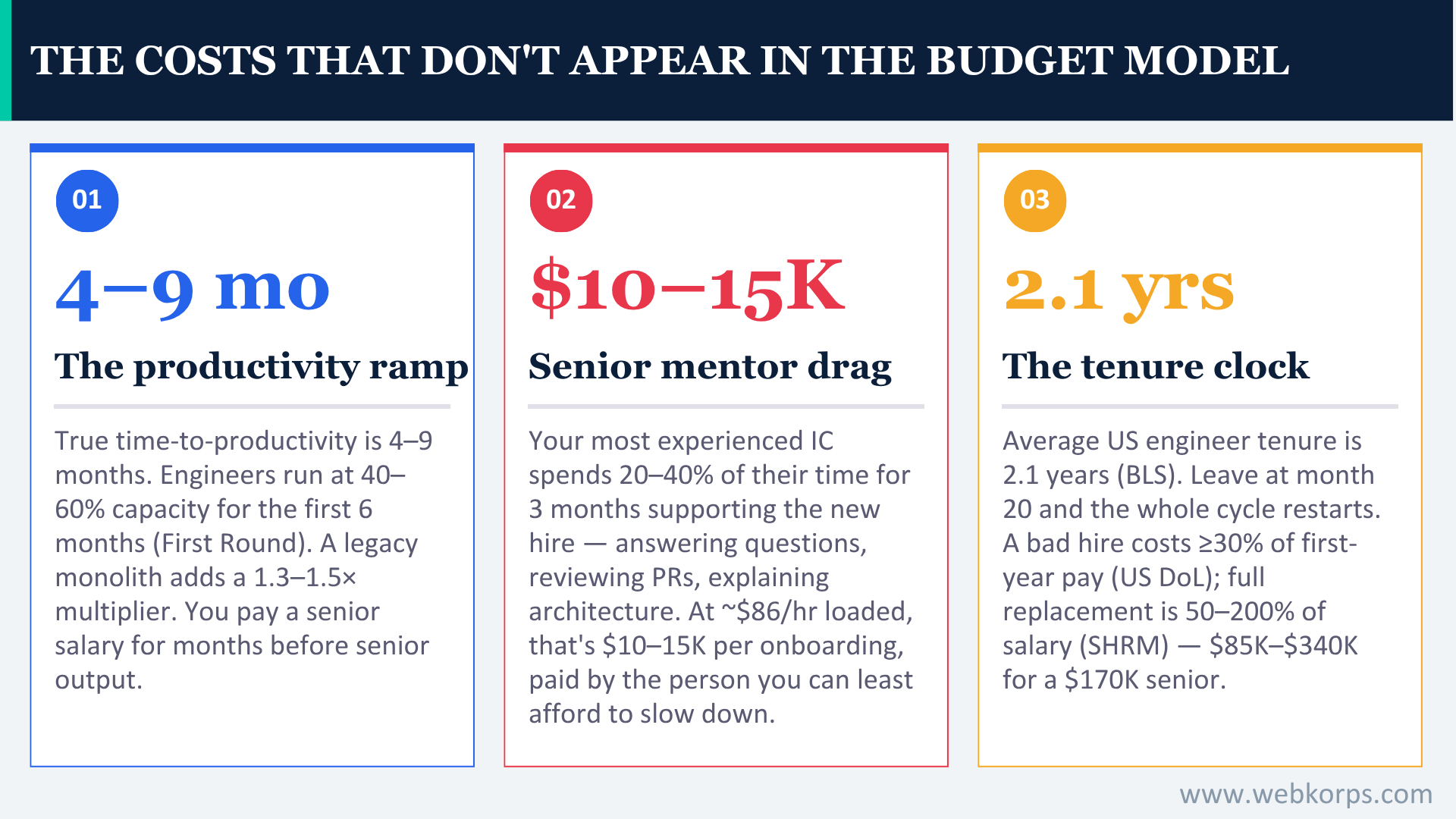
The cost stack above is the predictable part. The costs that actually destroy hiring ROI are the ones no budget model captures, because they only materialise later.
The 4-9 month productivity ramp
Formal onboarding runs 30-90 days, but true time-to-productivity ranges from 4 to 9 months depending on codebase complexity. First Round Capital research finds that most engineers operate at 40-60% of full capacity for their first six months. A legacy monolith adds a 1.3-1.5× multiplier versus a documented greenfield codebase. You are paying a senior salary for months before you receive senior output.
Senior mentor drag, the cost almost nobody models
When a new engineer joins, your most experienced IC, the highest-leverage person on the team, typically spends 20-40% of their working hours for the first three months answering questions, reviewing PRs, and explaining architecture. At a fully-loaded $86/hour for a senior, that is $10,000-$15,000 of hidden cost per onboarding cycle, paid in the productivity of the person you can least afford to slow down.
The 2.1-year tenure clock
The average US software engineer tenure is 2.1 years (BLS). If a hire leaves at month 20, the entire cost cycle restarts immediately, including recruiter fee, ramp, and knowledge-transfer loss. The US Department of Labor estimates a bad hire costs at least 30% of first-year earnings; SHRM puts full replacement cost at 50-200% of annual salary. For a $170K senior, a single mis-hire or early departure can cost $85,000-$340,000.
| THE NUMBER THAT SHOULD BE IN EVERY BOARD DECK |
| Predictable year-one cost of a $175K senior hire: $250K-$300K. Add the probability-weighted cost of a 2.1-year tenure and a 30-200% replacement risk, and the true expected cost of ‘one senior engineer’ over a realistic horizon is materially higher than any single-year salary line suggests. This is the number the augment-vs-hire decision should be measured against, not the base. |
Read Also: Why Startups and Enterprises Choose IT Staff Augmentation
The Augment Alternative: What the Comparison Actually Looks Like
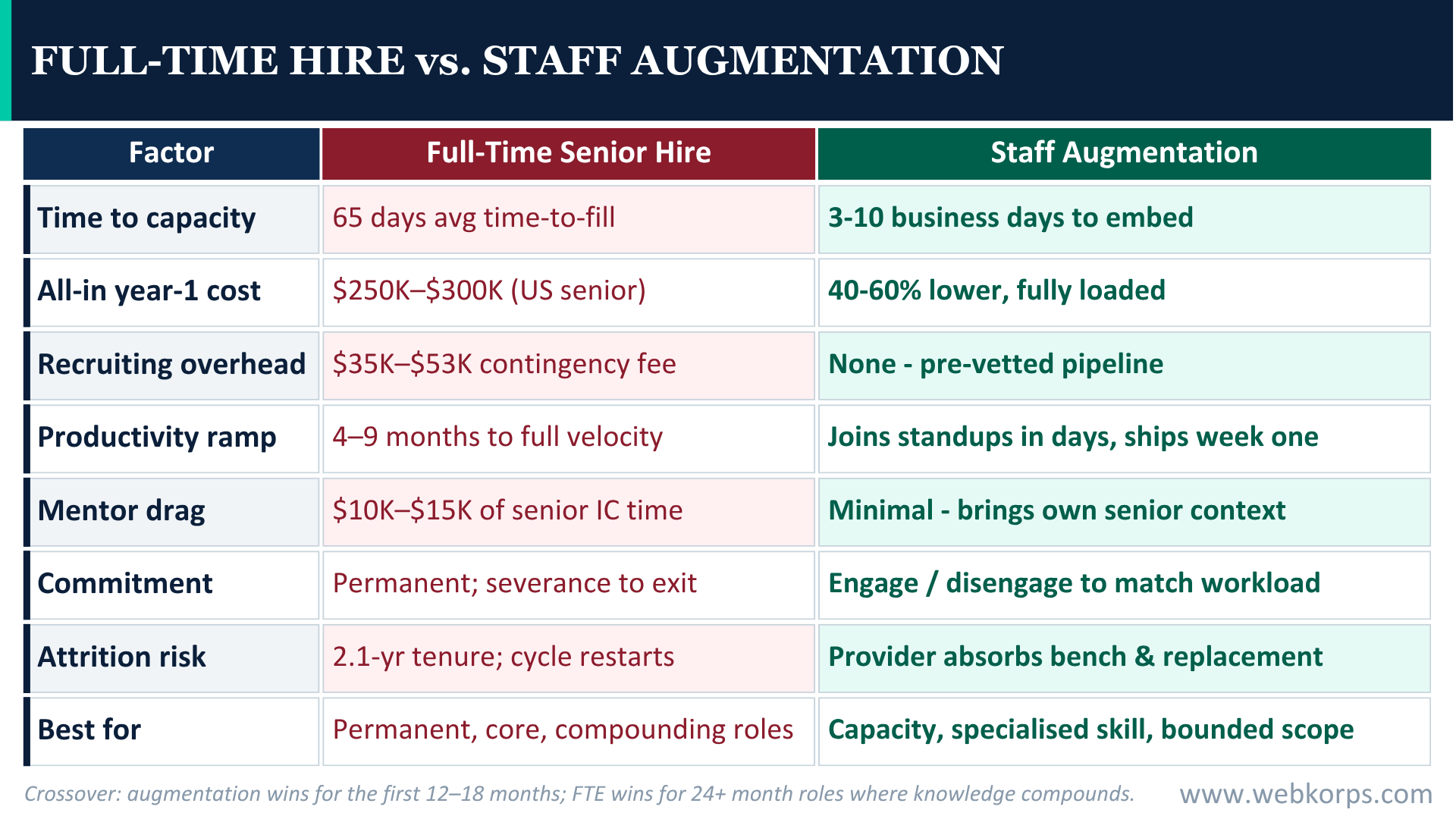
Staff augmentation embeds an external senior engineer directly into your team, under your management, in your tools, on your sprint cadence. It is not outsourcing, and it is not a freelancer marketplace; you retain full control of the work, and you extend capacity without the fixed cost of a permanent hire. In 2026, the model has moved from a tactical workaround to standard operating practice, with Gartner citing AI and cost pressure as the two forces accelerating the shift toward flexible staffing.
The honest comparison is more nuanced than ‘contractor hourly rate vs. salary.’ Per hour, a fully-utilised FTE can be cheaper than augmentation. The augmentation advantage shows up in four places the hourly comparison misses: speed to capacity, zero recruiting overhead, no ramp tail, and the ability to scale capacity up and down with the actual workload rather than carrying fixed headcount through quiet quarters.
| Factor | Full-Time Senior Hire | Staff Augmentation |
|---|---|---|
| Time to capacity | 65 days avg time-to-fill | 3-10 business days to embed |
| All-in year-1 cost | $250K-$300K (US senior) | 40-60% lower, fully loaded |
| Recruiting overhead | $35K-$53K contingency fee | None, pre-vetted pipeline |
| Productivity ramp | 4-9 months to full velocity | Joins standups in days, ships week one |
| Mentor drag | $10K-$15K of senior IC time | Minimal, brings own senior context |
| Commitment | Permanent; severance to exit | Engage / disengage to match workload |
| Attrition risk | 2.1-yr tenure; cycle restarts | Provider absorbs bench & replacement |
| Best for | Permanent, core, knowledge-compounding roles | Capacity, specialised skill, bounded scope |
The economics have a clear crossover. The general pattern across 2026 analyses: augmentation is more cost-effective for the first 12-18 months of an engagement; full-time hiring becomes more cost-effective for roles lasting 24+ months where institutional knowledge compounds. For a 6-12 month need, a post-Series-A output crunch, a fixed-scope build, a specialised skill you don’t have in-house, the augmentation math is decisive. A dedicated senior engineer who joins in 72 hours and costs a fraction of a US hire’s loaded rate, with no recruiting tail and no severance risk, is simply the better instrument for that job.
The Decision Framework: When to Hire, When to Augment
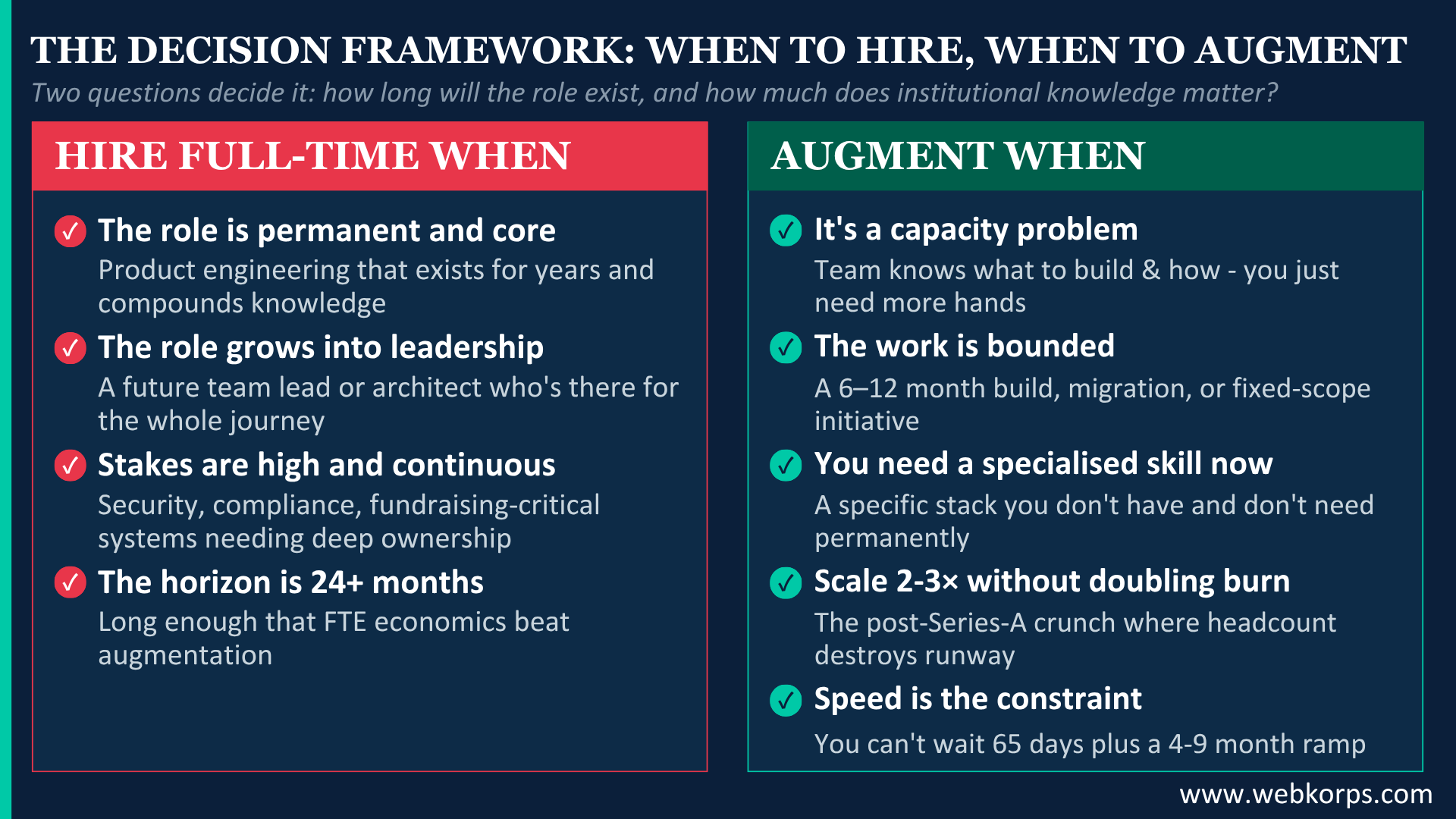
Cost is a constraint, not the deciding factor. The two questions that actually decide it: how long will this role exist, and how much does institutional knowledge matter? Layer on a third, is this a capacity problem or a capability problem?, The right model becomes clear. Use this framework.
Hire full-time when:
- The role is permanent and core, product engineering that will exist for years and compound institutional knowledge
- The role grows into leadership, a future team lead or architect who should be there for the whole journey
- The stakes are high and continuous, security, compliance, or fundraising-critical systems that demand deep, permanent ownership
- The horizon is 24+ months, long enough that FTE economics beat augmentation, and knowledge accumulation pays off
Augment when:
- It’s a capacity problem, not a capability gap. Your team knows what to build and how; you simply need more hands against a defined backlog
- The work is bounded, a 6-12 month build, a migration, a fixed-scope initiative with a clear end
- You need a specialised skill now, a specific stack (React, Node, Python, ML, DevOps) you don’t have and don’t need permanently
- You need to scale 2-3× without doubling burn, the classic post-Series-A crunch where the board expects 2× output, and doubling local headcount destroys runway
- Speed is the constraint; you cannot wait 65 days plus a 4-9 month ramp for the capacity you need this quarter
THE CAPACITY VS. CAPABILITY TEST
A capacity problem means your team knows what to build and how to build it, you just need more hands executing against a defined backlog. A capability problem means you need expertise your team doesn’t have. Capacity problems and bounded capability gaps are the clearest cases for augmentation. Permanent, knowledge-compounding ownership is the clearest case for a hire. Most engineering orgs have both; the mistake is using one instrument for every job.
How Webkorps Augments Engineering Teams
Webkorps provides senior engineering capacity through staff augmentation, pre-vetted engineers embedded into your team, under your management, in your tools, aligned to your sprint cadence. You get the output of a senior hire without the recruiting tail, the ramp, the mentor drag, or the severance risk. The model is built for exactly the scenarios the framework above identifies: capacity crunches, bounded builds, specialised skills, and 2-3× scaling without doubling burn.
What the engagement looks like in practice:
- Days, not months: pre-vetted senior engineers embedded in 3-10 business days against your brief, versus a 65-day average time-to-fill
- Under your management: augmented engineers work inside your tools, your repos, and your sprint cadence. You direct the work, and we extend the capacity
- No recruiting or attrition overhead: no contingency fees, no bench cost, no severance risk, we absorb the pipeline and replacement burden
- Senior, specialised, ready: the full stack, backend, frontend, mobile, cloud, DevOps, AI/ML, with engineers who bring their own senior context and ship in week one
- Scale up and down with the roadmap: expand for a crunch, contract when it passes, capacity matched to actual workload, not fixed headcount
THE WEBKORPS ENGINEERING CAPACITY TRACK RECORD
250+ developers · 500+ projects across 30+ countries · ISO 27001 · CMMI Level 3. IT staff augmentation that embeds senior engineering capacity into your team in days, the flexible alternative to a $300K permanent commitment when the work calls for it.
The Salary Was Never the Cost
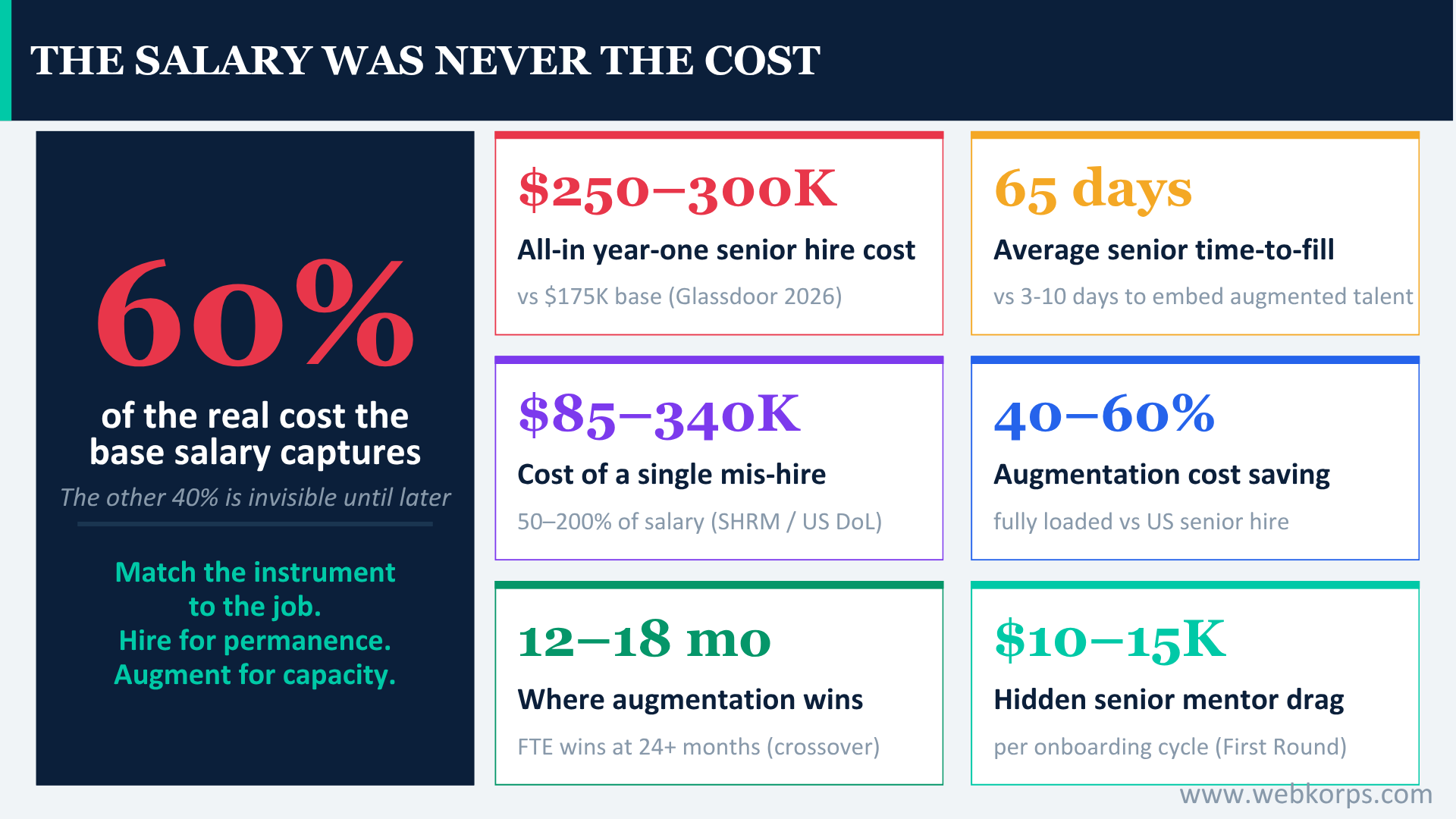
The VP who approved a $175K hire and watched it become a $270K line item didn’t make a mistake. For a permanent, core, knowledge-compounding role, that hire may be the best investment available. The mistake the data exposes is treating the salary as the cost, and treating the full-time hire as the only instrument. Once the real number is on the table, $250K-$300K in year one, a 65-day fill, a 4-9 month ramp, and a 2.1-year tenure clock, the augment-vs-hire decision stops being ideological and becomes arithmetic.
For permanent roles that compound institutional knowledge over a multi-year horizon, hire and budget the real number, not the base. For capacity crunches, bounded builds, specialised skills, and the post-Series-A scaling problem, augmentation is not the cheaper compromise; it is the better instrument, delivering senior capacity in days at 40-60% of the loaded cost, with the provider absorbing the recruiting and attrition risk that quietly inflates every permanent hire.
For VPEng and Heads of Talent Acquisition, the takeaway is not ‘augment instead of hiring.’ It is: know the real cost of both, match the instrument to the job, and stop letting the board-deck salary make a decision that the full math should make.
| Need Senior Engineering Capacity Without the $300K Commitment? |
| Webkorps embeds pre-vetted senior engineers into your team in days, not months, under your management, in your tools, on your sprint cadence. ISO 27001 certified. CMMI Level 3. 250+ developers across 30+ countries. Book a free staffing strategy call to model augment vs. hire for your roadmap. |
| Book a Staffing Strategy Call with Webkorps |
| Explore IT Staff Augmentation |
Frequently Asked Questions
Q: What is the total cost of hiring a senior engineer in 2026?
The all-in, year-one cost of a US senior software engineer is $250,000-$300,000, against an average base salary of about $175,559 (Glassdoor 2026). Beyond base, the stack includes ~30% in benefits and payroll tax, a 20-30% recruiter contingency fee ($35K-$53K), equity and signing ($20K-$50K), a 4-9 month productivity ramp, $10K-$15K in senior mentor drag, equipment, and roughly $28K in vacancy cost during a 65-day fill. The salary captures barely 60% of the real number.
Q: Why is the real cost so much higher than the salary?
Because most of the cost is invisible in the budget model. The salary is the only line most teams track, but recruiting fees, benefits, equity, and a 65-day vacancy are paid before the engineer is productive, and the 4-9 month ramp means you pay a senior salary for months before you get senior output. Add senior mentor drag (your best IC loses 20-40% of their time) and the 2.1-year average tenure that restarts the whole cycle, and the true expected cost runs well above any single-year salary figure.
Q: What are the hidden costs of hiring a software engineer?
Three costs rarely make it into the budget. First, the productivity ramp: 4-9 months to full velocity, at 40-60% capacity for the first six months (First Round Capital). Second, senior mentor drag: your most experienced engineer spends 20-40% of their time supporting the new hire for three months, worth $10K-$15K. Third, attrition risk: with a 2.1-year average tenure (BLS), early departure restarts the cycle, and SHRM puts full replacement cost at 50-200% of salary, $85K-$340K for a $170K senior.
Q: Is staff augmentation cheaper than hiring a full-time engineer?
It depends on the time horizon. Per hour, a fully-utilised full-time employee can be cheaper. But on a fully-loaded basis for bounded work, staff augmentation runs 40-60% lower than a US senior hire, with no recruiting fee, no ramp-up time, and no severance risk. The crossover: augmentation is more cost-effective for the first 12-18 months; full-time hiring wins for roles lasting 24+ months where institutional knowledge compounds. For a 6-12 month need, augmentation is decisively cheaper and faster.
Q: When should you augment instead of hiring a senior engineer?
Augment when it is a capacity problem, not a capability gap (your team knows what to build, you just need more hands), when the work is bounded (a 6-12 month build or migration), when you need a specialised skill you don’t need permanently, when you must scale 2-3× without doubling burn (the post-Series-A crunch), or when speed is the constraint and you can’t wait 65 days plus a ramp. Hire full-time for permanent, core, knowledge-compounding roles on a 24+ month horizon.
Q: How fast can staff augmentation add senior engineering capacity?
With an experienced augmentation partner, pre-vetted senior engineers can be embedded in 3-10 business days from your initial brief, versus an average 65-day time-to-fill for a full-time senior hire, and that 65 days is before the 4-9 month ramp to full productivity. Augmented engineers join your standups, work in your tools and repos under your management, and typically ship code in week one because they bring their own senior context rather than ramping on a new career’s worth of process.