
 Posted by
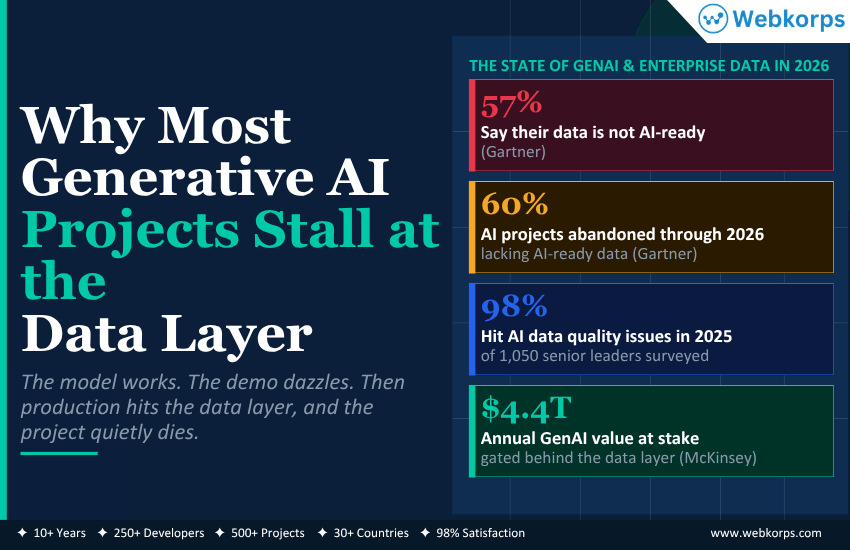
 The State of Generative AI & Enterprise Data in 2026
| Metric | Figure | Source |
|---|---|---|
| Organisations that say their data is not AI-ready | 57% | Gartner |
| AI projects lacking AI-ready data will be abandoned through 2026 | 60% | Gartner |
| Senior leaders who hit AI-related data quality issues in 2025 | 98% | 1,050-leader survey |
| Annual value GenAI could add – most gated behind the data layer | $4.4T | McKinsey |
A Chief Data Officer at a global insurer approved a generative AI assistant in early 2025. The pilot was flawless it answered policy questions, drafted correspondence, and summarised claims in a controlled demo. Eight months later, the project was dead. Not because the model failed, but because in production the assistant retrieved from policy documents scattered across three SharePoint sites, a legacy DMS, and an email archive nobody had catalogued. It cited expired policies. It surfaced documents employees weren’t cleared to see. It hallucinated when the right document wasn’t indexed. The model was never the problem. The data layer underneath it was never built.
This is the defining pattern of enterprise generative AI in 2026. MIT’s Project NANDA found that 95% of organisations deploying generative AI saw zero measurable return, and across MIT, Gartner, and RAND, the diagnosis converges on the same root cause. As one 2026 analysis put it bluntly: these are not AI failures. They are infrastructure failures wearing an AI label. The model is rarely the reason why a GenAI project dies. The data layer beneath it almost always is.
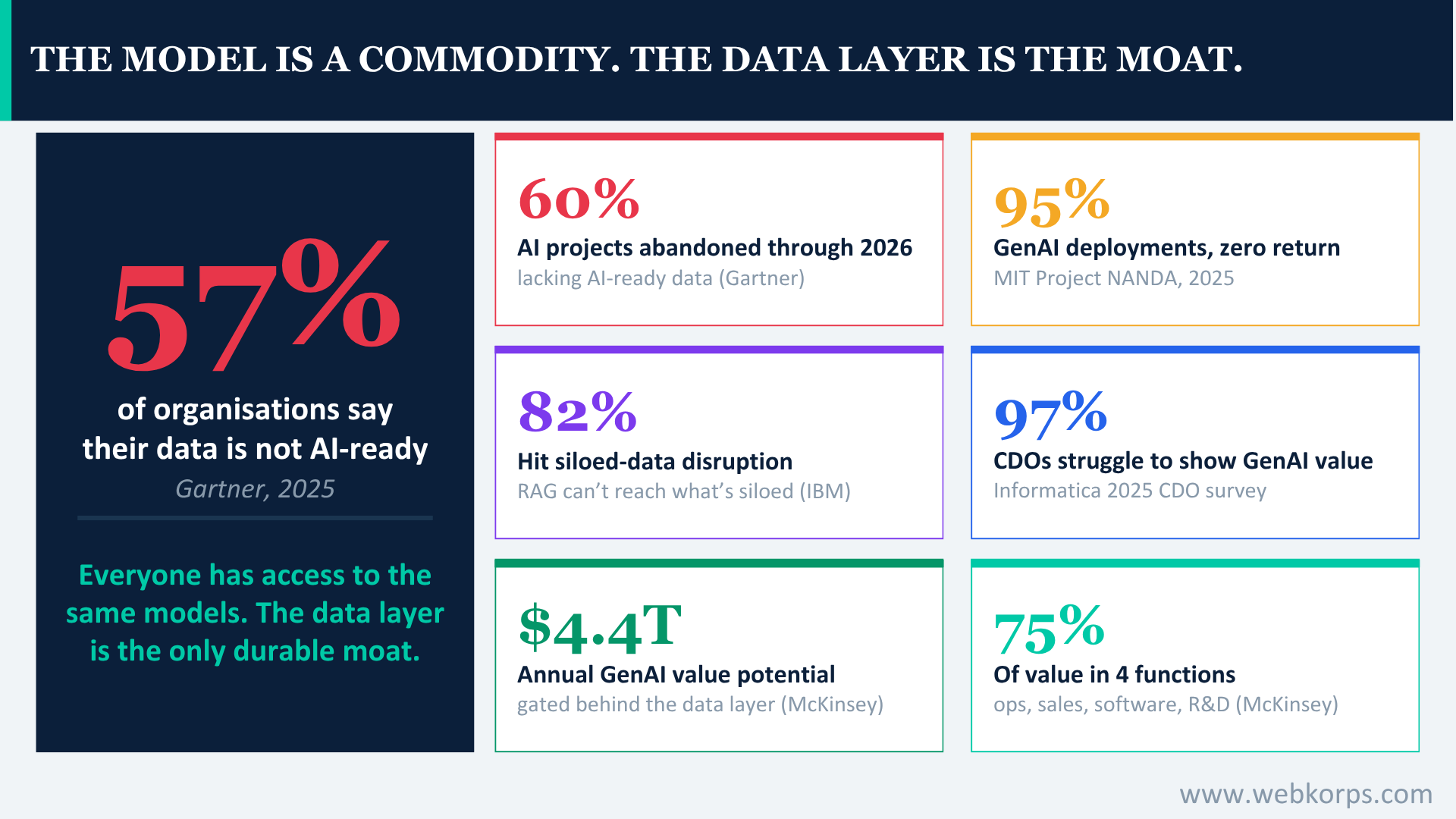
Generative AI made the data problem worse, not better. Traditional analytics ran on structured, governed tables. Generative AI runs on unstructured enterprise data, such as contracts, emails, PDFs, wikis, tickets, and tribal knowledge scattered across an organisation. Gartner reports that 57% of organisations estimate their data is not AI-ready, and predicts that 60% of AI projects lacking AI-ready data will be abandoned through 2026, a rate already at 42% of US companies.
This guide is written for CDOs and Heads of Data who own the layer where generative AI projects actually stall. It maps the five data-layer failures that kill GenAI before production, using a16z’s reference architecture for the LLM app stack to show where each failure lives, and McKinsey’s economic-potential research to frame what the stalled data layer is actually costing. The model is a commodity. The data layer is the moat and the bottleneck.
Table of Contents
Why the Data Layer Is Where Generative AI Actually Lives
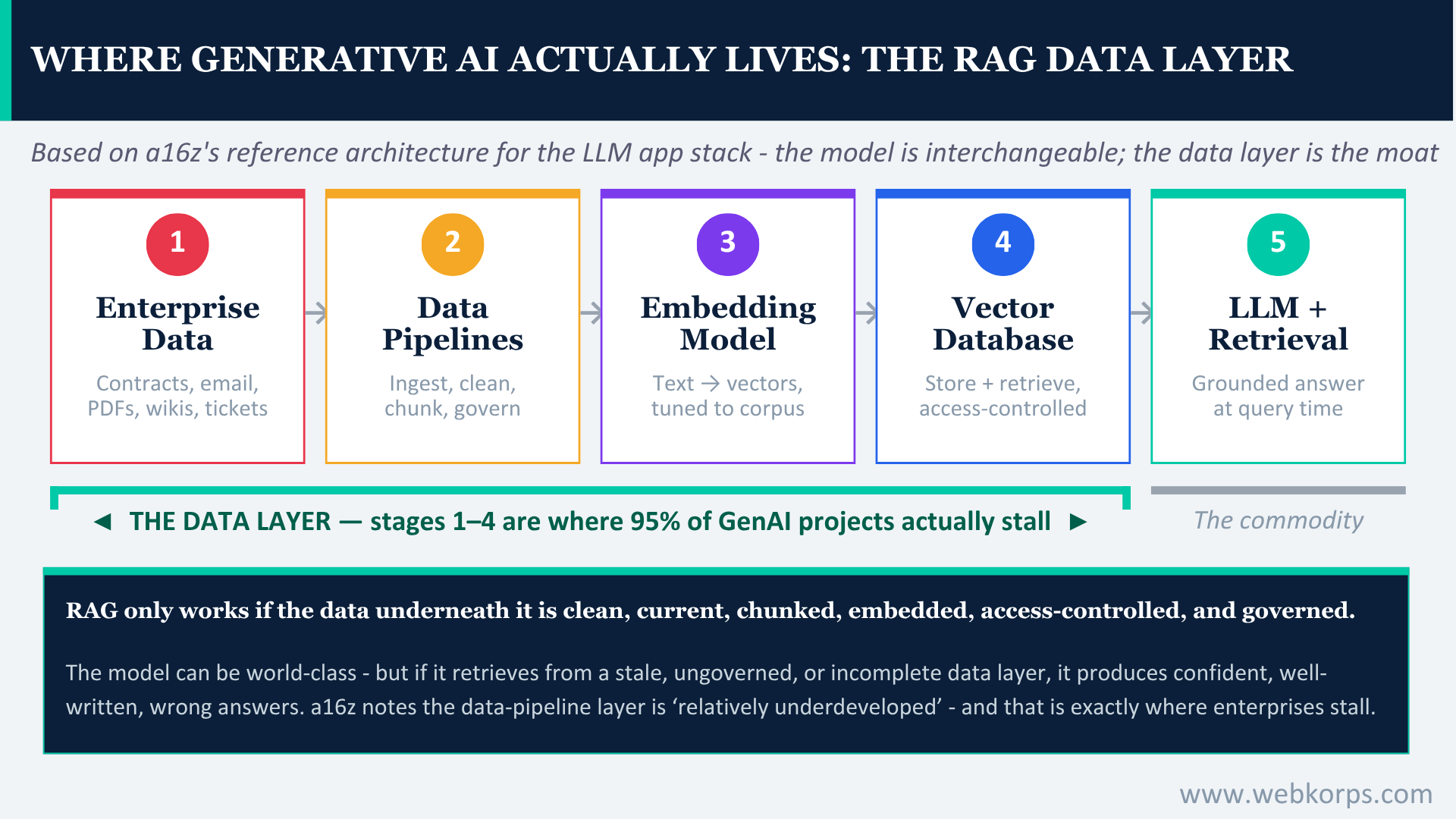
To understand why GenAI stalls at the data layer, you have to understand where the data layer sits in the stack. a16z’s widely adopted reference architecture for LLM applications describes a clear pattern: the model is only one component, and for enterprise use cases, it is not the component that does the differentiating work.
In the a16z stack, the dominant enterprise pattern is in-context learning via retrieval-augmented generation (RAG). The flow is: ingest private enterprise data through data pipelines, break it into chunks, pass it through an embedding model, store the vectors in a vector database, and at query time, retrieve the most relevant documents to ground the model’s response. The pre-trained model is interchangeable. The data pipeline, the embeddings, and the vector store are where your enterprise’s actual knowledge lives, and a16z itself notes the data-replication and pipeline piece of the stack is ‘relatively underdeveloped.’
This is the architectural truth most enterprises discover too late: RAG only works if the data underneath it is clean, current, chunked, embedded, access-controlled, and governed. The model can be world-class, but if it retrieves from a stale, ungoverned, or incomplete data layer, it produces confident, well-written, wrong answers. As the research puts it: garbage in, garbage out is no longer a cliche; it is the diagnosis for why so many AI pilots fail to reach production.
“AI readiness and unstructured data governance are now the same conversation. The AI models grounded on ungoverned content inherit every error, duplicate, and policy violation in the corpus.”
– Unstructured Data Governance Executive Playbook, 2026
The opportunity cost is staggering. McKinsey estimates generative AI could add $2.6 trillion to $4.4 trillion in value annually across 63 use cases, with about 75% concentrated in customer operations, marketing and sales, software engineering, and R&D. In banking alone, the figure is $200–340 billion annually. But that value is gated entirely behind the data layer. But that value is gated entirely behind the data layer. Even the most advanced creative automation platforms depend on accurate, AI-ready data to deliver reliable results. An organisation whose data isn’t AI-ready cannot capture any of it; the pilots will dazzle, and the production systems will stall.
Also read: MVP to Series A: Architectural Decisions That Pay for Themselves
The 5 Data-Layer Failures That Kill Generative AI Before Production
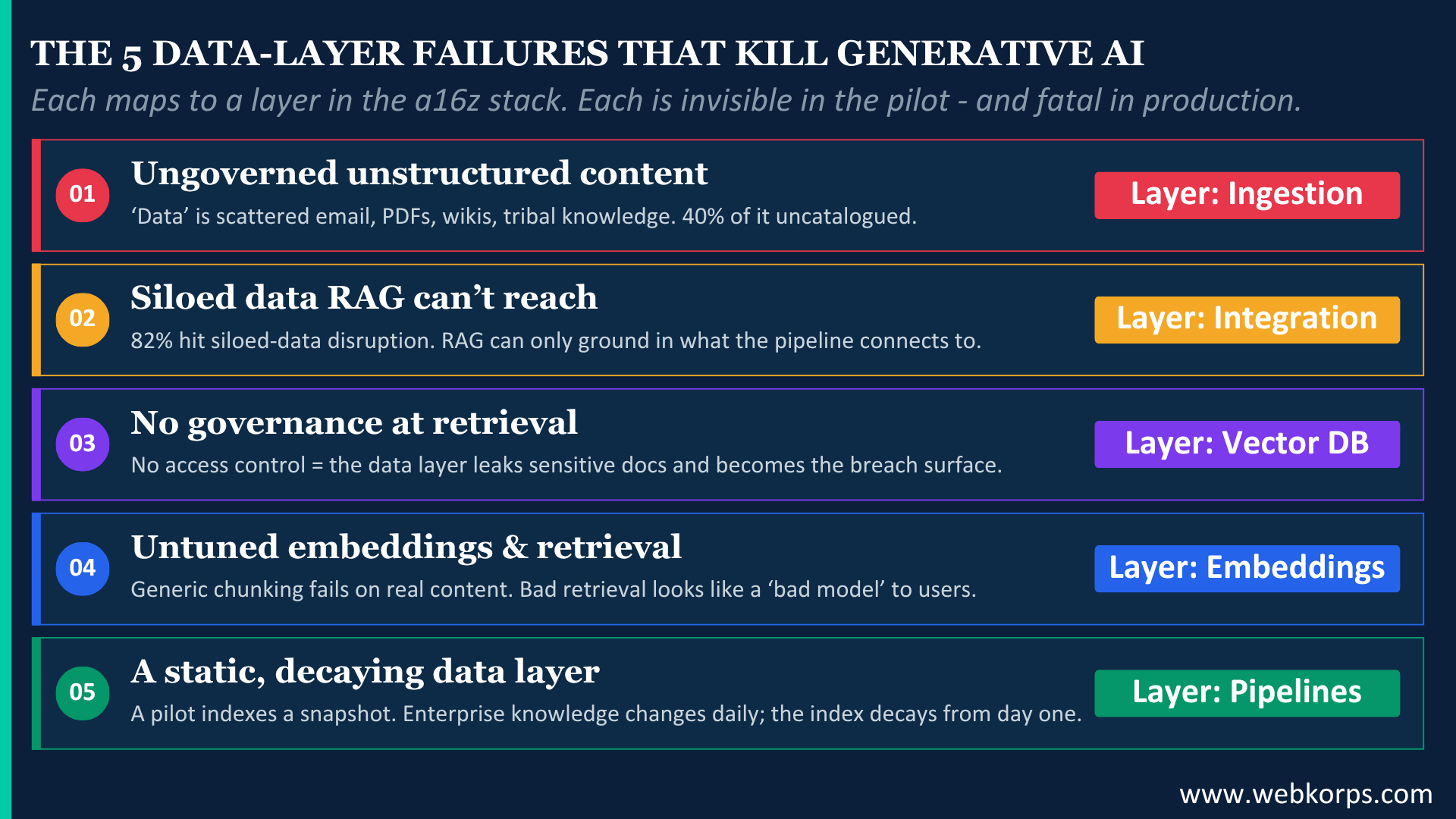
Each of these failures maps to a specific layer in the a16z stack. Each is a documented cause of GenAI project abandonment. And each is invisible in the pilot because pilots run on hand-picked, pre-cleaned data, while production runs on the real enterprise data estate.
01 · The Data Isn’t Actually Data – It’s Ungoverned Unstructured Content
Organisations discover their “data” isn’t structured data at all, it’s unstructured knowledge scattered across email threads, chat channels, SharePoint folders, shared drives, and tribal expertise locked in employees’ heads. Most enterprises cannot say what 40% of their unstructured datasets actually contain. Generative AI consumes this content directly, and a RAG system grounded on it inherits every error, duplicate, and stale document in the corpus.
- Stack layer: Data pipelines/ingestion – the very first stage of the a16z stack.
- The symptom: the assistant cites outdated policies, contradicts itself, or surfaces documents that should have been archived years ago.
- The fix: an unstructured data estate assessment, what percentage is catalogued, classified, deduplicated, and access-controlled, before a single embedding is generated.
02 · The Data Is Siloed – and RAG Can Only Retrieve What It Can Reach
IBM research shows 82% of enterprises experience workflow disruptions due to siloed data. A RAG system can only ground responses in data it can actually reach. When the relevant knowledge is locked in a system the pipeline was never connected to, a legacy DMS, a separate business unit’s data lake, a SaaS tool with no integration, the model simply doesn’t see it, and fills the gap with a plausible hallucination.
- Stack layer: Data pipelines/data integration, the connective tissue, a16z notes, is underdeveloped.
- The symptom: the assistant answers confidently but incompletely, missing context that exists in the enterprise but not in the indexed corpus.
- The fix: map every GenAI use case in the 18-month roadmap to its data access pattern and source systems before building, then build the integrations the pilot skipped.
03 · No Governance – So the Data Layer Becomes a Compliance and Security Liability
Informatica’s 2025 CDO survey found 97% of CDOs struggle to demonstrate generative AI business value, and a leading reason is that ungoverned data layers cannot be deployed safely. A RAG system with no access controls at the retrieval layer will surface salary data to interns, confidential contracts to the wrong region, and regulated PHI or PII to anyone who asks the right question. The data layer becomes the breach surface.
- Stack layer: Vector database + retrieval, where document-level access control must be enforced, not assumed.
- The symptom: security and legal block the production rollout because the retrieval layer cannot enforce who is allowed to see which document.
- The fix: embed access control, data lineage, and audit logging into the retrieval layer from the start; governance is not a wrapper around the data layer; it is part of it.
04 · The Embeddings and Retrieval Were Never Tuned for Enterprise Content
In the a16z stack, documents are chunked, embedded, and retrieved by semantic similarity. The default approach, generic chunking, off-the-shelf embeddings, naive top-k retrieval, works adequately in a demo on clean documents and degrades badly on real enterprise content: long contracts, tables, scanned PDFs, domain jargon, and mixed formats. Poor retrieval quality is indistinguishable from a “bad model” to the end user, but the fix is in the data layer, not the model.
- Stack layer: Embedding model + vector database, the semantic core of the retrieval pipeline.
- The symptom: the assistant retrieves loosely related but unhelpful passages, or misses the obviously relevant document, and users lose trust fast.
- The fix: domain-appropriate chunking strategy, embeddings evaluated against enterprise content, and a retrieval approach (hybrid search, re-ranking) tuned to the actual corpus.
05 · The Data Layer Is Static – But Enterprise Knowledge Changes Every Day
A pilot indexes a snapshot. Production has to keep up with a living enterprise: new contracts signed, policies updated, and employees who leave taking undocumented knowledge with them. When a key employee leaves and their expertise exists only in their head or is scattered across years of email, the AI systems grounded on that knowledge become obsolete overnight. A data layer with no refresh, re-embedding, or freshness strategy decays from the day it launches.
- Stack layer: Data pipelines (ongoing) – ingestion is not a one-time load; it is a continuous process.
- The symptom: the assistant was accurate at launch and slowly became wrong as the underlying knowledge drifted away from the indexed snapshot.
- The fix: automated ingestion, scheduled re-embedding, document freshness tracking, and a knowledge-capture process so departing expertise is documented before it walks out the door.
Also read: From Pilot to Production: A Practical AI Operationalization Framework
Why the Pilot Hid the Problem: Demo Data vs. Production Data
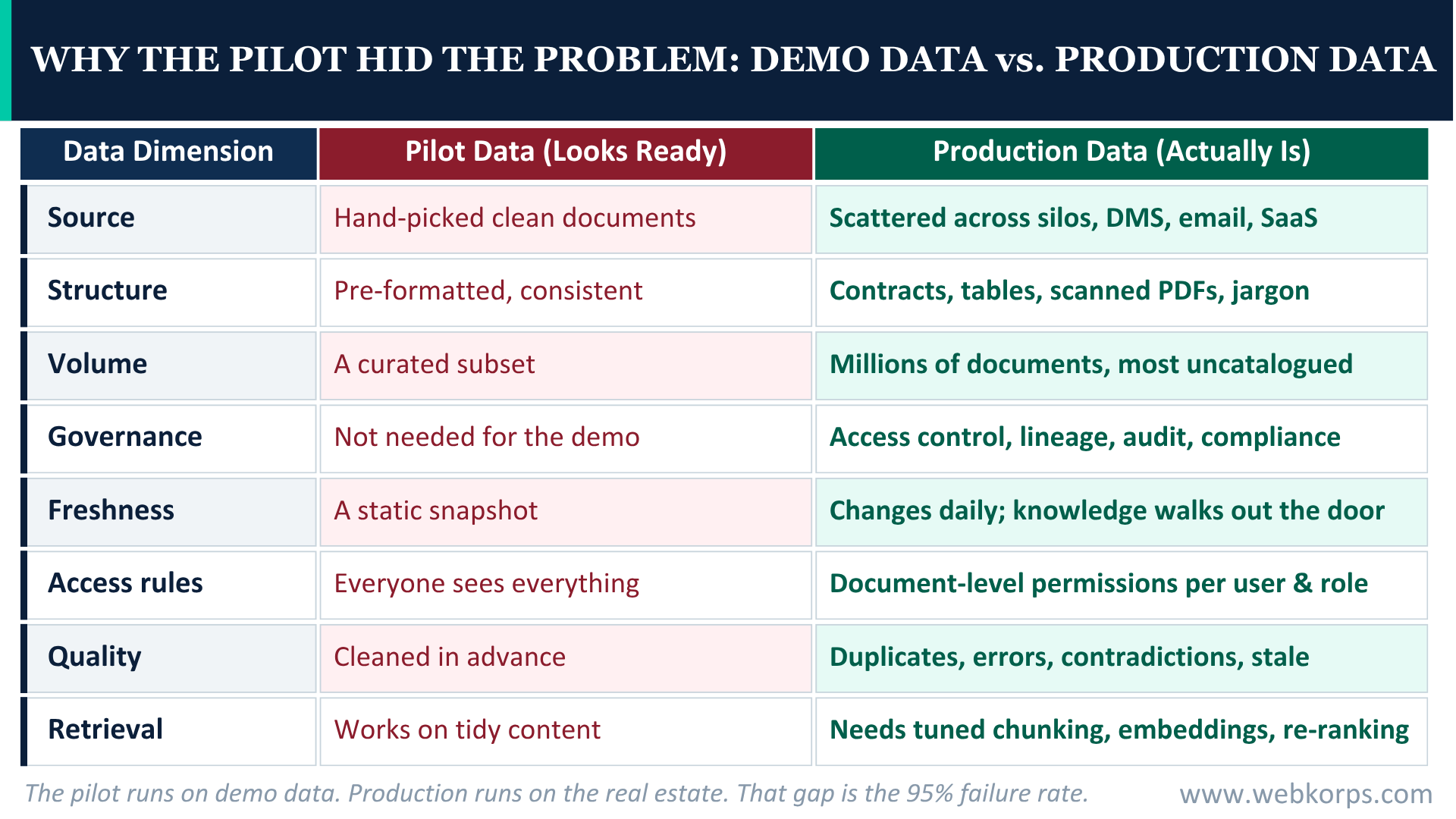
Every one of these failures is invisible in the pilot. That is precisely why CDOs are blindsided when the production rollout stalls. The pilot and the production system run on fundamentally different data, and the gap between them is the gap between the 5% who ship and the 95% who don’t.
| Data Dimension | Pilot Data (Looks Ready) | Production Data (Actually Is) |
|---|---|---|
| Source | Hand-picked clean documents | Scattered across silos, DMS, email, and SaaS tools |
| Structure | Pre-formatted, consistent | Mixed formats: contracts, tables, scanned PDFs, jargon |
| Volume | A curated subset | Millions of documents, most uncatalogued |
| Governance | Not needed for the demo | Access control, lineage, audit, and regulatory compliance |
| Freshness | A static snapshot | Changes daily; knowledge walks out the door |
| Access rules | Everyone sees everything in the demo | Document-level permissions per user and role |
| Quality | Cleaned in advance | Duplicates, errors, contradictions, stale content |
| Retrieval | Works on tidy content | Needs tuned chunking, embeddings, re-ranking |
Also read: How CTOs Are Evaluating AI/ML Development Company
What an AI-Ready Data Layer Actually Looks Like
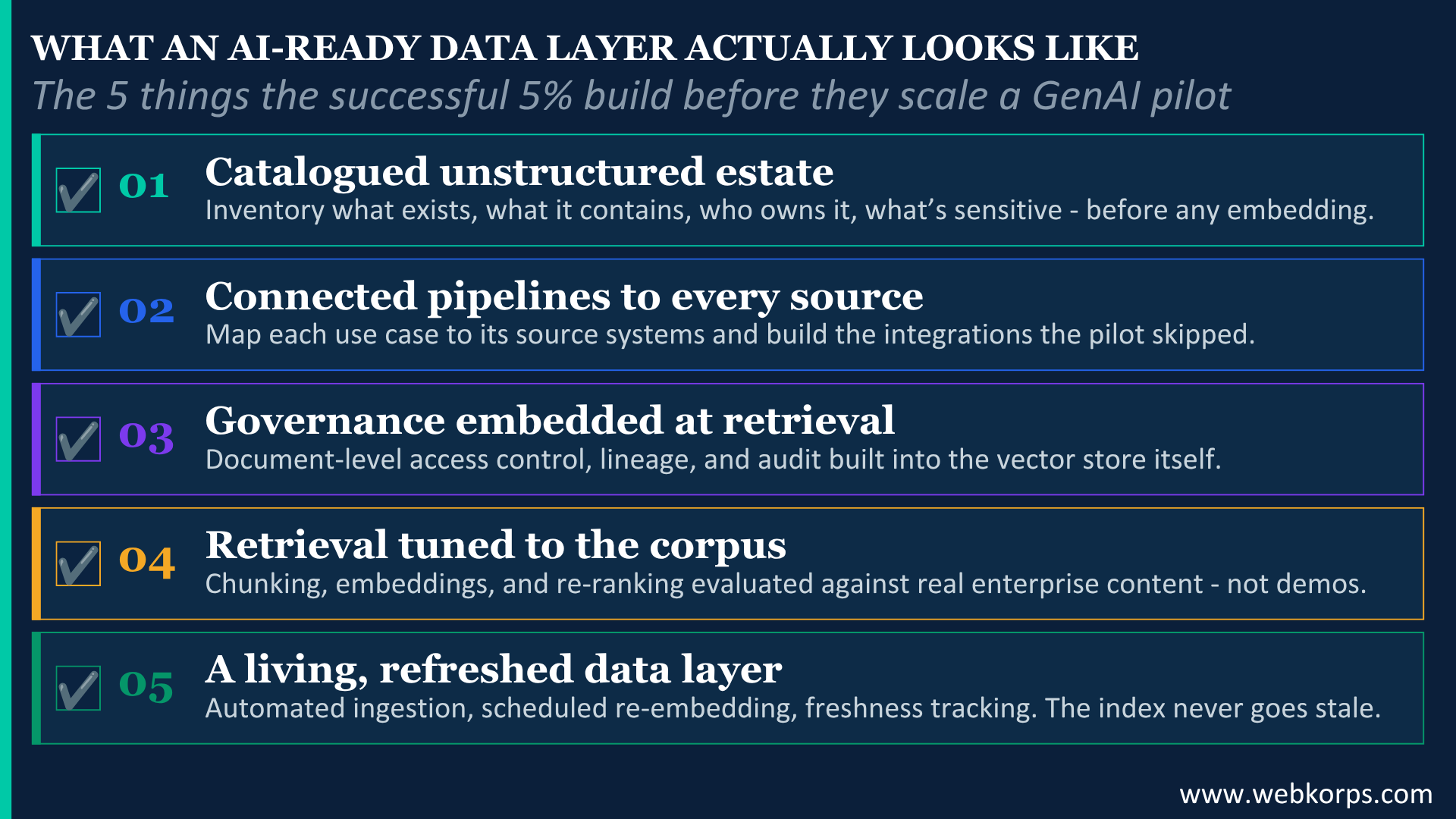
Gartner defines AI-ready data as data that is aligned to specific use cases, actively governed at the asset level, and supported by automated pipelines. For generative AI specifically, that translates into a data layer built deliberately around the a16z retrieval pattern, not improvised after the model is chosen. The CDOs in the successful 5% build five things before they scale a GenAI pilot.
- A catalogued, classified unstructured data estate: You cannot ground a model on content you cannot see. The foundation is an inventory of the unstructured estate: what exists, what it contains, who owns it, what is sensitive, and what should be disposed of. This is where unstructured data governance and AI readiness become the same project.
- Connected pipelines to every source the use case needs: For each GenAI use case, the data layer must reach every source system that the use case depends on, be mapped in advance, and be integrated deliberately. a16z calls the pipeline layer underdeveloped; the successful 5% treat it as the most important part of the preprocessing pipeline, because it is.
- Governance embedded at the retrieval layer: Document-level access control, data lineage, and audit logging are built into the vector store and retrieval flow, so the system physically cannot surface a document to a user who isn’t cleared for it. Governance is not a policy document; it is an architectural property of the data layer.
- Retrieval tuned to the actual corpus: Chunking strategy, embedding model, and retrieval approach evaluated and tuned against real enterprise content, not demo documents. Retrieval quality is the single largest lever on perceived model quality, and it lives entirely in the data layer.
- A living, refreshed data layer: Automated ingestion, scheduled re-embedding, and freshness tracking so the data layer keeps pace with the enterprise. A GenAI system is only as current as its data layer, and a static index decays from launch day.
How Webkorps Builds the Data Layer Generative AI Runs On
Most enterprises do not have a generative AI model problem. They have a data-layer problem, an unstructured estate that was never catalogued, pipelines that were never connected, governance that was never embedded, and retrieval that was never tuned. The model is a commodity you can swap in an afternoon. The data layer is the months of engineering that determine whether the model ever delivers value. This is the layer Webkorps builds.
Our data engineering and AI practice is built around the data layer that determines whether generative AI reaches production:
- Unstructured data assessment & governance: we catalogue, classify, and access-control the unstructured estate. The foundation 57% of organisations have not built
- RAG and retrieval architecture: data pipelines, chunking, embeddings, and vector infrastructure tuned to your actual enterprise content, following the a16z reference pattern
- Data integration across silos: connecting the source systems, each GenAI use case depends on the pipeline layer, a16z calls it underdeveloped, and most pilots skip
- Governance by design: document-level access control, lineage, and audit embedded into the retrieval layer, aligned to GDPR, HIPAA, and sector regulation
- A living data layer: automated ingestion, scheduled re-embedding, and freshness tracking so the system stays accurate long after launch
THE WEBKORPS DATA ENGINEERING TRACK RECORD
500+ delivered projects across 30+ countries · ISO 27001 · CMMI Level 3 · Data engineering, RAG architecture, and enterprise AI. We build the AI-ready data layer that turns generative AI pilots into production systems delivering measurable value.
The Model Is a Commodity. The Data Layer Is the Moat.
The insurer’s CDO, who watched a flawless pilot die in production, learned what the aggregate data already shows: the model is almost never why generative AI fails. The assistant hallucinated because the data layer was stale. It leaked documents because the data layer had no governance. It missed context because the data layer was siloed. Every failure that looked like a model problem was a data-layer problem wearing an AI label.
McKinsey’s $2.6-$4.4 trillion of annual GenAI value is real, but it is gated entirely behind the data layer. The organisations capturing it are not the ones with the best models; everyone has access to the same models. They are the ones who built a catalogued, connected, governed, tuned, and living data layer underneath. In a world where the model is a commodity, the data layer is the only durable moat and the only thing standing between a dazzling pilot and a production system that delivers.
For CDOs and Heads of Data, this is the most consequential reframing of the generative AI era: you do not own the model. You own the data layer. And the data layer is where generative AI is won or lost.
| Is Your Data Layer Ready for Generative AI? |
| Webkorps builds the data foundation that generative AI actually runs on unstructured data pipelines, vector infrastructure, retrieval architecture, and data governance. ISO 27001 certified. CMMI Level 3. 500+ projects across 30+ countries. Book a free GenAI data readiness assessment. |
| Book a GenAI Data Readiness Assessment |
Frequently Asked Questions
Q1: Why do most generative AI projects fail at the data layer rather than the model?
Modern enterprise generative AI runs on retrieval-augmented generation (RAG): the model is grounded in your own data, retrieved at query time. The pre-trained model is interchangeable and increasingly commoditised, but the data pipeline, embeddings, and vector store that feed it are unique to your enterprise. When a project fails, it is almost always because that data layer was stale, siloed, ungoverned, or untuned. MIT found 95% of GenAI deployments saw zero measurable return, and the consistent root cause across MIT, Gartner, and RAND is data readiness, not model quality.
Q2: What is “AI-ready data” for generative AI specifically?
Gartner defines AI-ready data as data aligned to specific use cases, actively governed at the asset level, and supported by automated pipelines. For generative AI, that means an unstructured data estate that is catalogued and classified, connected pipelines reaching every source a use case needs, document-level access control embedded at the retrieval layer, chunking and embeddings tuned to your real content, and a refresh strategy that keeps the index current. Gartner reports 57% of organisations say their data is not AI-ready, which is why 60% of under-supported AI projects will be abandoned through 2026.
Q3: Why does generative AI make the enterprise data problem harder than traditional analytics?
Traditional analytics ran on structured, governed tables in a warehouse. Generative AI runs on unstructured content, contracts, emails, PDFs, wikis, tickets, and tribal knowledge scattered across systems. This is data most enterprises never catalogued or governed; most cannot say what 40% of their unstructured datasets even contain. A RAG system grounded on this content inherits every error, duplicate, stale document, and access-control gap in it. AI readiness and unstructured data governance have effectively become the same project.
Q4: What is RAG, and why does it depend so heavily on the data layer?
RAG (retrieval-augmented generation) grounds a model’s answers in your own documents, retrieved at query time, to reduce hallucination. In the a16z LLM app stack, the flow is: ingest data through pipelines, chunk it, embed it into vectors, store it in a vector database, and retrieve the most relevant chunks per query. The model only sees what the data layer retrieves, so if the data is stale, siloed, poorly chunked, or ungoverned, the model produces confident but wrong answers. RAG quality is data-layer quality; the model is the smaller variable.
Q5: How can a CDO tell if a generative AI pilot will stall in production?
The pilot hides the problem because it runs on hand-picked, pre-cleaned data, while production runs on the real estate. Ask five questions before scaling: Is the full unstructured data estate catalogued and classified, or just the demo subset? Are all the source systems the use case needs actually connected? Is document-level access control enforced at retrieval? Has retrieval been tuned on real enterprise content, not tidy samples? Is there an automated refresh strategy, or is the index a static snapshot? A “no” to any of these is a production stall waiting to happen.
Q6: What is the business cost of an AI-unready data layer?
McKinsey estimates generative AI could add $2.6–$4.4 trillion in value annually, with around 75% concentrated in customer operations, marketing and sales, software engineering, and R&D, and $200–340 billion in banking alone. That value is gated entirely behind the data layer: an organisation whose data is not AI-ready captures none of it. Beyond opportunity cost, an ungoverned data layer is a direct breach and compliance liability, since a RAG system without retrieval-layer access control can surface sensitive or regulated documents to the wrong users.
This is such a common pain point for teams working on GenAI. Having solid data pipelines makes all the difference.