
 Posted by
 A VP of Engineering at a Series D fintech company told us recently: ‘We ran three AI pilots in 2024 with three different vendors. All three delivered working models. None of them survived contact with our production environment.’ The models degraded. The data pipelines weren’t maintained. The vendors had moved on. The total cost: $2.1M and fourteen months.
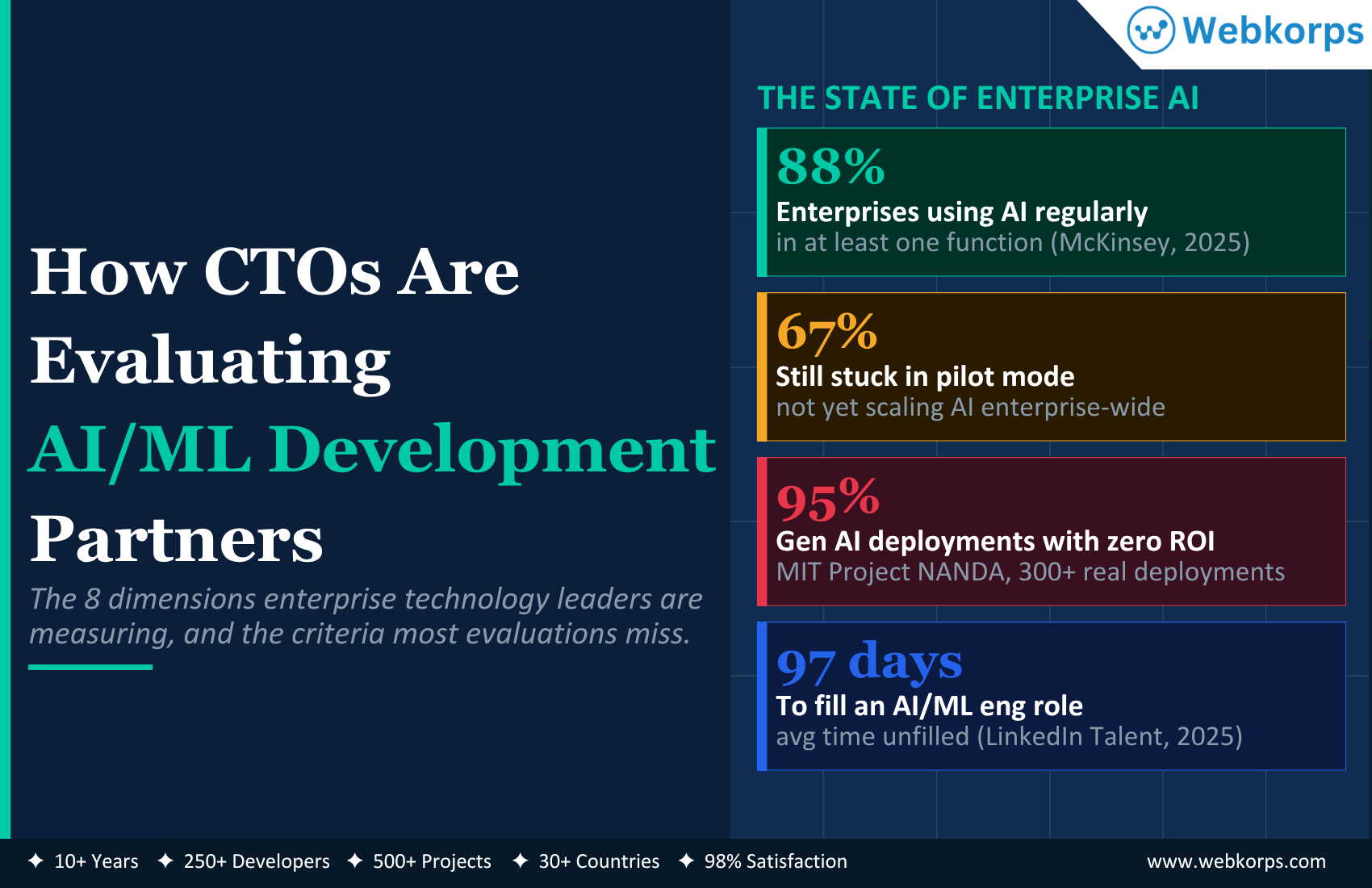
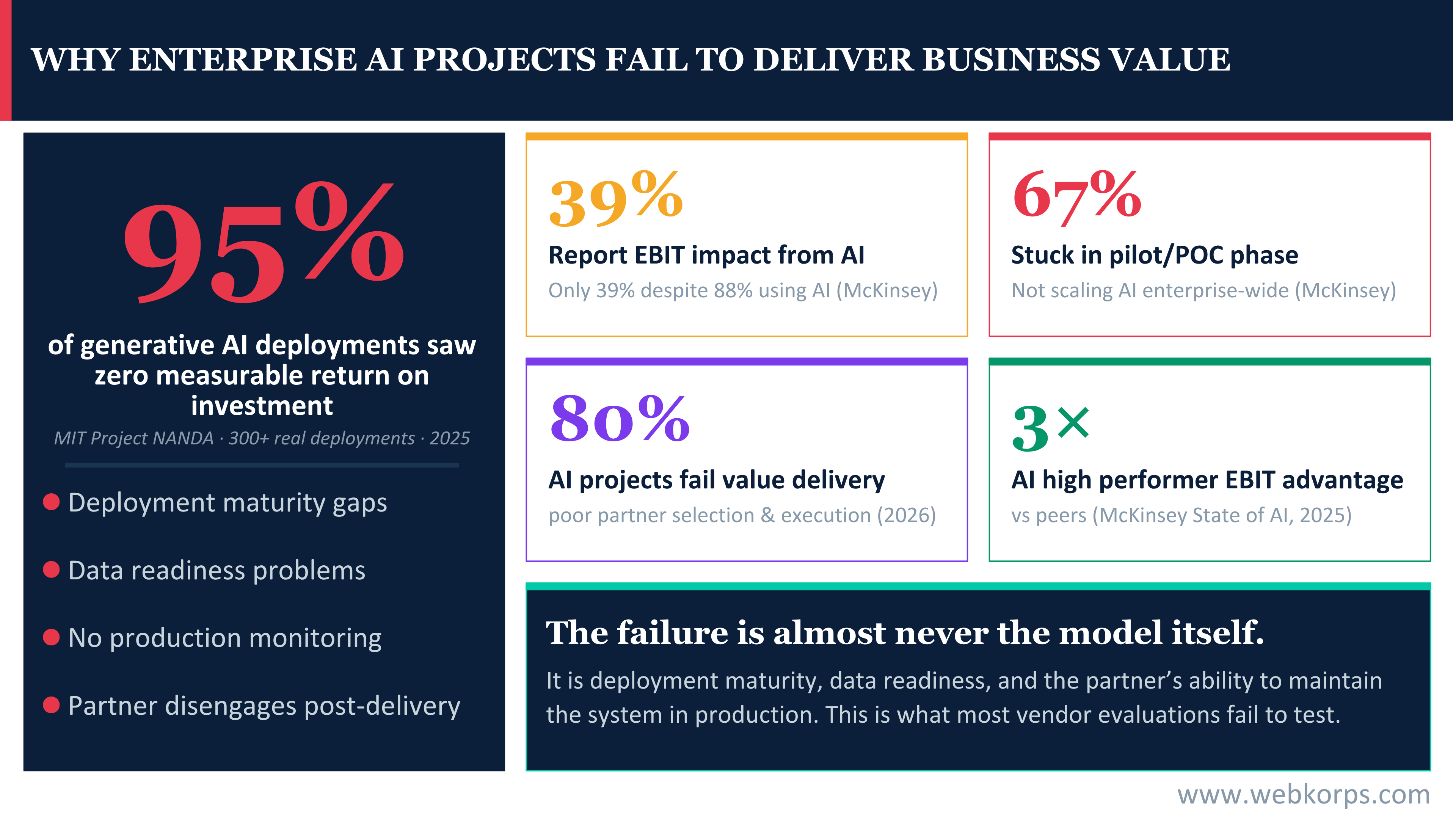
That story is not unusual. MIT Project NANDA’s 2025 research, covering over 300 real deployments, found that 95% of organisations deploying generative AI saw zero measurable return. The failure is in deployment maturity, data readiness, and production engineering, which is exactly what most vendor evaluations fail to test.
Enterprise CTOs have noticed. The AI/ML development company evaluation process in 2026 looks fundamentally different from 2023. The checklist that used to begin and end with ‘does the team understand transformers’ now runs across eight distinct dimensions, most of which have nothing to do with the sophistication of the model and everything to do with what happens after the model is deployed.
This piece maps those eight dimensions in full. It draws on McKinsey’s State of AI in 2025 (November 2025), Gartner’s Magic Quadrant methodology for AI services, HBR’s digital transformation research, and structured conversations with enterprise technology leaders. It is written for CTOs, VP Engineering, and AI programme owners who are either actively evaluating AI/ML development partners or preparing their organisations for that evaluation.
Table of Contents
Why the 2026 Evaluation Landscape Is Fundamentally Different
When McKinsey published its November 2025 State of AI report, the headline figures were striking: 88% of organisations now use AI regularly in at least one business function, and 72% regularly deploy generative AI, up from 33% in 2024. But the number that enterprise CTOs focused on was a different one: only 39% report any EBIT impact attributable to AI at the enterprise level.
The adoption story is complete. The value realisation story is not. The same challenge affects everything from enterprise AI systems to AI-powered creative platforms, where success depends on strong data and deployment foundations. And that gap, between widespread AI use and limited enterprise value, has fundamentally changed how CTOs evaluate the partners they trust to close it.
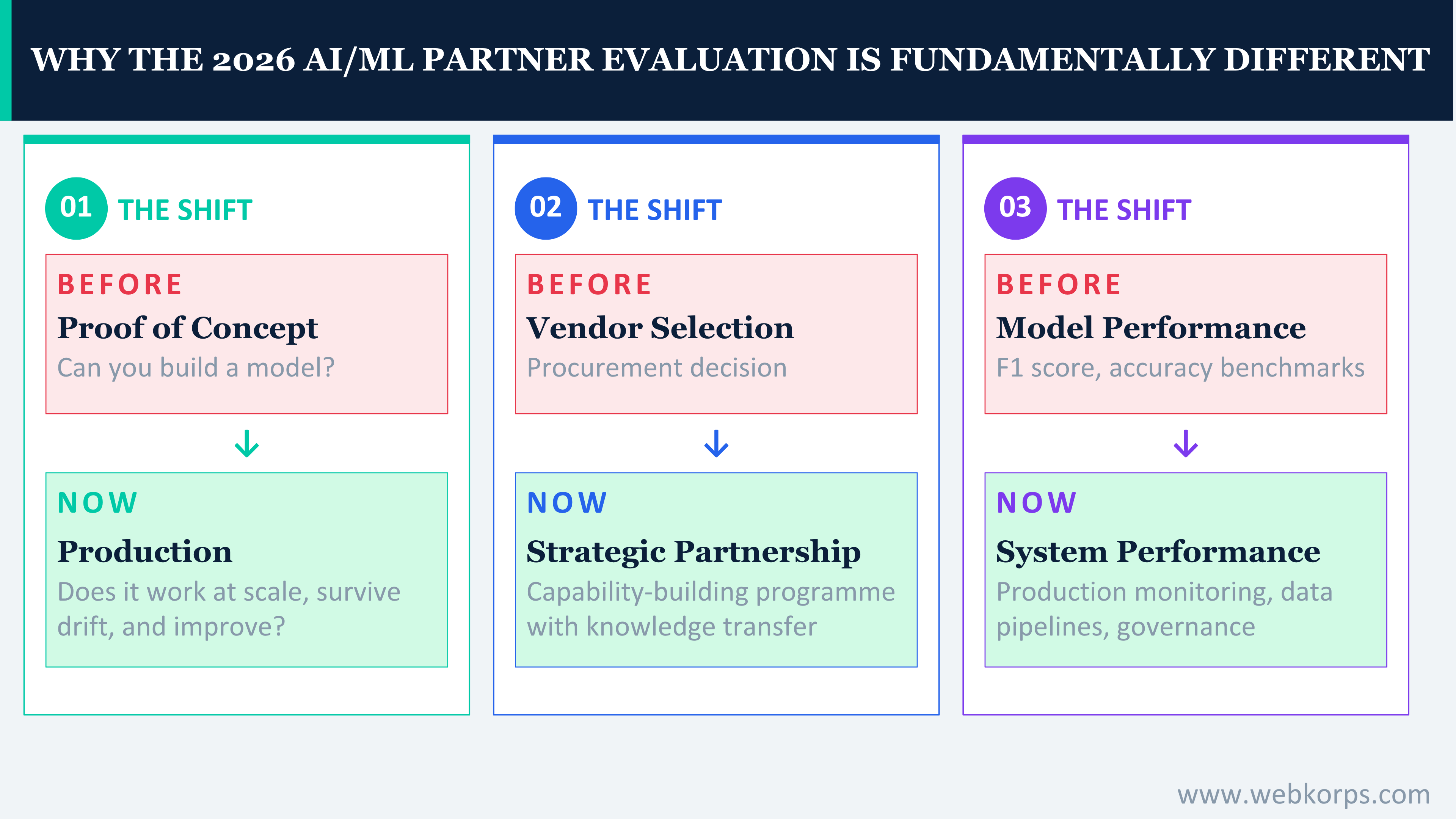
The three shifts that changed the evaluation criteria
- Shift 1, From proof-of-concept to production: The CTO who, in 2023, was asking ‘can you build an AI model for our use case?’ is in 2026 asking ‘can you deploy an AI system that performs reliably at production scale, survives data drift, integrates with our existing architecture, and improves over time?’ These are fundamentally different questions that require fundamentally different evaluation criteria.
- Shift 2, From vendor selection to strategic partnership: As HBR’s digital transformation research consistently shows, organisations that treat AI as a procurement decision consistently underperform those that treat it as a capability-building programme. The best-performing enterprise AI programmes are characterised by deep partner integration: shared ownership of outcomes, knowledge transfer built into delivery, and governance frameworks co-designed between client and partner.
- Shift 3, From model performance to system performance: Gartner’s evolving Magic Quadrant methodology for AI services reflects this shift explicitly: the 2026 evaluation framework has moved from ‘AI/ML Development’ as a capability to ‘Analytics and AI Readiness’, expanding scope to include monitoring production AI pipelines, not only training data preparation. An AI/ML development company that can train a high-performing model but cannot maintain it in production is not a production-grade partner.
“The 5.5% of organisations classified as AI high performers are 3× more likely to have strong senior leadership engagement, have redesigned workflows end-to-end, and set outcome-based objectives tied to business KPIs.”
— McKinsey State of AI, 2025
The 8 Dimensions Enterprise CTOs Are Evaluating in 2026
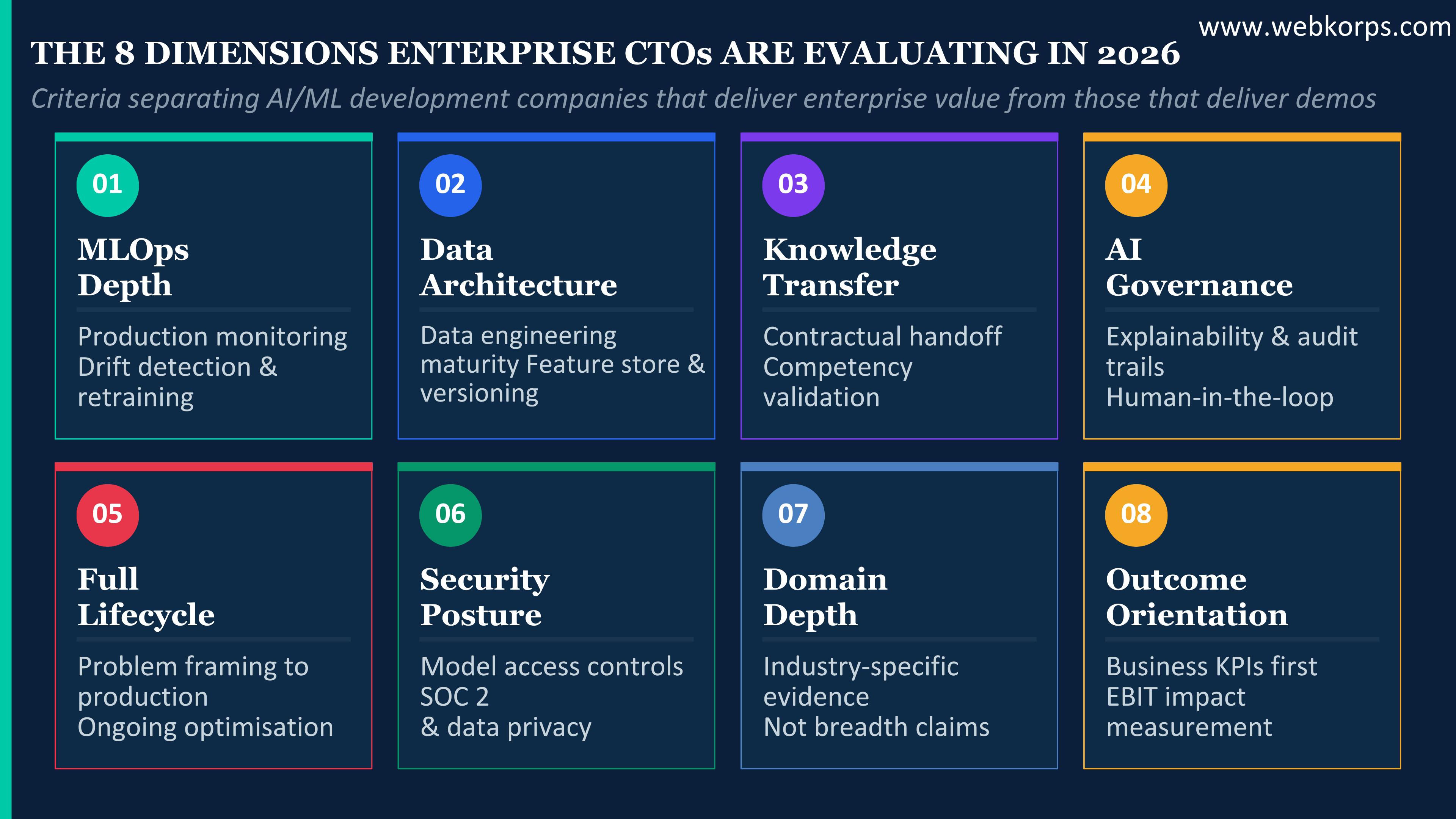
These criteria are drawn from structured conversations with enterprise technology leaders, McKinsey’s AI high-performer analysis, Gartner’s evaluation methodology, and Deployflow’s 2026 AI Engineering Company Evaluation Guide. They represent the evaluation framework that separates vendors who deliver pilots from partners who deliver enterprise AI capability.
- Production-grade MLOps depth, not model sophistication: The most sophisticated model in the world is worthless if it degrades within 90 days of deployment because nobody is monitoring data drift. MLOps is the discipline that keeps AI working in production, and it is the capability that most AI/ML development companies either lack or underinvest in. Gartner’s 2026 framework explicitly evaluates monitoring of production AI pipelines as a non-negotiable capability.
- Ask: What is your MLOps stack, and how do you monitor model performance in production? Walk me through your model drift detection and retraining pipeline.
- Ask: Can you show me a dashboard from a live production AI system you are currently maintaining?
- Ask: What happens when a production model degrades? Walk me through your incident response process from detection to resolution.
- Red flag: MLOps is described as ‘coming in Phase 2.’ Monitoring is manual. No documented drift detection or retraining protocol exists.
- Data architecture and engineering maturity: AI is only as good as the data that feeds it. Organisations with documented build-vs-buy decision frameworks deployed AI to production 45% faster than those deciding ad hoc (Databricks, 2025), but the underlying driver is data infrastructure maturity. A partner who cannot evaluate your data architecture critically and honestly is a partner who will build a model on a foundation it cannot support.
- Ask: Evaluate our current data infrastructure and tell me where the gaps are before you propose anything. Be specific.
- Ask: What is your view on when to use a data warehouse versus a data lakehouse, and how does that choice affect downstream model performance?
- Ask: How do you handle feature engineering for a use case where the training data and production data are generated by different systems?
- Red flag: Vague answers about ‘data quality.’ No clear view on feature stores or data versioning. Pipeline architecture is not addressed until after contract signing.
- Knowledge transfer and internal capability building: McKinsey’s high-performer research is unambiguous: AI value at scale requires internal capability, not perpetual vendor dependency. CTOs who build AI programmes on a foundation of vendor dependency are creating an escalating cost structure and a knowledge cliff. The evaluation question is whether the partner’s delivery model transfers capability or accumulates dependency. As The Thinking Company’s 2026 CTO guide notes: ‘For the first 1–2 production AI systems, partner with a firm that delivers and transfers knowledge simultaneously.’
- Ask: Show me an example of how knowledge transfer was structured in a previous engagement. What specifically was transferred, to whom, and how was it validated?
- Ask: After this engagement ends, what does our team need to maintain and improve this system without your involvement? Be specific.
- Ask: How do you structure documentation, code handoff, and model documentation so that our engineers can extend this system independently?
- Red flag: Knowledge transfer is ‘included.’ No structured programme. No validation of what was transferred. The answer requires the vendor to remain engaged.
- AI governance, explainability, and compliance architecture: Gartner’s 2026 Magic Quadrant evaluation explicitly calls out GenAI and agentic AI governance as a non-negotiable innovation criterion. McKinsey’s high-performer research shows that 65% of high-performing AI organisations have defined human-in-the-loop validation processes, versus 23% of others. For regulated industries, such as financial services, healthcare, and insurance, this is not a governance preference. It is a regulatory requirement that the development partner must architect from day one.
- Ask: How do you approach model explainability for a use case in a regulated environment? What tools, methods, and documentation standards do you use?
- Ask: Walk me through your AI governance framework: audit trails, bias testing protocols, human escalation triggers, and model card documentation.
- Ask: How do you handle GDPR / CCPA / HIPAA constraints at the model training and inference layer? Show me a past example.
- Red flag: Governance is a post-build consideration. Explainability tools are mentioned without being specified. Regulatory compliance is treated as a legal problem, not an engineering problem.
- Full-stack AI lifecycle capability: The AI/ML development company landscape in 2026 is bifurcated: firms that build models and firms that build AI systems. The distinction is between agencies that operate at Level 0–1 and those that operate at Level 2–3 of deployment maturity. An enterprise CTO evaluating an AI/ML development company needs a partner who covers the complete lifecycle: problem framing, data engineering, model development, system integration, deployment, and continuous optimisation. Partners who stop at model delivery create a dependency gap that is expensive to fill.
- Ask: Walk me through your full lifecycle delivery model from initial problem framing to production deployment to ongoing optimisation.
- Ask: What percentage of your engagements reach production deployment versus prototype or proof-of-concept delivery?
- Ask: What is your approach to integrating a new AI system with existing enterprise architecture, legacy ERP, CRM, or bespoke data infrastructure?
- Red flag: The word ‘prototype’ appears frequently. Production references are limited or unavailable. Integration is described as the client’s responsibility.
- Security posture and data handling at the model layer: The 2025 Deploflow CTO guide is direct: ‘Security posture is the final check: model access controls, API key management, and inference endpoint security. These are baseline hygiene. Any company that treats them as edge cases has never operated in a production environment with real security requirements.’ As AI systems handle increasingly sensitive enterprise data, customer records, financial transactions, and proprietary models, the security architecture of the AI layer becomes an extension of the enterprise security perimeter.
- Ask: Walk me through your data security architecture at the model layer: encryption at rest and in transit, API key management, access controls, and inference endpoint security.
- Ask: What is your data deletion policy for training data? Who has access to our data during model training, and what contractual protections exist?
- Ask: Do you have SOC 2 Type II certification? Can you share your security documentation and penetration testing reports?
- Red flag: Security documentation is vague or unavailable. Data retention policy is undefined. SOC 2 or equivalent certification cannot be demonstrated.
- Domain depth versus domain breadth: The enterprise AI/ML development company landscape is crowded with generalists who claim sector expertise they have approximated from publicly available case studies. Domain depth is validated by the specificity of past work, not the breadth of the industry list on the website. A partner claiming healthcare AI expertise should be able to discuss HIPAA compliance at the model layer, clinical workflow integration, and the specific regulatory constraints on AI diagnostic tools, not ‘we’ve done healthcare projects before.’ The Deployflow guide is precise: the evaluation should be ‘like a senior engineering hire, assess how they think, how they handle ambiguity, and whether their judgment holds up under scrutiny.’
- Ask: Show me two AI projects in our industry with similar data constraints, regulatory requirements, and integration complexity. Walk me through the specific decisions.
- Ask: What are the specific AI failure modes in our industry, and how do you architect against them?
- Ask: What do you believe we are underestimating about the complexity of this AI deployment based on what you know about our sector?
- Red flag: Industry references are all from different sectors. Specific regulatory or workflow constraints in your domain cannot be discussed in depth without additional research.
- Outcome orientation and business value measurement: The final and arguably most consequential evaluation criterion is the partner’s orientation toward business outcomes versus technical deliverables. McKinsey’s research is clear: organisations that set outcome-based objectives tied to business KPIs are the ones that achieve measurable EBIT impact from AI. A partner who consistently frames their work in terms of model accuracy, F1 scores, and technical benchmarks, without mapping those metrics to business outcomes, is a partner building impressive demos, not enterprise value.
- Ask: For a similar engagement, what business KPIs did you track alongside technical performance metrics? How did you define success with the client?
- Ask: When a model achieves target technical performance but the business outcome isn’t moving, what do you do? Give me a real example.
- Ask: How do you structure a business case for an AI investment with your clients before building begins?
- Red flag: Success is defined exclusively in technical terms. Business KPIs are absent from the proposal and SOW. ROI projections are deferred to post-delivery.
Partner Type vs. Programme Maturity: A Decision Framework
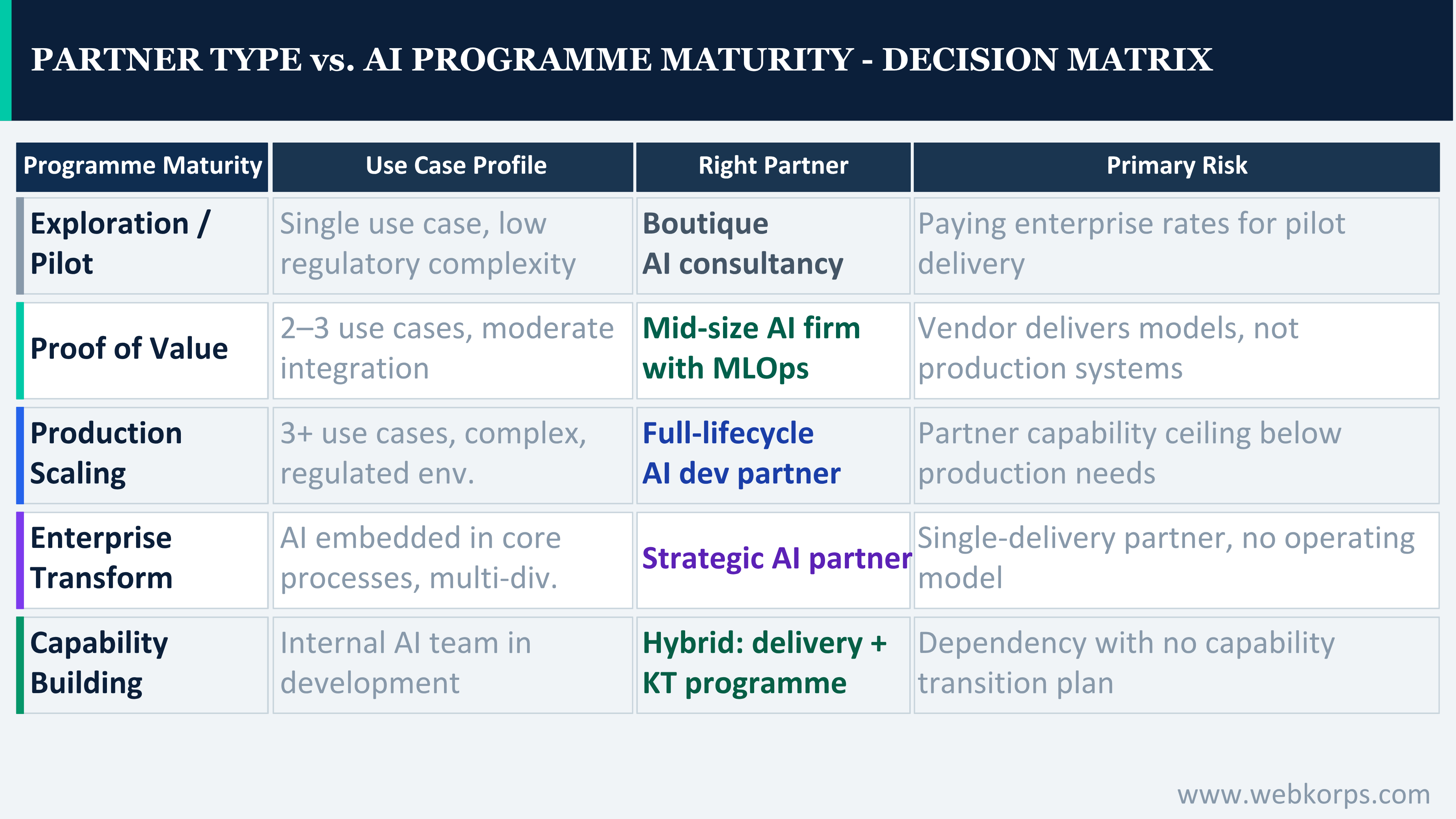
Not all AI/ML development partners serve the same buyer, and not all enterprise AI programmes require the same type of partner. Matching your programme maturity and use case complexity to the right partner archetype prevents the most common and expensive mismatch in enterprise AI investment.
| Programme Maturity | Use Case Profile | Right Partner Type | Primary Risk to Avoid |
|---|---|---|---|
| Exploration / Pilot | Single use case, low regulatory complexity, internal data | Boutique AI consultancy or specialist ML firm | Paying enterprise rates for pilot-stage delivery |
| Proof of value | 2–3 use cases, moderate integration, business case established | Mid-size AI engineering firm with MLOps practice | Vendor who delivers models but not production systems |
| Production scaling | 3+ use cases, complex integration, regulated environment | Full-lifecycle AI development partner with domain depth | Partner whose capability ceiling is below your production requirements |
| Enterprise transformation | AI embedded in core business processes, multiple divisions | Strategic AI partner with embedded team model | Single-delivery partner without ongoing operating model |
| Capability building | Internal AI team in development, knowledge transfer priority | Hybrid partner: delivery + structured knowledge transfer programme | Dependency accumulation with no capability transition plan |
What AI High Performers Do Differently When Selecting a Development Partner
McKinsey’s State of AI research identifies a small group, the top 5.5% of organisations by AI value, that it calls high performers. These organisations are 3× more likely to report EBIT impact from AI and 2.8× more likely to report fundamental workflow redesign than their peers. Their partner selection behaviour is systematically different in five observable ways.
- They evaluate for post-deployment capability, not pre-deployment promise: High-performing AI organisations run technical evaluation exercises that simulate production conditions, not sales scenarios. They ask partners to demonstrate monitoring dashboards from live systems, explain retraining protocols from past engagements, and describe specific production incidents and how they were resolved. The evaluation is designed to reveal capability that only exists if it has been exercised in production, not rehearsed for a pitch.
- They make knowledge transfer a contractual requirement: High performers treat AI development partner engagements as capability-building programmes, not delivery contracts. Knowledge transfer is not a nice-to-have deliverable in a final sprint. It is a structured programme, defined in the SOW, with specific validation checkpoints: the client’s engineers must demonstrate the ability to independently extend and maintain the system before the partner engagement concludes.
- They insist on outcome-based KPIs before build begins: Gartner and McKinsey both identify this as a high-performer differentiator: tracking well-defined KPIs for AI solutions enables insights into adoption and ROI. High-performing AI organisations define business success metrics before technical success metrics. The model accuracy target is set in the context of what accuracy improvement delivers in business terms, not as a standalone benchmark.
- They run domain-specific technical due diligence: High performers conduct technical due diligence that is specific to their domain and deployment context, not generic. A healthcare organisation evaluates how the partner has handled HIPAA-compliant model training in past engagements. A financial services organisation evaluates experience with model explainability under regulatory scrutiny. Generic capability claims are filtered out early; domain-specific evidence is the only currency that passes evaluation.
- They treat governance as architecture, not compliance: McKinsey’s research shows high performers are far more likely to have defined human-in-the-loop validation processes. This is not because they are more risk-averse, it is because they have learned that AI governance failure is the most common cause of production system shutdown in enterprise deployments. They evaluate partners on their governance architecture the same way they evaluate their security architecture: as a technical requirement, not a checklist item.
The Pre-Engagement Due Diligence Checklist for AI/ML Development Partners
Before signing any AI/ML development engagement, enterprise CTOs should be able to answer yes to every item in this checklist. Each item represents a failure mode documented in real enterprise AI programme post-mortems.
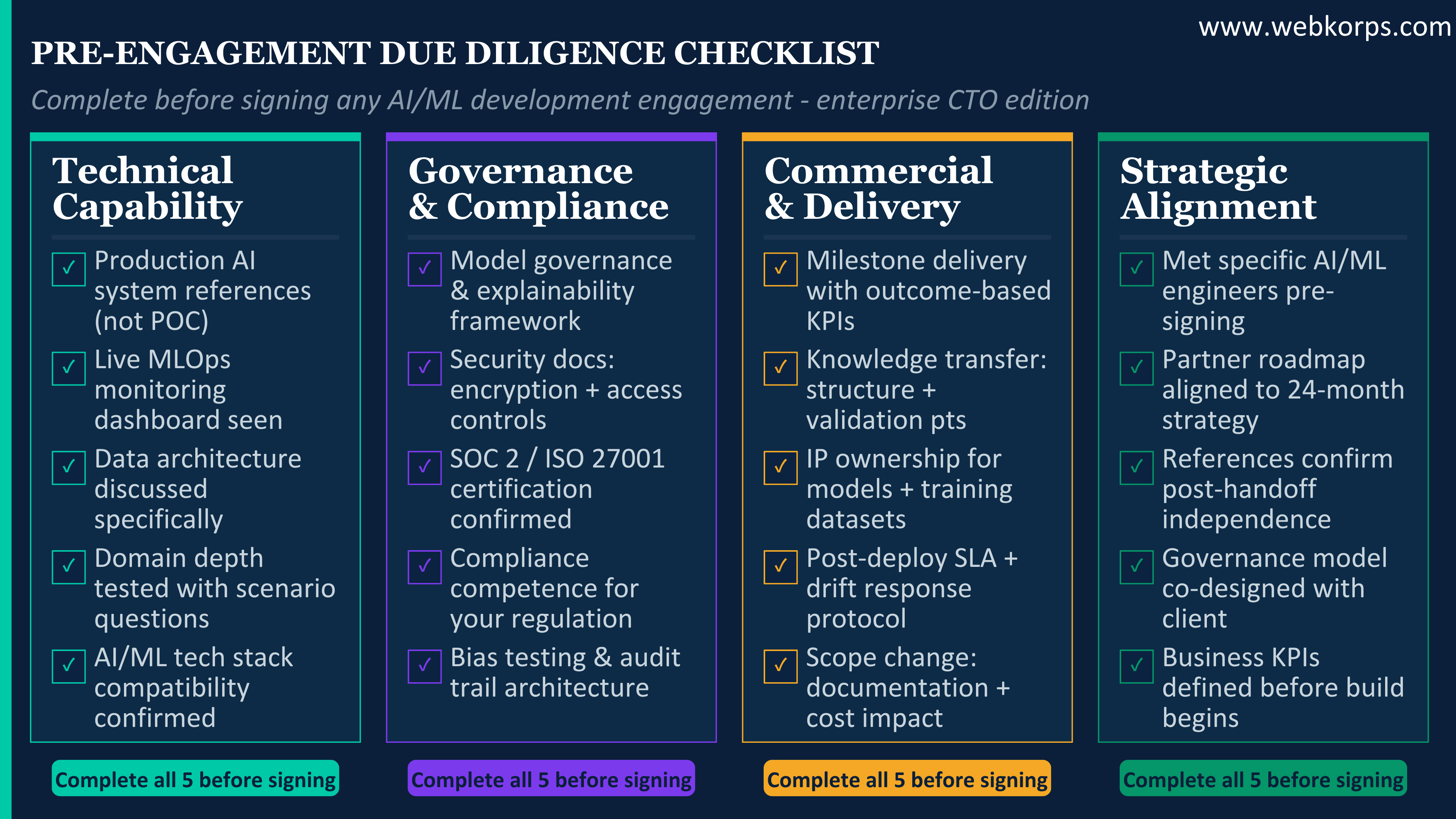
Technical capability validation
- Reviewed production AI system references, not prototypes or proof-of-concept demonstrations
- Observed a live MLOps monitoring dashboard from a system the partner currently maintains
- Evaluated the partner’s data architecture opinions with a specific question about your data infrastructure
- Tested domain depth through scenario-specific questions, not general capability claims
- Confirmed the AI/ML tech stack and its compatibility with your existing architecture
Governance and compliance validation
- Confirmed the partner’s model governance framework and explainability approach
- Reviewed data security documentation: encryption, access controls, deletion policy, SOC 2 / ISO 27001 certification
- Confirmed compliance competence for your specific regulatory environment (HIPAA, GDPR, PCI-DSS, SOX)
- Validated bias testing protocols and audit trail architecture for AI outputs
Commercial and delivery validation
- Confirmed milestone-based delivery structure with outcome-based KPIs at each stage
- Validated knowledge transfer programme: structure, timeline, and competency validation checkpoints
- Reviewed IP ownership for trained models, training datasets, and all AI system components
- Confirmed post-deployment support model: SLA, monitoring ownership, drift response protocol
Strategic alignment validation
- Met the specific AI/ML engineers and MLOps specialists who will work on the engagement
- Confirmed the partner’s AI roadmap aligns with your 24-month technology strategy
- Verified through direct reference calls that former clients can maintain their AI systems independently
How Webkorps Approaches AI/ML Development Partner Evaluation
We have heard this story too many times: a technically impressive AI system, delivered on time, that was unmaintainable within six months. The model degraded. The data pipelines weren’t monitored. The internal team couldn’t extend it. The vendor was unavailable.
Webkorps’ AI/ML practice is built around the conviction that an AI development engagement that does not transfer capability is a failed engagement, regardless of how good the model metrics were at delivery. Here is how our evaluation should be conducted:
- MLOps architecture: we run production AI systems for clients across 30+ countries. Our MLOps practice covers real-time monitoring, automated drift detection, retraining pipelines, and incident response. We can show you live dashboards from systems we currently maintain.
- Knowledge transfer: structured knowledge transfer is a contractual deliverable in every engagement, not an optional final sprint. We define specific competencies that your team must demonstrate before handoff is complete.
- Full lifecycle delivery: from data infrastructure assessment and feature engineering through model development, system integration, production deployment, and ongoing optimisation. We do not deliver models. We deliver AI systems.
- Governance by design: model explainability, audit trails, human-in-the-loop protocols, and bias testing are architectural requirements we define before development begins, not compliance items we address before delivery.
- Domain depth: our 250+ developers include specialists in healthcare, fintech, logistics, and enterprise digital transformation, with documented production deployments in each. Domain expertise is validated by specific prior work, not industry category lists.
- Outcome orientation: We define business KPIs alongside technical performance metrics before the first sprint begins. Success for us is EBIT impact, operational efficiency gain, or revenue uplift, not model accuracy on a held-out test set.
The Evaluation Has Changed. Has Your Preparation?
The VP of Engineering, whose story opened this piece, spent $2.1M and fourteen months discovering something the McKinsey State of AI research makes clear in aggregate: AI adoption is not the hard part. AI value is. And the gap between the two is almost always a partner selection decision made without the right evaluation criteria.
In 2026, the right evaluation criteria are well-understood by the CTOs who have lived through failed deployments, by Gartner’s evolving vendor assessment methodology, and by McKinsey’s high-performer research. The criteria are production-grade MLOps, data architecture maturity, knowledge transfer discipline, governance by design, full-lifecycle capability, domain depth, security posture, and outcome orientation.
An AI/ML development company that cannot be evaluated on all eight of these dimensions is not a production-grade partner for an enterprise AI programme. The vendor landscape is full of firms that can deliver impressive models. The list of firms that can deliver enterprise AI capability and transfer it is considerably shorter.
That is the list of enterprise CTOs in 2026 who are trying to build. This guide gives them the criteria to build it correctly.
| Ready to Evaluate Webkorps as Your AI/ML Development Partner? |
| Book a technical briefing with our AI/ML practice leads. We’ll walk through our MLOps architecture, data governance model, production deployment track record, and knowledge transfer approach, the criteria enterprise CTOs are prioritising in 2026. |
| Book a Technical Briefing Now! |
| Explore Our AI & ML Practice |
Frequently Asked Questions
What is an AI/ML development company, and how is it different from a traditional software development firm?
An AI/ML development company specialises in building systems that learn, adapt, and improve from data, not just executing fixed logic. Unlike traditional software firms, they cover model development, data engineering, MLOps, and production AI deployment. The key distinction in 2026: a genuine AI/ML development company delivers and maintains production AI systems with monitoring, drift detection, and retraining capabilities, not just trained models handed off for the client to maintain.
What is the most important criterion when evaluating an AI/ML development company in 2026?
Production-grade MLOps depth is the single highest-signal criterion. It is the capability most commonly absent from vendors who deliver impressive demos but cannot maintain AI systems in a live environment. Ask to see a live monitoring dashboard from a system they currently maintain. If they cannot show you one, the rest of the evaluation is moot; they have not operated AI at production scale.
Why do so many enterprise AI projects fail to deliver business value?
MIT Project NANDA’s 2025 research found that 95% of generative AI deployments saw zero measurable return across 300+ real projects. The root causes are consistent: deployment maturity gaps (the model works in testing but fails in production), data readiness problems (training data and production data behave differently), and production engineering deficits (no monitoring, no retraining pipeline, no incident response). The failure is almost never the model itself; it is the surrounding system and the partner’s ability to maintain it.
How should a CTO structure the technical due diligence process for an AI/ML development partner?
Treat it like a senior engineering hire, not a vendor RFP. Four steps: (1) Present a real production scenario from your environment and ask how they would architect the solution, evaluate the depth and specificity of the answer. (2) Ask to see a live production AI system they currently maintain, not a case study or demo. (3) Run a data architecture question specific to your infrastructure; vague answers reveal limited engineering depth. (4) Ask what went wrong in a past engagement and how they resolved it. Honesty here is a stronger signal than a polished reference call.
What is the difference between an AI/ML development company and an AI consultancy?
AI consultancies focus on strategy, architecture, design, and advisory; they help you decide what to build and how, but typically do not build and operate the system themselves. AI/ML development companies deliver full-lifecycle execution: data engineering, model development, system integration, production deployment, and ongoing maintenance. For enterprise AI programmes moving from exploration to production, the development company model is required; consultancy alone does not close the gap between recommendation and running an AI system.
How do enterprise AI high performers approach knowledge transfer with their AI/ML development partners?
McKinsey’s research identifies knowledge transfer discipline as a high-performer differentiator. Best practice: knowledge transfer is a contractual deliverable with specific competency milestones, not an informal “we’ll document everything at the end” arrangement. High performers define which specific capabilities the internal team must demonstrate (model retraining, pipeline maintenance, dashboard monitoring, bias testing) before the partner engagement concludes. The test is whether the internal team can independently extend and maintain the AI system six months post-handoff.
What governance requirements should an AI/ML development company meet for a regulated industry?
For regulated environments (healthcare, financial services, insurance), the development partner must architect governance from day one, not retrofit it pre-delivery. Non-negotiable requirements: model explainability tools appropriate for your regulatory context, bias testing protocols with documented results, human-in-the-loop escalation triggers, full audit trails on model inputs and outputs, data lineage documentation, and compliance with applicable data protection law at the training and inference layer (HIPAA for healthcare, GDPR/CCPA for consumer data, SOX for financial reporting). Any partner who positions governance as a compliance add-on rather than an architectural requirement has not operated in a regulated production environment.
How do you evaluate domain depth when selecting an AI/ML development company?
Domain depth is validated through specificity, not breadth. Ask for references from projects with similar regulatory constraints, integration complexity, and data characteristics to your own, not just the same industry label. In the reference conversation, ask specifically: what were the failure modes they encountered, how did they architect against them, and what would they do differently with your constraints in mind? A partner with genuine domain depth will discuss specific decisions, model architectures, data handling approaches, and regulatory interpretations, not general capability claims.
As a CTO, I appreciate how this article breaks down the evaluation criteria for AI/ML development companies.