
 Posted by
 The State of Enterprise AI Operationalization in 2026
| Metric | Figure | Source |
|---|---|---|
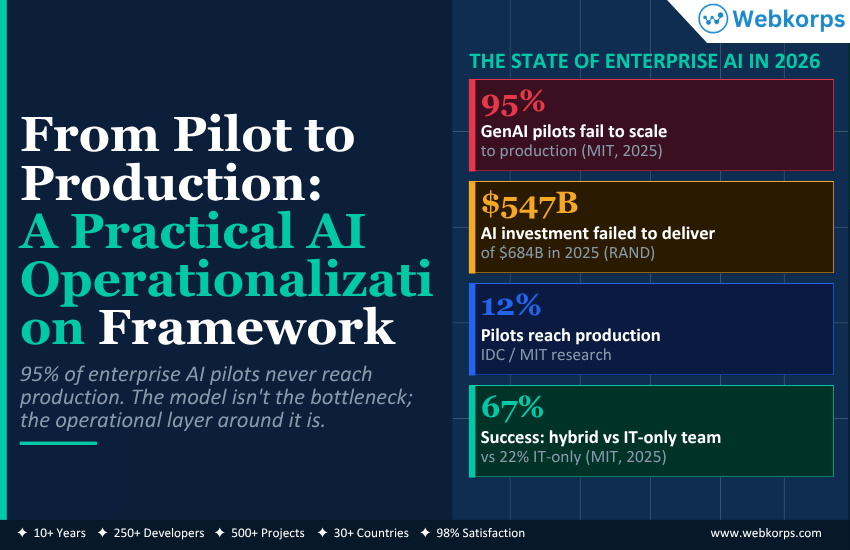
| Enterprise GenAI pilots that fail to scale to production | 95% | MIT, 2025 |
| AI investment in 2025 that failed to deliver business value | $547B of $684B | RAND, 2025 |
| Enterprise AI pilots that reach production | 12% | IDC / MIT research |
| Success rate: internal + external team vs. IT-only build | 67% vs. 22% | MIT, 2025 |
A Fortune 500 enterprise ran 14 AI pilots in 2024. Each one worked in the demo. Each one produced a compelling proof-of-concept. By the end of 2025, exactly one had reached production. The other thirteen were quietly shelved, not because the models failed, but because no one had built the data pipelines, the monitoring, the governance, or the operating model required to run them in the real world. Total sunk cost: an estimated $18 million. The CIO’s board now asks a single question at every AI review: ‘Will this one actually ship?’
That question is the defining challenge of enterprise AI in 2026. MIT’s 2025 research found that 95% of enterprise generative AI pilots fail to scale to production, and the failure is almost never the model. RAND’s 2025 analysis of over 2,400 initiatives found that 80.3% of AI projects fail to deliver their intended business value: 33.8% are abandoned before production, 28.4% complete but underdeliver, and 18.1% deliver some value but cannot justify the cost.
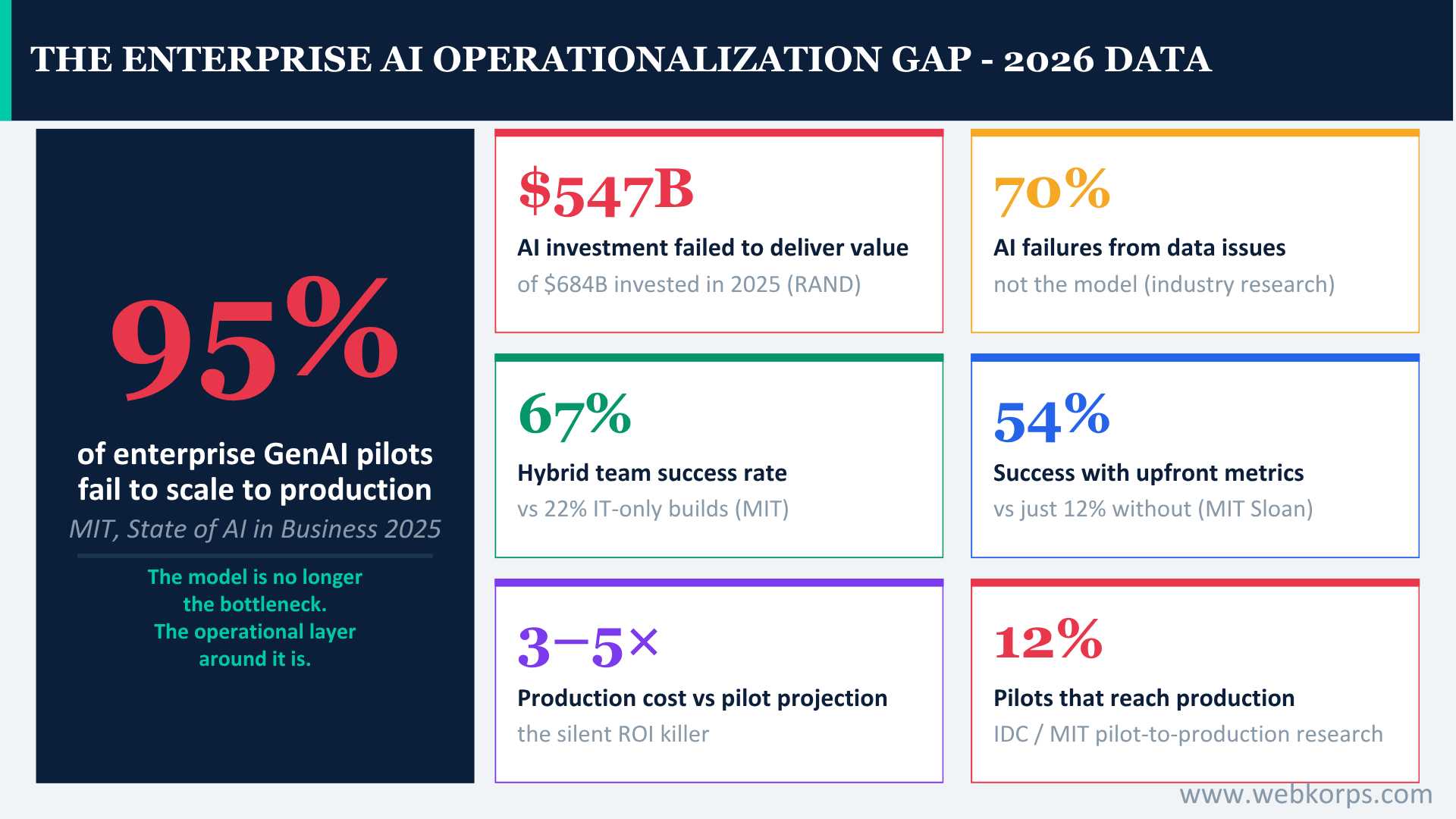
The pattern across every major 2025-26 study is identical: the model is no longer the bottleneck. The work around the model is. Data readiness, workflow integration, MLOps infrastructure, governance, and the operating model are where pilots go to die. As one MIT-surveyed executive put it: ‘The hype on LinkedIn says everything has changed, but in our operations, nothing fundamental has.’
This guide presents a practical, five-phase AI operationalization framework for Enterprise CIOs and CDOs. It synthesises Andrew Ng’s AI Transformation Playbook, MIT Sloan’s GenAI Divide research, RAND’s failure analysis, and current MLOps practice into a sequence that moves AI from pilot to production, and keeps it there. It is written for the leaders who bridge the gap between experimentation and enterprise value.
Table of Contents
Why Enterprise AI Pilots Stall: The Operationalization Gap
Andrew Ng’s AI Transformation Playbook makes a foundational point that most enterprises ignore: becoming an AI company is a repeatable process, not a series of one-off projects. The pilot is step one of five, not the destination. Most enterprises treat the successful pilot as the finish line, when it is actually the starting line for the harder work of operationalization.
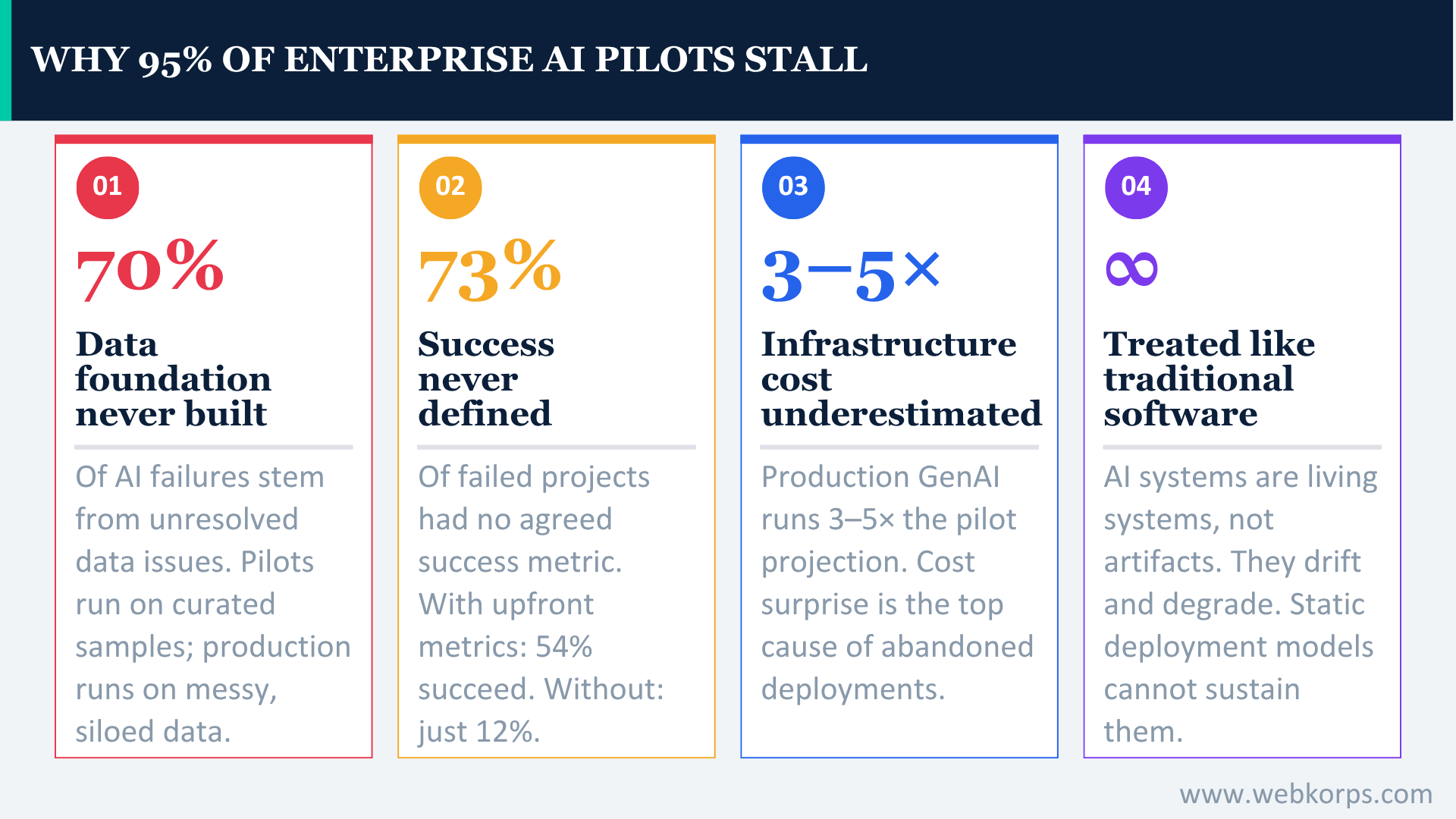
1. The data foundation was never built
Approximately 70% of AI failures originate from unresolved data issues. Pilots run on hand-curated, cleaned sample data. Production runs on messy, real-time, siloed enterprise data. Gartner predicts that 60% of AI projects lacking AI-ready data will be abandoned through 2026, and that rate is already at 42% of US companies. The pilot never had to solve the data problem. Production cannot avoid it.
2. Success was never defined
73% of failed AI projects had no agreed definition of success before the project started. Worse, 61% of enterprise AI projects were approved on projected ROI that was never measured after launch (MIT Sloan, 2025). Projects with quantified success metrics defined upfront achieve a 54% success rate; those without, just 12%. The pilot proved the model worked. It never defined what ‘working’ meant in business terms.
3. The infrastructure cost was underestimated
Production GenAI deployments typically run three to five times the initial cost projection, and infrastructure cost surprise is the leading cause of abandoned agent deployments. The pilot ran on a developer’s budget. Production runs on enterprise-scale inference, monitoring, and retraining costs that were never modelled.
4. AI was treated like traditional software
Enterprises that treat AI like traditional software underestimate integration complexity, leading to stalled builds and failed launches. AI systems are living systems, not one-time artifacts. They drift. They degrade. They require continuous monitoring and retraining. A deployment model built for static software cannot sustain a system that changes with its data.
“Pilots blending internal AI specialists with external expertise achieved a 67% success rate, versus only 22% for IT-only builds.”
– MIT, The GenAI Divide: State of AI in Business 2025
The 5-Phase AI Operationalization Framework
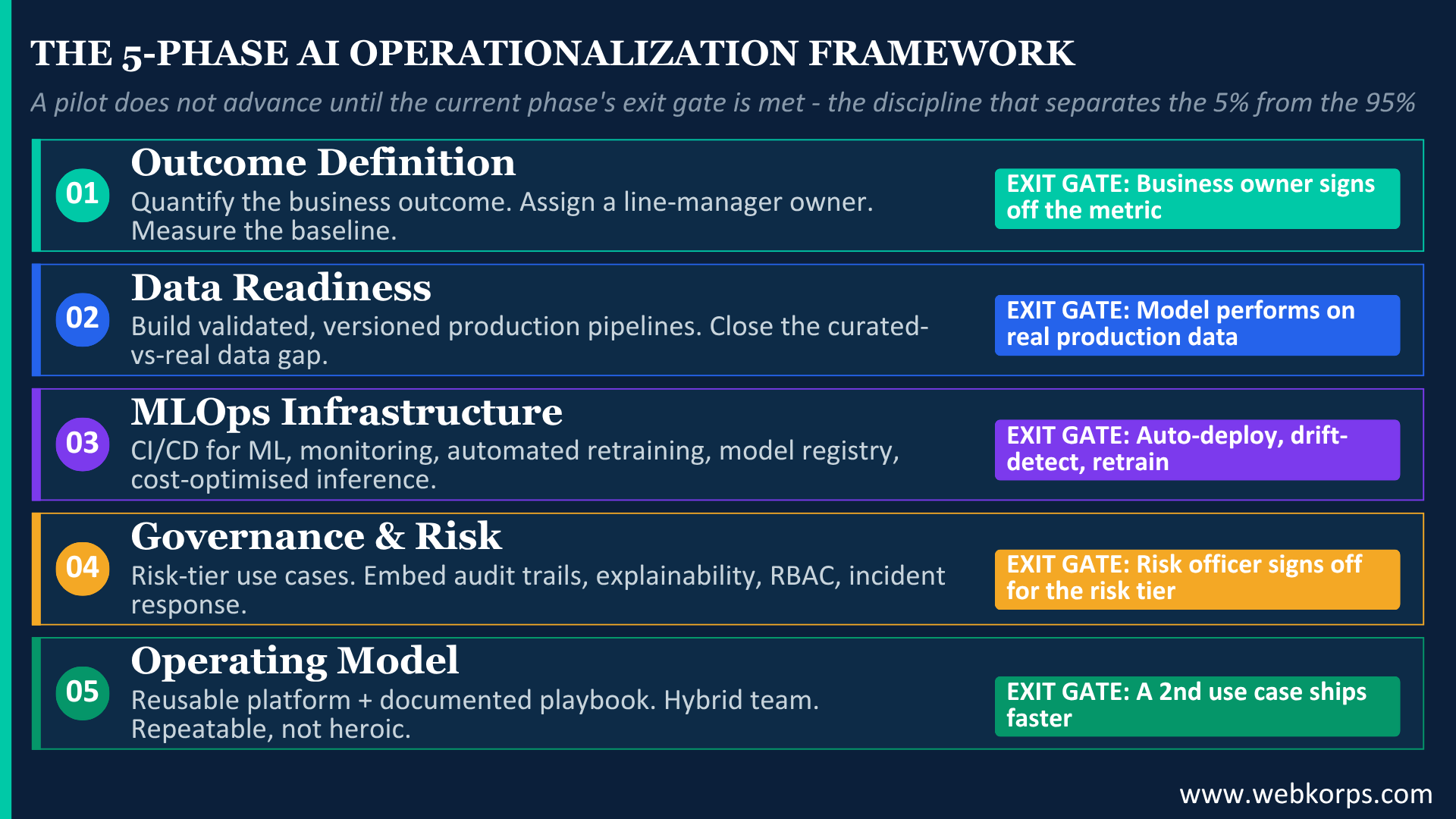
This framework adapts Andrew Ng’s five-step transformation sequence to the specific challenge of moving a validated pilot into sustained production. Each phase has a defined entry criterion, a set of deliverables, and an exit gate. A pilot does not advance to the next phase until the current phase’s exit gate is met; this discipline is what separates the 5% who reach production from the 95% who do not.
Phase 01 · Outcome Definition: Fix the Success Metric Before You Scale
The single highest-leverage intervention in AI operationalization is defining quantified business success before scaling. Projects with upfront success metrics succeed at 54%; those without, at 12%. This phase converts a pilot that “worked” into a production candidate with a measurable business case.
- Deliverable: A quantified business outcome. not a model metric. Not “92% accuracy” but “reduce claims processing time by 40%, saving $3.2M annually.”
- Deliverable: A baseline measurement of the current-state process, so post-deployment impact is provable to the board.
- Deliverable: A defined owner, a line manager, not just the central AI lab. MIT found that empowering line managers to drive adoption is a defining trait of the successful 5%.
- Exit gate: CFO or business-unit owner has signed off on the success metric and the measurement method. If no one owns the number, the pilot does not advance.
Phase 02 · Data Readiness: Build the Foundation for the Pilot Skipped
70% of AI failures originate from unresolved data issues. This phase closes the gap between the curated data the pilot used and the production data the system will actually run on. It is the phase enterprises most want to skip, and the one that most reliably kills them when they do.
- Deliverable: A data readiness assessment across availability, lineage, integration, accuracy, latency, security, and governance, scored against a maturity model from siloed (Level 0) to real-time governed (Level 4).
- Deliverable: Production data pipelines with validation, versioning, and a feature store, not the manual extracts the pilot relied on.
- Deliverable: Resolved data-access and governance permissions for the production data sources, with identity and refresh cycles defined.
- Exit gate: The model performs within acceptable tolerance on real production data, not curated sample data. If accuracy collapses on real data, the data foundation is not ready.
Phase 03 · MLOps Infrastructure: Build the System That Runs the Model
In 2026, AI success is not defined by model accuracy; it is defined by reliability, scalability, governance, and business impact. This phase builds the operational backbone: the CI/CD pipelines, monitoring, and retraining infrastructure that turn a model into a maintainable production service.
- Deliverable: CI/CD pipelines for the ML lifecycle, automated testing, and scheduled retraining, treating the model as a living system that degrades without maintenance.
- Deliverable: Production monitoring that tracks not only model accuracy but data drift, latency, and business KPIs, to prevent silent degradation.
- Deliverable: Infrastructure-as-code deployment (Terraform), containerised serving, auto-scaling, and a cost-optimised inference strategy, because production cost runs 3–5× the pilot projection.
- Deliverable: A model registry and versioning system so every production model is traceable, reproducible, and rollback-capable.
- Exit gate: The system can deploy a new model version, detect drift, and trigger retraining without manual intervention. If deployment is manual, it is not production-ready.
Phase 04 · Governance & Risk Controls: Make It Audit-Ready
As regulations like the EU AI Act take effect, governance is no longer an afterthought; it is a visible, mandatory part of the operating model. This phase embeds the controls that let an enterprise run AI in production without creating regulatory, operational, or reputational risk. It is the layer that the 95% skip and the 5% build in from the start.
- Deliverable: Risk-tiered use-case classification, high-impact workflows require human-in-the-loop review; low-risk workflows can run with lighter controls.
- Deliverable: Audit trails, explainability tooling, and policy enforcement embedded into the pipeline, not bolted on after deployment.
- Deliverable: Role-based access control, secure model endpoints, and logging sufficient to reconstruct any AI decision in an audit or incident review.
- Deliverable: A documented incident response and model-failure plan, what happens when the model produces a harmful or non-compliant output in production.
- Exit gate: A compliance or risk officer has signed off that the system meets the organisation’s governance and regulatory requirements for its risk tier.
Phase 05 · Operating Model: Make It Repeatable, Not Heroic
Andrew Ng’s central insight is that AI transformation is a repeatable playbook, not a series of heroic one-off projects. The MIT data confirms it: over 50% of 2025 AI budgets went to high-visibility “hero projects” with low ROI, while real returns came from systematic back-office automation. This final phase converts a single production success into an organisational capability.
- Deliverable: Reusable, modular pipelines and platform components so the next AI project starts from infrastructure, not from zero, the company-wide platform Andrew Ng identifies as essential to scale.
- Deliverable: Broad AI training across the organisation and a hybrid team model, internal specialists plus external expertise, the combination MIT found succeeds at 67% vs. 22% for IT-only builds.
- Deliverable: A documented operationalization playbook so the path from pilot to production is repeatable by any team, not dependent on the heroics of one.
- Deliverable: A portfolio governance process that prioritises back-office and operational use cases by ROI, not by visibility.
- Exit gate: A second AI use case has moved from pilot to production using the established framework, in materially less time than the first. Repeatability is the proof of operationalization.
Pilot-Grade vs. Production-Grade AI: What Actually Changes
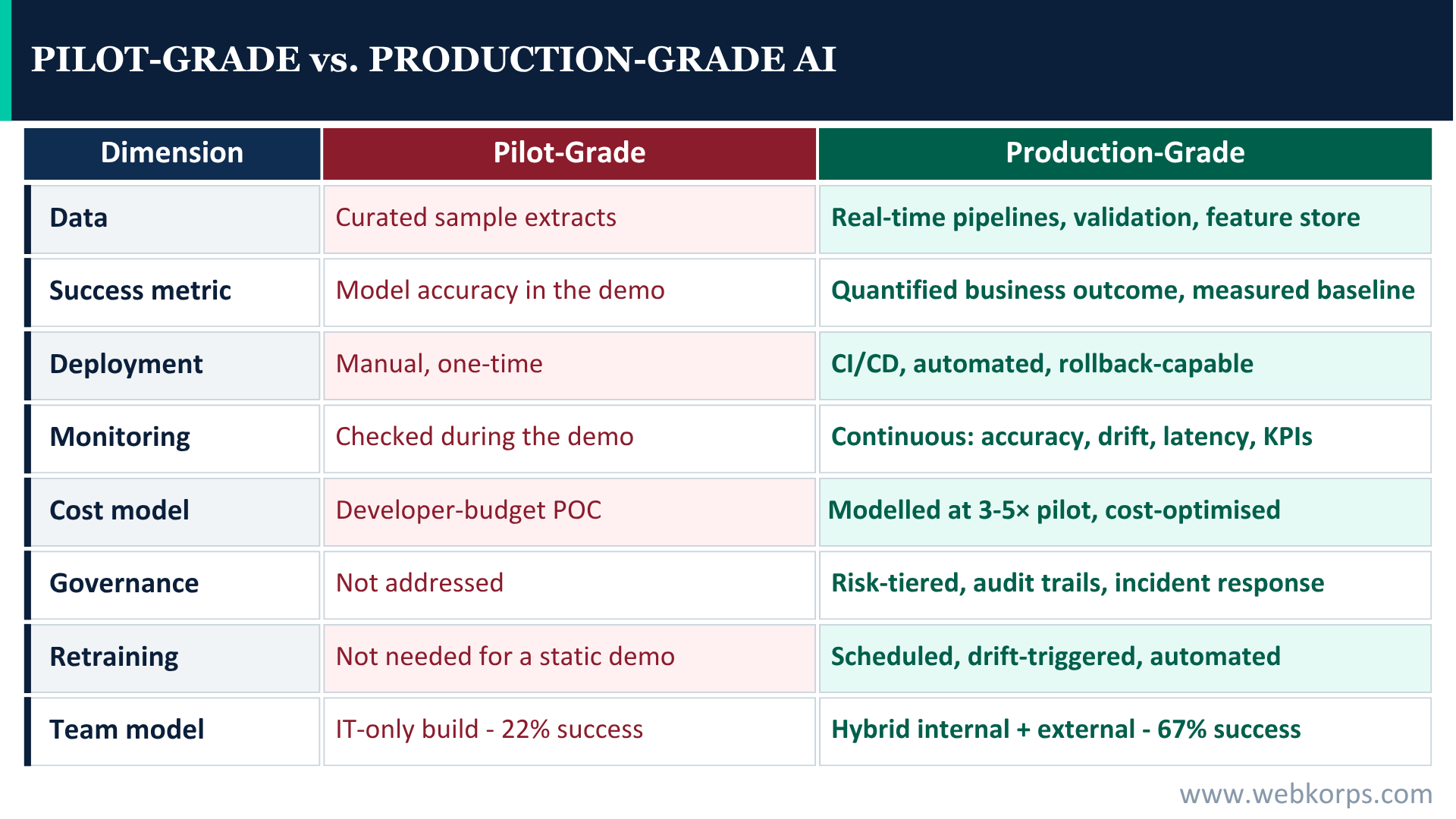
The gap between a pilot and a production system is not a matter of polish; it is a difference in kind. Each dimension below is a documented failure point where pilots who ignored the distinction did not survive contact with production.
| Dimension | Pilot-Grade | Production-Grade |
|---|---|---|
| Data | Curated sample extracts | Real-time pipelines, validation, versioning, feature store |
| Success metric | Model accuracy in the demo | Quantified business outcome with measured baseline |
| Deployment | Manual, one-time | CI/CD, automated, rollback-capable, reproducible |
| Monitoring | Checked during the demo | Continuous: accuracy, drift, latency, business KPIs |
| Cost model | Developer-budget proof-of-concept | Modelled at 3–5× pilot cost, cost-optimised inference |
| Governance | Not addressed | Risk-tiered, audit trails, explainability, incident response |
| Retraining | Not needed for a static demo | Scheduled, drift-triggered, automated |
| Ownership | Central AI lab | Business-unit line manager with a measured target |
| Team model | IT-only build (22% success) | Hybrid: internal + external expertise (67% success) |
| Repeatability | One-off hero project | Reusable platform, documented playbook |
The CIO’s AI Operationalization Readiness Checklist
Before committing a pilot to production scaling, an enterprise CIO or CDO should be able to answer yes to every item below. Each maps to a documented failure mode in the 2025–26 research.
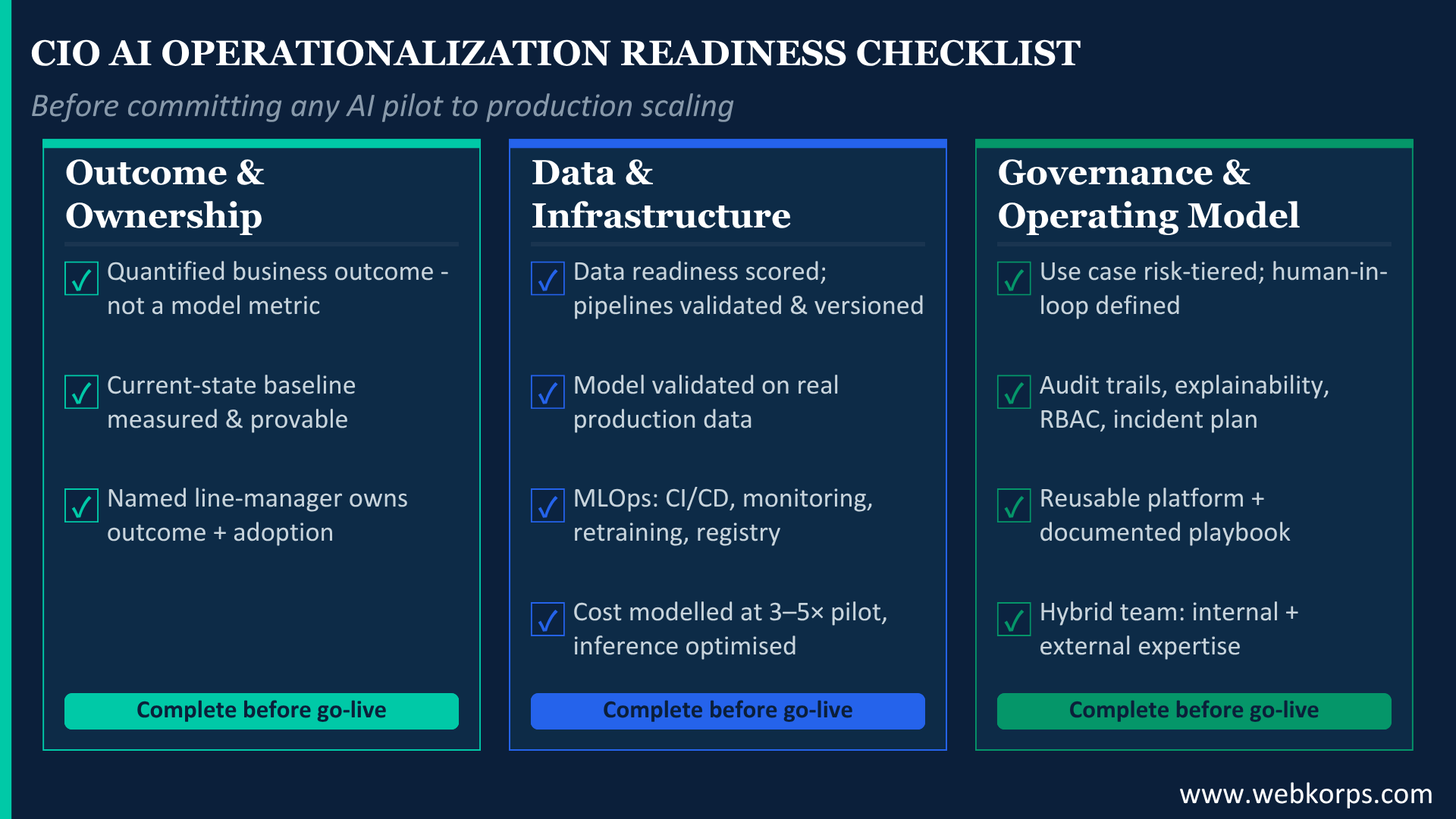
Outcome and ownership
- Quantified business outcome defined and signed off by the business-unit owner, not a model accuracy metric
- Current-state baseline measured, so post-deployment impact is provable
- A named line manager owns the outcome and the adoption
Data and infrastructure
- Data readiness assessed and scored; production pipelines built with validation and versioning
- Model validated on real production data, not curated samples
- MLOps infrastructure in place: CI/CD, monitoring, automated retraining, model registry
- Production cost modelled at 3–5× pilot projection with a cost-optimised inference strategy
Governance and operating model
- Use case risk-tiered; human-in-the-loop defined for high-impact workflows
- Audit trails, explainability, RBAC, and incident response are embedded in the pipeline
- Reusable platform components and a documented operationalization playbook
- Hybrid team model: internal specialists plus external operationalization expertise
How Webkorps Operationalizes Enterprise AI
Most enterprises do not have an AI model problem. They have an operationalization problem, a backlog of validated pilots that cannot cross the gap to production because the data foundation, the MLOps infrastructure, the governance layer, and the operating model were never built. This is precisely the gap Webkorps closes.
Our enterprise AI practice is built around the operational layer that determines whether AI reaches production, not the demo that determines whether it looks impressive:
- Data readiness and pipelines: we assess data maturity and build the validated, versioned production pipelines that 70% of failed AI projects never had
- MLOps infrastructure: CI/CD for ML, drift detection, automated retraining, model registry, and cost-optimised inference, the system that runs the model in production
- Governance by design: risk-tiered controls, audit trails, explainability, and incident response embedded from sprint one, aligned to EU AI Act and sector regulation
- The hybrid model that works: our specialists work alongside your internal team, the internal-plus-external combination MIT found succeeds at 67% versus 22% for IT-only builds
- Repeatable operating model: reusable platform components and a documented playbook so your second and third use cases reach production faster than your first
| THE WEBKORPS ENTERPRISE AI TRACK RECORD
500+ delivered projects across 30+ countries · ISO 27001 · CMMI Level 3 · Enterprise AI operationalization, MLOps, and data engineering. We build the operational layer that turns AI pilots into production systems that deliver measurable business value. |
The Pilot Was Never the Hard Part
The Fortune 500 enterprise that shelved thirteen of fourteen pilots made a category error that the data shows is nearly universal: it treated the pilot as the achievement. But the pilot was never the hard part. Demonstrating that a model works on curated data in a controlled environment is, in 2026, almost trivial. The hard part, the part where 95% of enterprise AI fails, is everything that comes after: the data foundation, the MLOps infrastructure, the governance, and the operating model that turn a working demo into a system that delivers value in production, month after month.
Andrew Ng’s playbook framed AI transformation as a repeatable process, not a sequence of heroic projects. The enterprises that internalise this, that build operationalization as a capability rather than improvising it project by project, are the 5% extracting real value while the 95% accumulate sunk costs and shelved pilots. The framework in this guide is the difference between the two.
AI operationalization is not a technical afterthought to the model. It is the discipline that determines whether the model ever matters. For the CIOs and CDOs who own the gap between pilot and production, it is the most consequential capability the enterprise can build in 2026.
| Ready to Move Your AI Pilots Into Production? |
| Webkorps builds the operational layer that turns AI pilots into production systems, MLOps pipelines, data architecture, governance, and monitoring. ISO 27001 certified. CMMI Level 3. 500+ projects across 30+ countries. Book a free AI operationalization readiness review. |
| Book an AI Operationalization Readiness Review |
| Explore Our Enterprise AI Practice |
Frequently Asked Questions
Q: What is enterprise AI operationalization?
Enterprise AI operationalization is the discipline of moving an AI model from a validated pilot into a sustained production system that delivers measurable business value. It covers everything around the model: production data pipelines, MLOps infrastructure (CI/CD, monitoring, retraining), governance and risk controls, and the operating model that makes the process repeatable. The model itself is rarely the hard part — operationalization is where 95% of enterprise AI pilots fail, according to MIT’s 2025 research.
Q: Why do 95% of enterprise AI pilots fail to reach production?
The failure is almost never the model. MIT and RAND’s 2025 research identifies four structural causes: the data foundation was never built (70% of failures stem from data issues), success was never quantified before the build (73% of failed projects had no agreed success definition), production infrastructure cost was underestimated (production runs 3–5× the pilot projection), and AI was treated like static traditional software rather than a living system requiring continuous monitoring and retraining.
Q: How is AI operationalization different from a successful AI pilot?
A pilot proves a model works on curated data in a controlled environment, which is, in 2026, almost trivial. Operationalization proves the model works on messy real-time production data, at scale, with monitoring, governance, and a defined business outcome, month after month. The differences are categorical: curated samples vs. production pipelines, manual deployment vs. CI/CD, demo-time checks vs. continuous drift monitoring, no governance vs. risk-tiered controls, and a one-off hero project vs. a repeatable platform.
Q: What does an AI operationalization framework include?
A practical framework moves through five phases, each with an exit gate:
- Outcome Definition: Quantify the business metric and assign an owner before scaling.
- Data Readiness: build validated production pipelines and confirm the model performs on real data.
- MLOps Infrastructure: CI/CD, monitoring, automated retraining, model registry.
- Governance & Risk Controls: risk tiering, audit trails, explainability, incident response;
- Operating Model: reusable platforms and a documented playbook that make the next deployment faster. A pilot advances only when each phase’s exit gate is met.
Q: How long does it take to move an AI pilot to production?
It varies by data readiness and use-case complexity, but MIT found mid-market organisations move from pilot to full implementation in roughly 90 days, while large enterprises typically take nine months or longer. The difference is rarely the model; it is the time required to build the data foundation, MLOps infrastructure, and governance that the pilot skipped. Enterprises with a reusable operationalization platform move materially faster on their second and third use cases than their first, which is the entire point of building operationalization as a repeatable capability.
Q: Should enterprises build AI operationalization in-house or use a partner?
MIT’s 2025 research provides a clear data point: pilots blending internal AI specialists with external expertise achieved a 67% success rate, versus only 22% for IT-only internal builds, a 3× difference. The most effective model is hybrid: internal teams own domain knowledge and the business outcome, while an external partner brings the MLOps, data engineering, and operationalization discipline that most internal teams have not yet built. The goal is capability transfer; the partner should leave the enterprise able to operationalize its next use case more independently.