
 Posted by
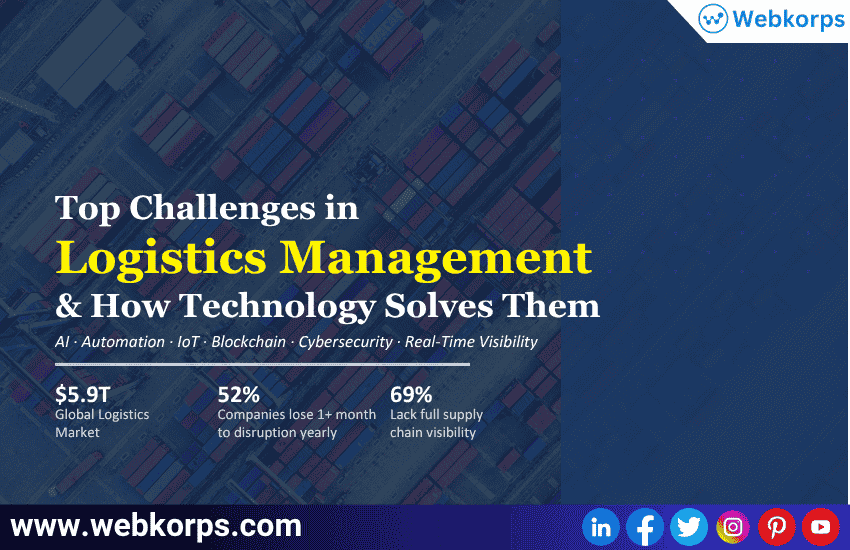
 The global logistics industry is bigger and more pressured than ever before. Valued at $5.9 trillion in 2025 and projected to reach $8.2 trillion by 2034, it forms the backbone of world trade. Yet behind those numbers lies a sector being tested like never before.
Supply chains that were already stretched thin got battered by pandemic aftershocks, geopolitical friction, climate events, and the relentless rise of e-commerce. Today, logistics managers aren’t just moving goods from Point A to Point B; they’re navigating port congestion, driver shortages, tariff volatility, cybercriminals, and customers who expect same-day delivery as a baseline.
Research from DP World found that more than 52% of companies worldwide lose over one month of operational capacity in any year affected by logistics disruption. The financial fallout is staggering: automotive supply chains alone absorb an estimated $13 billion in disruption costs annually, while tech firms face losses of around $16 billion.
So what does it take to not just survive but lead in this environment?
In this guide, we break down the biggest challenges in logistics management in 2026, what’s causing them, and, critically, how today’s technology solutions are helping logistics companies fight back. We’ve also included key insights that most blogs miss, so you walk away with a genuinely complete picture.
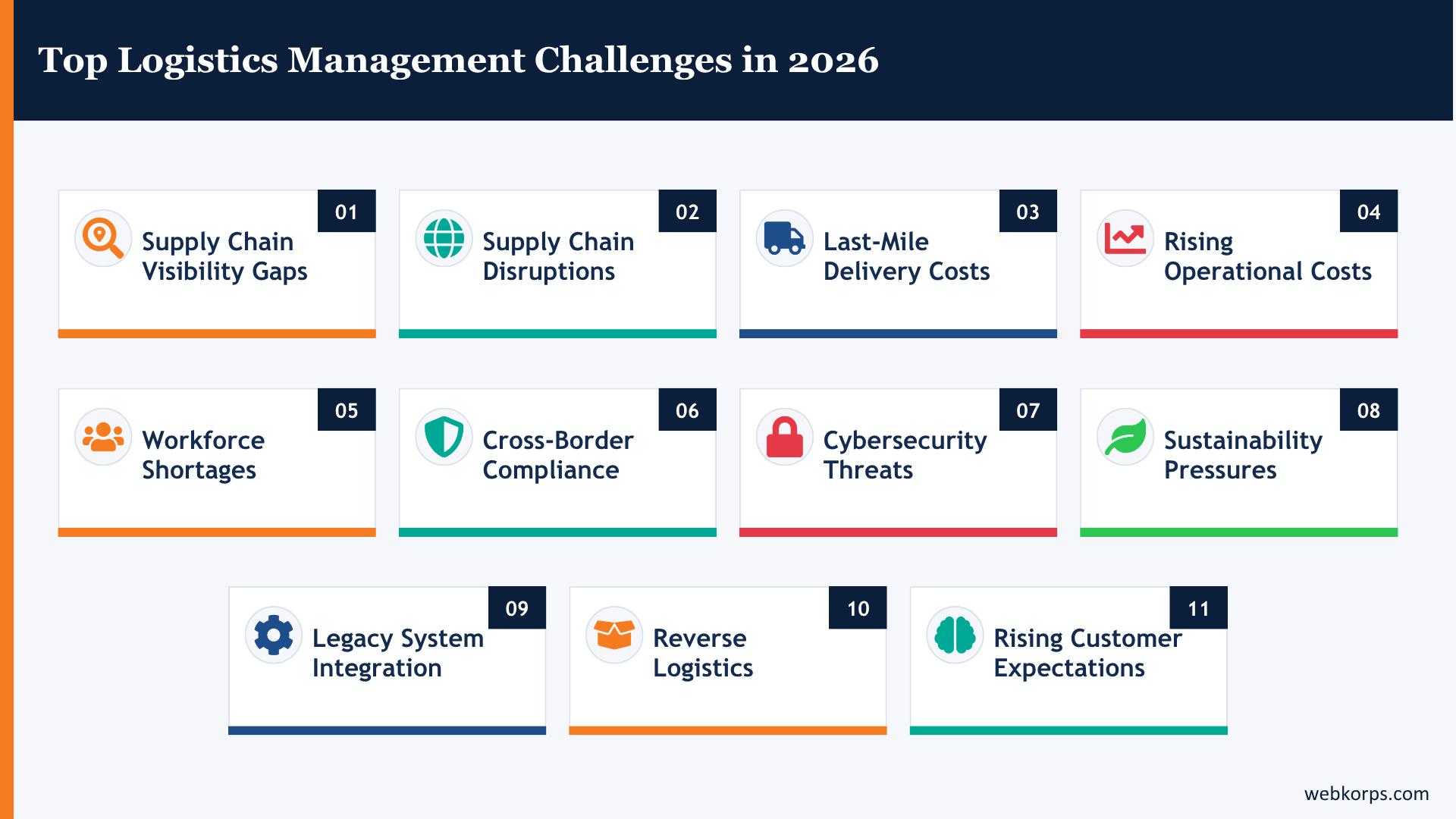
Table of Contents
Lack of End-to-End Supply Chain Visibility
The Challenge
Ask most logistics operations managers where their shipment is right now, at this exact moment, and many will pause. Despite years of investment in digital tools, a striking 69% of companies still lack full visibility into their supply chains, with only 6% reporting complete end-to-end transparency.
Visibility gaps hurt in multiple ways. When a consignment goes dark between a shipping port and a distribution center, teams are forced into reactive firefighting. Perishables spoil. Temperature-sensitive pharmaceuticals go out of compliance. Customers receive no updates and lose trust. And managers make costly decisions based on incomplete information.
The problem worsens across borders, where goods change hands between carriers, customs agencies, freight forwarders, and last-mile providers, each often running different systems that don’t talk to each other.
How Technology Solves It
The most effective solution is a layered real-time visibility stack:
- IoT-enabled sensors and smart trackers attached to pallets, containers, and vehicles provide live location, temperature, humidity, and condition data around the clock.
- Cloud-based Transportation Management Systems (TMS) centralize data from multiple carriers and partners into one dashboard, giving operations teams a single source of truth.
- AI-powered predictive visibility goes beyond tracking what has happened; it forecasts what’s likely to happen, alerting teams to potential delays before they materialize.
- Control towers, digital command centers that aggregate data across the full supply chain, allow companies to detect anomalies, reallocate resources, and respond in minutes rather than days.
Real-world example: Maersk, one of the world’s largest shipping companies, has been building advanced visibility capabilities that combine AI-driven agents with workflow automation tools. In 2026, these systems can reroute shipments in real time when disruptions are detected, without waiting for human escalation.
The business case is clear: companies that invest in supply chain visibility consistently report lower disruption costs, faster response times, and stronger customer satisfaction scores.
Supply Chain Disruptions and Resilience Failures
The Challenge
Disruption is no longer an occasional risk; it is a permanent operating condition. The last few years have been defined by one shock after another: pandemic-era demand imbalances, Red Sea security threats, Panama Canal capacity constraints, port congestion tied to labor strikes, and trade tariff instability. Geopolitical friction continues to reroute global flows and drive up carrier insurance costs.
The numbers tell a hard story: 94% of companies say their revenue has been negatively affected by supply chain disruptions. Recovery from major disruptions can take two to three years. And for many businesses, the damage extends beyond operational loss; supply chain failures lead directly to customer complaints, lost contracts, and lasting brand damage.
How Technology Solves It
The shift happening in 2026 is from reactive risk management to predictive resilience:
- AI-powered risk modeling integrates real-time global event feeds (weather, geopolitical news, port status) with internal supply chain vulnerability maps to flag risks before they escalate.
- Digital twins, virtual replicas of physical supply chain networks, allow companies to run disruption simulations, test alternative routings, and identify weak points without touching live operations.
- Multi-shoring and supplier diversification platforms help businesses identify and qualify backup suppliers across multiple regions, reducing single-source dependency. IDC forecasts that 50% of companies will shift to balanced multi-shoring sourcing by 2026.
- Scenario planning tools driven by machine learning let teams model “what-if” situations, such as what if a major port closes for two weeks? What if a key supplier goes offline? Have contingency plans pre-loaded and ready to activate.
The companies coming out ahead are not those who avoided disruption; they’re the ones who built systems that absorb shocks and adapt faster than competitors.
Last-Mile Delivery: The Most Expensive Mile in Logistics
The Challenge
Last-mile delivery remains the most costly and complex part of the logistics chain. It can account for 53% of total shipping costs, yet it is often the least efficient leg of the journey. Urban congestion, unpredictable traffic, failed delivery attempts, and customer demands for precise time windows compound the problem.
In 2026, the pressure has intensified further: FedEx and UPS have implemented additional rate and surcharge increases, pushing ground parcel costs to record levels. Nearly 59% of companies now emphasize same-day or next-day delivery, turning what was once a premium service into a basic expectation.
Dense cities create their own set of hurdles. Delivery trucks sit an average of 16 minutes in traffic per stop in major metropolitan areas. That dead time burns fuel, delays the next stop, and drives up per-delivery costs rapidly.
How Technology Solves It
A range of technologies is reshaping last-mile delivery:
- AI-powered route optimization dynamically recalculates delivery sequences as new orders arrive, traffic changes, or failed attempts are recorded, reducing fuel use and increasing stops completed per shift.
- Micro-fulfillment centers positioned within or near urban centers place inventory closer to end customers, reducing the distance goods need to travel on the most expensive leg.
- Smart locker networks allow multiple carriers to consolidate deliveries to shared pickup points, cutting individual door-step attempts significantly.
- Cargo bikes, electric delivery vehicles, and autonomous delivery robots are being piloted in dense city districts, reducing emissions while navigating streets inaccessible to full-sized trucks.
- Predictive delivery scheduling powered by machine learning analyzes customer behavior patterns to anticipate when someone is home and schedule deliveries accordingly, reducing failed first-attempt rates.
Companies embracing these multi-layered approaches are seeing measurable gains in delivery cost-per-order, on-time rates, and customer satisfaction scores.
Rising Operational Costs and Margin Compression
The Challenge
Logistics companies are caught in a brutal squeeze: costs keep rising while competitive pressure limits what they can charge. Fuel price volatility, rising labor costs, elevated asset replacement costs (trucks, forklifts, warehouse equipment), and the burden of technology investment are all compressing margins simultaneously.
Even as freight demand stabilizes post-pandemic, operators find that cost structures have permanently shifted upward. The math is unforgiving for companies without digital efficiency tools. Passing every cost increase to customers risks losing business; absorbing it destroys profitability.
How Technology Solves It
Smart logistics companies are attacking costs across multiple fronts simultaneously:
- Route optimization software can deliver ROI within 12 months by cutting fuel consumption and empty miles. Companies using AI-driven routing consistently report 10–20% reductions in fuel costs.
- Predictive maintenance platforms use IoT sensors on fleet vehicles and warehouse equipment to detect failures before they happen, avoiding costly emergency repairs and operational downtime.
- Collaborative shipping networks allow competing carriers to share transportation capacity on overlapping lanes, reducing the dead miles that kill margins on return legs.
- Dynamic pricing engines let logistics providers adjust rates in real time based on demand, capacity, and market conditions, capturing revenue during high-demand periods and staying competitive when demand softens.
- Warehouse automation, robotic picking, automated sorting, and smart shelving reduce labor dependency in one of the most cost-exposed parts of the operation. The warehouse automation market is forecast to surpass $30 billion by 2026.
AI adoption alone can cut logistics costs by 15% and boost service efficiency by 65%, according to supply chain research. The savings are real, but only for companies that move from pilot programs to enterprise-scale deployment.
Workforce Shortages and the Talent Crisis
The Challenge
Logistics has a serious people problem, and it’s getting worse. The U.S. logistics sector was projected to face a labor shortage of over 2 million workers by 2025, a gap that continues into 2026. The workforce is aging, with an average age of 42, while high turnover rates in warehouse and transportation roles drain training investment and institutional knowledge.
The problem isn’t just finding warm bodies. It’s finding workers with the right skills. As logistics operations become more technology-dependent, the need for workers comfortable with digital platforms, robotics, predictive tools, and data systems has grown sharply. Finding someone who can operate an autonomous mobile robot system or interpret a demand forecasting dashboard is much harder than filling a forklift role.
How Technology Solves It
Technology addresses the workforce crisis from two directions: reducing dependence on scarce labor and making the workplace more attractive to retain the people you have.
- Autonomous Mobile Robots (AMRs) handle repetitive warehouse tasks, picking, sorting, and transporting goods, without needing breaks, shifts, or sick days. AMRs are expected to account for over 60% of new automation deployments in distribution centers by 2026.
- AI-powered onboarding and training platforms reduce the time it takes to get a new hire productive, using guided interfaces, visual workflows, and real-time support tools that lower the skill ceiling for complex systems.
- Workforce management software that offers flexible scheduling, shift-swapping, and preference matching improves retention by giving workers more control over their time, a key factor in a competitive labor market.
- Collaborative robots (cobots) work alongside humans rather than replacing them, augmenting productivity without requiring the worker to be a robotics expert.
- SMS-based frontline communication platforms bridge the gap between operations managers and warehouse or field staff who don’t have regular access to email or desktop systems, improving coordination, reducing errors, and strengthening engagement.
The companies winning the talent war are those treating workforce investment as a technology problem as much as an HR one.
Cross-Border Compliance and Regulatory Complexity
The Challenge
Global logistics means navigating a constantly shifting maze of customs regulations, trade agreements, tariffs, documentation requirements, and country-specific rules. In 2026, this challenge has become even more acute. North American customs procedures are changing, new tariff structures have been introduced, and sustainability regulations are adding a new layer of compliance obligation in the EU and beyond.
One missing document can hold a shipment at a border for days. Fines for customs violations can exceed $10,000 per incident. And the rules change constantly; what was compliant last quarter may not be today.
How Technology Solves It
- Automated trade compliance software maintains continuously updated regulatory databases across every jurisdiction where a company operates, automatically generating and validating the correct documentation for each shipment.
- AI-powered tariff classification engines analyze product characteristics and automatically assign the correct HS codes, reducing misclassification errors that trigger audits and fines.
- Blockchain-based document management creates immutable, timestamped records of customs declarations, certificates of origin, and compliance attestations, building a verifiable audit trail that stands up to regulatory scrutiny.
- Carbon reporting and sustainability compliance tools are becoming essential as the EU’s Carbon Border Adjustment Mechanism (CBAM) and similar regulations require logistics companies to document and report their emissions footprint across supply chains.
Compliance technology transforms what was once a cost center and a liability into a competitive advantage, enabling companies to clear borders faster, avoid penalties, and enter new markets with confidence.
Cybersecurity Vulnerabilities: The Silent Threat Growing in the Shadows
The Challenge
This is the challenge that gets the least attention in logistics, and it may be the most dangerous one. A 2026 survey found that while 44% of logistics companies plan to prioritize predictive visibility, only 11% cited cybersecurity as a top investment priority. That gap is a major vulnerability.
Logistics networks are highly attractive targets for cybercriminals. They operate complex, interconnected digital systems, including Transportation Management Systems, Warehouse Management Systems, IoT sensor networks, GPS tracking platforms, and customs portals, often integrated with dozens of third-party carriers, suppliers, and government agencies. Each integration point is a potential entry point.
The threats are real and escalating:
- Ransomware attacks encrypt critical operational systems and demand payment to restore access. A successful ransomware attack on a logistics TMS can shut down entire distribution networks within hours.
- Data breaches expose sensitive client information, shipment details, and operational blueprints. The global average cost of a data breach rose to $4.88 million in 2024, a 10% increase year over year.
- IoT device exploitation, an infected sensor on a loading dock can serve as an entry point to broader inventory or routing systems.
- Invoice fraud and payment diversion schemes exploit weaknesses in financial transaction workflows to siphon funds or redirect shipments.
- Return fraud is an increasingly serious operational threat. Bad actors falsify return details, send back empty packages, or circumvent verification protocols, generating both financial loss and compliance headaches, especially in regulated sectors like pharmaceuticals.
As one industry leader put it: “The key challenge for 2026 won’t be whether the industry continues to innovate, but whether it can innovate safely.”
How Technology Solves It
- AI-powered threat detection systems continuously monitor network activity, flagging anomalous patterns, an unusual login from an unknown IP, or a sudden bulk data export, before breaches escalate.
- Zero-trust architecture eliminates the assumption that anything inside the network perimeter is safe. Every user, device, and system must authenticate continuously, limiting the blast radius of any compromise.
- End-to-end encryption protects data in transit and at rest across all systems, ensuring that intercepted data is unreadable.
- OT/IT network segmentation physically and logically separates operational technology (IoT devices, sensors, warehouse systems) from broader IT infrastructure, containing breaches before they spread.
- Multi-factor authentication (MFA) on all core systems, especially TMS and financial platforms, blocks credential-based attacks even when passwords are compromised.
- Regular penetration testing simulates real-world attack scenarios, identifying vulnerabilities before criminals do.
- Blockchain-based traceability for return workflows creates tamper-proof records of every product movement, making return fraud significantly harder to execute undetected.
Cybersecurity is not an IT checkbox; it is a strategic capability. Companies that connect data, automation, and cybersecurity into one intelligent ecosystem will build the resilience that 2026 demands.
Sustainability Pressures and Green Logistics
The Challenge
Sustainability is no longer a PR exercise for logistics companies; it is a commercial and regulatory imperative. The green logistics market is expected to grow from $1.28 trillion in 2024 to $1.91 trillion by 2029. Customers, investors, and regulators are all demanding measurable environmental performance, not pledges.
Decarbonizing logistics is genuinely hard. Long-haul trucking, air freight, and ocean shipping are among the most emissions-intensive activities in global commerce. Fleet replacement cycles are long and expensive. And the infrastructure for electric heavy vehicles is still maturing.
How Technology Solves It
- AI-driven route optimization reduces fuel consumption by minimizing unnecessary mileage, avoiding congestion, and optimizing load consolidation, cutting emissions alongside costs.
- Electric and hybrid vehicle fleet management platforms help logistics companies plan, operate, and optimize EV fleets, including charging scheduling and range management.
- Carbon footprint tracking tools measure and report Scope 1, 2, and 3 emissions across the supply chain, increasingly essential for EU CBAM compliance and ESG reporting.
- Sustainable warehouse design systems, including smart energy management, LED lighting automation, and solar integration, reduce facilities’ energy footprints significantly.
- Reverse logistics technology supports circular economy goals by optimizing the collection, sorting, refurbishment, and recycling of returned goods. The reverse logistics market exceeded $872.6 billion in 2025 and is growing at 7.3% annually, driven partly by sustainability mandates.
- Multi-modal transportation optimization tools help planners choose rail and sea freight over air wherever possible, shifting to lower-emission modes without sacrificing delivery commitments.
Technology Integration and Legacy System Debt
The Challenge
Most logistics companies didn’t start with clean, modern technology stacks. They built their operations over decades, layering new systems on top of old ones, acquiring companies with different platforms, and patching together workarounds. The result is a fragmented technology landscape where critical data lives in silos and systems that need to talk to each other can’t.
The integration challenge is compounded by the speed of technology change. AI agents, autonomous vehicle platforms, blockchain networks, and digital twin systems are all emerging simultaneously, and legacy infrastructure wasn’t designed to accommodate any of them cleanly.
How Technology Solves It
- API-first integration platforms serve as connectors between old and new systems, allowing data to flow between a legacy ERP and a modern TMS without requiring a complete system replacement.
- Middleware and orchestration layers create a real-time operational layer that turns siloed data into coordinated action, enabling faster decisions, automated workflows, and proactive disruption response.
- Modular cloud-based logistics platforms allow companies to upgrade individual capabilities (routing, warehousing, customs) incrementally rather than forcing a single massive transformation program.
- Technology governance frameworks help logistics operators evaluate new solutions against standardized integration criteria, preventing the “new tool, new silo” cycle that created the legacy debt in the first place.
Gartner predicts that by 2026, over 75% of commercial supply chain management vendors will offer advanced AI, analytics, and data science functionality embedded in their platforms, making integration increasingly achievable for companies that prioritize it.
Reverse Logistics: The Underestimated Cost Center
The Challenge
As e-commerce grows, so does the volume of returns. The average e-commerce return rate climbed to 20.4% in 2024, up from 16.5% in 2022. Managing those returns efficiently, collecting, inspecting, sorting, refurbishing, recycling, or disposing of goods, is complex, expensive, and increasingly regulated.
Poorly managed reverse logistics bleed margin through inefficient transportation routes, excessive manual handling, slow processing, and products sitting idle when they could be resold or remanufactured. In regulated sectors like pharmaceuticals and electronics, mishandled returns also create compliance risks.
How Technology Solves It
- Automated returns management platforms allow customers to self-initiate and track returns online, reducing customer service burden while generating structured data about return reasons.
- AI-powered disposition engines analyze returned item data and automatically recommend the optimal path for each unit, restock, refurbish, recycle, or dispose, based on condition, demand signals, and margin calculations.
- Predictive analytics for return forecasting help logistics planners anticipate return volumes by SKU and geography, enabling proactive resource allocation.
- Blockchain-based traceability creates an auditable chain of custody for returned goods, reducing fraud and ensuring regulatory compliance in sectors like pharmaceuticals.
- Circular supply chain platforms connect reverse logistics data with procurement and manufacturing systems, enabling companies to close the loop and recover maximum value from returned goods.
Companies that treat reverse logistics as a strategic capability, rather than a necessary evil, consistently outperform peers on both cost efficiency and customer retention.
Escalating Customer Expectations
The Challenge
Consumer expectations have been permanently recalibrated by Amazon, Uber Eats, and the broader culture of on-demand everything. In B2C logistics, same-day or next-day delivery is increasingly standard. In B2B logistics, customers expect precise delivery windows, real-time shipment updates, digital proof of delivery, and the ability to change delivery instructions mid-route.
Meeting these expectations while maintaining profitability creates pressure that flows all the way back through the logistics chain.
How Technology Solves It
- Customer-facing real-time tracking portals keep customers informed throughout the delivery journey, reducing “where is my order?” inquiries and building trust.
- Preference management systems capture individual delivery profiles, time windows, special handling, communication preferences, and automatically route shipments accordingly.
- Proactive exception management tools detect potential delays and automatically notify customers before they have to ask, turning a negative experience into a demonstration of service quality.
- Electronic proof of delivery (ePOD) systems capture digital signatures, photos, and timestamps at the point of delivery, eliminating disputes and creating clean audit records.
- Net Promoter Score (NPS) and closed-loop feedback systems in B2B logistics help companies understand which accounts are at risk, what’s driving dissatisfaction, and where to prioritize service improvements.
DHL Supply Chain’s approach is instructive here: by implementing structured feedback workflows and transparency-focused communications, they transformed customer experience across their global operations, improving satisfaction and retention measurably.
Common Mistakes in Logistics Management And How to Avoid Them
Even experienced logistics teams make avoidable errors. The difference between companies that scale efficiently and those that constantly firefight often comes down to a handful of recurring mistakes, mistakes that quietly drain margins, frustrate customers, and create operational bottlenecks that compound over time.
Here are the most common mistakes in logistics management, and what smart companies are doing differently in 2026.
Relying on Manual Processes in a Data-Driven World
One of the most persistent mistakes in logistics management is continuing to run critical operations, inventory counts, shipment tracking, order verification, and documentation through spreadsheets, phone calls, and paper-based systems. Manual processes introduce human error at every touchpoint. A miskeyed quantity, a missed update, or a misfiled customs document can cascade into delays, disputes, and fines.
Research shows that manual data handling not only introduces more errors but also makes it nearly impossible to act on real-time information, because by the time data is entered, verified, and shared, the situation has already changed.
The fix: Invest in a connected digital infrastructure, a Transportation Management System (TMS), a Warehouse Management System (WMS), and automated data capture tools like barcode scanners and RFID. These systems reduce input errors, accelerate data availability, and free up your team to focus on decisions rather than data entry.
Poor Inventory Management: Too Much or Too Little
Inventory imbalance is one of the most expensive mistakes a logistics operation can make, and it cuts both ways. Overstocking ties up working capital, occupies expensive warehouse space, and increases the risk of spoilage or obsolescence. Understocking leads to stockouts, missed orders, and, critically, lost customers who will not wait and will not return.
Many businesses still rely on gut instinct or outdated historical data to make inventory decisions, especially when demand patterns have become far less predictable since the pandemic.
The fix: Implement demand forecasting tools powered by AI and machine learning. These systems analyze historical sales data, seasonal trends, promotional calendars, and external signals, like port congestion or supplier lead time shifts, to generate inventory recommendations that keep stock levels optimized without over- or under-buying. Companies using predictive inventory management consistently report lower carrying costs and higher order fulfillment rates.
Choosing the Cheapest Carrier Instead of the Right One
Cost pressure in logistics is real and relentless. But one of the most common and costly mistakes managers make is selecting carriers purely on price, without adequately evaluating reliability, on-time performance, damage rates, or service capability on specific lanes.
A carrier that saves $0.50 per shipment but delivers late 20% of the time is not saving money; it’s generating customer complaints, chargebacks, and repeat shipments that erase the savings many times over.
The fix: Build a carrier scorecard that tracks on-time delivery rate, damage claims, exception handling speed, and communication quality alongside cost. Use Transportation Management Systems that allow you to compare carrier performance data historically and in real time before tendering a load. The right carrier relationship, not just the cheapest rate, is what builds the delivery consistency your customers expect.
Neglecting Last-Mile Planning Until It’s Too Late
Companies invest heavily in long-haul transportation and warehouse efficiency, then treat last-mile delivery as an afterthought, something to figure out when the goods arrive at the final hub. This is a fundamental mistake. Last-mile delivery is where the customer experience is made or broken, and it is also where the majority of logistics costs accumulate.
Failed delivery attempts, poor route sequencing, and lack of proactive communication all drive up cost-per-delivery while degrading customer satisfaction. In 2026, with parcel rates at record highs and same-day expectations now mainstream, last-mile inefficiency is a serious competitive liability.
The fix: Plan last-mile operations proactively. Use AI-powered route optimization that dynamically sequences deliveries based on real-time traffic, delivery time windows, and driver availability. Implement electronic proof of delivery (ePOD) systems to eliminate disputes and track performance by driver, zone, and route. And communicate proactively with customers, automated delivery notifications dramatically reduce failed attempts and eliminate the “where is my order?” call volume that burdens customer service teams.
Underestimating the Importance of Supplier Relationship Management
Many logistics operations treat suppliers as interchangeable vendors, negotiating on price, placing orders, and only engaging when something goes wrong. This transactional approach creates fragility. When a key supplier experiences a delay, a quality issue, or a capacity constraint, companies with shallow relationships have no early warning and no leverage to prioritize recovery.
Shipping delays, late vendor deliveries, and misaligned inventory are costly mistakes that can quickly undermine profit margins. World-class businesses that absorb supplier disruptions most gracefully are those that treat supplier relationships as strategic partnerships, with regular communication, shared visibility into demand signals, and joint contingency planning.
The fix: Build supplier scorecards and conduct regular performance reviews. Share demand forecasts upstream so suppliers can plan production and capacity rather than reacting to purchase orders. Diversify your supplier base across regions to reduce single-source dependency, and invest in supplier onboarding technology that speeds up the qualification of backup partners when you need them.
Ignoring Real-Time Data and Operating on Yesterday’s Information
Logistics operations generate enormous volumes of data every hour, GPS pings, sensor readings, order updates, carrier status feeds, and customs clearance notifications. Companies that fail to capture, integrate, and act on this data in real time are making decisions based on information that is already outdated.
This mistake shows up in multiple ways: warehouse managers who don’t know a delivery is running three hours late until the customer calls; operations teams who can’t reroute a shipment before it misses a connection; finance teams reconciling invoices without visibility into what was actually delivered and when.
The fix: Invest in a supply chain visibility platform or control tower that consolidates real-time data from carriers, warehouse systems, and IoT devices into a single operational view. Pair it with automated alerting, so that when an exception occurs (a delay, a temperature breach, a customs hold), the right person is notified immediately rather than discovering the problem after the fact. Real-time data doesn’t just improve decision-making; it shifts your operation from reactive to proactive.
Failing to Plan for Disruptions Until a Crisis Hits
Perhaps the most strategically costly mistake in logistics management is treating disruption as an exception rather than a regular operating condition. Too many companies have no documented contingency plans for common disruption scenarios, such as a key supplier going offline, a port closure, a sudden demand spike, or a cybersecurity incident. When something goes wrong, they improvise, and improvisation at scale is expensive.
More than 52% of companies worldwide lose more than one month of operational capacity in any year affected by logistics disruption. Logistics Business The financial and reputational damage compounds when there is no plan to fall back on.
The fix: Conduct regular disruption scenario planning. Use digital simulation tools or supply chain digital twins to model what happens when a key node fails, and pre-build response playbooks so your team can activate a plan in hours rather than days. Diversify your carrier base, your supplier geography, and your inventory positioning so that a single point of failure doesn’t bring your entire operation to a halt.
Overlooking the True Cost of Poor Communication
In logistics, a communication failure is an operational failure. When a driver doesn’t receive updated delivery instructions in time, a shipment goes to the wrong address. When a warehouse team isn’t informed of an incoming surge, goods pile up at the dock. When a customer doesn’t receive a proactive delay notification, they call, tying up customer service resources and eroding trust simultaneously.
This is especially acute in logistics because the workforce is largely deskless; drivers, warehouse pickers, and field staff are not sitting at computers waiting for emails. Traditional communication channels fail them, and the operational cost of that failure is measured in missed deliveries, processing errors, and avoidable disputes.
The fix: Implement communication tools designed for frontline workers, SMS-based platforms, mobile apps, and two-way messaging systems that reach drivers and warehouse staff on the devices they carry. On the customer side, deploy automated notification systems that proactively update recipients at each key milestone: dispatch, in transit, out for delivery, delivered. Proactive communication is not a “nice-to-have “; it is a direct driver of customer retention and operational efficiency.
Treating Technology as a One-Time Fix Rather Than an Ongoing Investment
Many companies invest in a logistics technology platform, go live, declare the implementation a success, and then stop. No ongoing optimization, no training refreshers as the system evolves, no integration of new capabilities as they become available. Within 12 to 18 months, the platform is underutilized, and the competitive advantages it was supposed to deliver have not materialized.
Technology in logistics is not a destination; it’s a discipline. Systems require continuous tuning, data quality maintenance, and user adoption efforts to keep delivering value.
The fix: Establish an ongoing technology governance process. Assign ownership of each platform to an internal champion responsible for driving adoption, gathering user feedback, and coordinating with vendors on updates and new capabilities. Set quarterly KPIs that measure the business impact of each technology investment, not just system uptime, but actual outcomes like delivery accuracy, cost-per-shipment, and customer satisfaction scores. Treat technology as a capability to build, not a box to check.
Skipping the Human Side of Digital Transformation
Finally, and this is the mistake that quietly derails more logistics technology projects than any technical issue, companies underestimate how much their people matter in a digital transformation. New systems are deployed without adequate training. Workers fear that automation will eliminate their jobs and resist adoption. Managers don’t communicate the why behind changes, so teams comply without committing.
The result: expensive technology sits underutilized, workarounds persist alongside the new system, and the organization never captures the efficiency gains it invested in.
The fix: Treat people as the most important variable in any technology rollout. Communicate clearly and early about what’s changing, why, and what it means for individual roles. Invest in hands-on training tailored to specific job functions, not generic system walkthroughs. Identify internal “technology champions” in each team who support peer learning and flag adoption issues before they calcify into organizational habits. And where possible, involve frontline workers in solution design; the people closest to the process often identify the most important requirements.
The bottom line on logistics management mistakes: Most of them are not the result of bad intentions or incompetent teams. They are the result of operating under pressure, without the right tools, processes, or information. The companies that consistently outperform their peers in logistics are not miracle workers; they are simply more systematic about identifying where they are leaking value, and more deliberate about closing those gaps with the right technology and the right practices.
How Webkorps Helps Logistics Companies Navigate These Challenges
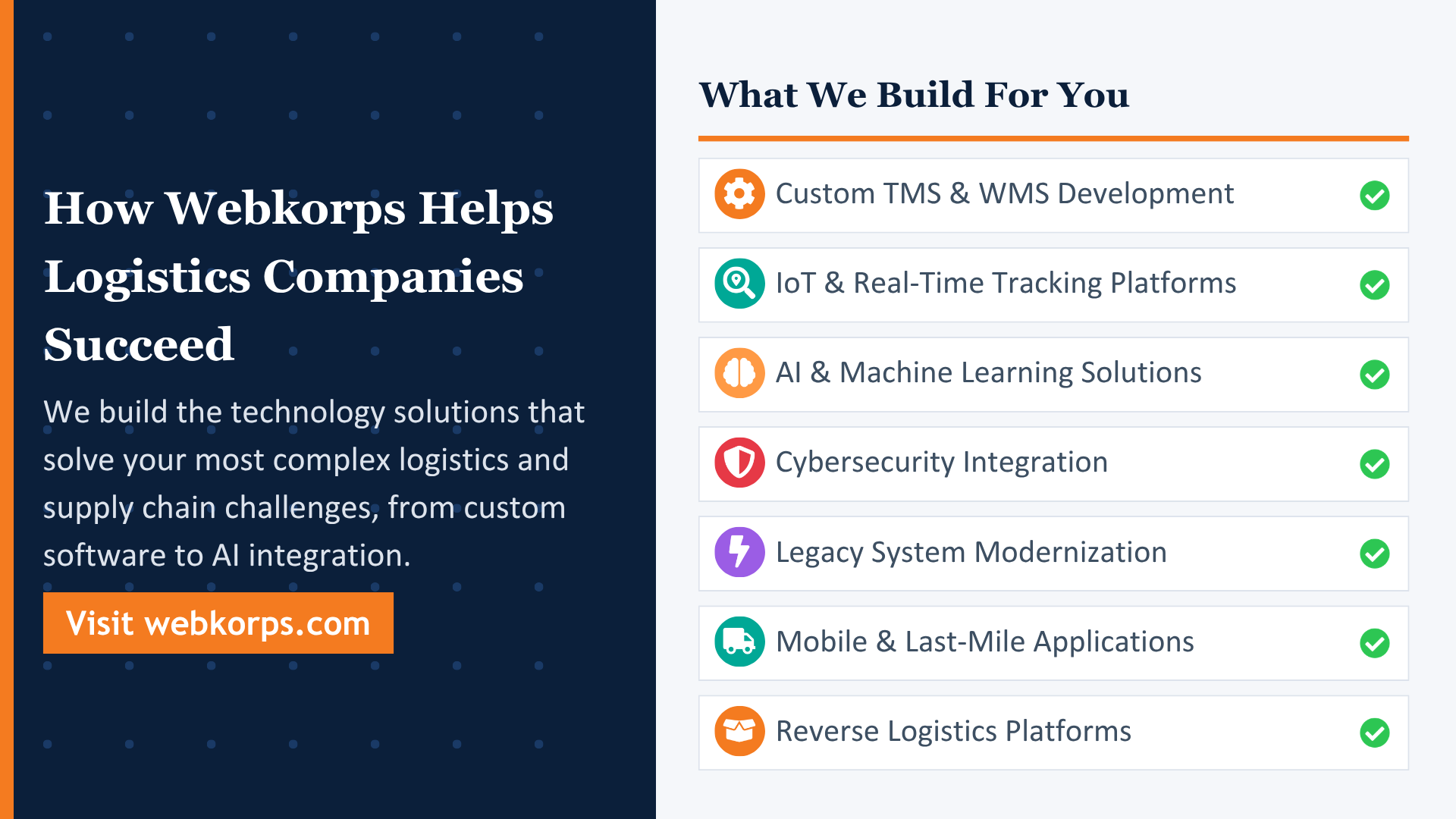
At Webkorps, we work with logistics and supply chain companies at every stage of their digital transformation, from initial technology roadmap design to building and deploying custom software solutions.
Our capabilities in this space include:
- Custom TMS and WMS development tailored to your specific carrier relationships, network structure, and customer requirements
- IoT integration and real-time tracking platforms that consolidate data from multiple devices and carriers into unified visibility dashboards
- AI and machine learning solutions for demand forecasting, route optimization, and predictive maintenance
- Cybersecurity integration, ensuring that as you digitize, you build security into the architecture rather than bolting it on afterward
- Legacy system modernization, connecting your existing infrastructure with modern platforms through APIs and middleware, so you don’t have to start from scratch
- Mobile applications for frontline worker communication, electronic proof of delivery, and field operations management
- Reverse logistics platforms that automate returns processing and maximize recovery value
Whether you’re a regional logistics provider looking to automate your warehouse, a global freight forwarder modernizing your visibility stack, or a supply chain team building resilience into your operations, Webkorps brings the technical expertise and logistics domain knowledge to deliver results.
Conclusion
The logistics industry in 2026 is defined by two competing forces: relentless complexity on one side and the most capable technology toolkit in history on the other. The companies that will lead are not the ones that have been untouched by disruption; they are the ones that responded to it by building smarter, more connected, more resilient operations.
The biggest logistics management challenges, visibility gaps, supply chain disruptions, last-mile costs, labor shortages, compliance burdens, cybersecurity threats, sustainability mandates, and rising customer expectations all have technology-driven solutions available today. The question is no longer whether to invest in logistics technology; it is how fast and how strategically to do it.
The logistics automation market is growing at 14.7% CAGR through 2030. The cloud logistics software market is expanding at 10.2% annually. The companies making confident bets on these technologies now are building competitive advantages that will be very difficult to close in three to five years.
Ready to future-proof your logistics operations? The team at Webkorps specializes in building the technology solutions that logistics companies need to solve their hardest operational problems, from custom software development to AI integration and cybersecurity. Get in touch with us to explore how we can help you move faster, smarter, and more securely in 2026 and beyond.
Frequently Asked Questions
What are the biggest challenges in logistics management in 2026?
The biggest logistics management challenges in 2026 include supply chain visibility gaps, last-mile delivery costs, workforce shortages, rising operational costs, cross-border compliance complexity, cybersecurity threats, supply chain disruptions, sustainability pressures, legacy system integration, reverse logistics inefficiencies, and escalating customer expectations. These challenges are deeply interconnected; a visibility gap, for example, can trigger cost overruns, delayed deliveries, and customer dissatisfaction simultaneously.
How does technology help solve logistics challenges?
Technology addresses logistics challenges across multiple dimensions. AI and machine learning improve demand forecasting, route optimization, and autonomous decision-making. IoT sensors provide real-time visibility into shipment location and condition. Warehouse automation (AMRs, robotic picking) reduces labor dependency. Cloud-based TMS and WMS platforms centralize operations data. Blockchain enhances traceability and compliance. Together, these technologies can reduce logistics costs by up to 15% and improve service efficiency by 65%, according to supply chain research.
What is the most expensive part of logistics management?
Last-mile delivery is consistently the most expensive part of logistics it can account for up to 53% of total shipping costs. The final leg from the distribution hub to the customer’s door is highly fragmented, labor-intensive, and difficult to optimize at scale. Urban congestion, failed delivery attempts, and rising parcel surcharges from major carriers make the last-mile one of the highest-priority areas for technology investment in 2026.
What are the most common mistakes in logistics management?
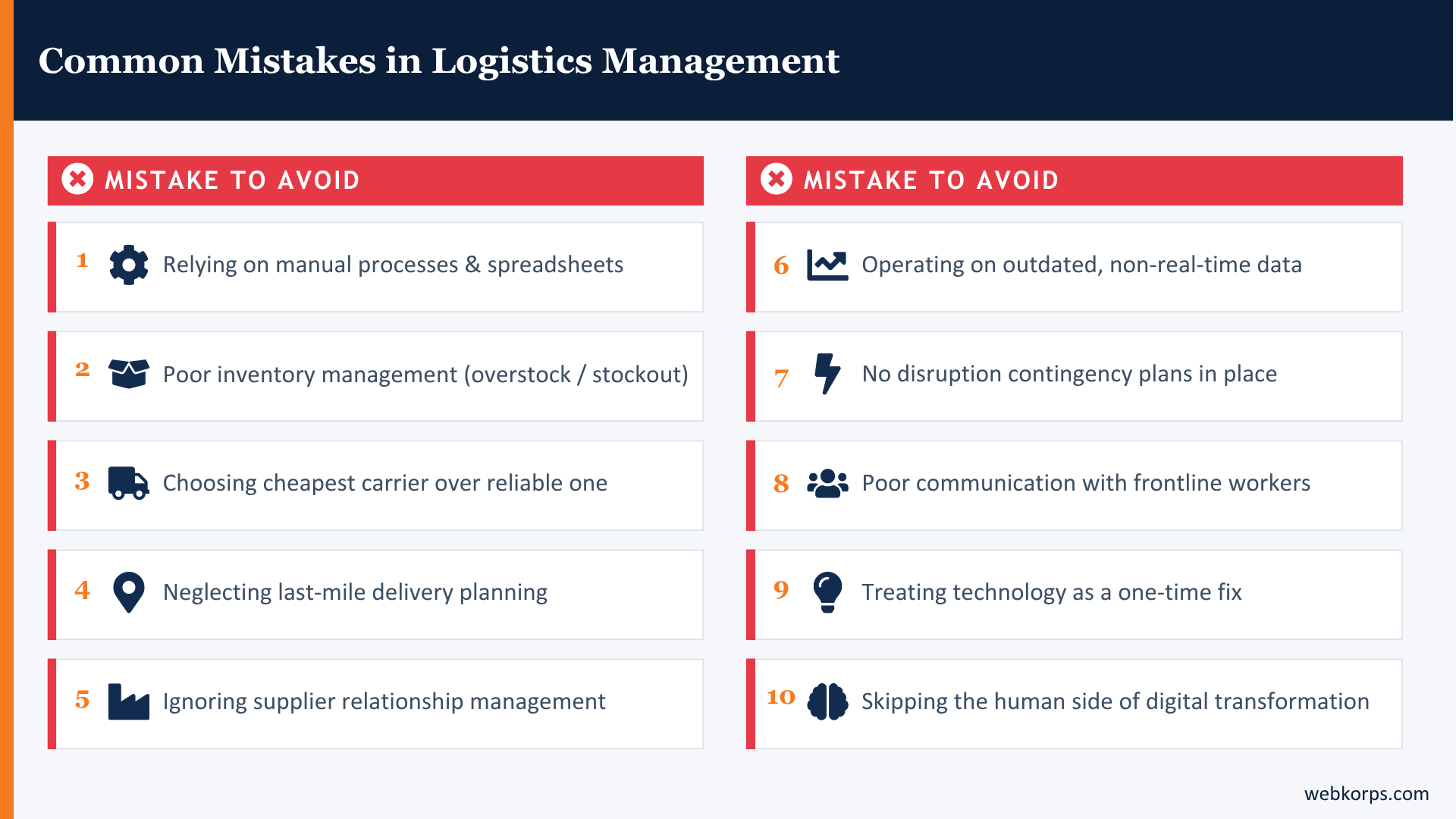
The most common logistics management mistakes include relying on manual processes and spreadsheets, poor inventory planning (leading to overstock or stockouts), choosing carriers based solely on price, neglecting last-mile delivery strategy, ignoring supplier relationship management, operating on outdated real-time data, having no disruption contingency plans, poor frontline worker communication, treating technology as a one-time investment rather than an ongoing capability, and underestimating the human side of digital transformation.
How can logistics companies improve supply chain visibility?
Logistics companies can improve supply chain visibility by implementing IoT-enabled sensors and smart trackers on shipments, deploying cloud-based Transportation Management Systems (TMS) that consolidate carrier data into a single dashboard, using AI-powered predictive visibility tools that forecast disruptions before they occur, and building digital control towers that give operations teams a real-time end-to-end view of inventory, shipments, and exceptions across all partners and geographies.
What role does AI play in modern logistics management?
AI plays a central and growing role in logistics management. In 2026, AI is being used for demand forecasting, dynamic route optimization, predictive maintenance of fleet and warehouse equipment, automated customs classification, exception management, warehouse picking optimization, and increasingly, autonomous decision-making, such as rerouting shipments or adjusting inventory levels without human intervention. Companies adopting AI in their logistics operations consistently report lower operational costs and faster response times.
How serious is cybersecurity risk in the logistics industry?
Cybersecurity risk in logistics is serious and growing, yet significantly underinvested. A 2026 survey found that only 11% of logistics companies cite cybersecurity as a top investment priority, despite being highly exposed. Logistics networks operate complex, interconnected digital systems that are attractive targets for ransomware, data breaches, and invoice fraud. A successful cyberattack on a Transportation Management System can shut down distribution operations within hours. The average cost of a data breach reached $4.88 million in 2024, making proactive cybersecurity investment far less expensive than the alternative.
What is last-mile delivery, and why is it so challenging?
Last-mile delivery refers to the final leg of a shipment’s journey, from a distribution hub or fulfillment center to the end customer’s door. It is the most challenging part of the logistics chain because it is highly fragmented (many individual stops instead of bulk deliveries), subject to urban congestion and traffic unpredictability, heavily dependent on labor, and exposed to high rates of failed first-attempt deliveries. It is also where customer experience is most directly shaped, making it both the costliest and most strategically important part of the delivery process.
How can logistics companies reduce operational costs?
Logistics companies can reduce operational costs through a combination of strategies: AI-powered route optimization (which can cut fuel costs by 10–20%), predictive maintenance to avoid costly emergency repairs, collaborative shipping networks that reduce empty miles, warehouse automation that lowers labor dependency, dynamic pricing engines that capture revenue during demand peaks, and demand forecasting tools that prevent costly overstocking or expedited shipping from stockouts. Companies should prioritize solutions with the fastest ROI; route optimization software, for example, can deliver returns within 12 months.
What is reverse logistics, and why does it matter in 2026?
Reverse logistics refers to the process of managing goods flowing backward through the supply chain, returns, repairs, refurbishments, recalls, and recycling. It matters more than ever in 2026 because e-commerce return rates have climbed to 20.4%, placing enormous pressure on logistics infrastructure. Poorly managed reverse logistics bleeds margin and damages customer relationships. The global reverse logistics market exceeded $872.6 billion in 2025 and is growing at 7.3% annually, driven by both consumer return volumes and sustainability regulations requiring companies to account for end-of-life product handling.
What is supply chain resilience, and how can companies build it?
Supply chain resilience is the ability of a logistics operation to absorb disruptions, geopolitical events, weather, supplier failures, cyberattacks, and recover quickly without significant loss of service or revenue. Companies build resilience by diversifying their supplier base across multiple regions, maintaining strategic inventory buffers at key network points, using AI-powered risk modeling to detect disruption signals early, running disruption simulation exercises with digital twin technology, and developing pre-built response playbooks so teams can activate contingency plans in hours rather than improvising under pressure.
How does IoT improve logistics management?
IoT (Internet of Things) improves logistics management by providing continuous, real-time data on the location, condition, temperature, humidity, and handling of goods throughout the supply chain. Smart sensors attached to pallets, containers, and vehicles eliminate the blind spots between handoff points, which is where most visibility failures occur. For temperature-sensitive goods like pharmaceuticals and food, IoT monitoring is particularly critical, as it ensures compliance with storage requirements and provides evidence in the event of a dispute. IoT data also feeds predictive maintenance systems, reducing fleet and equipment downtime.
What is a Transportation Management System (TMS), and do I need one?
A Transportation Management System (TMS) is software that helps logistics operations plan, execute, and optimize the movement of goods. It typically includes carrier selection and rate comparison, shipment tracking, freight billing, route optimization, and reporting. If your business ships more than a few hundred orders per month, manages multiple carriers, or operates across regions, a TMS is almost certainly worth the investment. Modern cloud-based TMS platforms connect directly with WMS, ERP, and carrier systems, giving you a unified operational view and significantly reducing manual coordination work.
How is sustainability changing logistics operations?
Sustainability is shifting from a CSR talking point to a core operational and regulatory requirement in logistics. The EU’s Carbon Border Adjustment Mechanism (CBAM) and similar regulations require companies to measure and report supply chain emissions. Customers and investors are demanding evidence of progress, not pledges. In practical terms, this means logistics companies are investing in electric and hybrid vehicle fleets, AI-driven route optimization to minimize fuel consumption, energy-efficient warehouse design, carbon footprint tracking tools, and reverse logistics capabilities that support circular economy goals.
What technologies are transforming logistics in 2026?
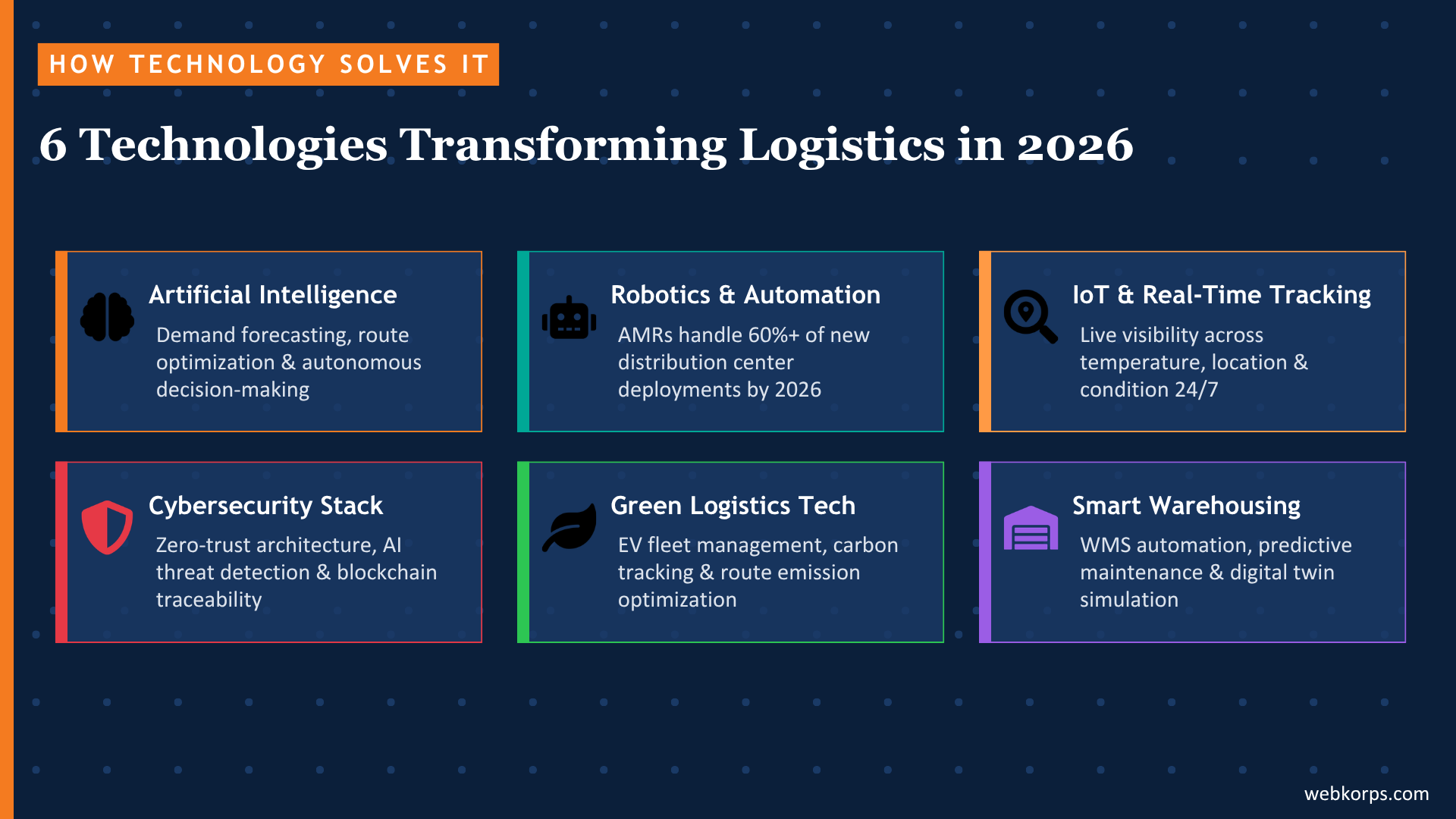
The six technologies most actively transforming logistics management in 2026 are Artificial Intelligence (demand forecasting, route optimization, autonomous decisions), Robotics and Automation (AMRs, automated sorting and picking), IoT and Real-Time Tracking (live shipment visibility), Cybersecurity Stack (zero-trust architecture, AI threat detection), Green Logistics Technology (EV fleet management, carbon tracking), and Smart Warehousing (WMS automation, digital twins, predictive maintenance). Companies investing across all six dimensions consistently outperform peers who adopt only one or two in isolation.
How does poor communication affect logistics operations?
Poor communication in logistics creates a cascade of operational failures. When drivers don’t receive updated delivery instructions in time, shipments go to the wrong addresses. When warehouse teams aren’t informed of incoming surges, dock congestion builds. When customers aren’t proactively notified of delays, call volume spikes, and trust erodes. The challenge is amplified because logistics workforces are largely deskless, and traditional email-based communication fails drivers and warehouse staff who aren’t sitting at computers. Companies investing in SMS-based frontline communication platforms and automated customer notification systems consistently report measurable gains in delivery accuracy and customer satisfaction.
How long does it take to see ROI from logistics technology investment?
The ROI timeline varies significantly by technology type. Route optimization software can deliver measurable returns within 6–12 months through fuel savings and improved delivery capacity. Warehouse management systems typically show positive ROI within 12–18 months through labor efficiency and inventory accuracy gains. Robotics and automation investments (AMRs, conveyor systems) generally require 2–3 years to recoup, but deliver sustained long-term cost advantages. AI and predictive analytics platforms vary depending on implementation complexity, but companies that invest in data governance before deployment consistently see faster, more substantial returns.
What should logistics companies prioritize when starting digital transformation?
Logistics companies starting their digital transformation journey should prioritize in this order: first, data infrastructure — ensuring data is clean, accessible, and flowing across systems; second, supply chain visibility — deploying tracking and TMS tools that give real-time operational awareness; third, high-ROI quick wins — route optimization and automated documentation that pay back fast; fourth, workforce enablement — communication tools and training that bring people along; and fifth, advanced capabilities — AI forecasting, robotics, and predictive analytics that require the earlier foundations to deliver full value. Starting with advanced technology before fixing data and visibility is one of the most common and costly mistakes in logistics digital transformation.