
 Posted by
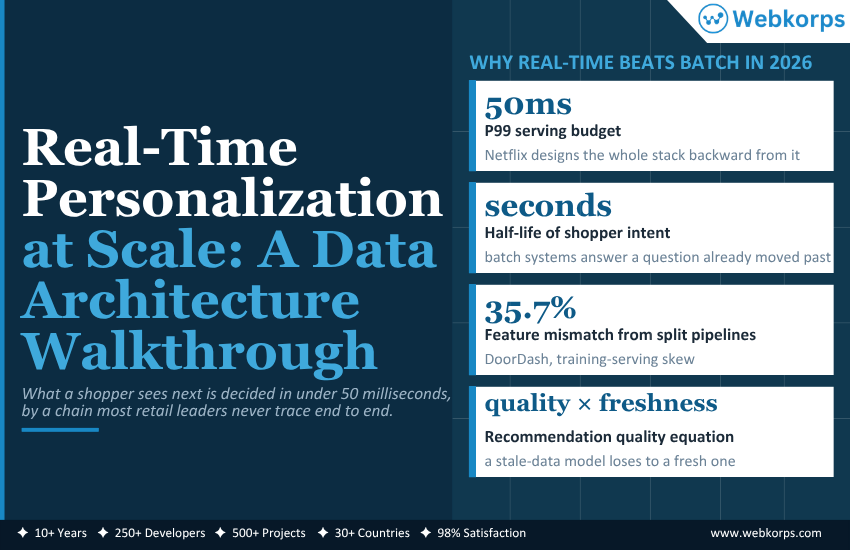
 A shopper searches for “lightweight marathon shoes,” scrolls past three results, lingers on a trail runner, and drops it in the cart. Seconds later, they hit the homepage again. What they see next- a curated row of running gear or the same generic banner from last Tuesday is decided in under 50 milliseconds by a chain of systems most retail leaders have never traced end to end. That chain is real-time personalization architecture, and understanding how one click travels through it is the fastest way to know whether your stack can compete.
Most walkthroughs of this topic list tools: Kafka here, Flink there, Redis for caching. Far more useful is following the click itself. Here is that journey, layer by layer.
Could your stack personalize inside a single session? Webkorps builds architectures that can. Book a review
Table of Contents
Why batch personalization quietly loses
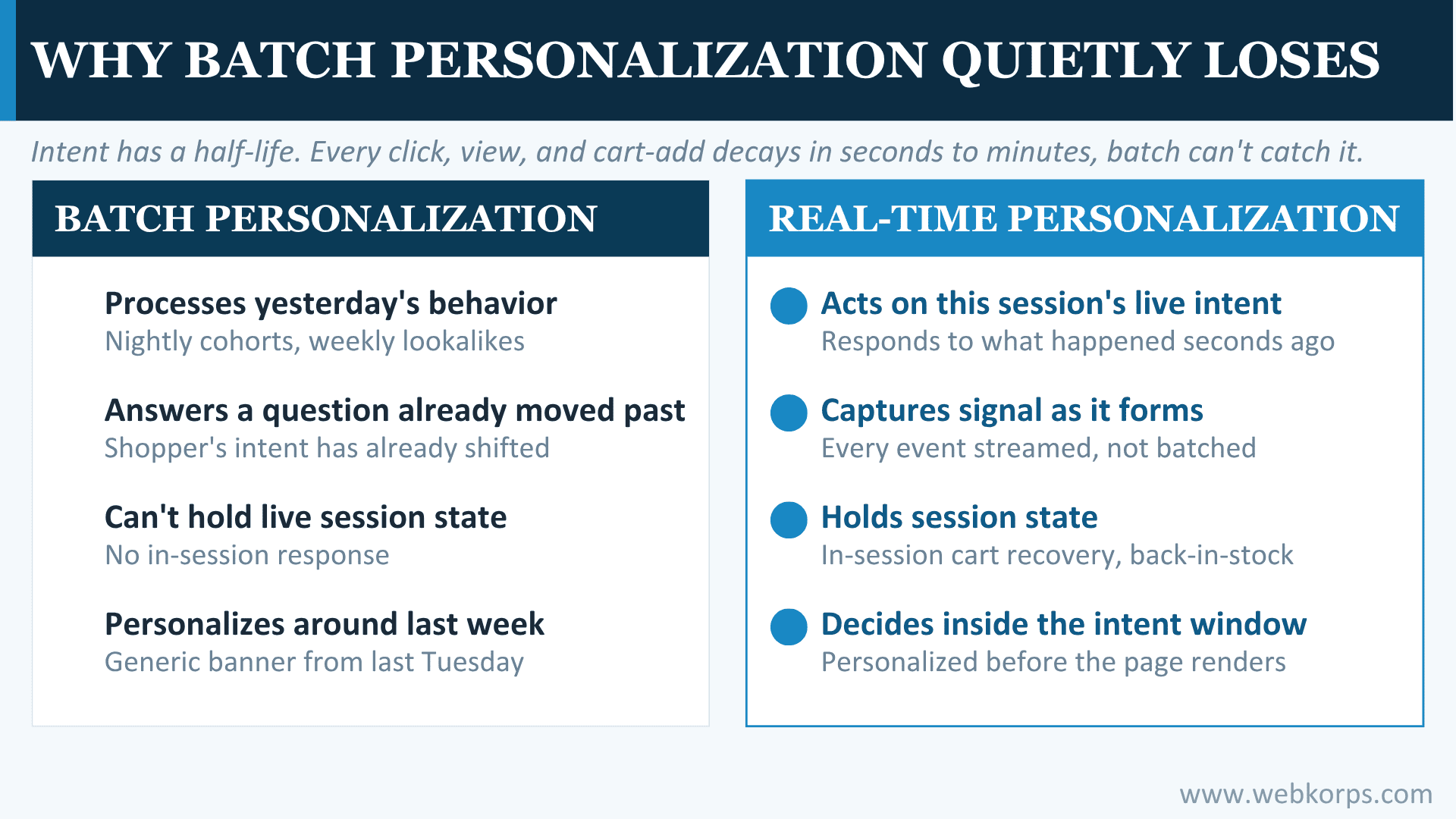
Intent has a half-life. Every click, view, and cart-add is a signal of what a shopper wants right now, and that signal decays in seconds to minutes. Batch systems nightly cohort recompute, weekly lookalike refreshes process yesterday’s behavior, so they answer a question the shopper has already moved past. As Netflix’s engineering team frames it, recommendation quality is really two problems multiplied: model quality × feature freshness. A brilliant model ranking on stale data loses to a mediocre model that knows what the shopper did ninety seconds ago, and both lose if the answer arrives after the page has already been rendered.
That multiplication is why leading retail and streaming platforms converge on the same shape. A serving budget gets fixed first; Netflix designs backward from roughly 50ms at the 99th percentile, and every upstream decision is engineered to protect it.
Why a single click triggers four systems, not one
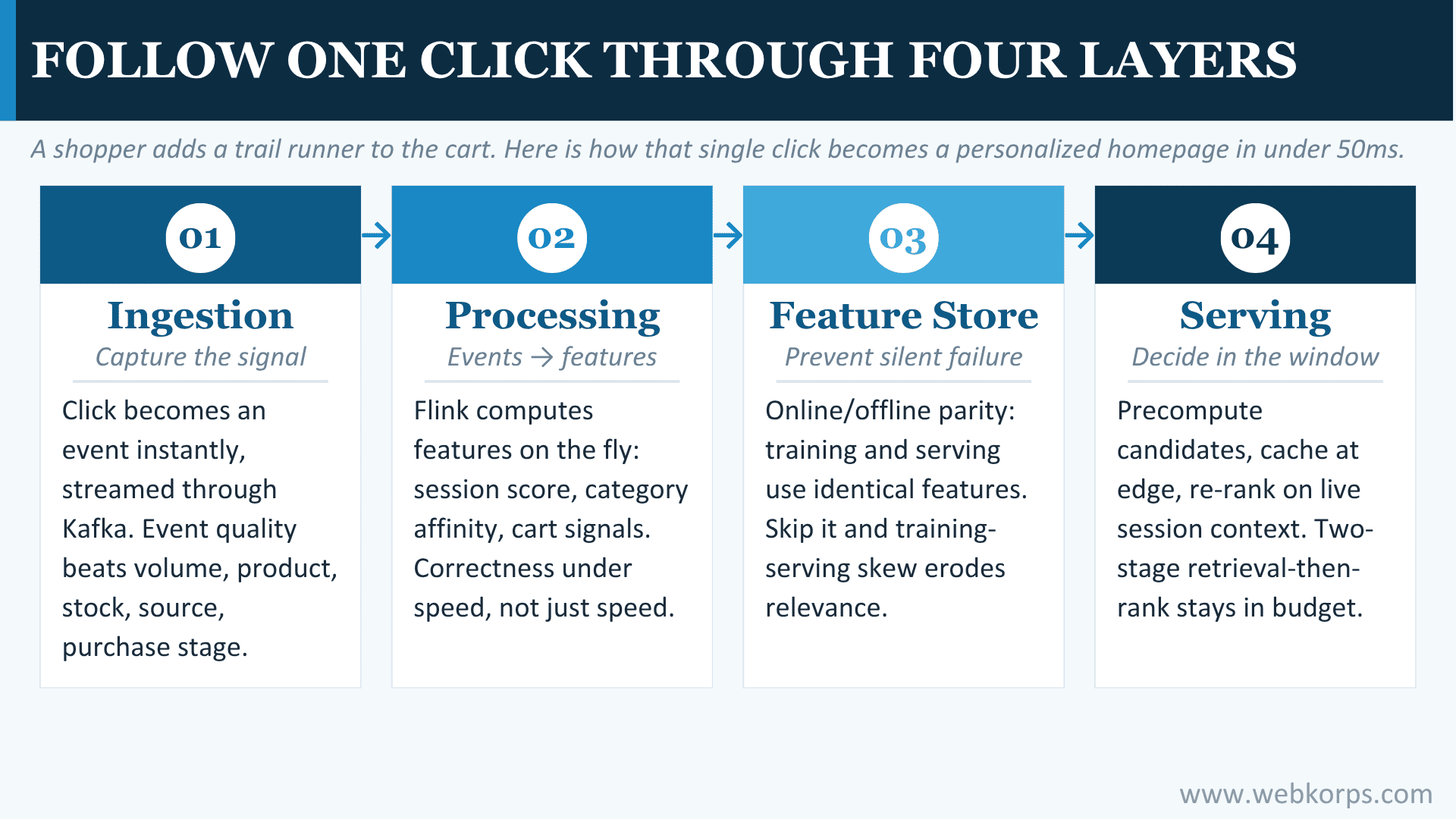
- Ingestion – capturing the signal: A click becomes an event the moment it happens, streamed through Apache Kafka rather than written to a database and queried later. Event quality beats volume: a signal carrying product viewed, stock position, traffic source, and purchase stage tells the system what a shopper is trying to do; a bare page-view only says a page loaded. Getting the event contract right, agreed across product, data, and marketing before a single offer engine reads it, is where personalization quality actually begins.
- Processing – turning events into features: Raw clicks aren’t useful alone. A stream processor like Apache Flink computes features on the fly: session engagement score, category affinity, cart-abandonment signals, updating as each event arrives. Speed isn’t the point; correctness under speed is. A 30-minute-old feature for fraud, pricing, or personalization isn’t stale; it’s wrong.
- Feature store – the layer that prevents silent failure: Computed features land in a feature store whose single most important property is online/offline parity: features used to train a model must be computed identically to features served at inference. Skip this, and you get training-serving skew, the quiet killer of personalization systems. DoorDash measured a 35.7% feature mismatch in a split batch-and-streaming setup. Same definitions, both paths, no drift.
- Serving – deciding in the intent window: When the homepage request arrives, production systems borrow Netflix’s hybrid pattern: precompute candidate recommendations in advance, cache them at the edge, then re-rank against live session context at request time. Precomputation does the heavy lifting; a fast online layer applies what the shopper did seconds ago. Two-stage retrieval-then-rank keeps the round trip inside budget.
Where scale actually breaks
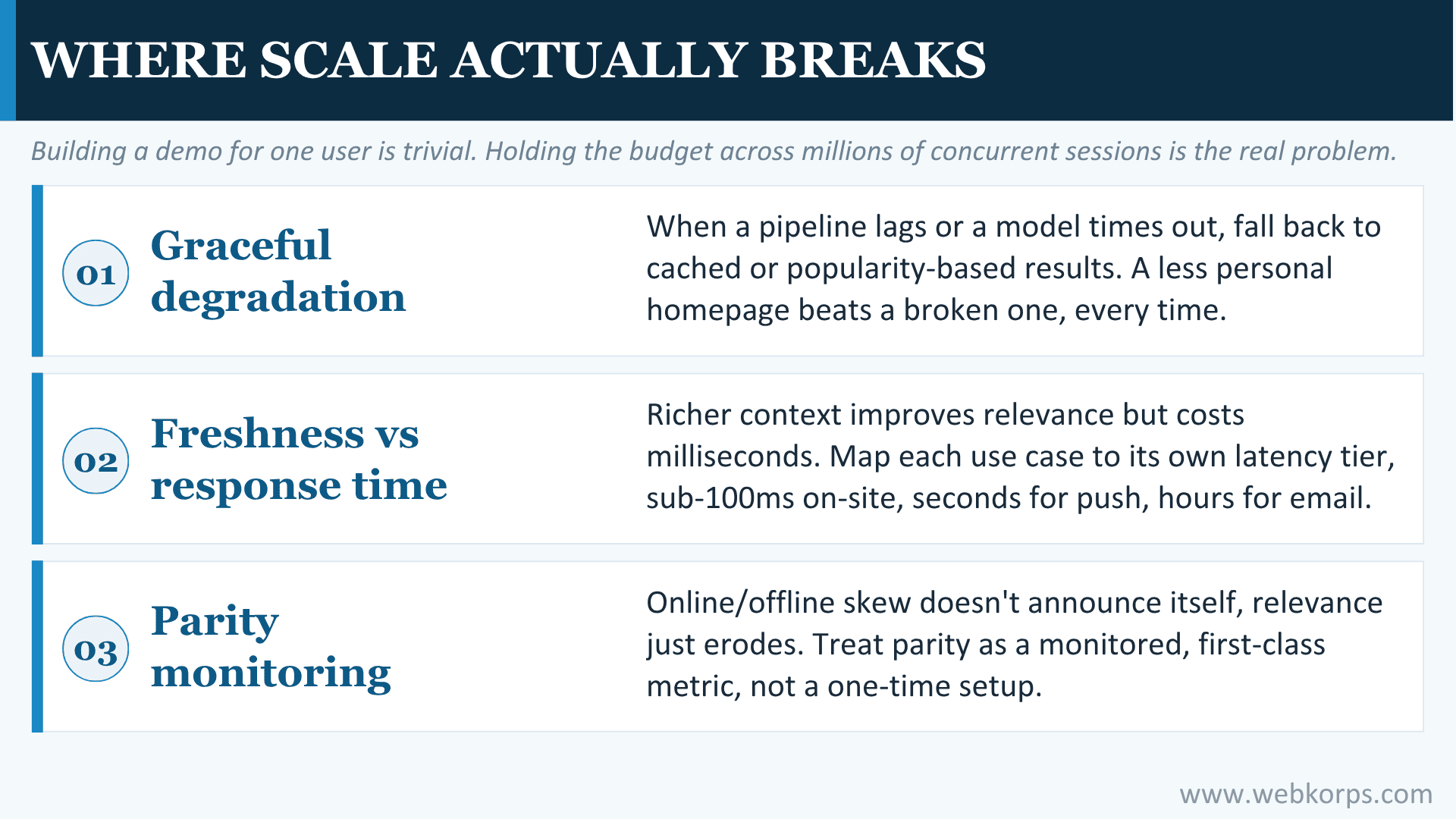
Building a demo for one user is trivial. Holding a latency budget across millions of concurrent sessions during a peak drop is the real engineering problem, and it surfaces in three places worth naming early.
- Graceful degradation. When a feature pipeline lags or a model times out, a well-designed system falls back to cached or popularity-based results instead of failing the page. A slightly less personal homepage beats a broken one, every time.
- Feature freshness versus response time. Richer context improves relevance but costs milliseconds. Mapping each use case to its own latency tier sub-100ms for on-site re-ranking, second-to-minute for push triggers, hours for email lets one streaming foundation serve them all without over-engineering the cheap cases.
- Parity monitoring. Online/offline skew doesn’t announce itself; relevance just erodes. Treating parity as a monitored, first-class metric, not a one-time setup, is what separates systems that stay sharp from ones that slowly decay.
Turn architecture into advantage
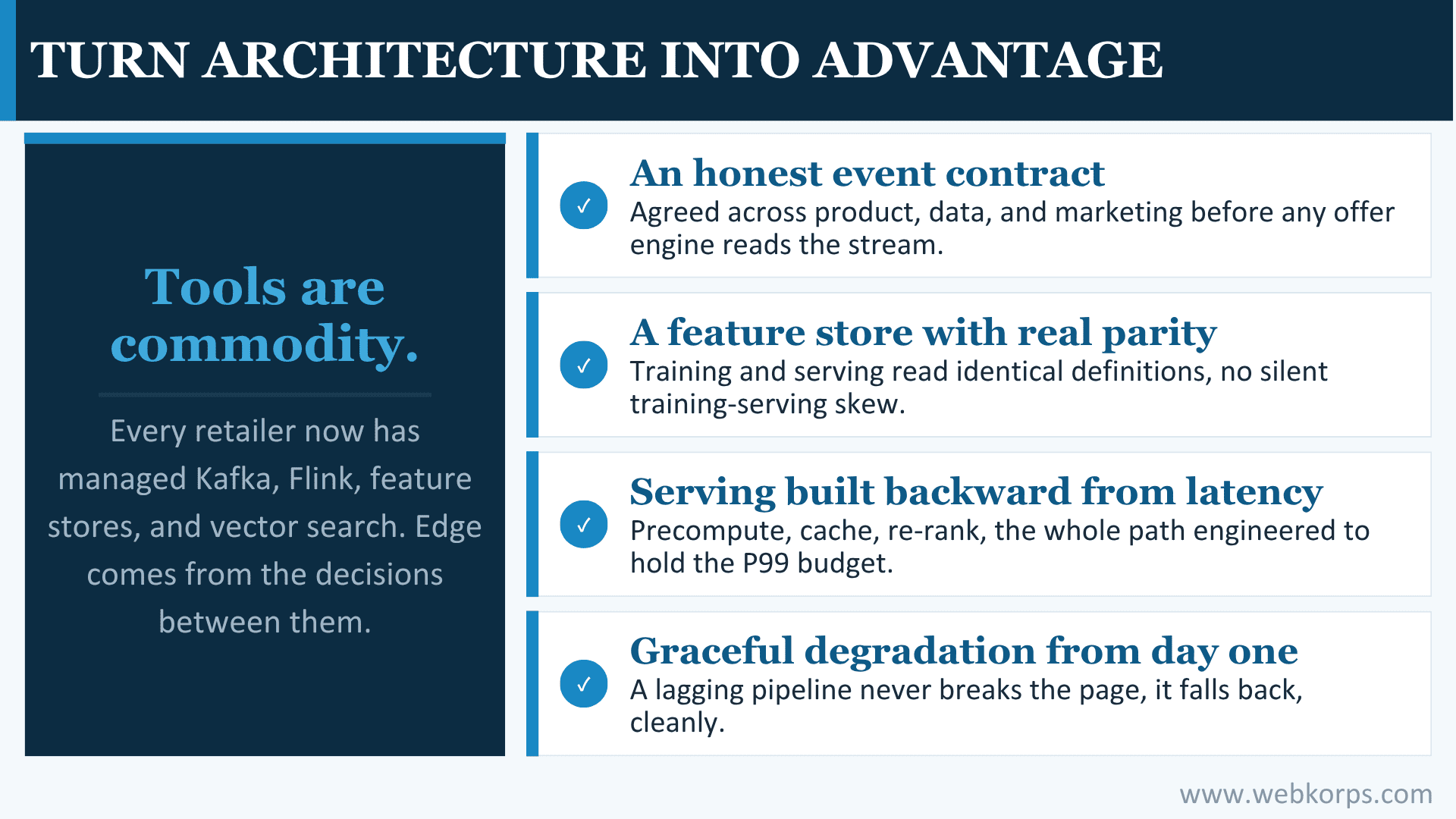
Every retailer now has access to the same components managed Kafka, Flink, feature stores, vector search that once required a dedicated ML platform team. Competitive edge no longer comes from owning the tools; it comes from the deliberate design decisions between them: an honest event contract, a feature store with real parity, a serving path engineered backward from a latency budget, and graceful degradation built in from day one. Retailers who get that chain right respond to intent inside the session. Everyone else is still personalizing around what a shopper did last week.
Ready to build personalization that keeps up with your shoppers?
Webkorps designs and builds real-time data architectures for retail streaming ingestion, feature stores with online/offline parity, low-latency serving, and graceful degradation, modeled on the patterns proven at Netflix and Shopify scale.
Book a Personalization Architecture Review
Frequently Asked Questions
Q: What is real-time personalization architecture?
A data system that captures shopper signals, computes behavioral features, and delivers individualized content in under 200 milliseconds, usually four layers: streaming ingestion, stream processing, a feature store, and low-latency serving.
Q: Why isn’t batch personalization enough anymore?
Intent decays in seconds to minutes. Batch systems process yesterday’s behavior, so they answer a question the shopper has already moved past, responding to last week’s browsing, not this session’s live intent.
Q: What is a feature store and why does it matter?
A feature store computes, stores, and serves the features models use. Its key property is online/offline parity: training and serving use identical feature definitions, which prevents training-serving skew that silently erodes relevance.
Q: What latency does real-time personalization require?
It depends on the use case. On-site re-ranking needs sub-100ms (Netflix targets ~50ms at P99); push triggers run second-to-minute; email orchestration runs in hours. One streaming foundation can serve all these tiers.
Q: How do systems personalize inside 50 milliseconds?
By precomputing candidate recommendations in advance, caching them at the edge, then re-ranking against live session context at request time. Precomputation does the heavy lifting; a fast online layer applies the latest signals.