
 Posted by
 Back in 2022, a US-based SaaS founder asking about offshore development had one opening question: “What’s your hourly rate?” In 2026, that same conversation starts very differently. “Which AI coding agents does your team run, and what’s your review process for AI-generated pull requests?”
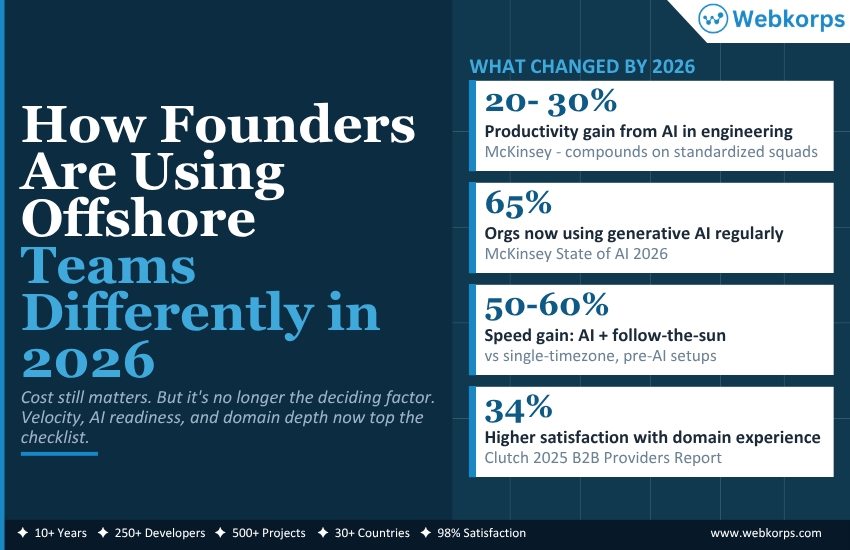
That shift, quiet but seismic, captures exactly how offshore development team strategy has evolved. Cost still matters. But it’s no longer the deciding factor. Engineering velocity, AI readiness, and domain depth have moved to the top of the evaluation checklist. Founders who haven’t updated their offshore playbook are working with a model that’s at least three years out of date.
Here’s what’s actually changed, and why the teams getting it right are outpacing competitors who rely on local hiring alone.
Ready to build an offshore team engineered for 2026, not 2022? Webkorps delivers dedicated, AI-augmented squads built around your domain and compliance needs – Schedule a Discovery Call with Webkorps
Table of Contents
AI Augmentation Has Redefined What an Offshore Developer Delivers
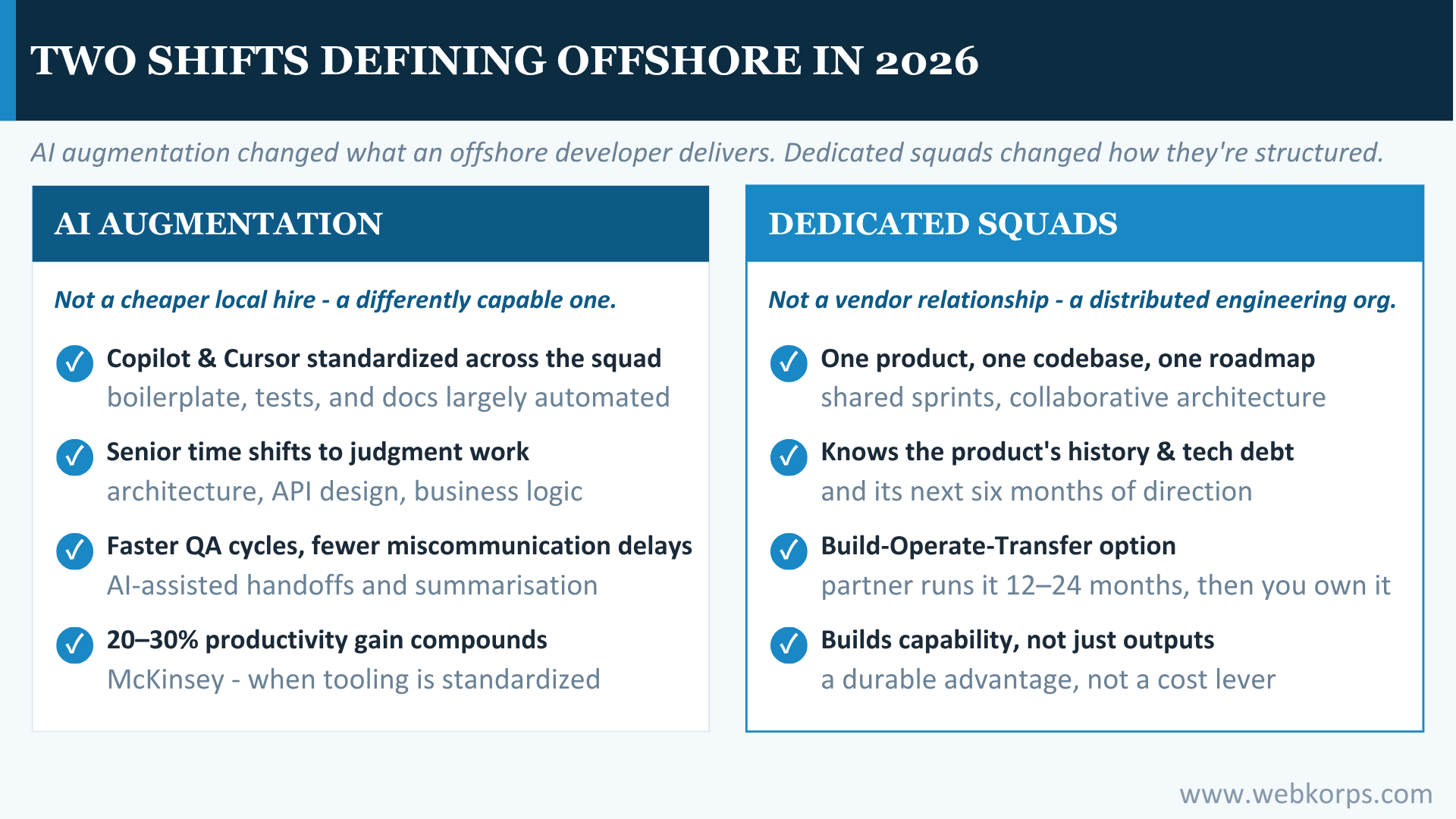
Offshore software development was always about accessing skilled talent at a lower cost. In 2026, that equation has a new multiplier: AI tooling. Developers using GitHub Copilot, Cursor, and similar assistants are completing tasks significantly faster than those relying on manual workflows alone. According to McKinsey, AI integration in engineering functions produces productivity gains of 20–30% across knowledge work, and in dedicated offshore development contexts where AI tooling is standardized across the squad, those numbers compound.
What this means practically: an AI-augmented offshore engineer in 2026 is not a cheaper version of a local hire. They’re a differently capable resource. Boilerplate code, test scaffolding, and documentation that once consumed sprint capacity are now largely automated. Senior engineers on offshore teams are spending a larger proportion of their time on architecture decisions, API design, and business logic, the judgment-intensive work that moves products forward.
McKinsey’s 2026 State of AI data shows 65% of organizations now regularly use generative AI in their workflows. Offshore teams that have embedded these tools into their delivery process are reporting measurably faster QA cycles and fewer miscommunication-related delays. Teams that haven’t adapted are already slower and more expensive, and that gap widens with every month.
Dedicated Squads Have Replaced Project-Based Outsourcing
Founders who burned money on offshore engagements in the past typically did so through project-based outsourcing: hand off a spec, receive code, discover the gap between the two at the worst possible moment. That model hasn’t improved. It’s been abandoned by the smartest operators.
Dedicated offshore development teams, squads that work exclusively on one product, within one codebase, aligned to one roadmap, have become the dominant structure for venture-backed startups and scaleups. Rather than a vendor relationship, this looks more like a distributed engineering org. Sprints are shared. Architecture decisions are made collaboratively. The offshore squad knows the product’s history, its technical debt, and its next six months of direction.
Platforms like Codieshub and similar dedicated team providers offer a build-operate-transfer (BOT) model, where a partner recruits and manages the team for 12–24 months before the founders take full ownership. For startups that can’t afford the distraction of global HR operations, this reduces friction without sacrificing long-term control.
The distinction that matters: outsourcing buys you outputs. Dedicated offshore teams build organisational capability. For founders playing a long game, that difference determines whether offshore development is a tactical cost lever or a durable competitive advantage.
Offshore Mindset Has Shifted: 2022 vs 2026
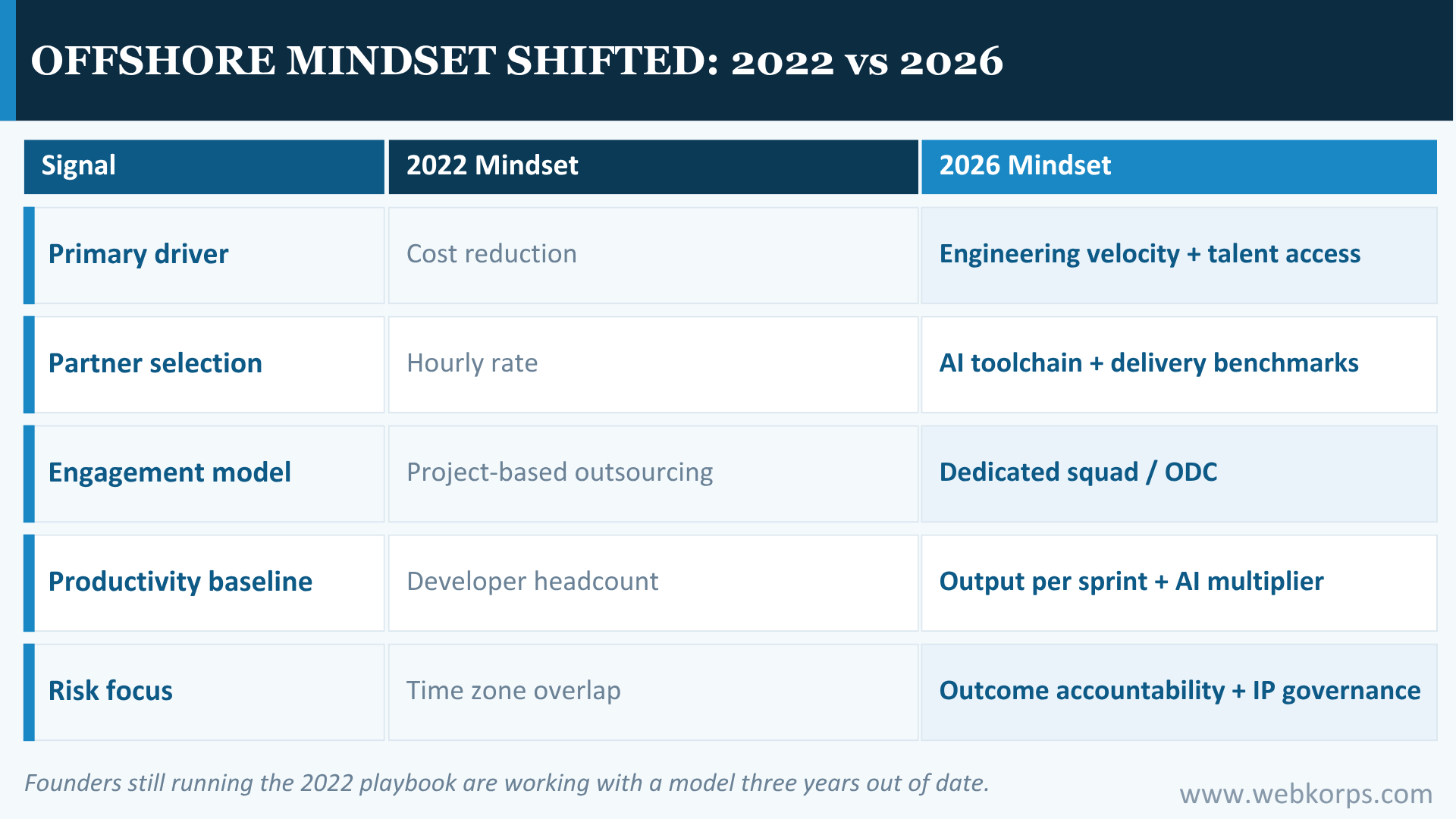
| Signal | 2022 Mindset | 2026 Mindset |
| Primary driver | Cost reduction | Engineering velocity + talent access |
| Partner selection criterion | Hourly rate | AI toolchain + delivery benchmarks |
| Engagement model | Project-based outsourcing | Dedicated squad / ODC |
| Productivity baseline | Developer headcount | Output per sprint + AI multiplier |
| Risk focus | Time zone overlap | Outcome accountability + IP governance |
Selection Criteria Have Become Far More Specific
Ask founders who built successful offshore software teams what they wish they’d known earlier, and the answers cluster around one theme: generic vendor evaluation doesn’t work.
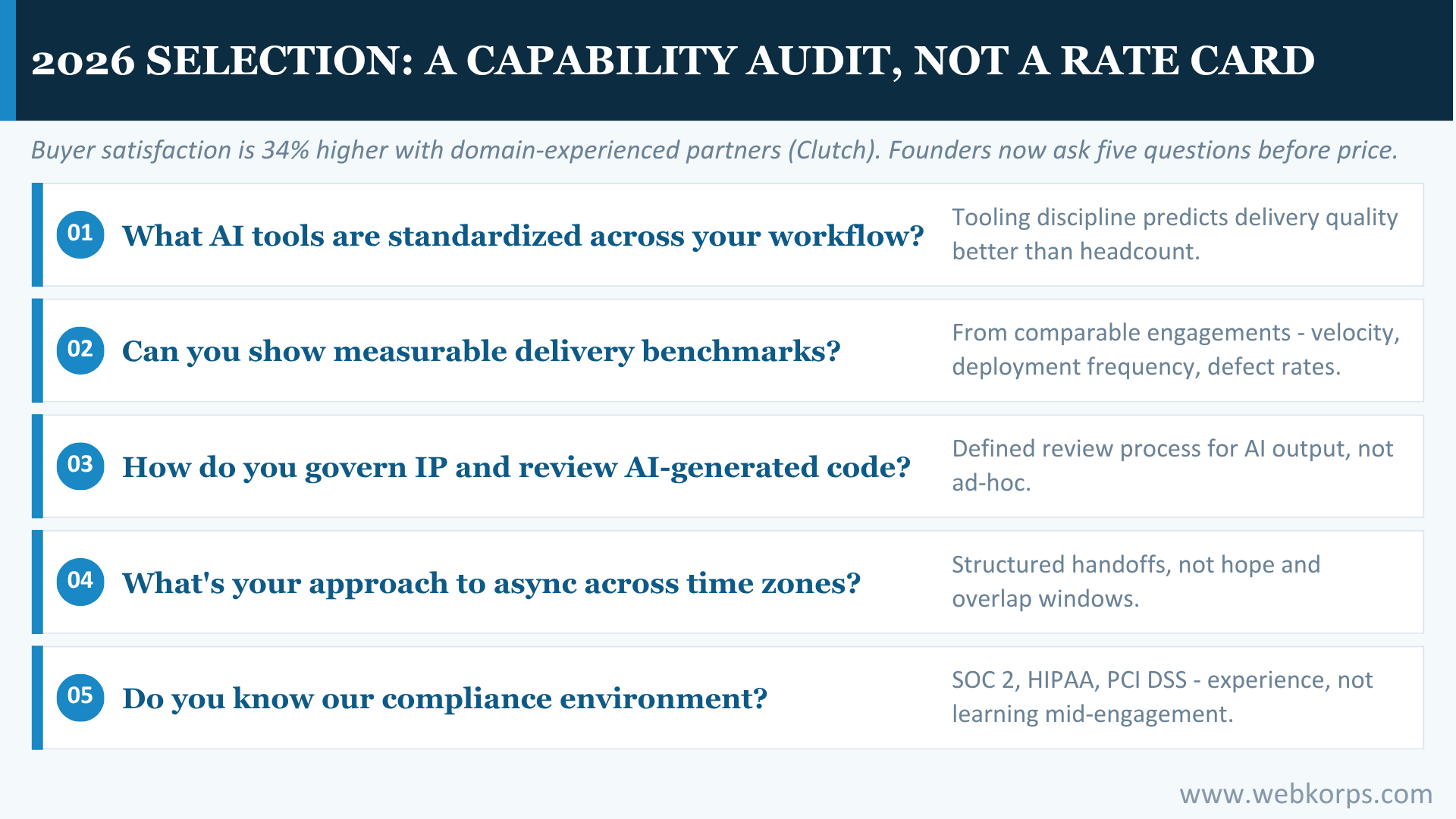
Clutch’s 2025 B2B Service Providers Report found that buyer satisfaction scores for offshore development engagements are 34% higher when the partner has documented prior experience in the client’s industry, compared to engagements where the team is learning the domain during the project. This isn’t surprising to anyone who’s watched an offshore team navigate a fintech compliance requirement or a healthcare data pipeline for the first time mid-engagement.
Evaluation in 2026 has shifted from rate cards to capability audits. Founders are asking:
- What AI tools are standardized across your engineering workflow?
- Can you show measurable delivery benchmarks from comparable engagements?
- How do you handle IP governance and code review for AI-generated output?
- What’s your approach to asynchronous communication across time zones?
- Do you have experience with our compliance environment, SOC 2, HIPAA, PCI DSS?
Founders who skip these questions in favour of price comparison are running the 2019 offshore playbook. That’s the playbook that produces the war stories, not the success cases.
Ask us any of these questions. We’ll have the answers ready – Book a Call
Follow-the-Sun Engineering Has Become a Competitive Weapon
Asynchronous development, where one timezone hands off to another, has always been a theoretical advantage of offshore models. In practice, it was often undermined by poor documentation, misaligned tooling, and gaps between teams that created more friction than speed.
AI-augmented workflows have changed that. When context is captured automatically through AI-assisted documentation, task summarisation, and structured async handoffs, the follow-the-sun model stops being theoretical and starts compounding. Startups running AI-augmented, follow-the-sun engineering with offshore partners are reporting 50-60% speed improvements over single-timezone, pre-AI setups.
For a venture-backed startup competing on time-to-market, this isn’t a marginal advantage. Shipping two quarters of the roadmap in one is the kind of edge that changes fundraising dynamics.
Common Mistakes Founders Are Still Making
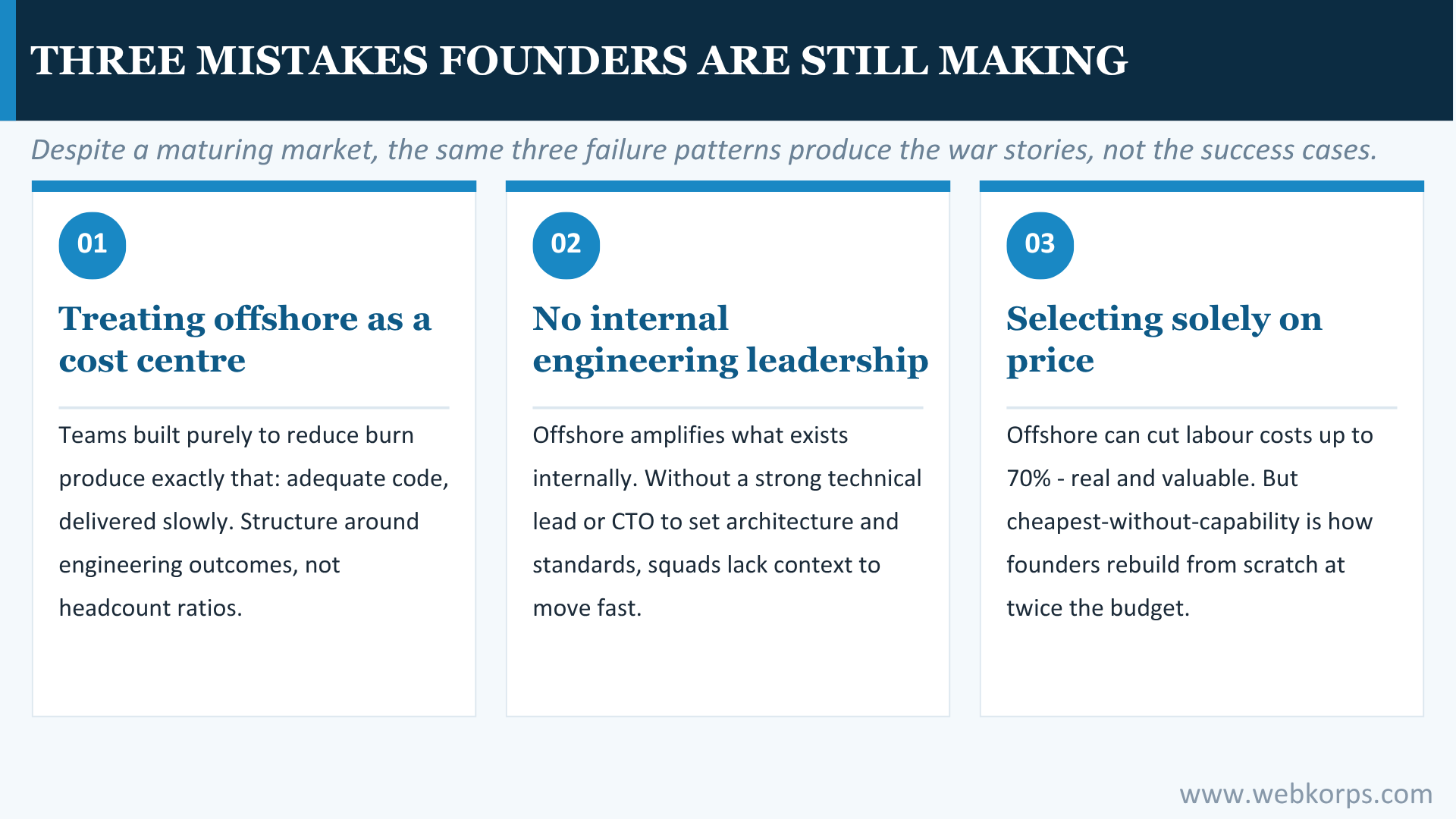
Despite the maturing offshore market, several failure patterns persist:
Mistake 1: Treating Offshore as a Cost Centre
Offshore development teams that exist purely to reduce burn tend to produce exactly what you’d expect from a cost-minimised function: adequate code delivered slowly. The most productive offshore partnerships are structured around engineering outcomes, not headcount efficiency ratios.
Mistake 2: Starting Without Internal Engineering Leadership
Offshore teams amplify what already exists internally. Without a strong internal technical lead or CTO to define architecture, set standards, and handle stakeholder alignment, offshore squads lack the context to make good decisions at speed. Founders who try to skip this role and delegate everything offshore typically discover the limitation six months in.
Mistake 3: Selecting Solely on Price
Offshore development can reduce labour costs by up to 70% depending on region and model. That’s a real number and a real advantage. But selecting the cheapest vendor without evaluating AI tooling, domain experience, and delivery discipline is how founders end up rebuilding from scratch at twice the budget. Rate cards are the last thing to negotiate, not the first.
Actionable Takeaways for Founders Evaluating Offshore Partners
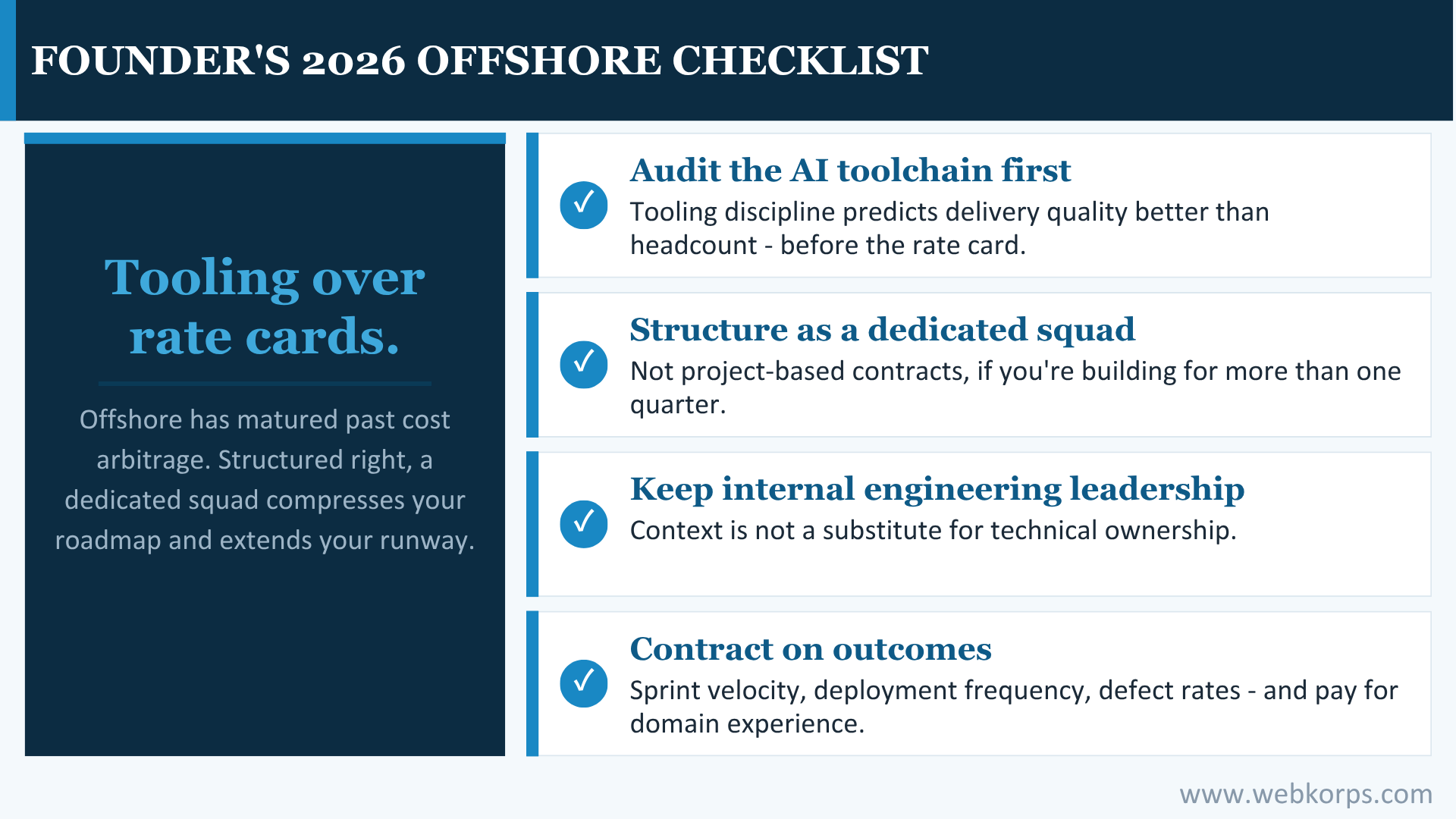
- Audit any prospective partner’s AI toolchain before evaluating their rate card; tooling discipline predicts delivery quality better than headcount.
- Structure engagements as dedicated squads, not project-based contracts, if building for more than one quarter.
- Ensure internal engineering leadership exists before engaging an offshore team; context is not a substitute for technical ownership.
- Define outcome-based accountability in your contract: sprint velocity targets, deployment frequency, and defect rates.
- Evaluate domain experience explicitly; a team that has worked in your compliance environment is worth a 15–20% premium over a generalist offshore vendor.
Conclusion
Offshore development has matured well past cost arbitrage. For founders building in 2026, a dedicated offshore development team, structured correctly, evaluated rigorously, and augmented with AI tooling, is one of the highest-leverage decisions in the engineering org. Getting it wrong is expensive. Getting it right compresses your roadmap, extends your runway, and builds a distributed engineering capability that scales with the company.
Webkorps builds dedicated offshore development teams for startups, scaleups, and enterprise product teams across logistics, healthcare, and fintech. Our squads are ISO 27001 certified, AI-tooled, and experienced across the compliance environments that matter to regulated industries.
See how Webkorps builds offshore teams that ship – Book a Discovery Call
Frequently Asked Questions
What is a dedicated offshore development team?
A squad of engineers working exclusively on one product, sharing sprints, architecture decisions, and long-term context as an extension of the internal team.
How is offshore software development different in 2026?
Selection now prioritizes AI toolchain maturity and delivery benchmarks over hourly rate. AI-augmented engineers deliver meaningfully higher output per sprint.
What are the biggest risks of hiring an offshore development team?
Selecting on price alone, skipping internal technical leadership, and using project-based contracts for long-term work. IP governance and compliance alignment also matter.
How do offshore teams handle AI coding tools in 2026?
Mature partners standardize tools like Copilot and Cursor with defined AI-output review processes. 65% of engineering orgs now use generative AI regularly (McKinsey).
What is the build-operate-transfer (BOT) model in offshore development?
A partner recruits and manages the team for 12–24 months, then transfers full control to the client, reducing early hiring burden.
How should founders evaluate offshore software development partners?
On AI toolchain documentation, domain experience, compliance track record, and measurable delivery benchmarks, a capability audit, not a rate comparison.
What does offshore development cost in 2026?
Labour costs can drop up to 70% depending on region and model. Total value still depends on AI maturity, seniority, and domain fit.
Is offshore software development effective for startups?
Yes, when structured well. Dedicated squads with internal leadership and AI-augmented workflows let startups ship at the pace of much larger teams.