
 Posted by
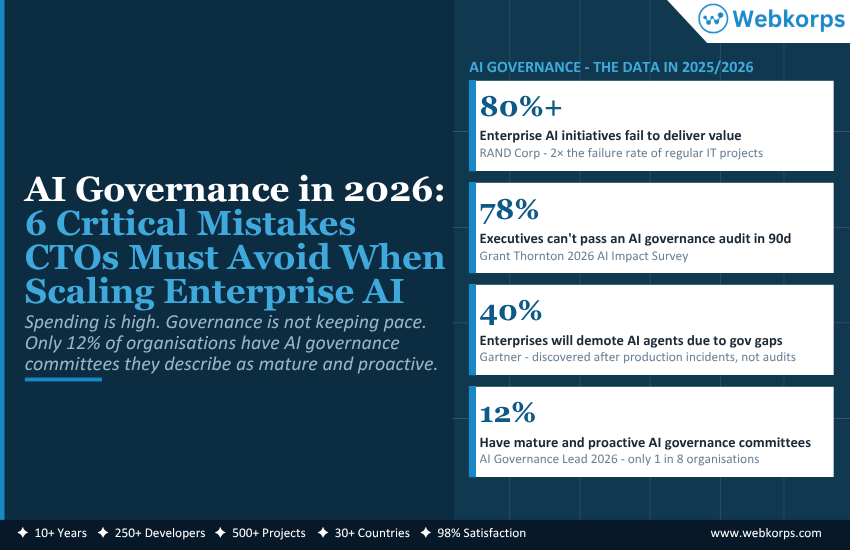
Enterprises poured roughly $684 billion into AI in 2025. RAND Corporation’s analysis of more than 2,400 enterprise AI initiatives found that over 80% fail to deliver their intended business value, roughly double the failure rate of regular IT projects. McKinsey’s 2025 Global AI Survey found 88% of organisations now use AI in at least one business function, but only a fraction see measurable bottom-line impact.
Grant Thornton’s 2026 AI Impact Survey identified the gap precisely: 78% of business executives lack strong confidence they could pass an independent AI governance audit within 90 days. McKinsey’s own 2026 AI Trust Maturity Survey found only one in three enterprises has reached the governance maturity level adequate for the autonomous AI systems they’re already running.
Spending is high. Governance is not keeping pace. Here is where most CTOs are losing ground, and what the organisations closing the gap are doing differently.
Discover how to close the AI governance gap and turn your enterprise AI investments into measurable business outcomes. Let’s discuss with Webkorps team
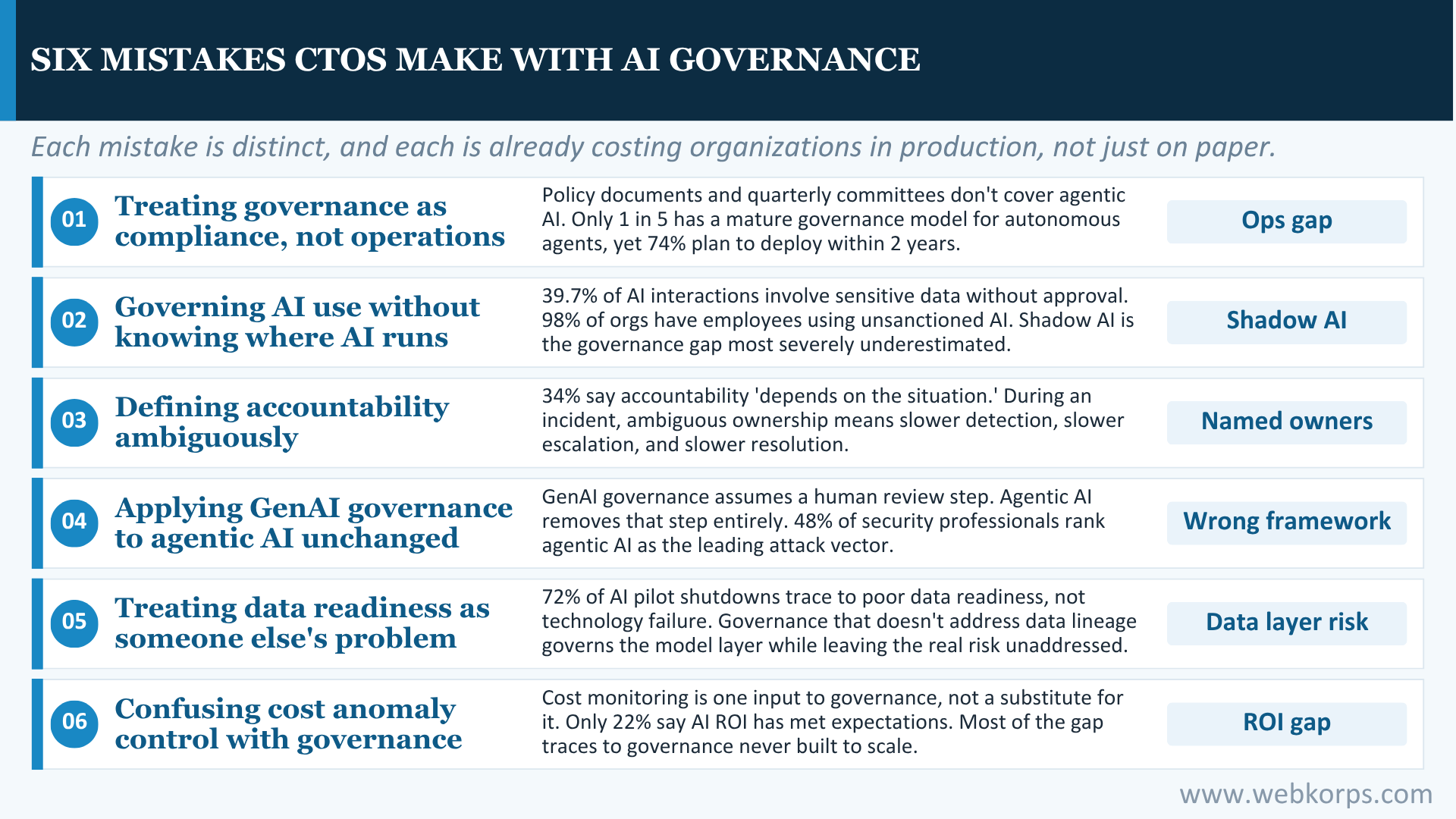
Table of Contents
Mistake 1: Treating Governance as a Compliance Exercise, Not an Operational Discipline
Most AI governance programmes start as a response to a regulatory signal, an EU AI Act briefing, a board request, a procurement questionnaire from an enterprise customer. That framing shapes everything that follows: governance becomes a policy document, an approval checklist, and a committee that meets quarterly.
That model was adequate for AI systems that were static, narrow, and human-supervised. Agentic AI systems, agents that plan, decide, and execute across systems without human intervention in each step, operate at a different risk surface. Gartner predicted that by 2027, 40% of enterprises will demote or decommission autonomous AI agents due to governance gaps identified only after production incidents (TQA, 2026). Not during audits. After incidents.
Deloitte’s 2026 State of AI in the Enterprise report puts the scale of the problem clearly: only one in five companies has a mature governance model for autonomous AI agents, yet 74% plan to adopt agentic AI within two years. Governance built for static systems is already inadequate for the AI most organisations are currently deploying.
Effective governance in 2026 is an operational discipline, not a compliance programme. It runs continuously, monitors model outputs against business outcomes, and has defined escalation paths that don’t require a committee to convene before a decision is made.
Mistake 2: Governing AI Use Without Knowing Where AI Runs
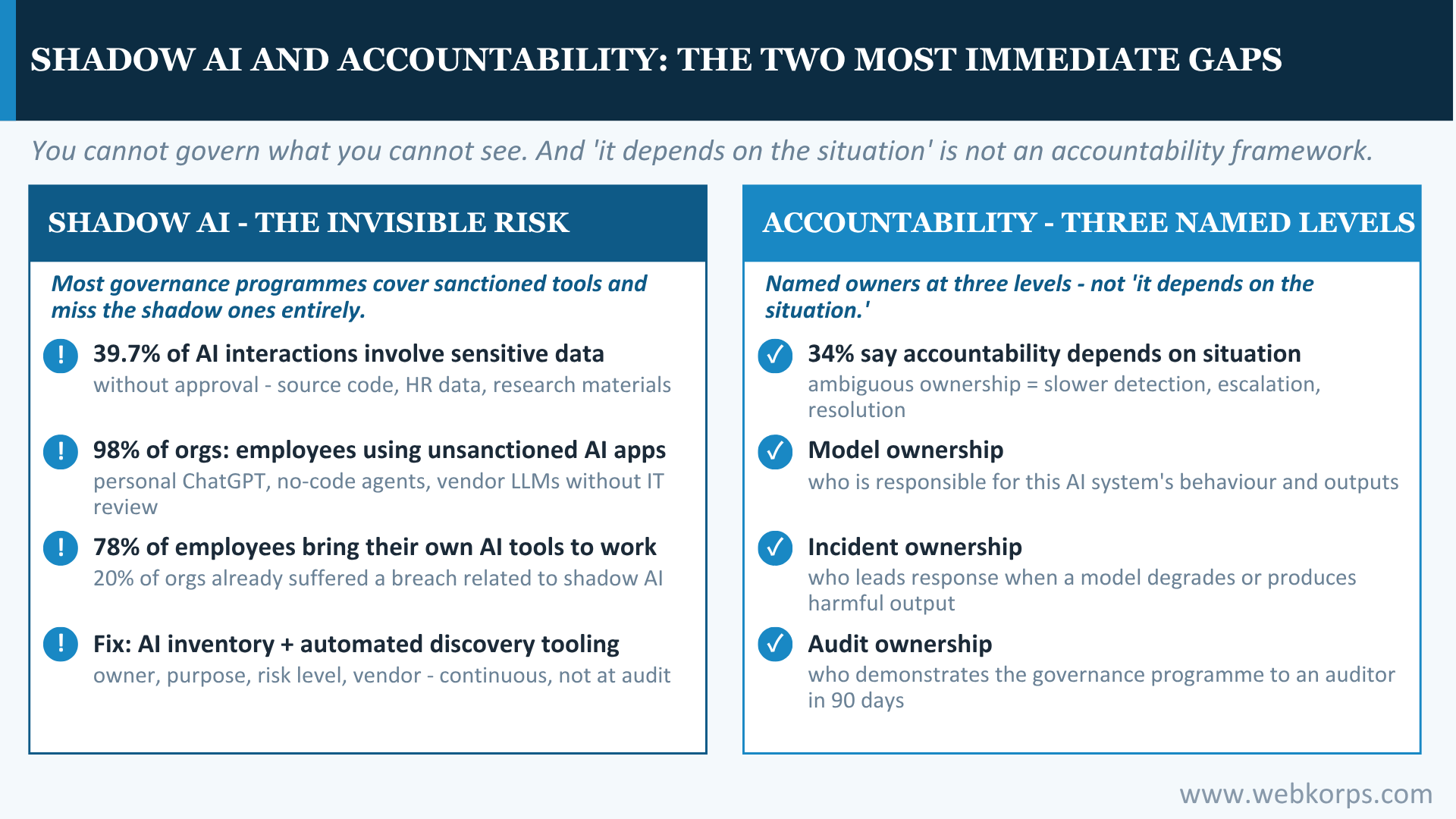
Enterprises cannot govern what they cannot see. Cyberhaven Labs’ 2026 AI Adoption and Risk Report found that 39.7% of all human interactions with AI tools involve sensitive data, source code, research materials, and HR data among the most common categories entered into external AI tools without approval.
Shadow AI is the governance gap that most organisations severely underestimate. 98% of organisations have employees using unsanctioned apps, including shadow AI. 78% of employees bring their own AI tools to work. 20% of organisations have already suffered a security breach related to shadow AI (AI Governance Lead, 2026).
CTOs who believe their AI governance programme covers the AI their organisation actually uses are typically governing the sanctioned tools and missing the shadow ones. A central AI inventory with required fields, owner, purpose, risk level, vendor, alongside automated discovery tooling that scans endpoints, browsers, and SaaS connectors is the minimum operational baseline for knowing what’s actually running.
Over 50% of organisations lack systematic inventories of AI systems currently in production or development (AI Governance Lead, 2026). Without an inventory, governance policy is a document that doesn’t connect to reality.
Mistake 3: Defining Accountability Ambiguously
Retool’s 2026 State of AI Governance report surveyed 307 CTOs, CIOs, and CISOs and found that when asked who is accountable for incidents with AI-generated tools: 34% said “it depends on the situation,” 32% said engineering leadership or the CTO, 23% said the team or individual who built it, and 10% said they hadn’t defined it yet.
“It depends on the situation” is not an accountability framework. During an incident, ambiguous ownership produces slower detection, slower escalation, and slower resolution, at exactly the moment when speed is most consequential.
63% of organisations that experienced AI-related breaches either have no AI governance policy or are still developing one (AI Governance Lead, 2026). Governance policy without clear ownership is a different version of the same problem.
Effective AI governance assigns named accountability at three levels: model ownership (who is responsible for a specific AI system’s behaviour and outputs), incident ownership (who leads response when a model degrades or produces harmful output), and audit ownership (who can demonstrate the governance programme to an external auditor within 90 days). None of these roles should be “it depends.”
Establish clear AI accountability with defined ownership, faster incident response, and audit-ready governance across your enterprise. Discuss with Webkorps team
Mistake 4: Applying GenAI Governance Frameworks to Agentic AI Unchanged
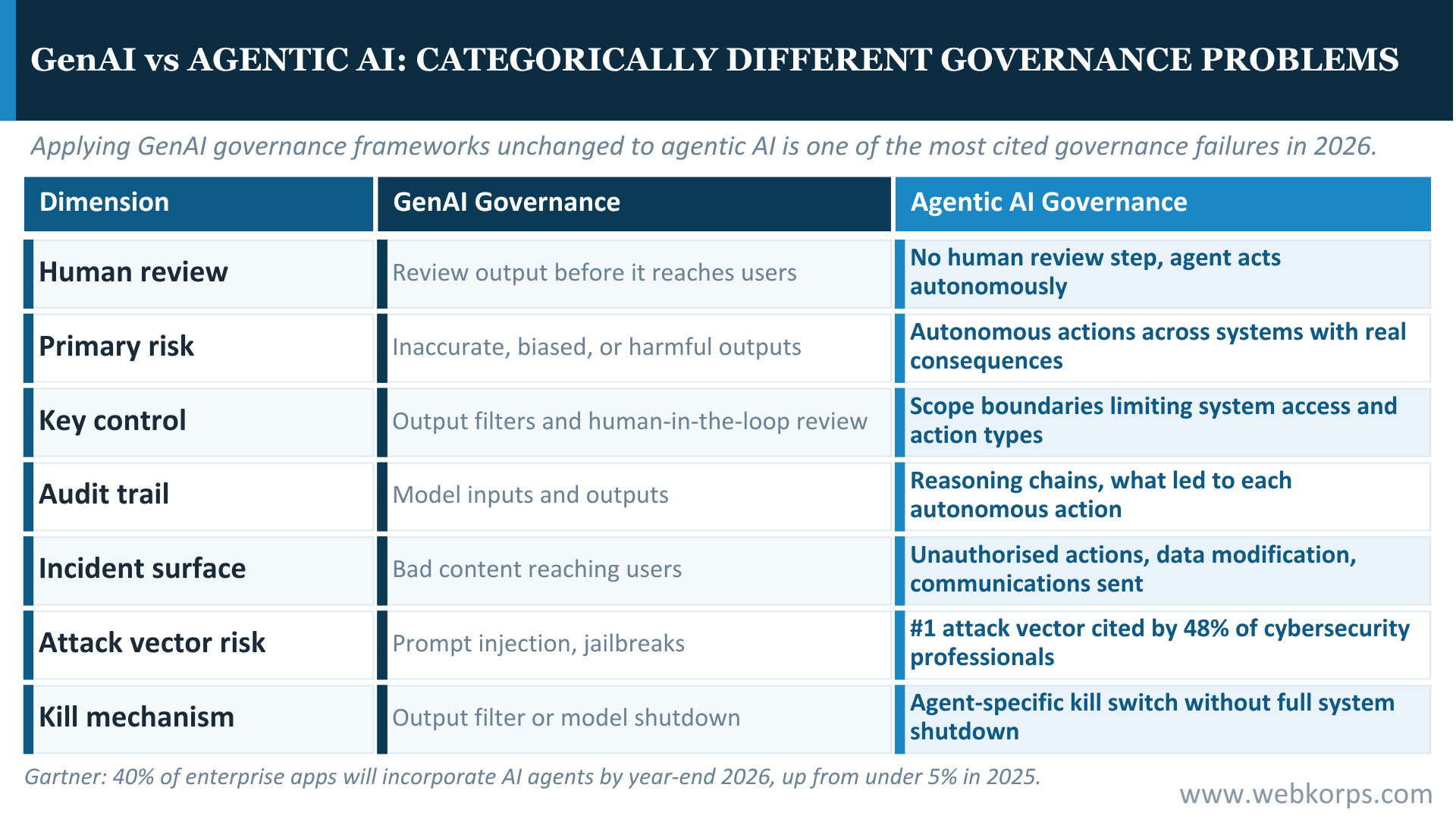
Generative AI and agentic AI present categorically different governance problems. Most failures trace back to applying generative AI governance frameworks unchanged to agentic AI, which is a categorically different risk (TQA, 2026).
GenAI governance focuses on output review: checking model responses for accuracy, bias, and appropriateness before they reach end users. That model assumes a human review step exists between model output and consequence.
Agentic AI removes that step. An agent that can book travel, modify database records, send communications, or execute code acts autonomously across systems. 48% of cybersecurity professionals already rank agentic AI as the leading attack vector, ahead of deepfakes and traditional social engineering (Cyberhaven, 2026). Gartner projects 40% of enterprise applications will incorporate AI agents by year-end, up from under 5% in 2025.
Agentic governance requires different controls: scope boundaries that define which systems an agent can access and which actions it can take, human-in-the-loop checkpoints at high-stakes decision points, audit trails that capture not just outputs but the reasoning chain that produced them, and kill switches that can halt agent activity without requiring a full system shutdown.
CTOs who have adapted their GenAI approval workflows to cover agentic deployments have adapted the wrong thing.
Mistake 5: Treating Data Readiness as Someone Else’s Problem
AI governance and data governance are treated as separate functions in most organisations. In practice, they’re the same problem viewed from different angles.
Grant Thornton’s 2026 AI Impact Survey found 55% of CIOs and CTOs report fewer than half of their core applications are AI-ready. Insufficient data readiness is cited as the third-leading cause of AI underperformance, behind governance failures and accountability gaps, both of which also have data components (Grant Thornton, 2026).
AI project failure rates jumped from 17% to 42% between 2024 and 2025. S&P Global’s analysis attributes 72% of potential AI pilot shutdowns to poor data readiness rather than technology limitations (TechTarget, 2026). Governance programmes that don’t address data lineage, data quality, and data access controls are governing the model layer while leaving the data layer, where most of the risk actually lives, unaddressed.
Effective AI governance treats data readiness as a prerequisite, not a separate workstream. Which data trained each model? Where does inference data come from, and who can access it? What happens when upstream data changes? These are governance questions, not just data engineering questions.
Mistake 6: Confusing Cost Anomaly Control with Governance
85% of organisations misestimate AI costs, with token usage often running tens of thousands of dollars per month above forecast (Presidio, 2026). Cost anomaly alerts are becoming a standard feature of AI governance programmes, which is correct. Uncontrolled AI usage generates material unexpected costs.
But cost control is not governance. An organisation with excellent cost monitoring and no explainability framework, no bias testing, and no incident response protocol has built financial controls around a system it cannot audit, explain, or defend.
ISACA’s 2026 AI Pulse Poll, surveying over 3,400 digital trust professionals, found only 22% of organisations say AI ROI has met or exceeded expectations. Most of the gap traces back to governance structures never built to scale alongside the technology (Forbes Technology Council, 2026). Cost visibility is one input to that governance structure, not a substitute for it.
What Mature AI Governance Actually Looks Like
Organisations closing the governance gap share several characteristics:
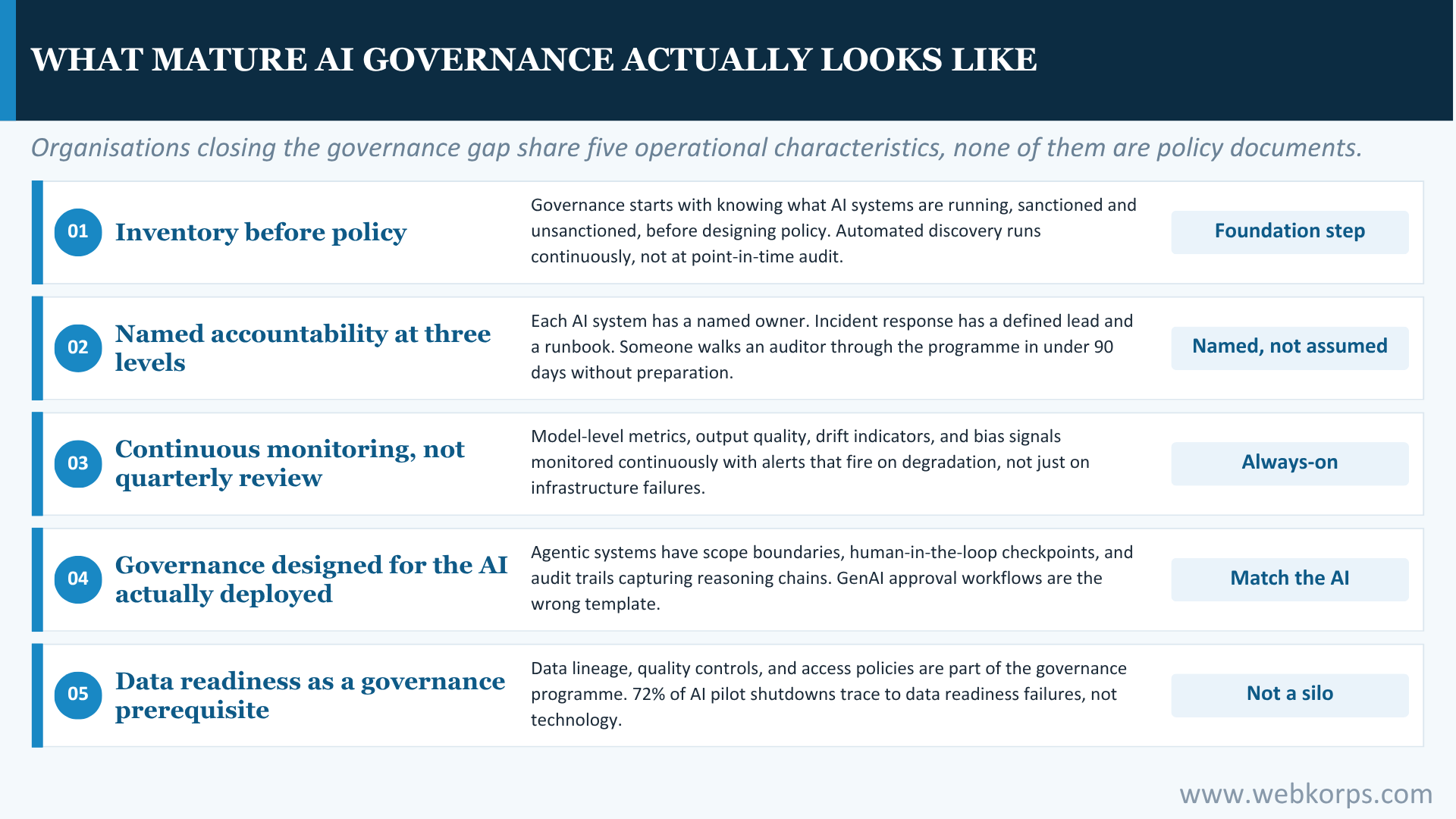
- Inventory before policy: Governance starts with knowing what AI systems are running, sanctioned and unsanctioned, before designing policy around them. Automated discovery runs continuously, not at point-in-time audit.
- Named accountability at model, incident, and audit levels: Each AI system has a named owner. Incident response has a defined lead and a runbook. Someone can walk an auditor through the governance programme in under 90 days without preparation.
- Continuous monitoring, not quarterly review: Model-level metrics, output quality, drift indicators, and bias signals are monitored continuously with alerts that fire on degradation, not just on infrastructure failures.
- Governance designed for the AI actually deployed: Agentic systems have scope boundaries, human-in-the-loop checkpoints, and audit trails capturing reasoning chains, not just outputs.
- Data readiness as a governance prerequisite: Data lineage, quality controls, and access policies are part of the governance programme, not a separate workstream.
Conclusion
AI governance that exists only as a policy document, a compliance checklist, or a quarterly committee meeting is governance built for the AI of three years ago. Autonomous agents, shadow AI proliferation, and regulatory scrutiny accelerating across every regulated industry have moved the baseline.
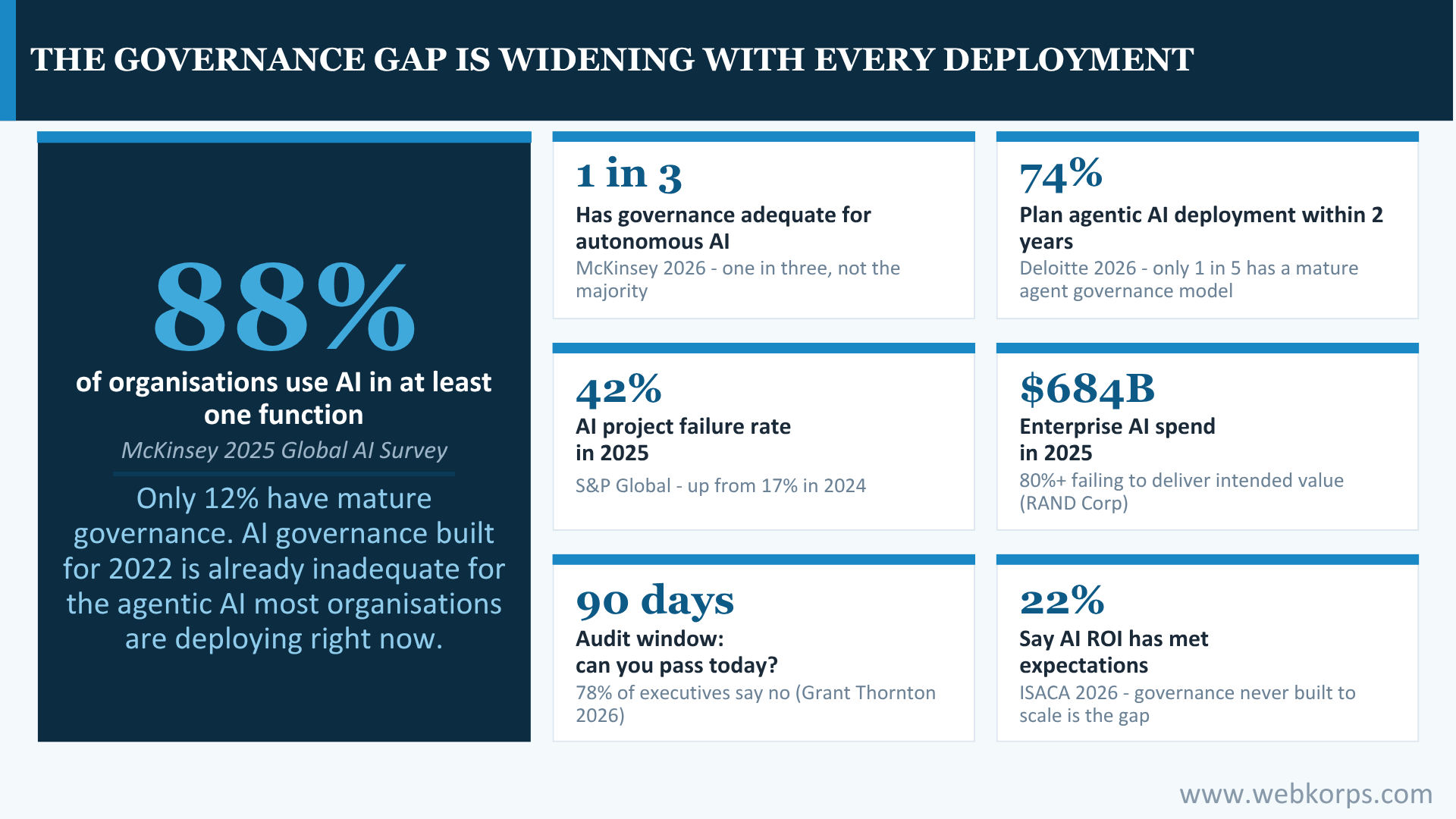
Only 12% of organisations describe their AI governance committees as mature and proactive (AI Governance Lead, 2026). For the other 88%, the gap between the AI already running in production and the governance programme designed to cover it is widening with every deployment.
Webkorps builds AI governance frameworks for engineering teams in fintech, healthcare, and logistics, from AI inventory design and accountability models through to agentic system controls and audit-ready documentation. Our engineering squads are ISO 27001 certified and CMMI Level 3 assessed.
Ready to build AI governance that matches the AI your team is actually deploying? Book a Discovery Call
Frequently Asked Questions
What is AI governance in an enterprise context?
AI governance is the operational framework defining who owns AI systems, how their outputs are monitored, what accountability exists when they fail, and how the organisation demonstrates compliance to auditors. In 2026, effective governance covers both sanctioned deployments and shadow AI running without visibility.
Why do most AI governance programmes fail?
Most are built as compliance exercises, policy documents and approval checklists, rather than operational disciplines. They govern static AI systems and don’t account for agentic AI, shadow AI proliferation, or the continuous monitoring required to detect model drift and output degradation in production.
What is shadow AI and why is it a governance risk?
Shadow AI is AI tooling employees use without organisational approval, personal ChatGPT accounts, no-code agents, and vendor LLMs integrated without IT review. 78% of employees bring their own AI tools to work; 20% of organisations have already suffered a breach related to shadow AI (AI Governance Lead, 2026).
How is agentic AI governance different from GenAI governance?
GenAI governance focuses on reviewing outputs before they reach users. Agentic AI acts autonomously across systems, modifying records, sending communications, executing code, without a human review step. Agentic governance requires scope boundaries, human-in-the-loop checkpoints, reasoning-chain audit trails, and agent kill switches.
What percentage of enterprises have mature AI governance?
Only 12% describe their AI governance committees as mature and proactive (AI Governance Lead, 2026). Only one in three has reached the governance maturity adequate for the autonomous AI systems they’re already running (McKinsey, 2026). Only one in five has a mature governance model for autonomous AI agents specifically (Deloitte, 2026).
What should an AI governance programme include in 2026?
An AI inventory covering all deployments (sanctioned and shadow), named accountability at model, incident, and audit levels, continuous model-level monitoring, governance controls specific to agentic AI, data readiness as a prerequisite, and incident response runbooks tested under realistic conditions, not just defined on paper.
What is the cost of poor AI governance?
Grant Thornton’s 2026 AI Impact Survey found 46% of executives cite governance failures as a leading cause of AI underperformance. RAND Corporation found over 80% of enterprise AI initiatives fail to deliver intended value. AI project failure rates jumped from 17% to 42% between 2024 and 2025 (S&P Global).
How do you build accountability into AI governance?
Assign named owners at three levels: model ownership (responsible for system behaviour and outputs), incident ownership (leads response when a model fails), and audit ownership (can demonstrate the governance programme to an external auditor within 90 days). “It depends on the situation” is not an accountability framework.