
 Posted by
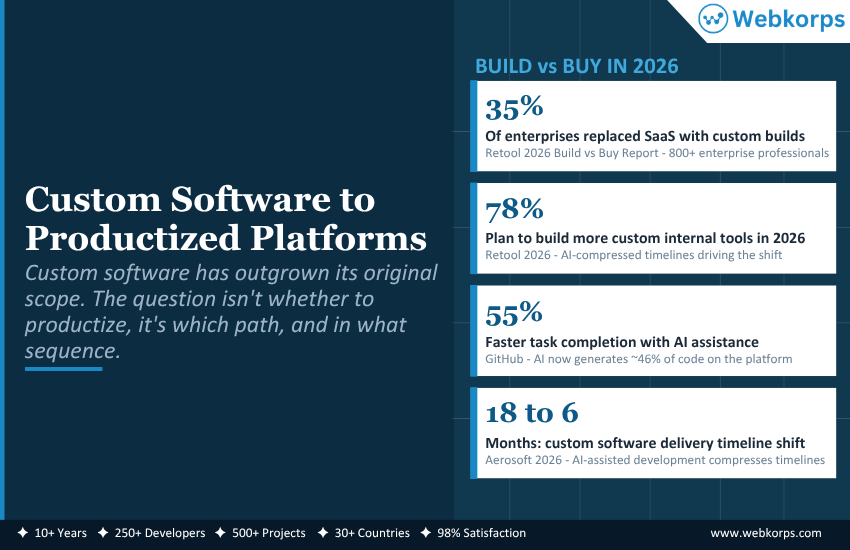
Retool’s 2026 Build vs. Buy Report surveyed over 800 enterprise professionals and found that 35% had already replaced SaaS tools with custom-built software, and 78% expected to build more custom internal tools in 2026. AI-assisted development has compressed timelines dramatically: what once took 18 months can now be delivered in six (Aerosoft, 2026). GitHub’s own research found developers complete tasks 55% faster with AI assistance, with AI now generating roughly 46% of code on the platform.
Shift is creating a new inflection point in how engineering leaders think about internal tooling. Custom software that started as a solution for one team’s specific problem is being recognised as something more: a productizable capability with genuine market value, or at minimum, a platform that multiple internal business units should be running on rather than a patchwork of SaaS subscriptions.
Transition is worth making, and how to execute it without breaking what already works is one of the highest-leverage decisions a CTO or founder faces. Here is how to think through both questions.
Table of Contents
Two Directions, One Decision
Productizing internal software takes two distinct forms, and conflating them leads to expensive misalignment:
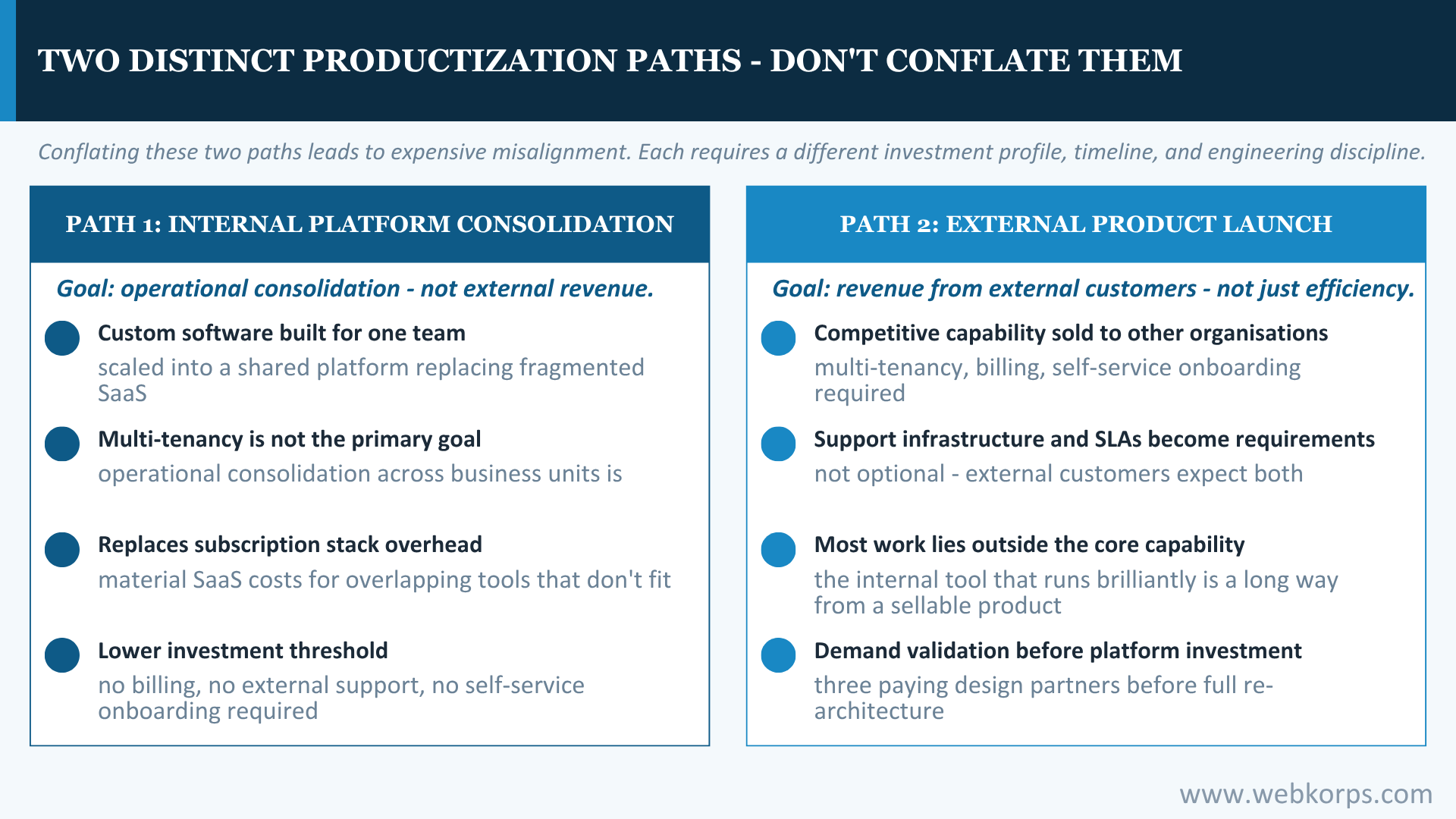
- Internal platform consolidation: Taking custom software built for one team and scaling it into a shared platform that replaces fragmented SaaS tools across the organisation. Multi-tenancy isn’t the goal; operational consolidation is.
- External product launch: Taking a competitive capability built internally and turning it into a product sold to other organisations. Multi-tenancy, subscription billing, self-service onboarding, and support infrastructure all become requirements.
Most organisations attempting the second path underestimate how much of the work lies outside the core capability. An internal tool that runs brilliantly on a single database schema, maintained by one engineer who knows every edge case, is a long way from a product that can be provisioned in minutes by a customer who’s never spoken to anyone on the team.
Both paths are worth taking in the right circumstances and require different investment profiles, different timelines, and different engineering disciplines to execute well.
Building internal software that’s outgrown its original scope? Talk to Webkorps Team Today
Signals That Indicate Productization Is Worth Pursuing
Not every internal tool is worth productizing. Several signals distinguish genuine product opportunities from engineering projects that are better left as internal tooling:
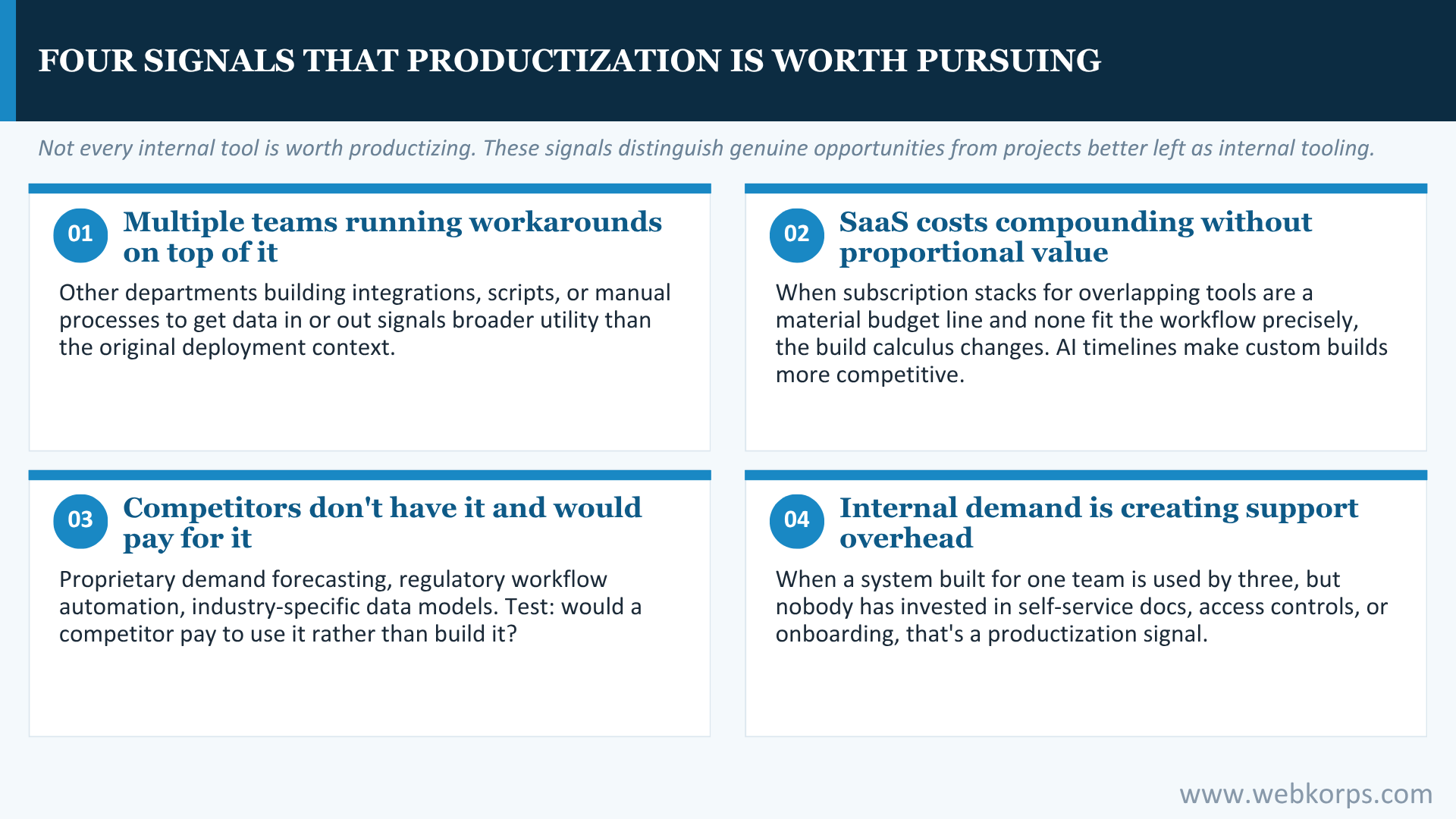
- Multiple teams are running workarounds on top of it: When other departments start building integrations, scripts, or manual processes to get data into or out of an internal system, that’s a signal the underlying capability has broader utility than its original deployment context. It’s also a sign the current architecture wasn’t designed for that breadth, and will need work before it can support it cleanly.
- SaaS subscription costs are compounding without proportional value: Retool’s 2026 report found enterprises increasingly replacing SaaS tools with custom builds as the cost-of-ownership comparison shifts. When subscription stacks for overlapping tools represent a material budget line, and none of them fit the workflow precisely, the build calculus changes. Custom software built on a competitive AI development pipeline now costs less than it did three years ago and delivers more.
- Competitors don’t have it and would pay for it: Operational capabilities that are genuinely differentiated, proprietary demand forecasting, regulatory workflow automation, industry-specific data models, represent genuine IP that can be monetised externally. The test is whether a competitor would pay to use it rather than build it themselves.
- Internal demand is creating support overhead: When a system built for one team is being used by three, but no one has invested in self-service documentation, access controls, or onboarding flows, the original team is absorbing support load that doesn’t scale. That’s a productization signal: the capability has outgrown its deployment model.
What Changes Technically When Internal Becomes Platform
Engineering delta between an internal tool and a productized platform is larger than most organisations anticipate, and the gap widens with every feature added to the internal version without platform architecture in mind.
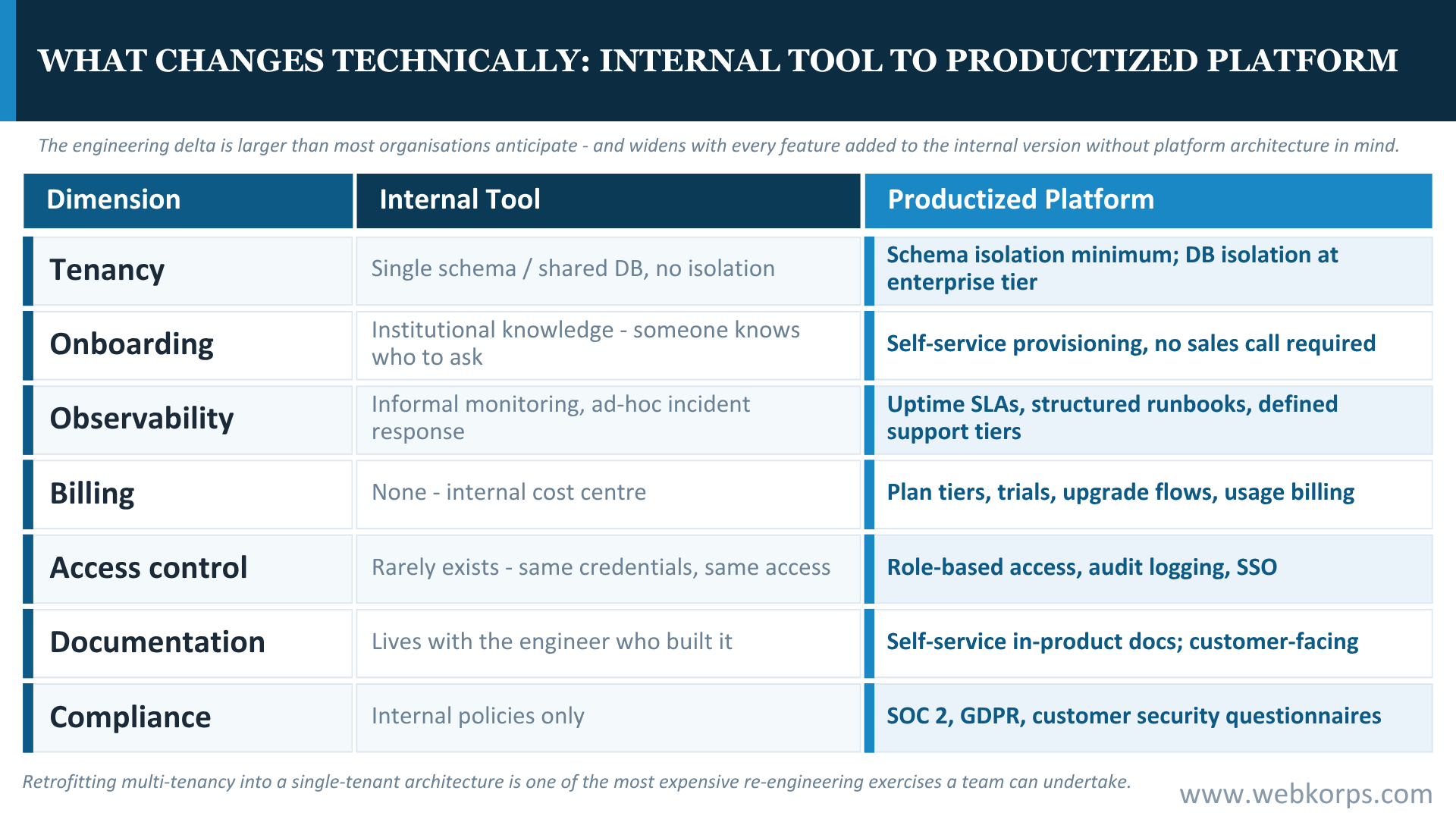
- Multi-tenancy: Internal tools typically operate on a single schema or a shared database with no tenant isolation. Productized platforms require data isolation between customers, at minimum at the schema level, and at the enterprise tier at the database level. Retrofitting multi-tenancy into a single-tenant architecture is one of the more expensive re-engineering exercises a team can undertake. Designing for it from the point of the productization decision avoids that cost.
- Self-service onboarding. Internal tools rely on institutional knowledge; someone knows who to ask, where the documentation lives, and which edge cases require manual handling. External products cannot assume any of that. Self-service onboarding that lets customers provision accounts, configure integrations, and reach first value without a sales call is a growth ceiling question: without it, every new customer requires engineering or sales time that doesn’t scale.
- Observability and SLA accountability. Internal tools can tolerate planned downtime windows, ad-hoc monitoring, and informal incident response. Products sold to customers require uptime commitments, structured observability, incident management runbooks, and a support tier that can respond within defined SLAs. None of this is insurmountable, but none of it is free, and underestimating the operational surface area is one of the most cited productization failures.
- Subscription and billing infrastructure. Plan tiers, trial periods, upgrade and downgrade flows, usage-based billing, and payment processing are significant implementation work even when delegated to a platform like Stripe Billing. Getting the billing model wrong, pricing per seat when customers expect usage-based, or missing a natural upgrade trigger affects revenue architecture as much as feature gaps.
How to Sequence the Transition
Organisations that execute this transition well do it in phases, not in a single re-architecture sprint:
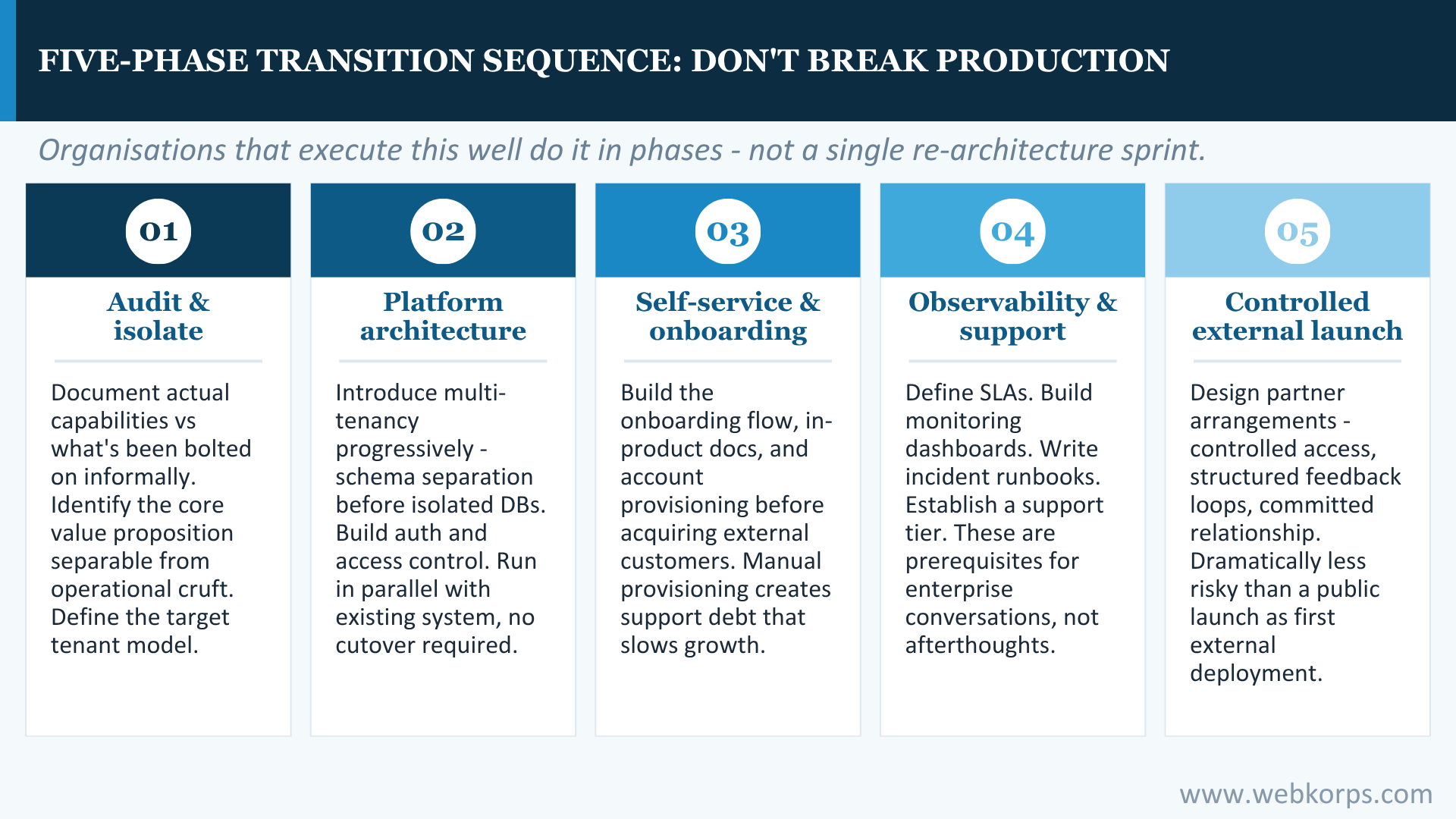
- Phase 1 – Audit and isolate: Document the existing system’s actual capabilities versus what’s been bolted on informally. Identify the core value proposition that would be worth productizing, separate from the operational cruft that’s accumulated around it. Define the target tenant model.
- Phase 2 – Platform architecture without breaking production. Introduce multi-tenancy progressively, starting with schema separation on the existing database before migrating to isolated databases at the enterprise tier. Build the authentication and access control layer that internal tooling almost never has. This phase can run in parallel with the existing system without a cutover.
- Phase 3 – Self-service and onboarding. Build the onboarding flow, in-product documentation, and account provisioning before acquiring any external customers. Attempting to onboard external customers onto a system that requires manual provisioning generates support debt that slows growth.
- Phase 4 – Observability and support infrastructure: Define SLAs. Build monitoring dashboards. Write incident runbooks. Establish a support tier. These are prerequisites for enterprise customer conversations, not afterthoughts.
- Phase 5 – Controlled external launch: Bring initial customers in under design partner arrangements, controlled access, structured feedback loops, and a committed relationship that funds continued development. This is different from a public launch and dramatically less risky as a first external deployment.
Engineering the transition right the first time saves more than it costs. Talk to Webkorps About Platform Architecture
Common Mistakes in the Transition
- Re-architecting before validating external demand: Engineering teams often invest heavily in platform architecture, multi-tenancy, billing, and observability before confirming that external customers would actually pay for the capability. Validate demand with design-partner commitments before investing in the full platform.
- Underestimating operational surface area: Running a 24/7 service for external customers is a different operational commitment than running internal tooling. Monitoring, incident response, security patching, backup management, and customer support tooling all represent ongoing costs beyond development that internal tools don’t require.
- Choosing technology for novelty rather than maintainability: Novel frameworks that are exciting during the build become hard to hire for two years later. Battle-tested technologies with large talent pools should be the default unless there is a compelling technical reason to deviate.
Actionable Framework for the Decision
Before committing to productization, answer these questions:
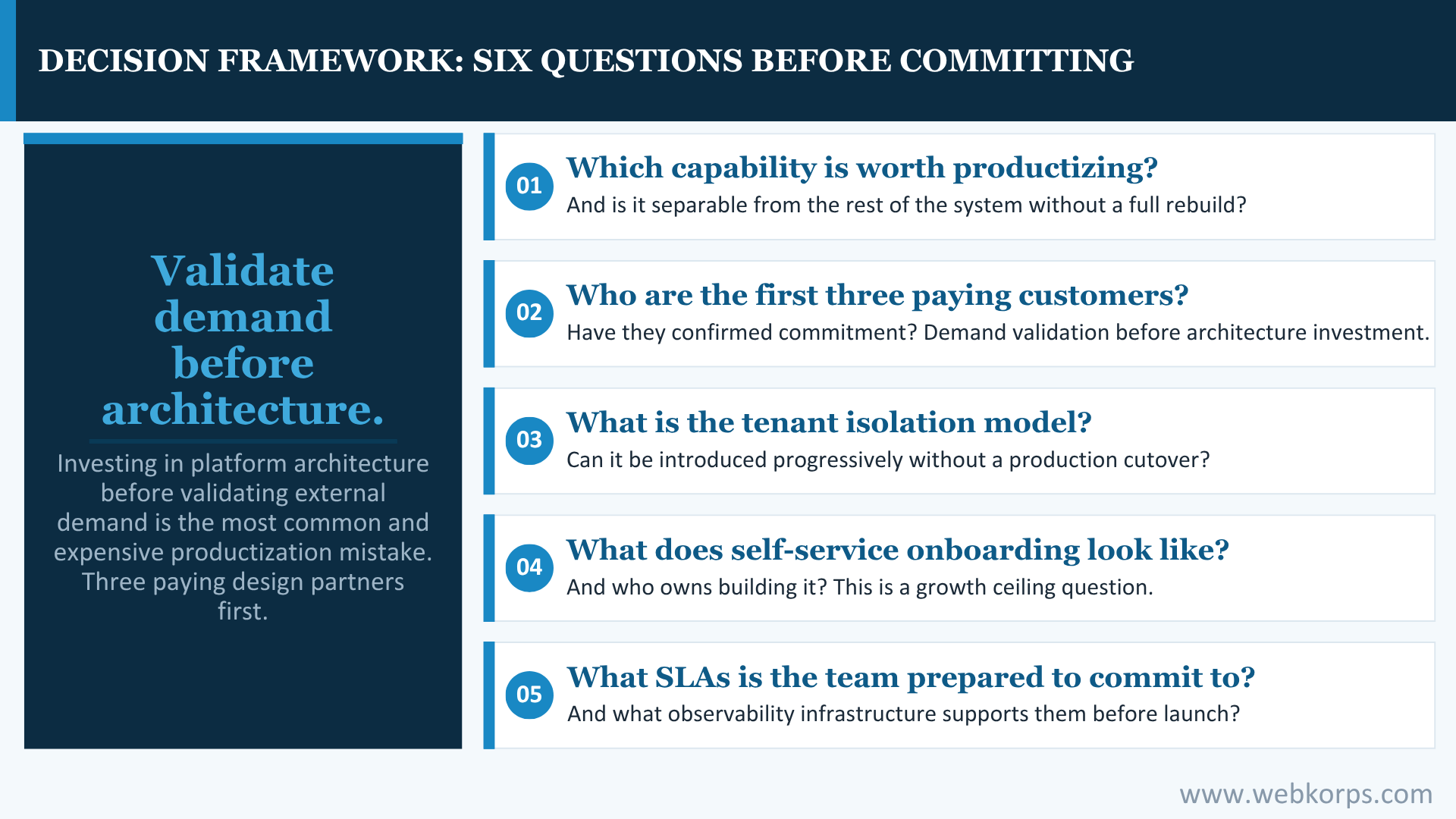
- Which specific capability is worth productizing, and is it separable from the rest of the internal system without a full rebuild?
- Who are the first three external customers who would pay for it, and have they confirmed that commitment?
- What is the tenant isolation model, and can it be introduced progressively without a production cutover?
- What does self-service onboarding look like, and who owns building it?
- What SLAs is the team prepared to commit to, and what observability infrastructure supports them?
- Which technology choices in the existing system create long-term maintainability risk at platform scale?
Conclusion
Custom software is no longer the expensive, slow-moving liability it was five years ago. AI-assisted development has compressed timelines and costs enough that 35% of enterprises have already replaced SaaS tools with custom builds, and 78% plan to build more in 2026 (Retool, 2026). For organisations sitting on internal capabilities that have outgrown their original deployment context, productization is a genuine strategic option.
Executing it well requires honesty about the engineering delta between internal tool and platform, a phased approach that doesn’t break production during the transition, and demand validation before the full platform investment. Organisations that get this sequence right build durable competitive advantages. Organisations that skip straight to platform re-architecture without validating demand or scoping the operational surface area spend the engineering budget without building the business.
Webkorps builds platform engineering programmes for organisations transitioning internal tools to productized SaaS, from multi-tenant architecture and self-service onboarding through to observability design and enterprise compliance. Our engineering squads are ISO 27001 certified and CMMI Level 3 assessed, with experience across fintech, healthcare, and logistics product environments.
Ready to productize an internal capability without breaking what already works? Book a Discovery Call With Webkorps
Frequently Asked Questions
What is a productized platform in software development?
A productized platform is internal custom software that has been re-architected for multi-tenant use, either across internal business units or as an external product sold to customers. It requires self-service onboarding, tenant isolation, subscription billing, and defined SLAs that internal tools don’t need.
When should a company productize internal software?
When multiple teams are building workarounds on top of it, SaaS subscription costs for overlapping tools are material, the capability is genuinely differentiated from what competitors have, or internal demand is creating support overhead the original team can’t absorb.
What is the difference between internal tooling and a productized platform?
Internal tools operate on single-tenant architecture, rely on institutional knowledge for onboarding, and have informal support structures. Productized platforms require multi-tenancy, self-service provisioning, billing infrastructure, structured observability, and SLA commitments, a significantly larger operational surface area.
How long does it take to productize internal software?
Depends on the architectural delta. With AI-assisted development, what once took 18 months can be delivered in six (Aerosoft, 2026). The timeline is determined more by the gap between existing architecture and platform requirements, multi-tenancy, self-service onboarding, and observability than by feature development.
What are the biggest risks when productizing internal software?
Re-architecting before validating external demand, underestimating the operational surface area of running a 24/7 customer-facing service, and choosing technology for novelty over long-term maintainability. Each is avoidable with the right sequencing.
What is multi-tenancy and why does it matter for productized platforms?
Multi-tenancy means multiple customers share the same application infrastructure while their data remains isolated. It’s the core architectural requirement that separates an internal tool from a platform. Retrofitting multi-tenancy into a single-tenant system is one of the most expensive re-engineering exercises in software; designing for it early is significantly cheaper.
How has AI changed the build vs buy decision in 2026?
AI-assisted development has compressed custom software timelines and costs significantly. GitHub data shows developers complete tasks 55% faster with AI assistance, with AI generating roughly 46% of code on the platform. Retool’s 2026 report found 35% of enterprises have already replaced SaaS with custom builds as a result.
What should come before platform re-architecture?
Demand validation, confirmed commitments from at least three external customers who would pay for the capability. Investing in platform architecture before validating external demand is the most common and expensive productization mistake.