
 Posted by
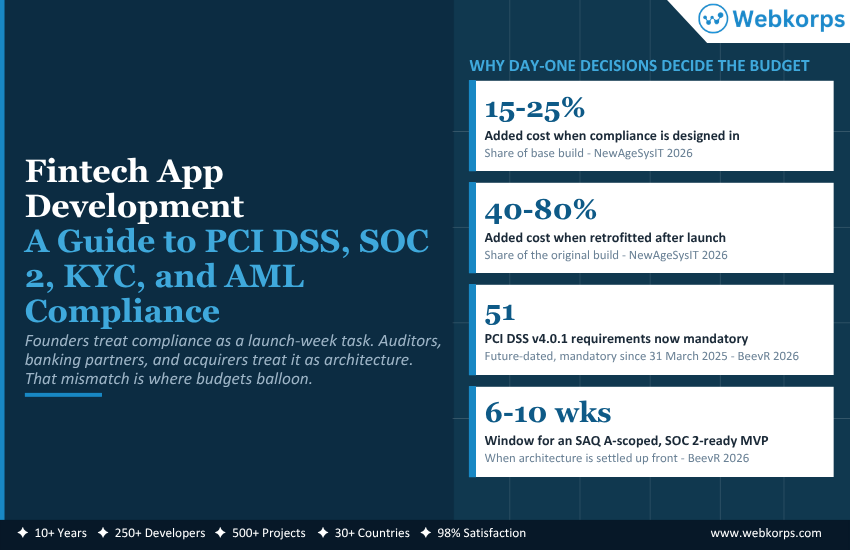
Fintech founders often see compliance as a final checkpoint before launch, while auditors, banking partners, and payment acquirers see it as a foundation that must be built into the platform from day one. Overlooking this distinction can turn a promising fintech launch into a costly exercise of delayed timelines, unexpected expenses, and architectural rework.
Building a compliance-ready fintech platform isn’t about securing every certification before onboarding the first customer; it’s about making the right architectural decisions early, embedding security controls into development, and creating an audit-ready trail from the very first commit. As highlighted in a 2026 founder checklist, an MVP doesn’t necessarily need a PCI DSS audit or SOC 2 report on day one, but it does need an architecture designed to keep sensitive cardholder data away from its servers (BeevR, 2026).
Right compliance decisions can save months of rework and high costs. Discover what it takes to build a secure, audit-ready fintech platform from day one. Talk to Webkorps About Compliance-First Architecture
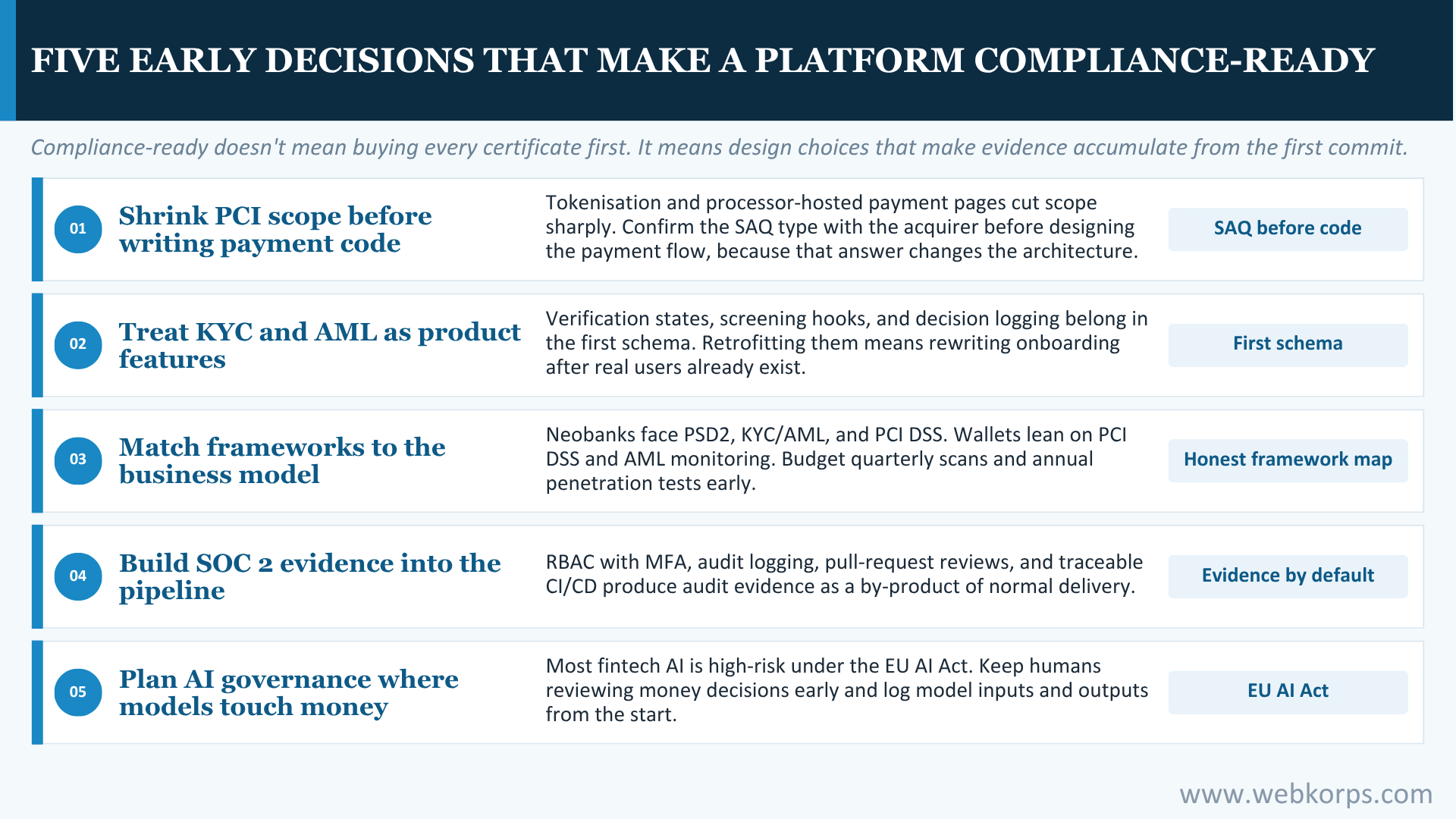
Table of Contents
Shrink PCI Scope Before Writing Payment Code
PCI DSS applies to any organisation that stores, processes, or transmits cardholder data, or can affect the environment that does. Scope is the lever founders control. Tokenisation and processor-hosted payment pages cut it sharply (Sensussoft, 2026), and apps that rely entirely on a compliant processor without touching raw card data carry a much smaller burden (Code Driven Labs, 2026).
PCI DSS v4.0.1 is now the only active version, and 51 future-dated requirements became mandatory on 31 March 2025 (BeevR, 2026). Confirm the SAQ type with the acquirer before designing the payment flow, because that answer changes the architecture.
Treat KYC and AML as Product Features, Not Add-Ons
Onboarding users and moving money trigger identity verification and transaction monitoring duties, whichever processor sits underneath. Those flows touch the data model, the user journey, and the audit log at once. Retrofitting them means rewriting onboarding after real users already exist.
Design the customer record, verification states, and screening hooks into the first schema. Log every decision with a timestamp and reason code. Banking partners routinely request SOC 2 Type II reports, PCI evidence, BSA/AML programme documentation, and penetration test reports (NewAgeSysIT, 2026).
Match Frameworks to the Business Model
Obligations differ by model. Digital banks and neobanks typically face PSD2, KYC/AML, PCI DSS, and regional banking rules, while payment and wallet apps lean on PCI DSS, PSD2 in the EU, and AML transaction monitoring (Code Driven Labs, 2026). A compliance-ready fintech platform starts with an honest map of which frameworks apply, before any architecture is drawn.
Operating duties follow launch. Quarterly vulnerability scanning and annual penetration testing are standard PCI DSS expectations, and fintechs processing over 300K transactions face Service Provider Level 1 requirements (Sensussoft, 2026). Budget for those recurring costs early.
Build SOC 2 Evidence Into the Delivery Pipeline
SOC 2 isn’t legally mandated the way PCI DSS is for card data, yet it has become close to a market expectation for fintechs working with banking partners or enterprise clients (Code Driven Labs, 2026). Examiners review change management, so pipeline discipline doubles as audit evidence (Automation Atlas, 2026).
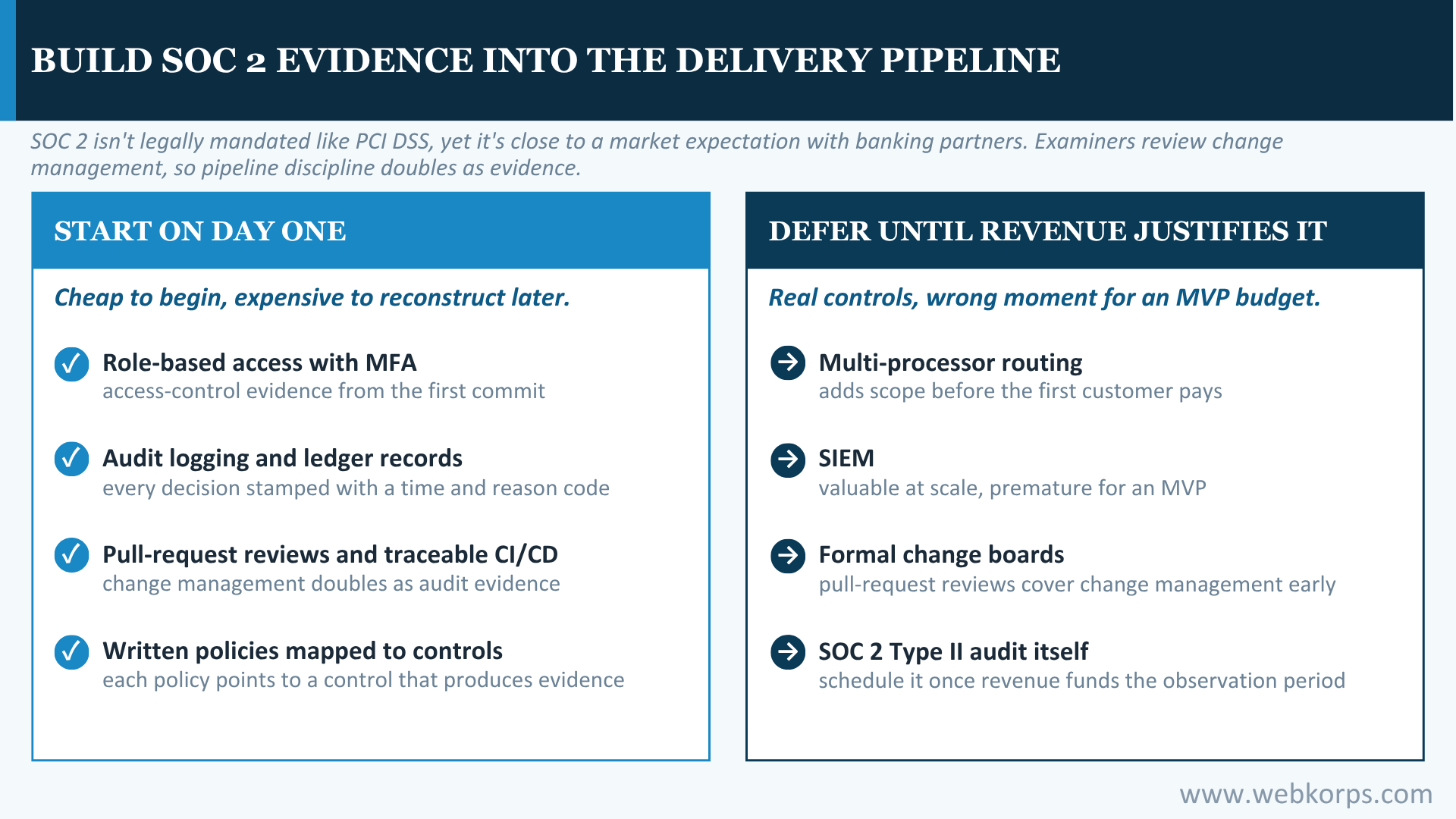
Start these controls on day one: role-based access with MFA, audit logging, pull-request reviews, traceable CI/CD, ledger records, and written policies. Defer multi-processor routing, SIEM, formal change boards, and the Type II audit itself until revenue justifies them (BeevR, 2026).
Compliance-Ready FinTech Platform vs Retrofit: What Changes
| Area | Built in from day one | Retrofitted after launch |
| Card data | Tokenised, processor-hosted flow with a small PCI scope | Card data discovered across services; scope sprawls |
| Identity and AML | Verification states and screening in the first schema | Onboarding rewritten with live users |
| Audit evidence | Logs and PR reviews accumulate from the first commit | Evidence reconstructed before the audit |
| Added cost | 15-25% of base build | 40-80% of original build |
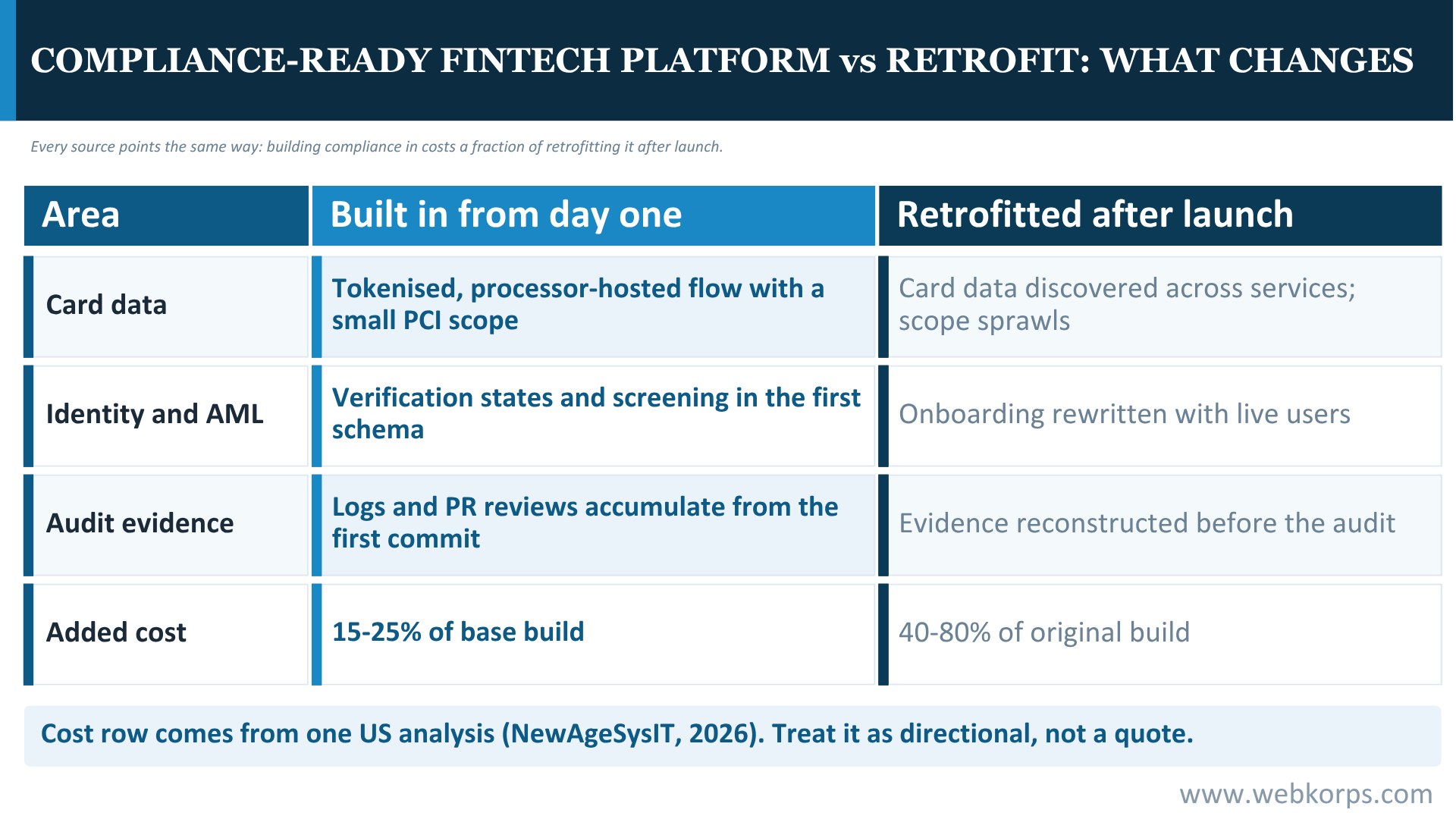
The cost row comes from one US analysis, so treat it as directional rather than a quote (NewAgeSysIT, 2026). Every source points the same way: a compliance-ready fintech platform costs a fraction of one retrofitted after launch.
Also read: How AI Is Revolutionizing FinTech Software Development
Plan for AI Governance if Models Touch Money Decisions
Fintech platforms using AI carry extra obligations. Under the EU AI Act, most fintech AI is classed as high-risk, requiring explainability, model inventories, and human oversight before deployment (Intellivon, 2026). Keep humans reviewing AI money decisions in early releases, and log model inputs and outputs from the start. Policy-as-code keeps those controls enforceable instead of aspirational.
Common Mistakes in Fintech Compliance Planning
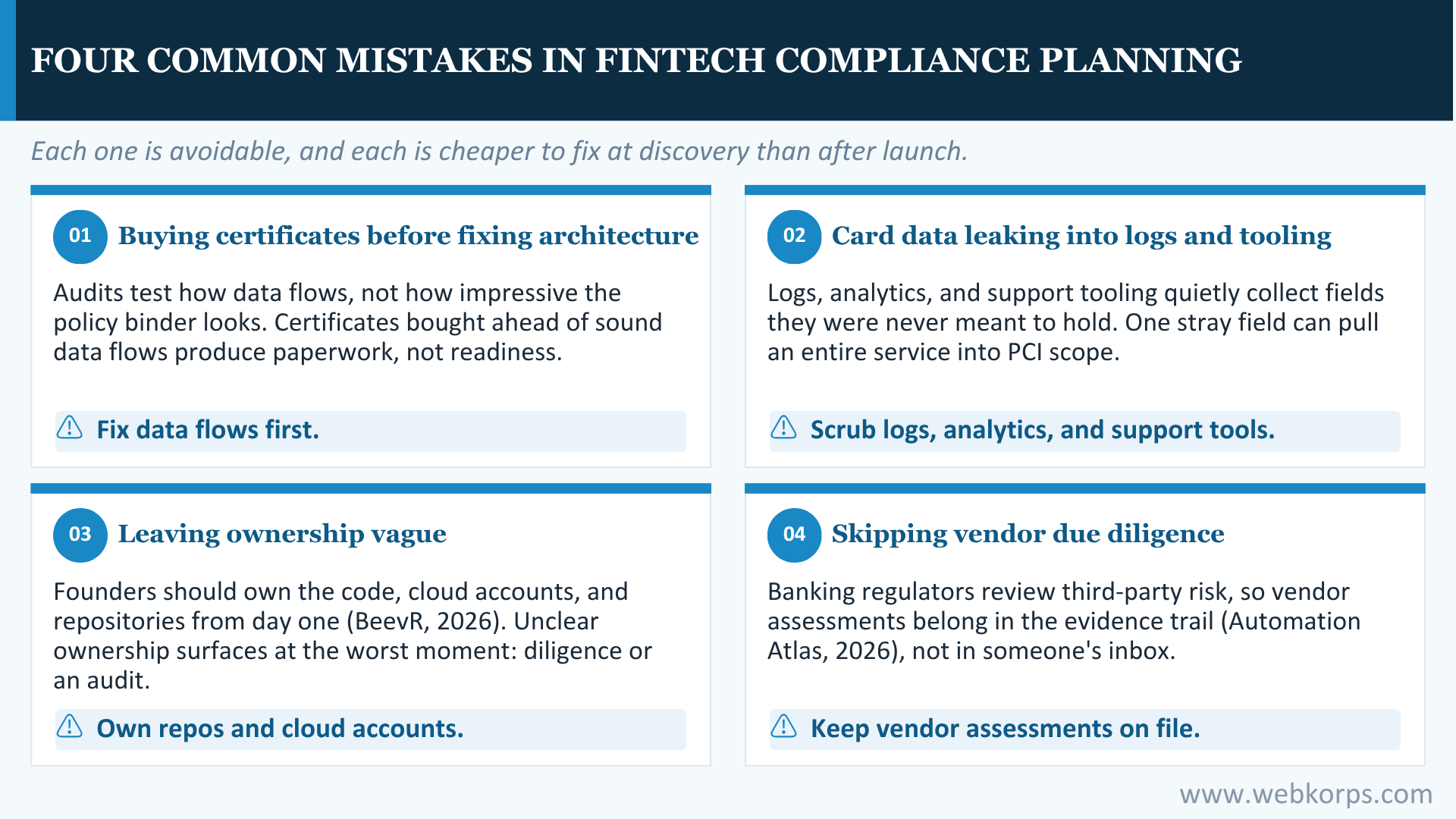
- Buying certificates before fixing architecture. Audits test how data flows, not how impressive the policy binder looks.
- Letting card data leak into logs, analytics, and support tooling. One stray field can pull an entire service into PCI scope.
- Leaving ownership vague. Founders should own the code, cloud accounts, and repositories from day one (BeevR, 2026).
- Skipping vendor due diligence. Banking regulators review third-party risk, so vendor assessments belong in the evidence trail (Automation Atlas, 2026).
Actionable Steps for Founders and CTOs
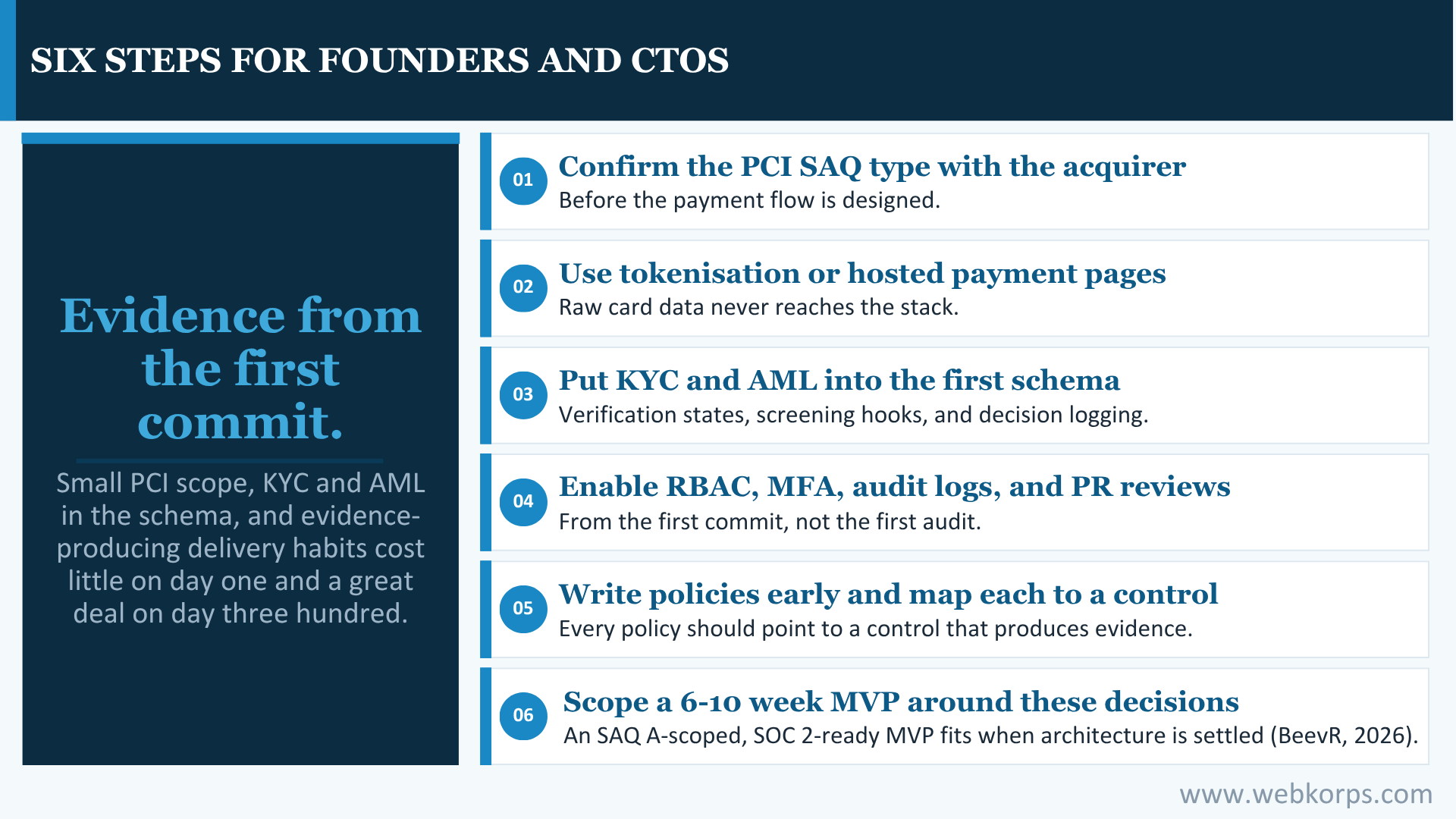
- Confirm the PCI SAQ type with the acquirer before the payment flow is designed.
- Use tokenisation or processor-hosted payment pages so raw card data never reaches the stack.
- Put KYC states, AML screening hooks, and decision logging into the first schema.
- Enable RBAC, MFA, audit logging, and pull-request reviews from the first commit.
- Write policies early and map each one to a control that produces evidence.
- Scope a 6-10 week MVP build around these decisions; an SAQ A-scoped, SOC 2-ready MVP fits that window when architecture is settled up front (BeevR, 2026).
Read also: Explainable AI for Fintech: How to Pass a Regulator Audit on Your ML Models
Conclusion
Compliance is cheaper to build in than bolt on. Get PCI scope, KYC/AML, and audit-ready controls right from day one to avoid costly rework, accelerate launches, and build lasting trust.
Webkorps helps fintech startups, scaleups, and enterprises build secure, scalable, and compliance-ready platforms from the first sprint. Backed by ISO 27001-certified engineering teams and CMMI Level 3 assessment, we make security and compliance part of the architecture.
Partner with Webkorps to turn compliance into a competitive advantage and build lasting trust. Book a Discovery Call with Webkorps Team
Frequently Asked Questions
What is a compliance-ready fintech platform?
A platform whose architecture, data flows, and delivery habits meet PCI DSS, KYC/AML, and SOC 2 expectations by design, so audit evidence exists without a last-minute rebuild.
Does a fintech MVP need PCI DSS certification on day one?
No. It needs an architecture that keeps card data off its servers and controls that generate evidence from the first commit (BeevR, 2026).
How does tokenisation reduce PCI scope?
Tokens replace card numbers, so systems never store or process raw cardholder data. Fewer systems in scope means fewer controls to implement and audit.
Is SOC 2 mandatory for fintech companies?
Not legally, but it is close to a market expectation when working with banking partners or enterprise clients (Code Driven Labs, 2026).
How long does a compliance-ready fintech MVP take?
An SAQ A-scoped, SOC 2-ready MVP fits roughly 6-10 weeks when the architecture is decided up front (BeevR, 2026).
How much does retrofitting compliance cost?
One US analysis estimates 40-80% of original development cost, versus 15-25% when PCI DSS is designed in from the start (NewAgeSysIT, 2026).
When do KYC and AML requirements apply?
Whenever a platform onboards users or moves money, identity verification and transaction monitoring apply regardless of which payment processor sits underneath.
Does the EU AI Act affect fintech platforms?
Yes. Most fintech AI is classed as high-risk, requiring explainability, model inventories, and human oversight before deployment (Intellivon, 2026).