
 Posted by
 The Demo-to-Production Gap for Enterprise AI Agents in 2026
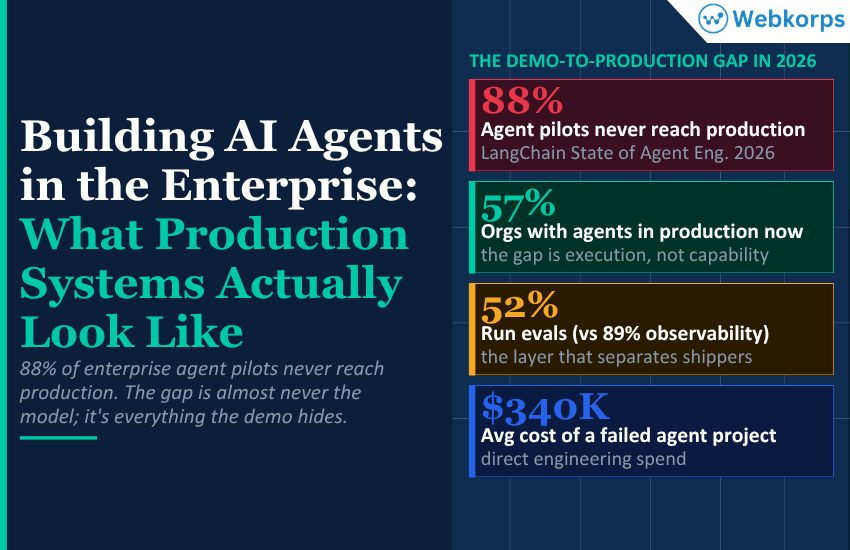
| Metric | Figure | Source |
|---|---|---|
| Enterprise AI agent pilots that never reach production | 88% | LangChain 2026 |
| Organisations that now have agents in production | 57% | LangChain 2026 |
| Teams running observability vs. evals | 89% / 52% | LangChain 2026 |
| Average direct cost of a failed enterprise agent project | $340K | Industry analyses 2026 |
The demo is always flawless. An innovation leader watches an AI agent take a plain-English request ‘reconcile last quarter’s vendor invoices and flag the discrepancies’ and watches it reason, call a few tools, and produce a clean answer in forty seconds. The room is sold. Six months later, the same agent is quietly switched off. It worked 80% of the time, which felt extraordinary in the demo and became unacceptable in production, where the other 20% meant wrong numbers in front of a CFO, an action taken against the wrong account, and a finance team that stopped trusting it. The model never got worse. The demo just never showed what production actually requires.
This is the defining story of enterprise AI agents in 2026, and the numbers are stark. LangChain’s State of Agent Engineering report found that 88% of AI agent pilots never reach production a systemic pattern across industries and company sizes. The average failed enterprise agent project burns $340,000 in direct engineering spend before it’s shelved. And the cause is almost never what executives expect. As one widely cited analysis put it: agents that succeed in demos fail in production because demos are controlled environments and production is not.
Here is the part that matters for anyone deciding whether to invest. The thing that fails is rarely the model. The model is the most reliable component in the entire system. What fails is everything around it: the integration layer, the evaluation harness, the memory, the guardrails, the observability, all the unglamorous machinery the demo carefully hides. This guide is a tour of that machinery. It’s written for enterprise innovation leaders who want to understand, before committing budget, what a production AI agent actually looks like underneath the forty-second magic trick, drawing on the engineering guidance published by Anthropic, OpenAI, and LangChain, the teams who build these systems at the largest scale.
Table of Contents
First, the Distinction That Saves Most Projects: Workflow vs. Agent
Before anatomy, a definition and it’s the single most useful idea in the field. Anthropic, in its widely referenced engineering guide Building Effective Agents, draws a sharp line between two things the industry sloppily calls ‘agents’:
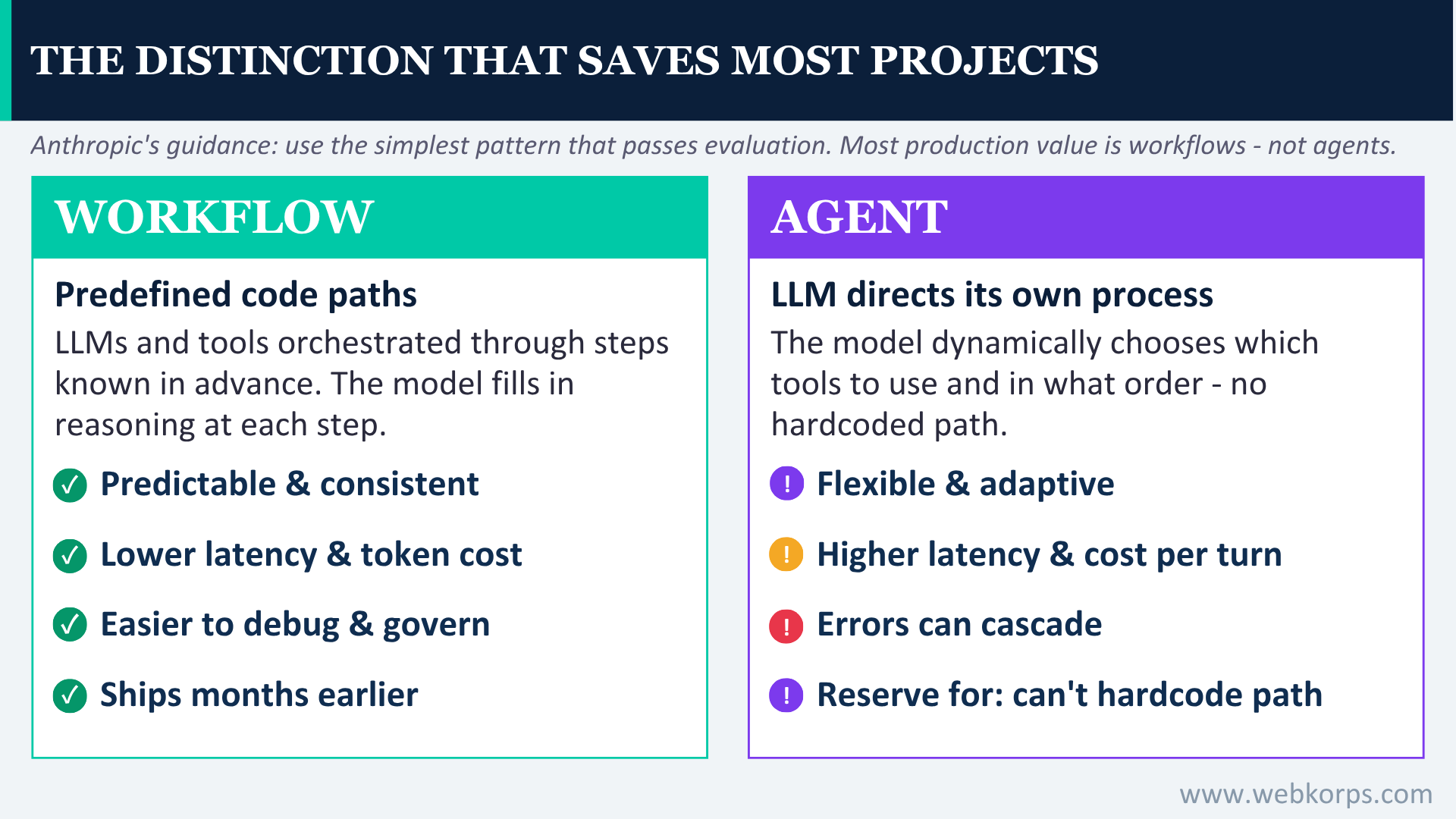
- Workflows are systems where LLMs and tools are orchestrated through predefined code paths. The steps are known in advance; the model fills in the reasoning at each step.
- Agents are systems where the LLM dynamically directs its own process, deciding which tools to use and in what order, without a hardcoded path.
This distinction is not academic. It is the decision that most often separates the projects that ship from the ones that stall, because of what Anthropic found across dozens of implementations: the most successful systems weren’t using complex frameworks or full autonomy; they were built with simple, composable patterns. Agents trade predictability for flexibility, and every additional autonomous turn adds latency, token cost, and the chance that an early mistake cascades through the whole task.
“Consistently, the most successful implementations weren’t using complex frameworks. Instead, they were building with simple, composable patterns.”
– Anthropic, Building Effective Agents
For an enterprise innovation leader, the takeaway is liberating: you probably need an agent far less often than the hype implies. A great deal of real production value is delivered by workflows routing a request to the right specialised prompt, running subtasks in parallel, chaining a few well-defined steps. Anthropic’s guidance is to use the simplest pattern that passes evaluation, and reserve full agents for the genuinely hard cases: tasks where you cannot hardcode the path, but you can still verify the agent made progress a coding agent checked by tests, a support agent backed by real tool actions. The most expensive mistake in this field is building an autonomous agent where a three-step workflow would have shipped months earlier and broken far less often.
The Anatomy of a Production Agent: The Six Layers the Demo Hides
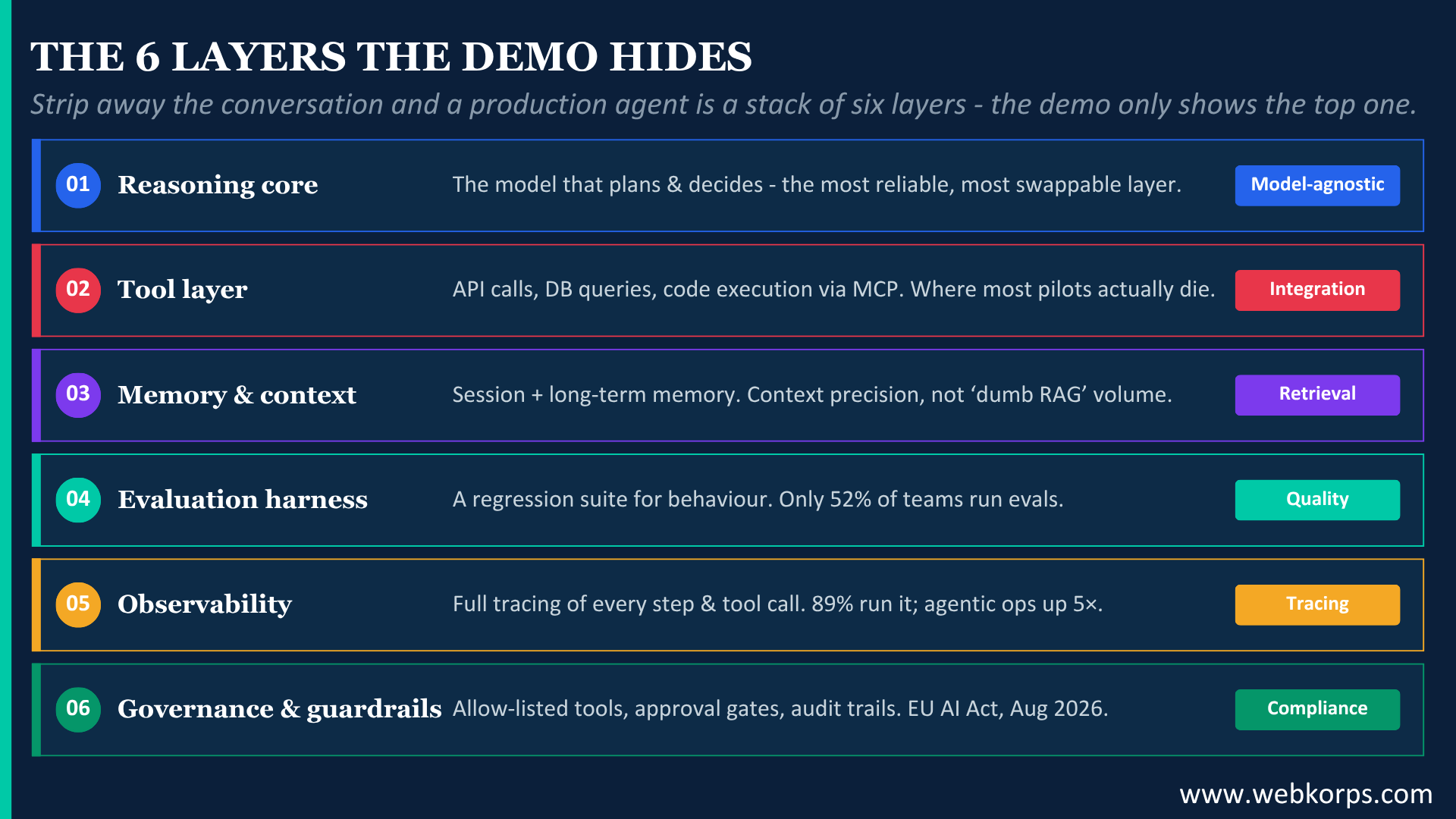
1. The Reasoning Core – the part everyone thinks is the whole thing
The LLM that plans and decides. In 2026, this is increasingly model-plural: LangChain found that using multiple models is now the norm, with teams routing different steps to different models for cost and capability. Critically, this is the most reliable and most swappable layer in the system – which is exactly why building everything else to be model-agnostic matters so much.
- What the demo shows: the model reasoning fluently.
- What production adds: model routing, fallbacks, and the discipline to treat the model as a replaceable commodity, because the one you build on will be superseded within months.
2. The Tool Layer – where most pilots actually die
An agent that can only talk is a chatbot. An agent that can act needs tools, including API calls, database queries, code execution, and document retrieval. These capabilities can also support tasks like AI video creation through connected tools. OpenAI frames these as composable primitives, and the emerging standard for connecting them is the Model Context Protocol (MCP). This layer is, by repeated finding, the single most underestimated cause of pilot failure: authenticating to legacy systems, managing credentials for thousands of users, and making well-formed calls to brittle internal APIs routinely exceeds the entire model-side effort.
- What the demo shows: two clean tool calls against a sandbox.
- What production adds: secure auth to Salesforce, Oracle, and homegrown systems; credential management; rate limiting; and graceful handling of the tool calls that fail, time out, or return garbage.
3. Memory and Context – the difference between a goldfish and a colleague
A demo agent starts fresh every time. A production agent has to remember session state across a multi-step task, and longer-term context about the user, the account, the history. The trap here has a name: “dumb RAG,” dumping an entire wiki into the context window and hoping the model finds the right byte. The lesson the field learned the hard way is context precision, not context volume; sometimes less context produces better results.
- What the demo shows: a single clean exchange.
- What production adds: stateless service design with session and long-term memory in external stores, and a retrieval layer tuned so the agent gets the right context, not all of it.
4. The Evaluation Harness – the layer that turns 80% into something you can trust
This is the layer that most cleanly separates the 12% who ship from the 88% who don’t. You cannot improve what you cannot measure, and an agent that is right 80% of the time is invisible without evals and catastrophic without them. Yet only 52% of teams run evaluations, even though nearly all run observability. An eval harness is a regression suite for behaviour: task-level success scored for quality, not just completion — because an agent that confidently produces a plausible wrong answer must count as a failure, not a success.
- What the demo shows: the run that worked.
- What production adds: offline evals on a test set run on every prompt change, online evals on real traffic, and quality-checked success metrics that can’t be gamed by the agent doing only the easy tasks.
5. Observability – because an agent can be “up” and still failing
Traditional software is up or down. An agent can be fully “up” and still returning confident wrong answers, taking unnecessary actions, or stuck in a loop that never surfaces as an error. That’s why 89% of teams now run observability; it’s table stakes, and 62% have full tracing that lets them inspect every individual reasoning step and tool call. This is also why a new role, “agentic ops,” has exploded: 56% of enterprises now name a dedicated lead, up 5× in two years. Think SRE for agents.
- What the demo shows: the final answer.
- What production adds: full execution tracing across every step, third-party call, and decision point; success-rate, tool-error, and latency dashboards per agent; and drift detection for when a model update silently changes behaviour.
6. Governance and Guardrails – the layer that gets you past the CISO
The layer that decides whether the agent is ever allowed near production data. “The LLM said so” is not an acceptable answer when a regulator asks why an agent approved a loan. Production agents need bounded autonomy: allow-listed tools, scoped permissions, human-in-the-loop approval gates for high-risk actions, and full auditability. With the EU AI Act’s high-risk obligations taking effect in August 2026, this layer is moving from best practice to legal requirement – Article 14 mandates human oversight interfaces with verified confirmation steps for high-risk systems.
- What the demo shows: an agent doing whatever it wants, safely, in a sandbox.
- What production adds: dev → UAT → pre-prod → prod promotion with human approval gates, scoped credentials, output validation, kill switches, and audit trails complete enough to satisfy a regulator.
Also read: Why Most Generative AI Projects Stall at the Data Layer
Demo Agent vs. Production Agent: The Honest Comparison
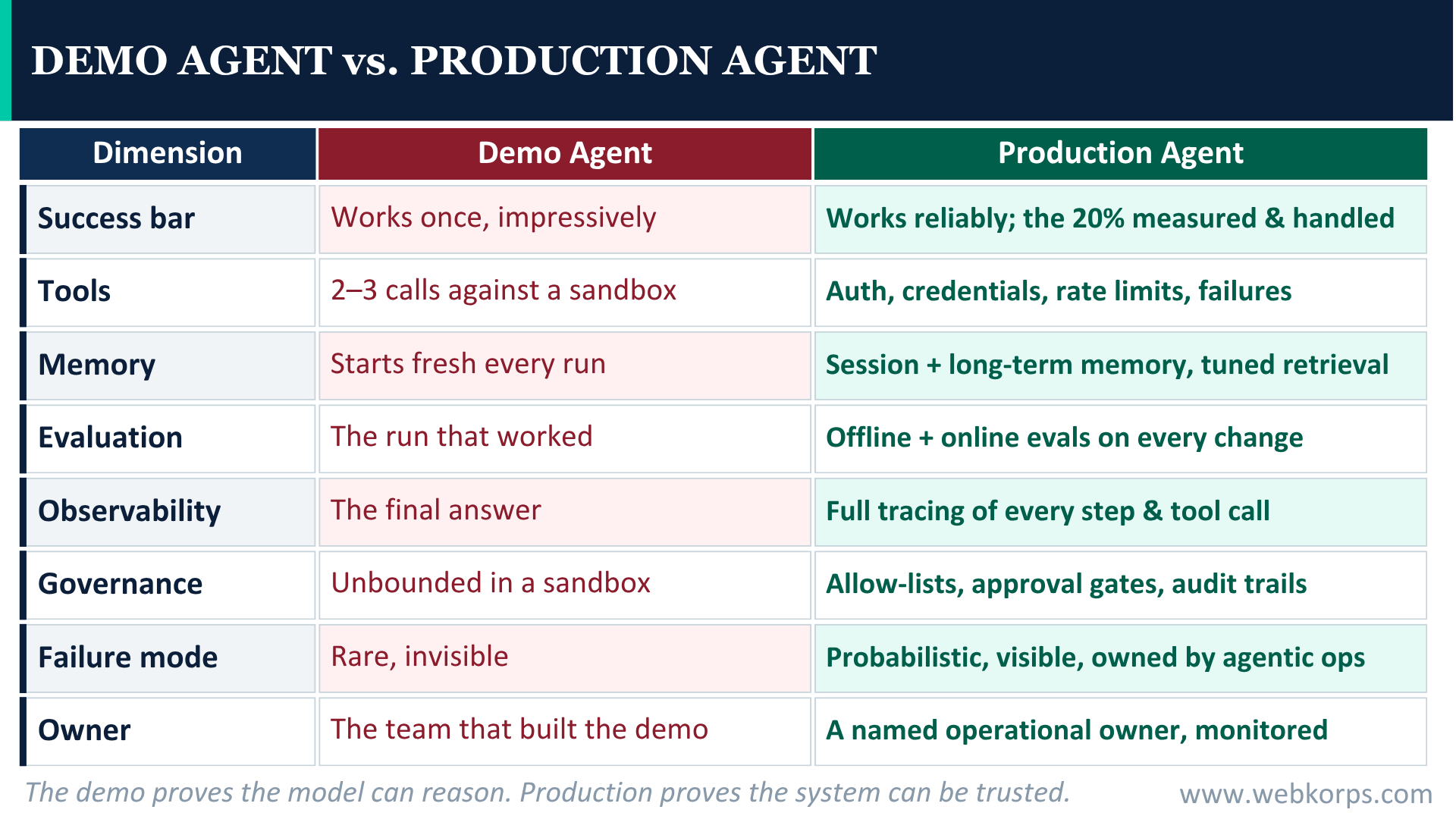
| Dimension | Demo Agent | Production Agent |
|---|---|---|
| Success bar | Works once, impressively | Works reliably; the 20% is measured and handled |
| Tools | 2–3 calls against a sandbox | Auth, credentials, rate limits, failure handling |
| Memory | Starts fresh every run | Session + long-term memory, tuned retrieval |
| Evaluation | The run that worked | Offline + online evals on every change |
| Observability | The final answer | Full tracing of every step and tool call |
| Governance | Unbounded in a sandbox | Allow-listed tools, approval gates, audit trails |
| Failure mode | Rare, invisible | Probabilistic, visible, owned by agentic ops |
| Owner | The team that built the demo | A named operational owner, monitored continuously |
Where Enterprise Innovation Leaders Should Actually Start
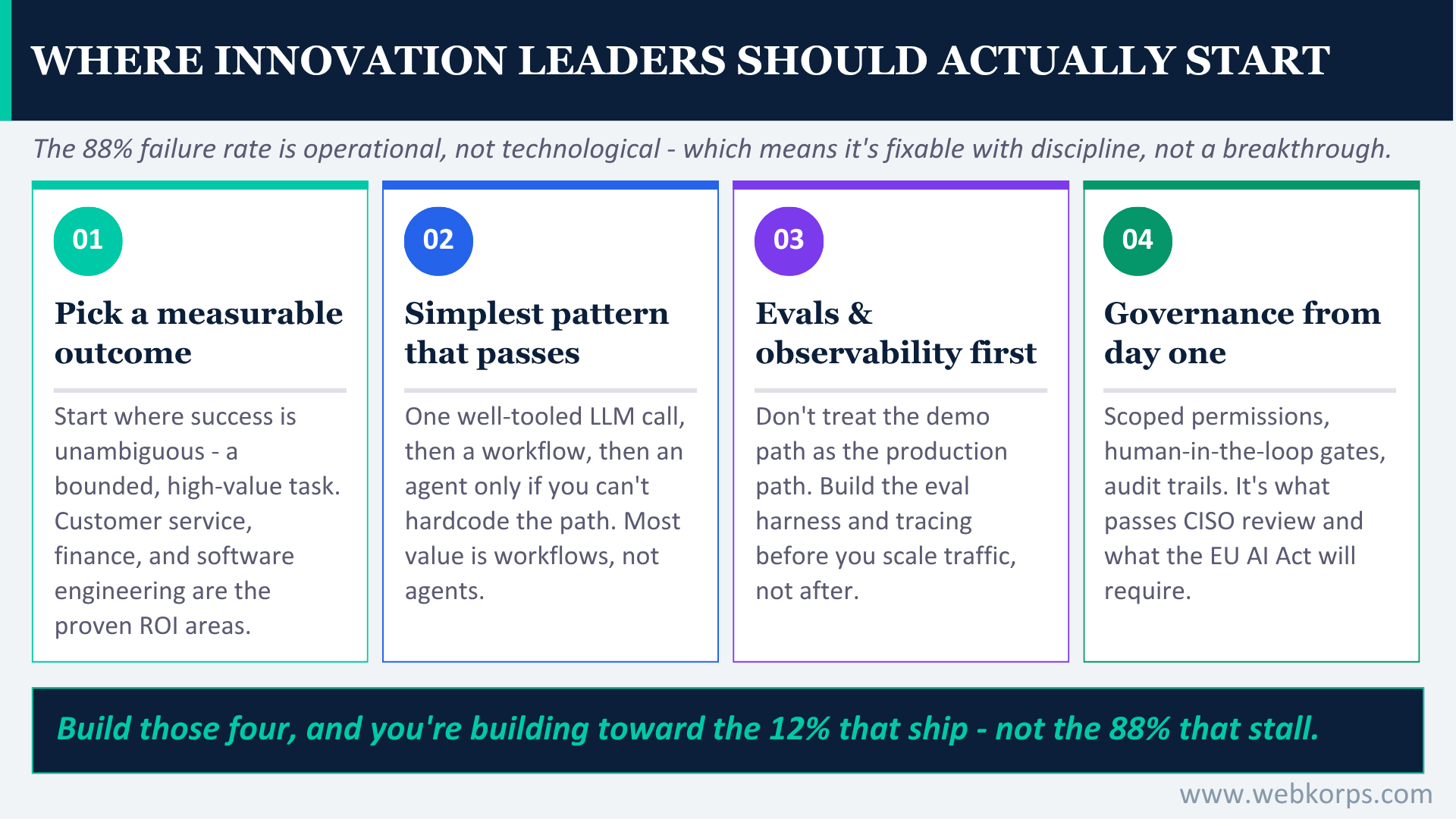
The good news inside the 88% failure rate is that the failures are operational, not technological, which means they’re fixable with discipline rather than a breakthrough. The teams crossing into production share a recognisable pattern, and it is almost the opposite of the demo-first instinct.
1. Pick a workflow with a measurable outcome, not an impressive demo
Start where success is unambiguous: a bounded, high-value task with a clear definition of ‘correct.’ Customer service, finance automation, and software engineering are the proven 2026 ROI areas precisely because the outcome is measurable. Ambiguous-ROI showcases are the most reliable way to lose executive support before the program matures.
2. Use the simplest pattern that passes evaluation
Follow Anthropic’s discipline: try a single well-tooled LLM call first, then a workflow, and only reach for a full autonomous agent when you genuinely cannot hardcode the path. Most production value is workflows, not agents. The simplest system that meets today’s requirement is the right one.
3. Build evaluation and observability before you scale traffic
The biggest mistake teams make is treating the demo path as the production path: unbounded tools, unmeasured quality, no operational owner. Tighten those three before scaling. An eval harness and tracing are not polish you add later; they are the instruments that tell you whether the agent is safe to expand.
4. Design governance in from day one
Scoped permissions, human-in-the-loop gates, and audit trails are not things you bolt on before launch; they are what gets you past CISO review at all, and what the EU AI Act will soon require. The companies cancelling agent projects in 2027 are the ones that built without governance in 2026.
| THE ONE-SENTENCE VERSION FOR YOUR NEXT STEERING MEETING |
| The model is not the hard part, and the demo is not the product. A production AI agent is a tool layer, a memory layer, an evaluation harness, observability, and governance wrapped around a model that’s the most reliable component in the stack. Build those layers, start with a workflow on a measurable outcome, and you’re building toward the 12% that ship rather than the 88% that stall. |
How Webkorps Builds Enterprise AI Agents That Survive Production
Most enterprises don’t have an AI agent model problem; the model works in the demo every time. They have a production-system problem: the tool layer, the evaluation harness, the memory, the observability, and the governance that the demo never showed and the team never budgeted for. That is the layer Webkorps builds.
Our agentic AI practice is built around the machinery that determines whether an agent reaches production, not the demo that determines whether it looks impressive:
- Workflow-first design: we start with the simplest composable pattern that passes evaluation, following the Anthropic discipline so you ship a reliable workflow instead of stalling on an over-engineered agent
- The integration layer that kills most pilots: secure tool connections to your real systems Salesforce, Oracle, internal APIs with MCP-standard integration, credential management, and failure handling
- Evaluation and observability from day one: offline and online eval harnesses, full execution tracing, and the agentic-ops discipline to catch drift before users do
- Governance by design: allow-listed tools, human-in-the-loop approval gates, audit trails, and EU AI Act-aligned controls that pass CISO review
- Model-agnostic architecture: built so the reasoning core is a swappable commodity because the model you start on will be superseded within months
Also read: Agentic AI in Logistics: When Your Supply Chain Starts Making Decisions Without You
The Demo Was Never the Product
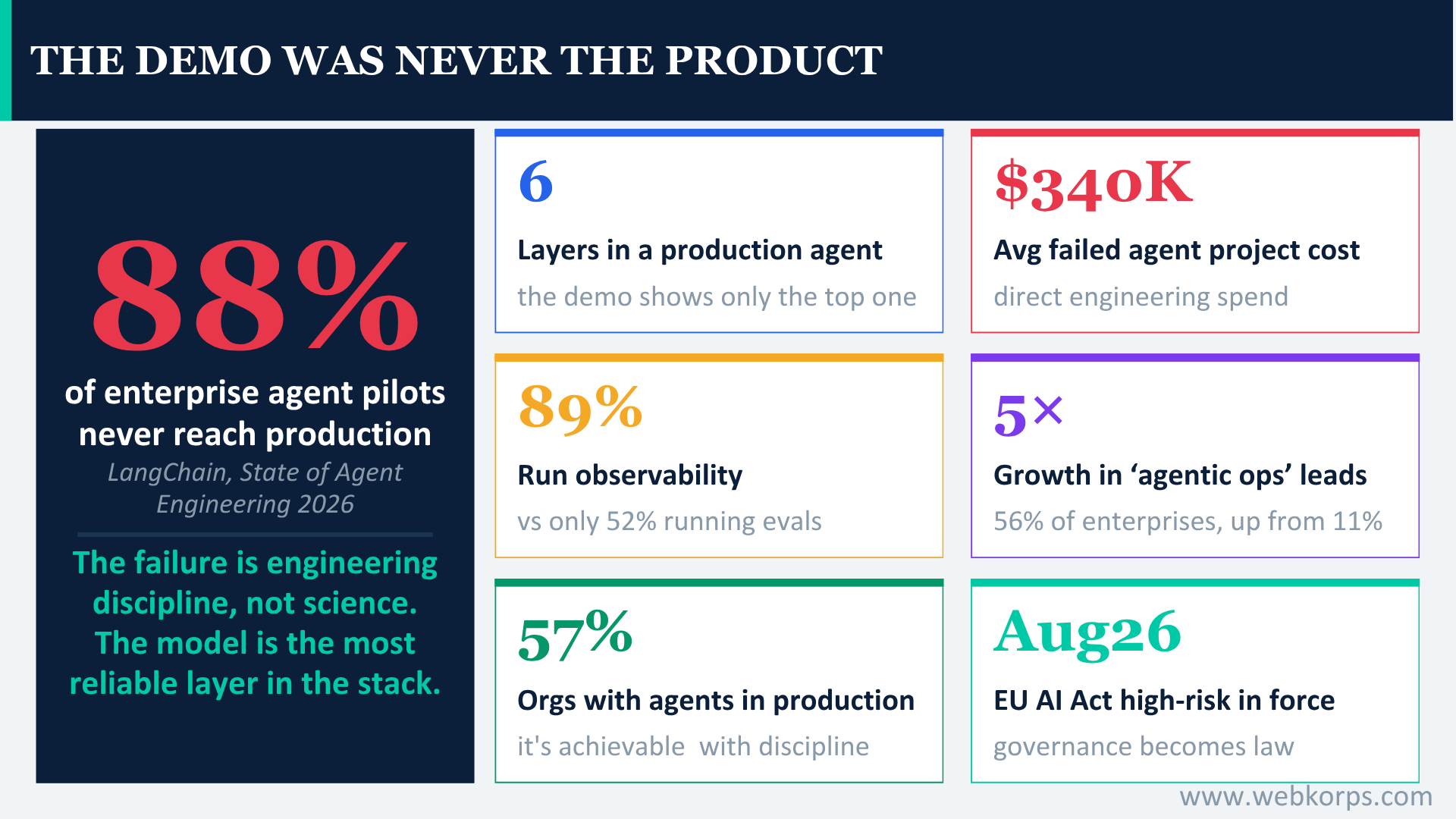
The agent that got switched off after six months didn’t fail because the model got worse. It failed because the organisation mistook a forty-second demo for a production system, and the demo had quietly hidden the tool layer, the evals, the memory, the observability, and the governance that the other 20% of cases demanded. That gap, not the model, is where 88% of enterprise agents die.
The encouraging truth underneath that scary number is that the failures are engineering and operational discipline, not science. The model capability that makes demos dazzle is real and improving monthly. What’s scarce and what actually separates the companies extracting value from the ones accumulating shelved pilots is the willingness to build the unglamorous layers underneath: to measure the 80%, handle the 20%, and govern the whole thing tightly enough to trust it with real data and real decisions.
For enterprise innovation leaders, that’s the most important reframing of the agentic era. The question was never ‘can the model do it?’ in the demo; it always can. The question is whether you’ll build the production system underneath. Do that, and AI agents deliver exactly what the demo promised. Skip it, and you’ll join the 88% who learned, six months and $340,000 later, that the demo was never the product.
| Building Past the Demo? |
| Webkorps designs and ships enterprise AI agents that survive production: the tool layer, memory, evaluation harness, observability, and governance that the 88% who stall never built. ISO 27001 certified. CMMI Level 3. 250+ developers across 30+ countries. Book a free agent readiness review. |
| Book an AI Agent Readiness Review |
| Explore Our Agentic AI ML Services |
Frequently Asked Questions
Q: What is an enterprise AI agent?
An enterprise AI agent is a system that uses a large language model to perceive, reason, and take real-world actions toward a goal, not just answer questions. Unlike a chatbot, it connects to enterprise tools (APIs, databases, CRMs), executes multi-step tasks, and adapts to changing inputs. In production, it’s not just a model: it’s a stack of six layers- reasoning core, tools, memory, evaluation, observability, and governance- working together. The model is the most reliable layer; the surrounding machinery is what makes the agent trustworthy enough to deploy.
Q: Why do most enterprise AI agent pilots fail to reach production?
LangChain’s 2026 research found 88% of agent pilots never reach production, and the cause is rarely the model. Agents that work in a controlled demo fail in production because production isn’t controlled. An agent that’s right 80% of the time looks impressive in a demo and broken in production, where the 20% is visible to real users. The real blockers are integration (connecting to brittle legacy systems), missing evaluation, weak observability, and absent governance, operational gaps, not model limitations.
Q: What is the difference between an AI workflow and an AI agent?
A workflow orchestrates LLMs and tools through predefined code paths; the steps are known in advance, and the model fills in reasoning at each step. An agent lets the LLM dynamically direct its own process, choosing which tools to use and in what order without a hardcoded path. Anthropic’s guidance is to use the simplest pattern that passes evaluation: most production value comes from workflows, and you should reserve full agents for tasks where you can’t hardcode the path but can still verify progress.
Q: What does a production AI agent actually need beyond the model?
Six layers. A reasoning core (the model, ideally swappable); a tool layer with secure auth, credentials, and failure handling; memory and tuned retrieval for context; an evaluation harness measuring quality not just completion; observability with full step-and-tool-call tracing; and governance with allow-listed tools, human-in-the-loop gates, and audit trails. The demo only shows the reasoning core. The other five layers are what 88% of stalled pilots never built, and what separates a trustworthy production system from an impressive proof of concept.
Q: How do you evaluate an enterprise AI agent?
With an evaluation harness, a regression suite for agent behaviour. Run offline evals on a fixed test set on every prompt change to catch regressions before deployment, and online evals on real production traffic to catch issues in real time. Critically, score for quality, not just completion: an agent that confidently produces a plausible but wrong answer must count as a failure. Only 52% of teams currently run evals despite 89% running observability; closing that gap is one of the clearest markers of teams that reach production.
Q: Are AI agents ready for enterprise production in 2026?
Yes, but readiness is operational, not just technological. 57% of organisations now have agents in production, so it’s clearly achievable, yet 88% of pilots still stall. The model capability is real and improving monthly; what’s scarce is the discipline to build the tool, evaluation, observability, and governance layers underneath. Agents succeed in production when teams start with a measurable workflow, use the simplest pattern that works, build evals and tracing before scaling, and design governance in from day one to pass CISO review and meet EU AI Act requirements.
Love the honest take on enterprise AI agents—way less glamorous than the demos, way more pragmatic.