
 Posted by
 THE STATE OF HEALTHCARE AI COMPLIANCE IN 2026
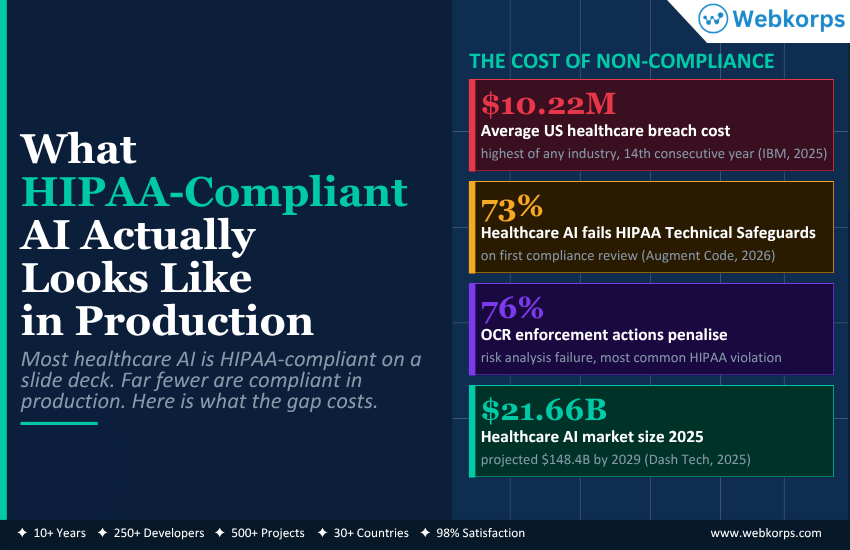
| $10.22M | 73% | 76% | $21.66B |
| Average US healthcare breach cost (IBM, 2025) — highest of any industry, 14th consecutive year | Healthcare AI implementations fail HIPAA Technical Safeguards on first compliance review (Augment Code, 2026) | Of 2025 OCR enforcement actions included a penalty for risk analysis failure (HIPAA Journal, 2026) | Healthcare AI market size in 2025 – expected to reach $148.4B by 2029 (Dash Tech, 2025) |
A regional health system deployed an AI-powered clinical documentation assistant in Q3 2024. The vendor had signed a BAA. Data was encrypted at rest and in transit. The security team signed off. Eight months later, OCR opened an investigation. The finding: the AI system was accessing patient records beyond what was necessary for its documented function, audit logs were insufficient to reconstruct access events, and the risk analysis had not been updated to include the AI system as a technology asset. The settlement cost exceeded $2.1 million, more than the three-year contract value of the AI system itself.
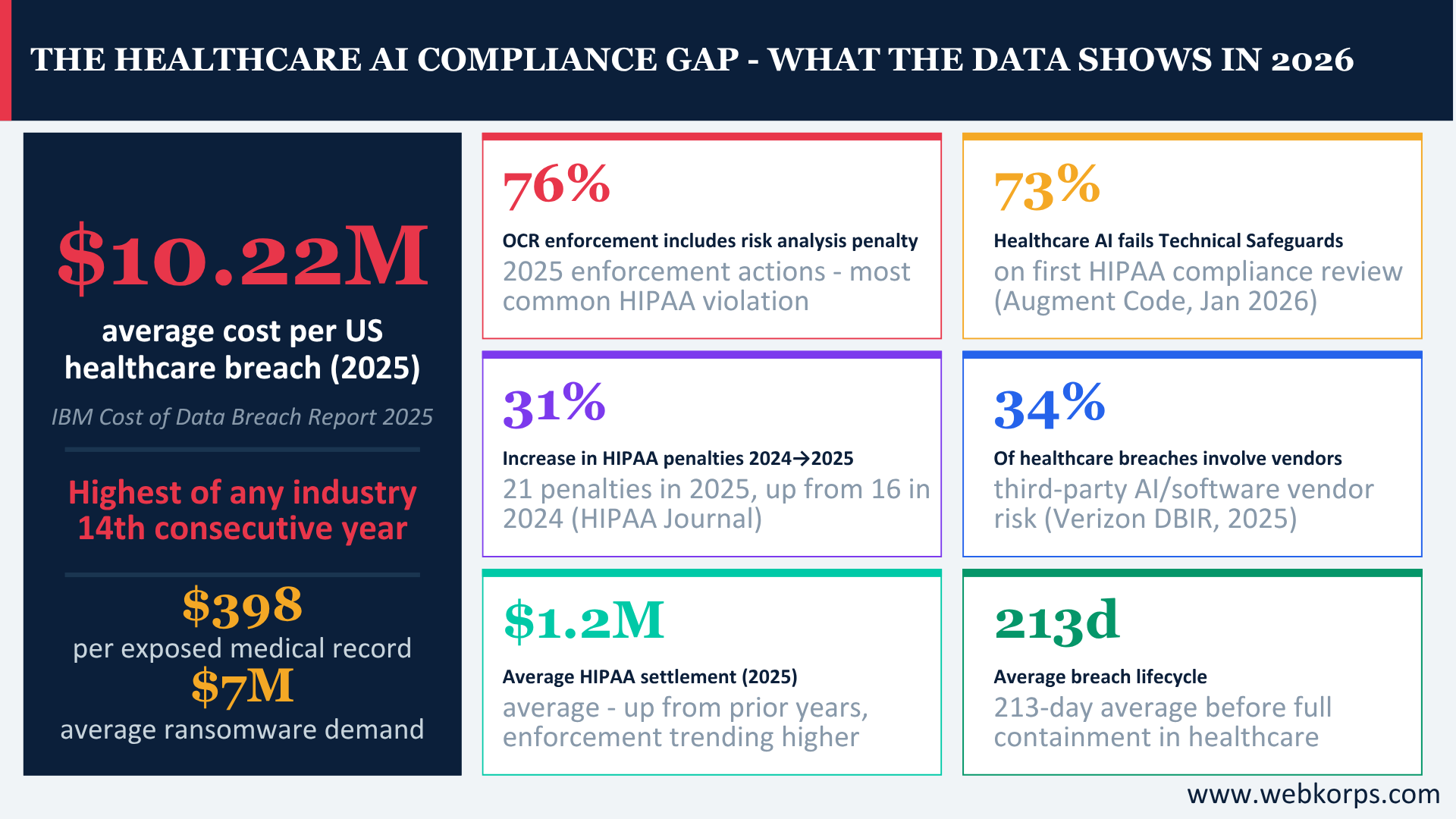
This is the story OCR is telling through its enforcement actions in 2026. 76% of HIPAA enforcement actions in 2025 included a penalty for risk analysis failure (HIPAA Journal). The failure is almost never encryption; most healthcare organisations have encryption. The failures are systemic: AI systems that access ePHI beyond the minimum necessary standard, audit trails that cannot reconstruct who accessed what and when, Business Associate Agreements that do not reflect what the system actually does, and risk analyses that were completed before the AI system was deployed and never updated.
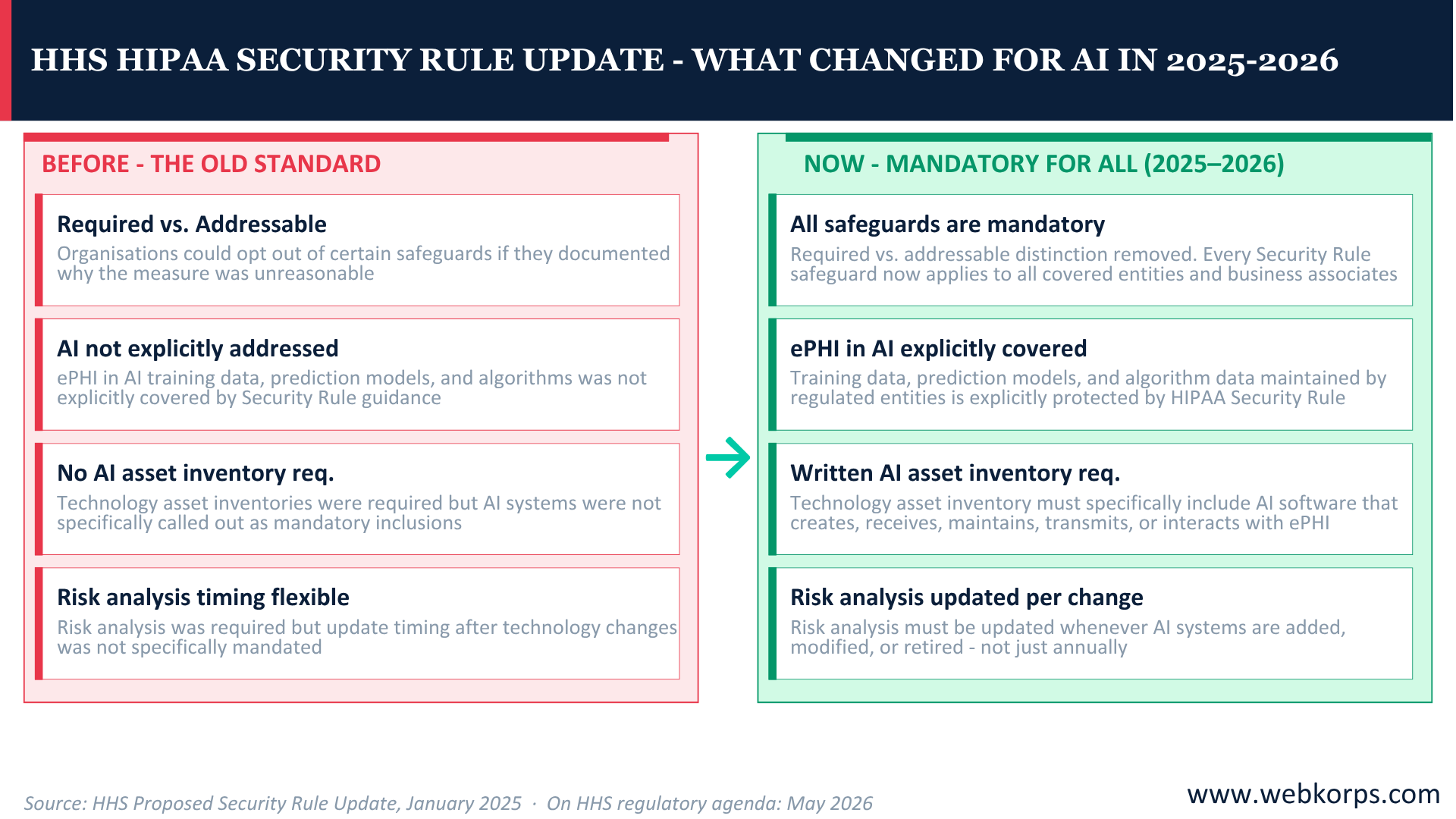
The January 2025 HHS proposed update to the HIPAA Security Rule makes this explicit: ePHI used in AI training data, prediction models, and algorithm data is protected by HIPAA. AI systems that create, receive, maintain, or transmit ePHI must appear in the covered entity’s written technology asset inventory. The “required vs. addressable” distinction that allowed organisations to opt out of certain safeguards has been removed; all safeguards are now mandatory.
This guide is written for Healthcare CIOs and Heads of Innovation who are evaluating, deploying, or currently operating AI systems that touch patient data. It maps what HIPAA-compliant AI development actually looks like in production, at the architectural layer, the governance layer, and the operational layer, drawing on HHS’s updated Security Rule guidance, HIMSS AI transformation research, JAMA Network’s clinical AI deployment analysis, and current OCR enforcement patterns.
Table of Contents
What HIPAA Actually Requires of AI Systems, Beyond the BAA
The most common misconception in healthcare AI procurement is that HIPAA compliance is primarily a vendor responsibility, that signing a Business Associate Agreement and selecting a vendor who claims HIPAA compliance transfers the regulatory obligation. OCR’s enforcement signals make clear that this is wrong.
OCR has signalled through settlement agreements that HIPAA’s Security Rule requirements apply to AI systems handling ePHI and that covered entities cannot rely on AI vendors’ security representations as a substitute for their own safeguard implementation (Kiteworks, 2026). The covered entity, the hospital, the health system, the payer, remains responsible for ensuring the AI system operates within HIPAA’s requirements, regardless of who built it.
The three safeguard categories that apply to every healthcare AI system
- Administrative Safeguards: Written policies and procedures governing how AI interacts with ePHI. A formal AI risk analysis is incorporated into the organisation’s enterprise-wide HIPAA risk analysis. Workforce training specific to AI use of PHI. Documented policies for AI system access, use, and disclosure.
- Physical Safeguards: Secure data centre hosting with hardware security modules (HSMs) for encryption key protection. Physical access controls to systems that process ePHI. Device and media controls covering AI training infrastructure and model storage environments.
- Technical Safeguards: Unique user identification for AI system access. Automatic logoff and session timeout. Encryption for data in transit and at rest using TLS 1.2+ and AES-256 standards. Audit controls, the most frequently deficient requirement in OCR investigations, generate and record logs sufficient to reconstruct any access event, including AI system queries and outputs.
| THE JANUARY 2025 HHS SECURITY RULE UPDATE, WHAT CHANGED FOR AI
HHS proposed rule (January 2025, on regulatory agenda for May 2026) establishes:
|
Also read: HIPAA vs DPDP Act: Complete Compliance Comparison for Healthcare AI in India
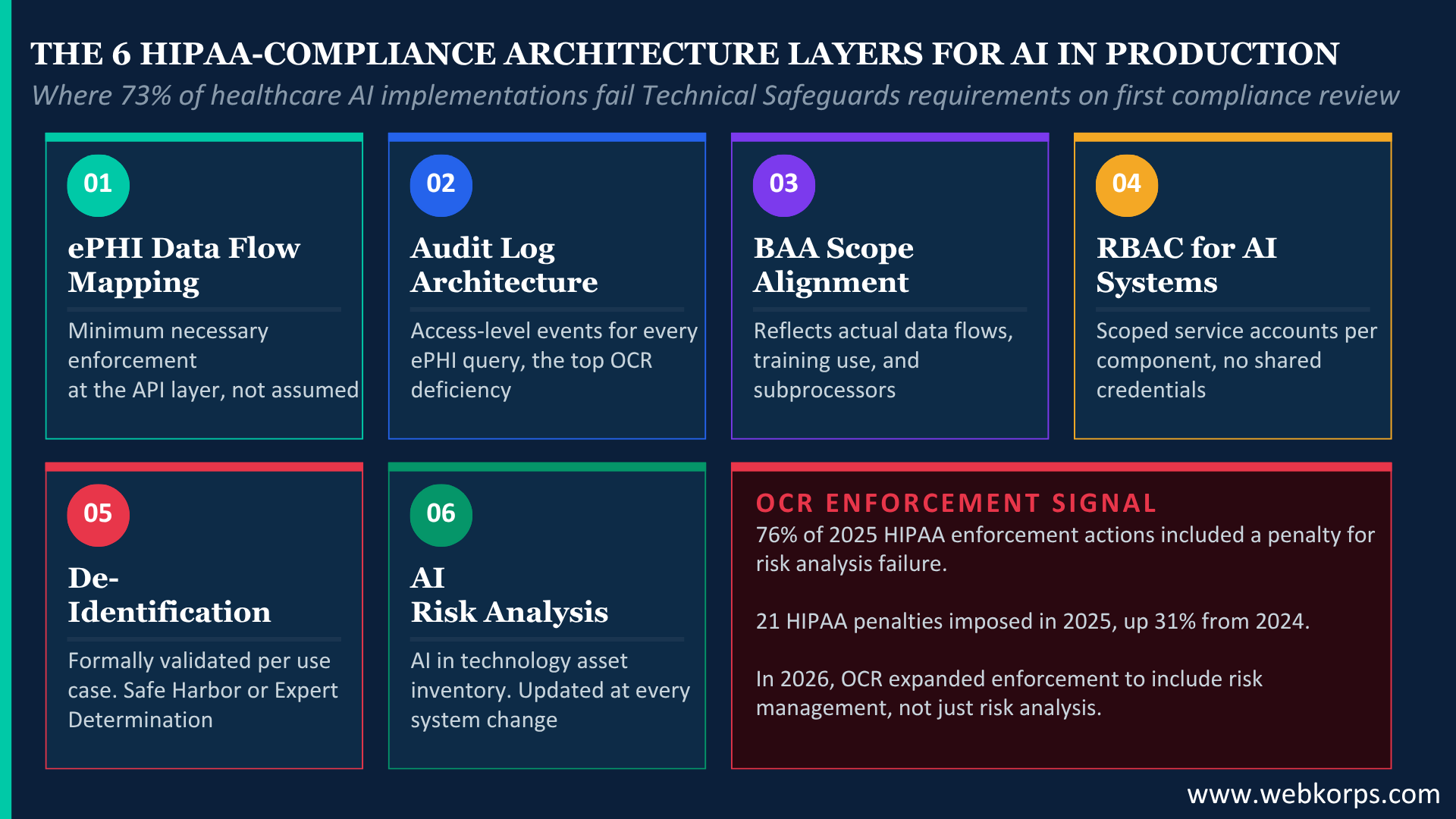
What Production-Grade HIPAA-Compliant AI Development Actually Looks Like, The 6 Architecture Layers
73% of healthcare AI implementations fail HIPAA Technical Safeguards requirements on first compliance review (Augment Code, 2026). The failures cluster in six specific architectural areas that most AI development teams, including experienced ones, get wrong when building for healthcare production environments.
Layer 01: ePHI Data Flow Mapping and Minimum Necessary Enforcement
The minimum necessary standard requires that AI systems access and use only the PHI strictly necessary for their intended purpose. In practice, most AI architectures are built to ingest as much data as possible, because more data produces better models. This creates a structural HIPAA tension that must be resolved at the architecture level, not in a policy document.
- Requirements:
- Every ePHI data flow through the AI system must be mapped: what data the model receives as input, what it processes, what it stores, what it outputs, and what it logs
- Data minimisation must be enforced at the API layer, not assumed from the source system. If the AI model only needs the diagnosis code and age, the integration layer must strip everything else before the data reaches the model
- Training data and inference data are different ePHI surfaces. Training data requires specific de-identification validation (Safe Harbor or Expert Determination under HIPAA) or explicit patient authorisation. Inference data requires the same access controls as any clinical system
- Common failure: The AI system is connected to the full patient record API because that was the easiest integration path. Minimum necessary enforcement was intended to happen at the model layer, but was never implemented.
Layer 02: Audit Log Architecture: The Most-Cited OCR Deficiency
HHS OCR’s audit trail requirement mandates that covered entities implement hardware, software, and/or procedural mechanisms that record and examine activity in information systems that contain or use ePHI. For AI systems, this is more complex than for traditional EHR access, because AI queries and outputs are not always discrete, named access events.
- Requirements:
- Every query made by or to the AI system that involves ePHI must generate an audit log entry with: timestamp, user or system identity, action performed, and the ePHI elements accessed or produced
- AI model inference events, including what data was passed to the model and what output was returned, must be logged at the level of detail required to reconstruct the event in an OCR investigation
- Audit logs must be tamper-evident, encrypted, and stored separately from the application they are monitoring. Log retention must meet or exceed HIPAA’s six-year minimum
- Common failure: Application logs exist but capture only errors and system events. ePHI access events by the AI system are not individually logged. Audit reconstruction requires manual log analysis across multiple systems.
Layer 03 · Business Associate Agreement Scope Alignment
A BAA that does not accurately reflect what the AI system actually does creates HIPAA exposure regardless of how comprehensive the security controls are. OCR investigations frequently discover that the BAA scope does not match actual data flows, the AI vendor accesses more ePHI than the BAA permits, or uses it in ways (model training, aggregated analytics) that were not disclosed at contract time.
- Requirements:
- The BAA must explicitly describe every use of ePHI by the AI system, including whether patient data is used for model training, whether outputs are stored, whether the vendor accesses logs containing ePHI, and whether subprocessors (cloud providers, API services) access ePHI
- The BAA must specify breach notification timelines, obligations for business associate subcontractors, and the process for returning or destroying ePHI at contract termination
- When AI vendors update their systems or change underlying model infrastructure, the covered entity must evaluate whether the BAA scope remains accurate and update it if not
- Common failure: The standard vendor BAA template was signed without review of actual data flows. Vendor uses aggregated patient data for model improvement, a use not covered by the signed BAA.
Layer 04 · Role-Based Access Control and Identity Management for AI
AI systems that access ePHI are subject to the same access control requirements as human users. These principles can also apply to AI-powered ad creation tools that handle sensitive data. Each AI system component that touches ePHI must have a unique identity, defined access scope, and access logging. This is architecturally more complex than human RBAC because AI systems often span multiple layers, inference endpoints, training pipelines, model storage, output caches, each of which may touch ePHI differently.
- Requirements:
- AI systems must use service accounts with defined, scoped permissions, not shared credentials or human user credentials
- Access to ePHI must be limited to the specific AI system component that requires it. The inference API does not need access to the training data store. The model registry does not need access to patient records
- Emergency access procedures must be documented for AI systems. What happens when the AI system is unavailable, and clinical staff need to access the information it would normally surface
- Common failure: The AI system runs under a shared service account with broad database permissions. Individual component access is not scoped. There is no process for reviewing or revoking AI system access when the system is decommissioned.
Layer 05 · De-Identification and Synthetic Data for Model Training
Using identifiable PHI to train an AI model almost always requires explicit written patient authorisation, because model training typically falls outside the standard treatment, payment, or healthcare operations purposes that permit ePHI use without authorisation. The two HIPAA-approved de-identification paths are Safe Harbor (removing 18 specific identifiers) and Expert Determination (statistical validation of re-identification risk), both of which must be validated for the specific AI use case.
- Requirements:
- De-identification must be formally validated before training data is used. Safe Harbor de-identification for one AI model does not automatically apply to another model using the same dataset
- Synthetic data generation (using GANs or Variational Autoencoders) must include re-identification risk testing; synthetic data that can be combined with public datasets to re-identify patients is not compliant
- Training, development, and production environments must be isolated and protected by separate security controls. Development models trained on de-identified data cannot be migrated to production environments alongside the de-identified training data
- Common failure: AI model trained on a dataset that was de-identified for research purposes and assumed to be usable for AI training. The de-identification validation was not conducted for the AI training use case.
Layer 06 · AI-Specific Risk Analysis and Ongoing Monitoring
The most-cited HIPAA violation in 2025 OCR enforcement actions is failure to conduct a comprehensive, enterprise-wide risk analysis. For AI systems, this means the AI system must appear in the risk analysis as a distinct technology asset, with documented risks, implemented controls, and a residual risk acceptance decision. The 2025 HHS proposed rule makes this explicit: a written technology asset inventory must include AI software that interacts with ePHI.
- Requirements:
- Every AI system that touches ePHI must be inventoried: system name, vendor, data elements accessed, data retention, access controls implemented, and residual risk assessment
- Risk analysis must be updated whenever the AI system changes, new model versions, new data sources, new integrations, new use cases, not only at initial deployment
- Ongoing monitoring must include AI system performance metrics (model drift, accuracy changes) alongside security metrics, because model degradation can create clinical safety risks that are distinct from data security risks
Common failure: AI system deployed after the annual risk analysis was completed. The risk analysis was not updated. OCR investigation found that the covered entity had not identified or addressed the risks specific to the AI system.
Also read: HIPAA-Compliant AI Software Development: The Complete Guide for Healthcare Companies
The FDA SaMD Boundary, When HIPAA Compliance Is Not Enough
HIPAA compliance is necessary but not sufficient for all healthcare AI deployments. AI that crosses from clinical informatics into autonomous diagnostic or treatment decision-making may trigger FDA medical device regulation under the Software as Medical Device (SaMD) framework, a classification error far easier to prevent than to remediate (Kiteworks, 2026).
JAMA Network’s March 2026 analysis is direct: health systems are deploying unproven algorithms with little evidence that they improve outcomes, or even do no harm. The editorial flagged that most deployed clinical AI systems lack the prospective clinical validation that would demonstrate patient benefit and that regulatory scrutiny has not kept pace with deployment speed.
The clinical AI classification question every CIO must answer before deployment
Ask these three questions for every clinical AI system under evaluation:
- Does the AI provide information to support clinical decision-making, or does it make clinical decisions? Decision support is typically not SaMD. Autonomous clinical decision-making is.
- Is a clinician required to review and validate every AI output before it influences patient care? Human-in-the-loop requirement determines risk classification.
- Does the AI system analyse patient-specific data to provide a diagnosis, treatment recommendation, or prognosis? If yes, FDA SaMD classification should be evaluated before deployment.
| JAMA NETWORK SIGNAL (MARCH 2026): MEDICINE IS FLYING BLIND ON AI
A year after its landmark AI summit, JAMA says health systems are deploying unproven algorithms with little evidence they improve outcomes, or even do no harm. The implication for CIOs: the deployment decision is not just a HIPAA question. It is a patient safety question, a liability question, and a clinical governance question. The compliance architecture and the clinical validation framework must be built together. |
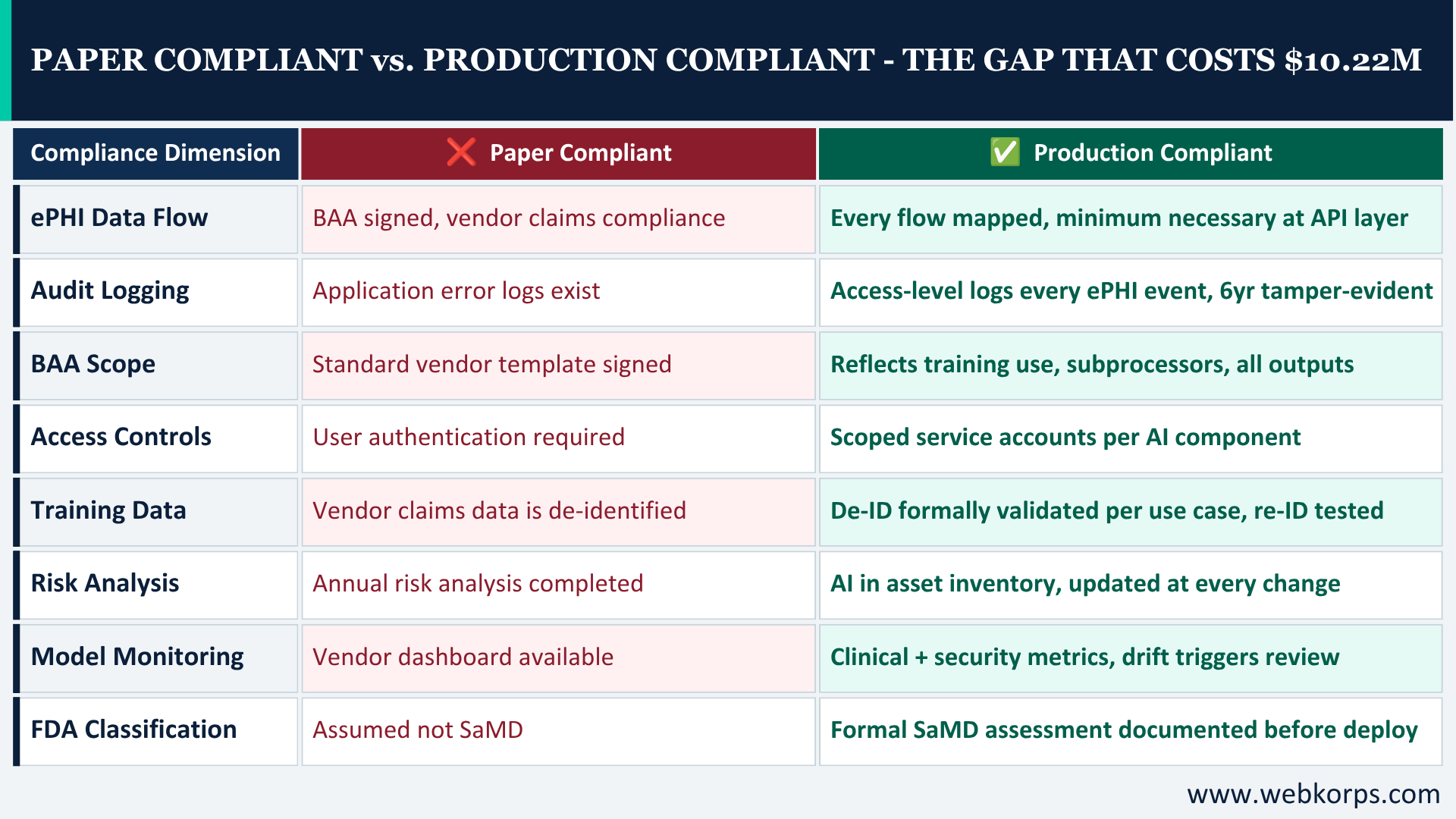
What Production-Grade HIPAA-Compliant AI Looks Like vs. What Most Systems Actually Are
| Compliance Dimension | Paper Compliant | Production Compliant |
|---|---|---|
| ePHI data flow | BAA signed, vendor claims compliance | Every ePHI flow is mapped, and minimum necessary is enforced at the API layer |
| Audit logging | Application error logs exist | Access-level audit logs for every ePHI event, tamper-evident, 6yr retention |
| BAA scope | Standard vendor template signed | BAA reflects actual data flows, including training, subprocessors, and outputs |
| Access controls | User authentication required | Scoped service accounts per AI component, automatic access reviews |
| Training data | Vendor claims data is de-identified | De-identification formally validated for the specific use case, synthetic data tested for re-identification |
| Risk analysis | Annual risk analysis completed | AI system in the technology asset inventory, risk analysis updated at deployment, and every system change |
| Model monitoring | Vendor dashboard available | Clinical accuracy + security metrics monitored, model drift triggers governance review |
| FDA classification | Assumed not SaMD | Formal SaMD classification assessment documented before deployment |
| Breach response | Breach notification policy exists | AI-specific breach scenarios tested, 60-day notification timeline operationalised |
| Workforce training | General HIPAA training completed | AI-specific training: risks of inputting PHI into public AI tools, approved AI use policies |
Healthcare CIO Due Diligence Checklist, Before Any AI System Is Deployed
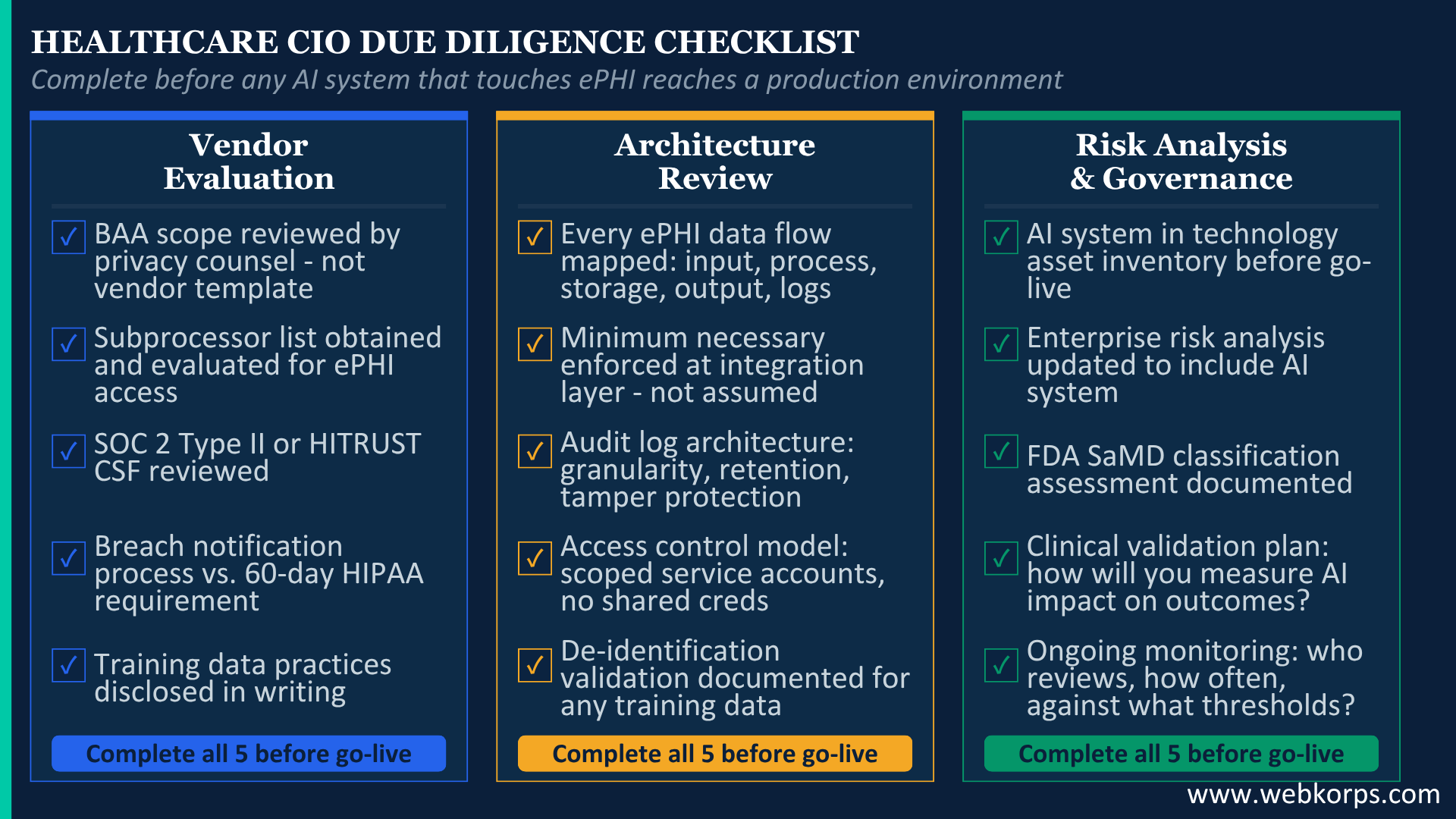
Vendor evaluation
- BAA scope reviewed against actual data flows by your privacy counsel, not the vendor’s template
- Vendor’s subprocessor list obtained and evaluated for ePHI access
- Security documentation reviewed: SOC 2 Type II, HITRUST CSF, or equivalent
- Vendor’s breach notification process reviewed against HIPAA’s 60-day requirement
- Training data practices disclosed in writing: Does the vendor use your patient data to improve their models?
Architecture review
- Every ePHI data flow mapped: input, processing, storage, output, logs
- Minimum necessary enforcement confirmed at the integration layer, not assumed at the source
- Audit log architecture reviewed: what is logged, at what granularity, for how long, and how is it protected?
- Access control model reviewed: scoped service accounts, no shared credentials, automatic review cadence
- De-identification validation documented for any training data use
Risk analysis and governance
- The AI system was added to the technology asset inventory before go-live
- Enterprise risk analysis updated to include the AI system as a distinct asset with assessed risks and controls
- FDA SaMD classification assessment documented
- Clinical validation plan defined: how will you know if the AI is improving or harming patient outcomes?
- Ongoing monitoring plan: who reviews model performance, with what frequency, against what clinical and security thresholds?
What a Production-Grade Healthcare AI Development Partner Looks Like
Webkorps builds custom healthcare AI systems for hospitals, health systems, and healthcare technology companies. ISO 27001 certified. CMMI Level 3. We have delivered 500+ projects across 30+ countries, with a healthcare practice that includes HIPAA-compliant AI deployments, HL7 FHIR integrations, and EHR interoperability systems.
Our healthcare AI development approach is built around the compliance architecture described in this guide, not as a post-build checklist but as an engineering requirement from sprint one:
- HIPAA Security Rule architecture by design: minimum necessary enforcement at the API layer, access-level audit logging for every ePHI event, scoped service accounts per AI component, AES-256 encryption at rest, and TLS 1.3 in transit
- BAA-aligned development: we review BAA scope against actual implementation at each sprint milestone, flagging scope drift before it becomes an OCR problem
- De-identification validation: we validate de-identification for the specific AI use case under Safe Harbor or Expert Determination standards, with documented validation records
- Technology asset inventory and risk analysis integration: Every AI system we build is documented to the standard required for inclusion in your HIPAA risk analysis
- FDA SaMD classification guidance: we assess classification risk before architecture design, not after delivery
- FHIR and EHR interoperability: HL7 FHIR R4, Epic, Cerner, and custom EHR integration with HIPAA-compliant data handling at every integration point
The Compliance Architecture Is the Product
The regional health system that paid $2.1 million to settle an OCR investigation had a signed BAA, encrypted data, and a vendor who claimed HIPAA compliance. What they did not have was a production-grade compliance architecture, one where ePHI flows were mapped, audit logs captured access events at the required granularity, and the AI system appeared in the risk analysis as a technology asset with assessed risks and implemented controls.
This is the gap that the $10.22 million average breach costs and 76% OCR enforcement rates for risk analysis failures are documenting in the aggregate. The healthcare AI market is growing rapidly, from $21.66 billion in 2025 to a projected $148.4 billion by 2029. The speed of deployment is outpacing the rigour of compliance architecture.
For Healthcare CIOs and Heads of Innovation, the question is not whether to deploy AI. It is whether the AI you deploy is compliant in production, not on a vendor’s marketing page, not in a signed BAA, but in the architecture, the audit logs, the risk analysis, and the monitoring programme that OCR will examine if something goes wrong. The compliance architecture is not a wrapper around the AI product. It is the product.
| Ready to Build HIPAA-Compliant AI That Survives OCR Scrutiny? |
| Webkorps builds production-grade HIPAA-compliant AI systems for health systems, hospitals, and healthcare technology companies. ISO 27001 certified. CMMI Level 3. Healthcare AI deployments across 30+ countries. Book a free healthcare AI architecture review with our team. |
| Book a Free Healthcare AI Architecture Review |
| Explore Our Healthcare AI Practice |
Frequently Asked Questions
Q1: What makes an AI system HIPAA-compliant in production?
HIPAA-compliant AI development in production requires six architecture layers working together: ePHI data flow mapping with minimum necessary enforcement at the API layer; access-level audit logging for every ePHI event the AI system touches; BAA scope that reflects actual data flows including training use and subprocessors; scoped service accounts per AI component; formally validated de-identification for any training data; and the AI system appearing as a distinct asset in the enterprise risk analysis with documented controls. A signed BAA and encrypted storage are necessary but not sufficient.
Q2: What are the most common HIPAA violations in healthcare AI deployments?
OCR enforcement data from 2025–2026 identifies three dominant failure modes:
- Risk analysis failure: the AI system was never added to the technology asset inventory, and the risk analysis was not updated at deployment (cited in 76% of 2025 enforcement actions).
- Audit log deficiency: logs capture system events but not ePHI access events at the granularity required to reconstruct an access event in an investigation.
- BAA scope mismatch: the vendor is using patient data in ways (model training, aggregated analytics) not covered by the signed BAA. All three are architectural failures, not security tool failures.
Q3: Does HIPAA apply to AI model training data?
Yes, explicitly. The January 2025 HHS proposed Security Rule update establishes that ePHI used in AI training data, prediction models, and algorithm data maintained by a regulated entity is protected by HIPAA. Using identifiable PHI to train an AI model almost always requires explicit written patient authorisation, because model training falls outside standard treatment, payment, or healthcare operations purposes. The two compliant paths are Safe Harbor de-identification (removing 18 specific identifiers) or Expert Determination (statistical validation), both of which must be validated for the specific AI use case, not carried over from prior research de-identification.
Q4: What is the difference between HIPAA compliance and FDA SaMD compliance for healthcare AI?
They address different risk surfaces and are both potentially required. HIPAA governs data privacy and security, including how ePHI is accessed, processed, stored, and protected by the AI system. FDA SaMD regulation governs patient safety, whether the AI system meets the clinical evidence standards required for a software product that influences diagnosis or treatment. AI that provides clinical decision support to a clinician who makes the final call is typically not SaMD. AI that autonomously generates a diagnosis or treatment recommendation may be. Both frameworks must be evaluated before deployment, HIPAA first, FDA SaMD classification second.
Q5: What should a healthcare CIO ask an AI vendor about HIPAA compliance?
Five questions that reveal whether a vendor is paper-compliant or production-compliant:
- “Walk me through every ePHI data flow in your system, input, processing, storage, output, and logs.”
- “What exactly does your audit log capture for each ePHI access event, and can we see a sample log entry?”
- “Does our patient data ever get used to train or improve your models? Is that in the BAA?”
- “Show me your technology asset inventory entry for your AI system and how your risk analysis addresses it.”
- “What is your breach notification process and how have you tested it against HIPAA’s 60-day requirement?” Inability to answer any of these specifically signals paper compliance, not production compliance.
Q6: How does the 2025 HHS Security Rule update change HIPAA requirements for AI?
The January 2025 proposed update (on HHS’s regulatory agenda for May 2026) makes four material changes for healthcare AI:
- Removes the “required vs. addressable” distinction; all Security Rule safeguards are now mandatory, including for AI systems.
- Explicitly establishes that ePHI used in AI training data and prediction models is HIPAA-protected.
- Requires a written technology asset inventory that includes AI software interacting with ePHI.
- Requires heightened risk analysis and risk management activities, including regular monitoring of known vulnerabilities in AI systems. Organisations that have not updated their risk analysis to include AI systems should treat this as an immediate remediation priority.
Great article on HIPAA compliance