
 Posted by
 Most multi-tenant SaaS guides hand you the same three models and wish you luck. This one is different: it sorts every decision into the ones you can change on a Tuesday afternoon and the four that, if you get them wrong, cost six figures and six months to undo.
Table of Contents
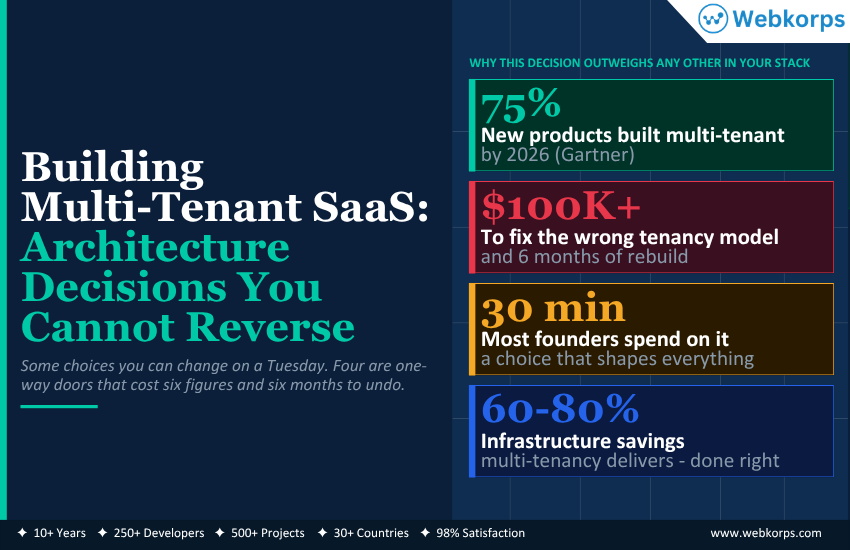
Why This Decision Carries More Weight Than Any Other in Your Stack
| Metric | Figure | Source |
|---|---|---|
| New digital products will be built multi-tenant by 2026 | 75% | Gartner |
| Typical cost to fix the wrong tenancy model | $100K+ / 6 months | Industry analyses 2026 |
| The time most founders spend on the choice | ~30 minutes | – |
| Infrastructure savings multi-tenancy delivers (done right) | 60–80% | – |
Here is a conversation that happens in SaaS companies more often than anyone admits. An enterprise prospect, the one whose logo would change the trajectory of the business, reaches the security review stage. Their CISO sends a questionnaire. Buried in it: ‘Confirm that customer data is stored in a dedicated database instance, in the EU region.’ The CTO reads it twice. The platform was built three years ago on a single shared database, every tenant’s rows commingled and separated by a tenant_id column. There is no dedicated instance. There is no region routing. And there is no way to add either without rebuilding the data layer the entire product sits on. The deal stalls. Then it dies.
That CTO didn’t make a careless decision. Three years earlier, a shared database with a tenant_id column was exactly the right call; it was fast to build, cheap to run, and perfect for the SMB customers they had. The mistake wasn’t the choice. The mistake was not knowing it was a one-way door. Some architecture decisions in multi-tenant SaaS can be changed later with a migration script and a quiet weekend. Others are load-bearing walls: rip one out after the building is occupied, and everything above it comes down.
Martin Fowler has a famously economical definition of software architecture: “the decisions that are hard to change.” The irreversibility is the architecture. Everything else is just code you can refactor on a Tuesday. This guide takes that lens and applies it specifically to multi-tenant SaaS, using the AWS Well-Architected SaaS Lens as the technical framework. We’ll separate the decisions that are genuinely reversible from the four that are not, so you spend your scarce architectural attention where it actually matters, and never send the email that kills the enterprise deal.
Also read: The Total Cost of Hiring a Senior Engineer
Reversible vs. Irreversible: The Only Framing That Matters
Nearly every multi-tenant SaaS guide on the internet presents the decision as a menu: here are three models, silo, pool, bridge, pick one. That framing is technically accurate and strategically useless, because it treats a one-way door and a revolving door as if they were the same kind of choice. They are not. The useful question is never just ‘which model?’ It is ‘if I pick wrong, what does it cost me to change my mind?’
Fowler’s collaborator Neal Ford sharpens the definition to four words: architecture is ‘stuff that’s hard to change.’ The corollary, which the evolutionary-architecture school has spent two decades proving, is that good architects don’t try to make every decision correctly up front, an impossible task, since you have the least information you’ll ever have at the start. They do something smarter: they identify which decisions are irreversible and pour their energy into those, while deliberately keeping everything else cheap to change.
“The best architecture is one where decisions are flexible, reversible, and deferred as late as possible, so they can be substituted for alternatives that experience shows to be superior.”
-On Martin Fowler’s evolutionary architecture
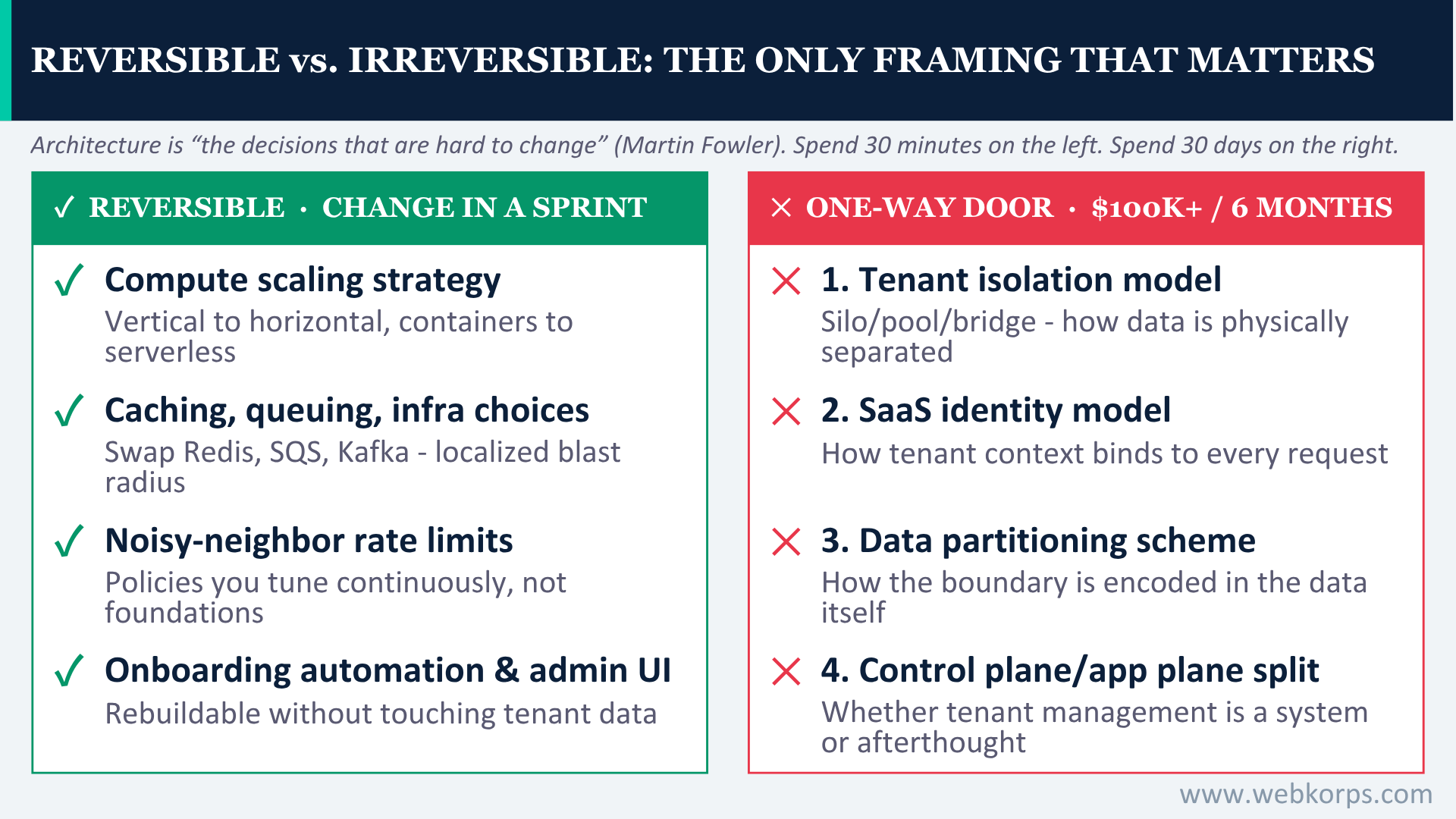
So, before we touch a single isolation model, here is the map. In multi-tenant SaaS, these decisions are genuinely reversible; change them when you have better information, and the cost is a sprint, not a quarter:
- Your compute scaling strategy, vertical to horizontal, containers to serverless; the tenancy model doesn’t care
- Caching, queuing, and most infrastructure choices, swap Redis for Memcached, SQS for Kafka, with localized blast radius
- Per-tenant rate limits and noisy-neighbor throttles are policies you tune continuously, not foundations
- Onboarding automation and the admin console are important, but rebuildable without touching tenant data
And these four are the one-way doors, the decisions where getting it wrong means a migration that costs $100K+ and six months, the kind of project that competes with your entire product roadmap. The rest of this guide is about these four.
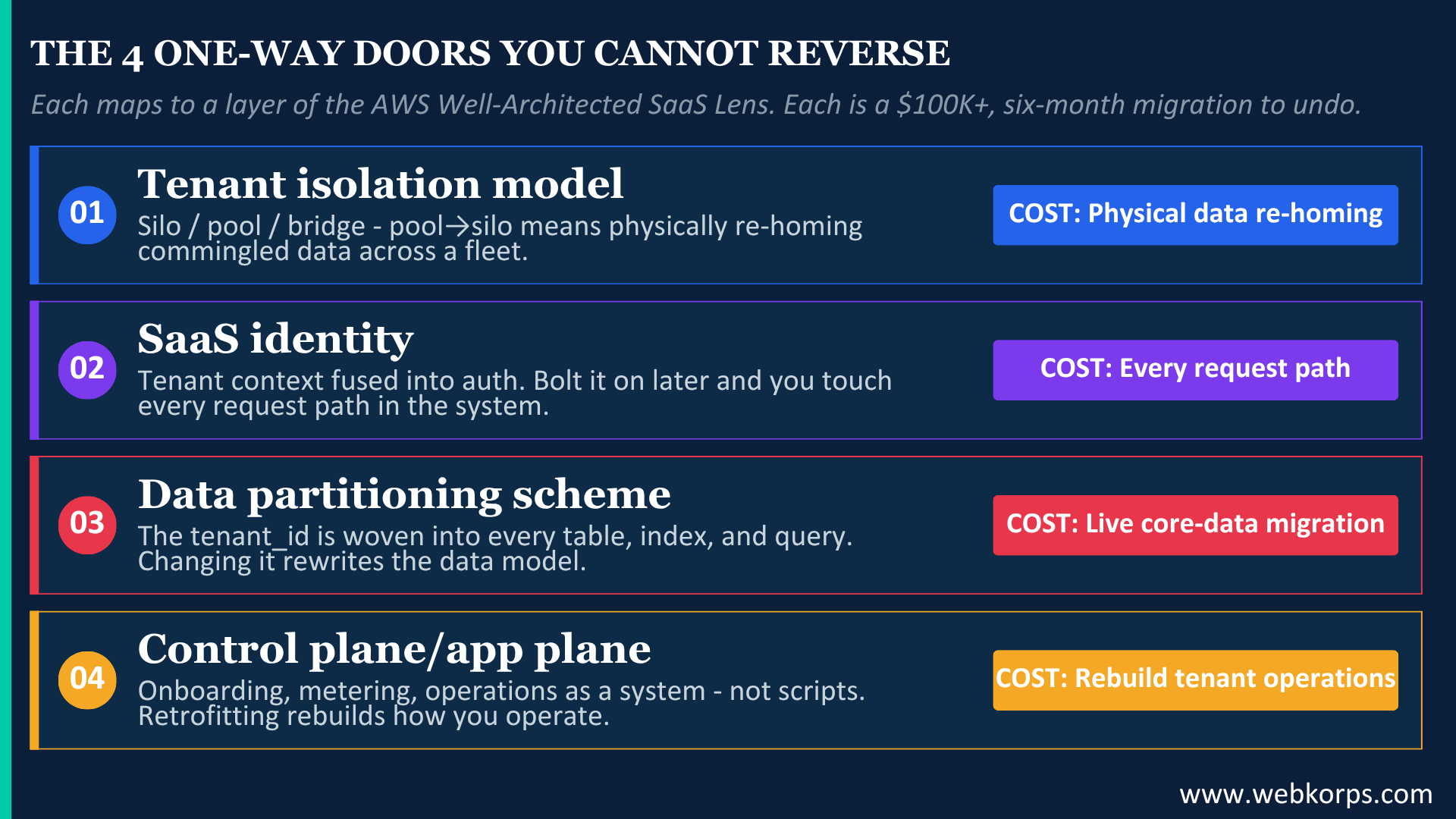
- Your tenant isolation model (silo/pool/bridge), how tenant data is physically separated
- Your SaaS identity model, how tenant context binds to every authenticated request
- Your data partitioning scheme, and how the tenant boundary is encoded in the data itself
- Your control-plane / application-plane split, whether tenant management is a system or an afterthought
Decision 1: The Tenant Isolation Model (Silo, Pool, Bridge)
This is the decision everyone knows about, and most people underestimate. The AWS Well-Architected SaaS Lens defines three isolation models, and the distinction is fundamentally about how much of your infrastructure tenants share. Understanding all three is table stakes; understanding why the choice is hard to reverse is the part that protects you.
The three models, precisely
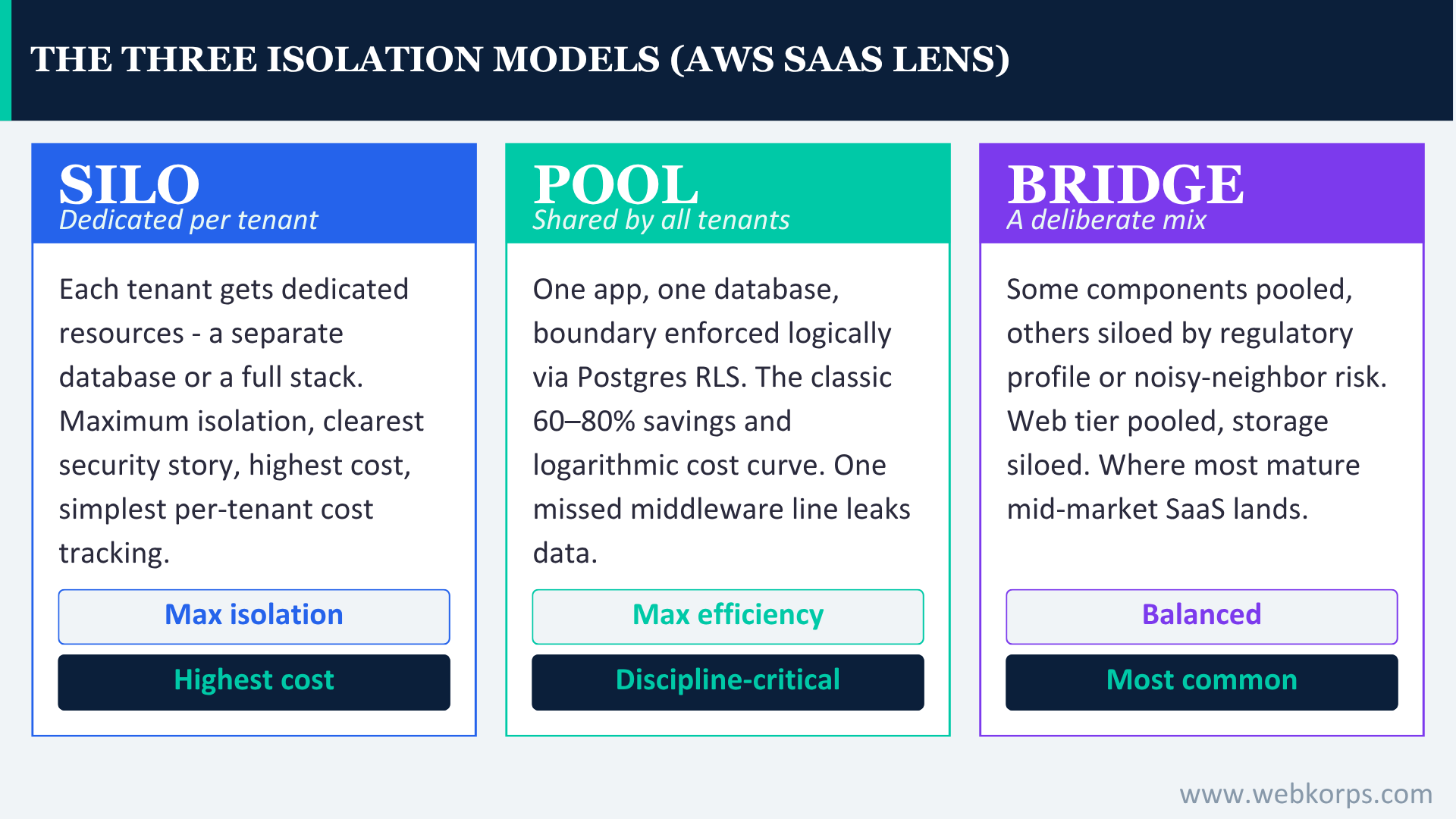
- Silo: each tenant gets dedicated resources, a separate database, sometimes a fully separate stack. Maximum isolation, the clearest security story, the highest cost, and the simplest per-tenant cost tracking. The AWS Lens is careful to note that a silo is still SaaS only if it’s wrapped in shared identity, onboarding, metering, and operations; you’ve accidentally built a managed-service business with none of the SaaS economics.
- Pool: all tenants share infrastructure, one application, one database, with the boundary enforced logically, typically through Postgres row-level security (RLS) or equivalent middleware. This is the classic multi-tenancy that delivers the 60–80% infrastructure savings and logarithmic cost curve: customer number 1,000 costs a fraction of customer number 10. It is also the model where a single missed line of middleware leaks one tenant’s data to another.
- Bridge: a deliberate mix. The AWS Lens describes it as acknowledging ‘the reality that SaaS businesses aren’t always exclusively silo or pool.’ The web tier might be pooled while storage is siloed; one microservice pools its data while another, steered by its regulatory profile or noisy-neighbor risk, silos it. The bridge is where most mature mid-market SaaS actually lands.
Why it’s a one-way door
Moving pool, silo means physically separating data that was designed to be commingled: re-homing every tenant’s rows into dedicated databases, rewriting every query’s connection logic, and rebuilding your deployment and migration tooling to operate across a fleet instead of one database. Moving silo → pool is arguably worse, you’re merging schemas that drifted independently and retrofitting isolation onto data that never had it. Either direction is a multi-month program with the highest-stakes possible failure mode: a migration bug doesn’t crash the app, it shows one customer another customer’s data.
| THE DECISION THAT AGES WORST |
| The model you need at 10 tenants is rarely the model you need at 1,000. A SaaS that starts with SMB customers and has no compliance requirements does not stay that way. The first enterprise client wants a dedicated instance. The first noisy-neighbor complaint lands in support. The first data-residency clause appears in a contract you badly want to sign. Teams that are designed for a single fixed model hit what engineers privately call ‘the rebuild moment’, and the rebuild always costs more than designing for evolution would have. |
Decision 2: SaaS Identity, Where Tenant Context Is Born
This is the irreversible decision almost no one writes about, and it is arguably the most foundational of the four. The AWS Lens calls it SaaS identity, and the concept is deceptively simple: in a normal application, authentication tells you who the user is. In SaaS, that’s only half the answer. You also need to know which tenant the user belongs to, and that tenant context has to be fused into the identity itself, then carried through every layer of the system on every single request.
Get this right, and tenant context flows automatically: your authenticated token carries the tenant identity, your data-access layer reads it without the developer thinking about it, and, as the AWS Lens explicitly recommends, you ‘limit the degree to which developers have exposure to tenancy.’ Get it wrong, and tenant identity becomes something every developer has to remember to pass, check, and enforce manually, in every endpoint, every query, every background job, forever.
Why it’s a one-way door
SaaS identity is the assumption every other layer is built on top of. If the tenant context lives in your JWT claims and flows through a shared middleware, isolation is enforced in one place. If instead it was bolted on, passed as a function argument here, read from a header there, inferred from the subdomain somewhere else, then retrofitting a unified identity model means touching every request path in the system. You are not changing a component; you are changing the contract that every component already depends on. That is the definition of architecturally hard to change.
“After authenticating a user, we need to know who the user is as well as which tenant they’re associated with. This merging of user identity with tenant identity is a foundational element of SaaS architecture.”
– AWS Well-Architected SaaS Lens
Decision 3: Data Partitioning, The Boundary Encoded in the Data
Isolation (Decision 1) is the strategy; partitioning is how that strategy is encoded into the data itself. In a pooled model, the dominant 2026 pattern is a single database where every table carries a tenant_id and isolation is enforced by Postgres row-level security. The RLS policy is what stands between ‘working SaaS’ and ‘front-page breach.’
The canonical pooled-isolation pattern looks like this, and the discipline it requires is the whole point:
| — Enable row-level security on every tenant table
ALTER TABLE orders ENABLE ROW LEVEL SECURITY; — The policy that enforces the tenant boundary CREATE POLICY tenant_isolation ON orders USING (tenant_id = current_setting(‘app.current_tenant’)::uuid); — Set on EVERY request, from the SaaS identity context SET app.current_tenant = ‘<tenant-uuid-from-token>’; |
Here is the trap the AWS-aligned guidance flags repeatedly: forgetting to set the tenant context on even one request path leaks cross-tenant data. A single background job, a single admin endpoint, a single new microservice that queries the database without setting app.current_tenant, and RLS either blocks everything or, if misconfigured, exposes everything. The partitioning scheme is only as strong as its least disciplined query.
Why it’s a one-way door
The partitioning key is woven into every table, every index, every query, and every foreign-key relationship in the schema. Changing it, from a tenant_id column to schema-per-tenant, or introducing a region/shard dimension for data residency, means rewriting the data model the entire application is built against, then migrating live production data without downtime and without a single mis-routed row. This is the migration in our opening story. It is the one that costs $100K and six months, because the partitioning scheme isn’t in the application; it is the application’s relationship to its data.
Decision 4: The Control Plane vs. Application Plane Split
The fourth irreversible decision is the most architectural and the easiest to skip under deadline pressure. The AWS Lens draws a hard line between two parts of every SaaS system: the application plane (where tenants actually use your product) and the control plane (the shared services that onboard, manage, meter, and operate all tenants, the ‘single pane of glass’). The principle: every SaaS must be operable through one shared control plane, regardless of whether the application plane is siloed, pooled, or bridged underneath.
This is precisely what separates real SaaS from a managed-service business wearing a SaaS costume. The AWS Lens is blunt about it: a fleet of siloed tenant stacks is only SaaS if it’s ‘surrounded with shared identity, onboarding, metering, metrics, deployment, analytics, and operations.’ Without that control plane, you don’t have a SaaS platform; you have N copies of a product, each requiring individual care, and your operational cost scales linearly with customers instead of logarithmically. That is the death of SaaS economics.
Why it’s a one-way door
If you build tenant onboarding, metering, and operations as ad-hoc scripts bolted onto the application plane, rather than as a distinct control plane with its own architecture, then every new tenant, every new isolation tier, and every new operational requirement is a custom job. Retrofitting a real control plane later means rebuilding how your entire company provisions, observes, and operates customers, while the ad-hoc version is live and load-bearing. You can add a feature to a product in a sprint. You cannot quietly swap out the operational nervous system that the whole business runs on.
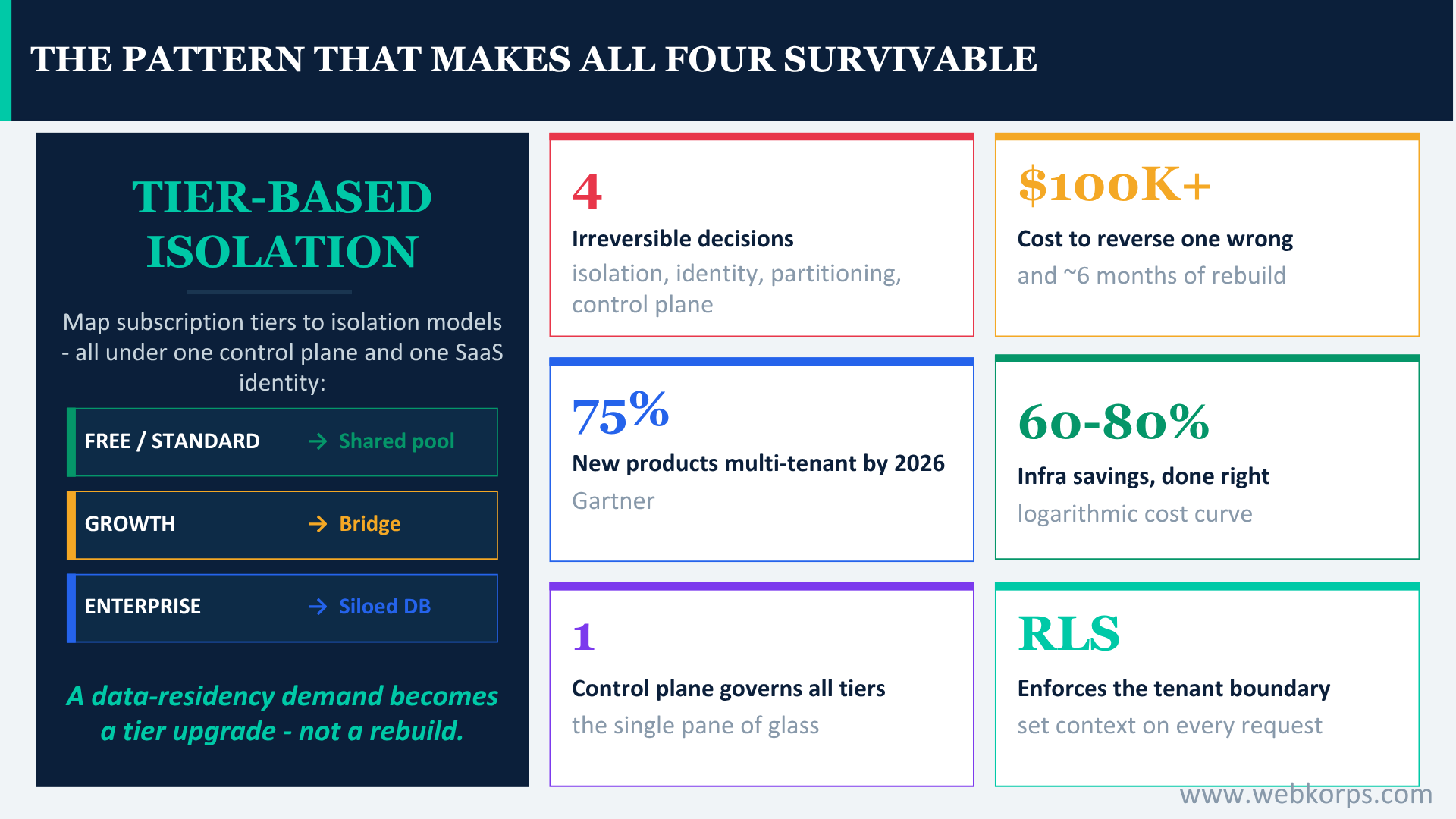
| THE PATTERN THAT MAKES ALL FOUR DECISIONS SURVIVABLE |
| The mature 2026 answer is tier-based isolation: map your subscription tiers to isolation models, free and standard tiers on a shared pool, enterprise tiers promoted to siloed databases, all governed by one control plane and one SaaS identity. The AWS Lens supports exactly this. Done right, an enterprise customer’s data-residency demand becomes a tier upgrade, not a rebuild. That is what ‘designing for evolution’ means in practice: the one-way doors are built once, correctly, so the reversible decisions stay reversible. |
Also read: Why Most Generative AI Projects Stall at the Data Layer
The Reversibility Map: Where to Spend Your Architectural Attention
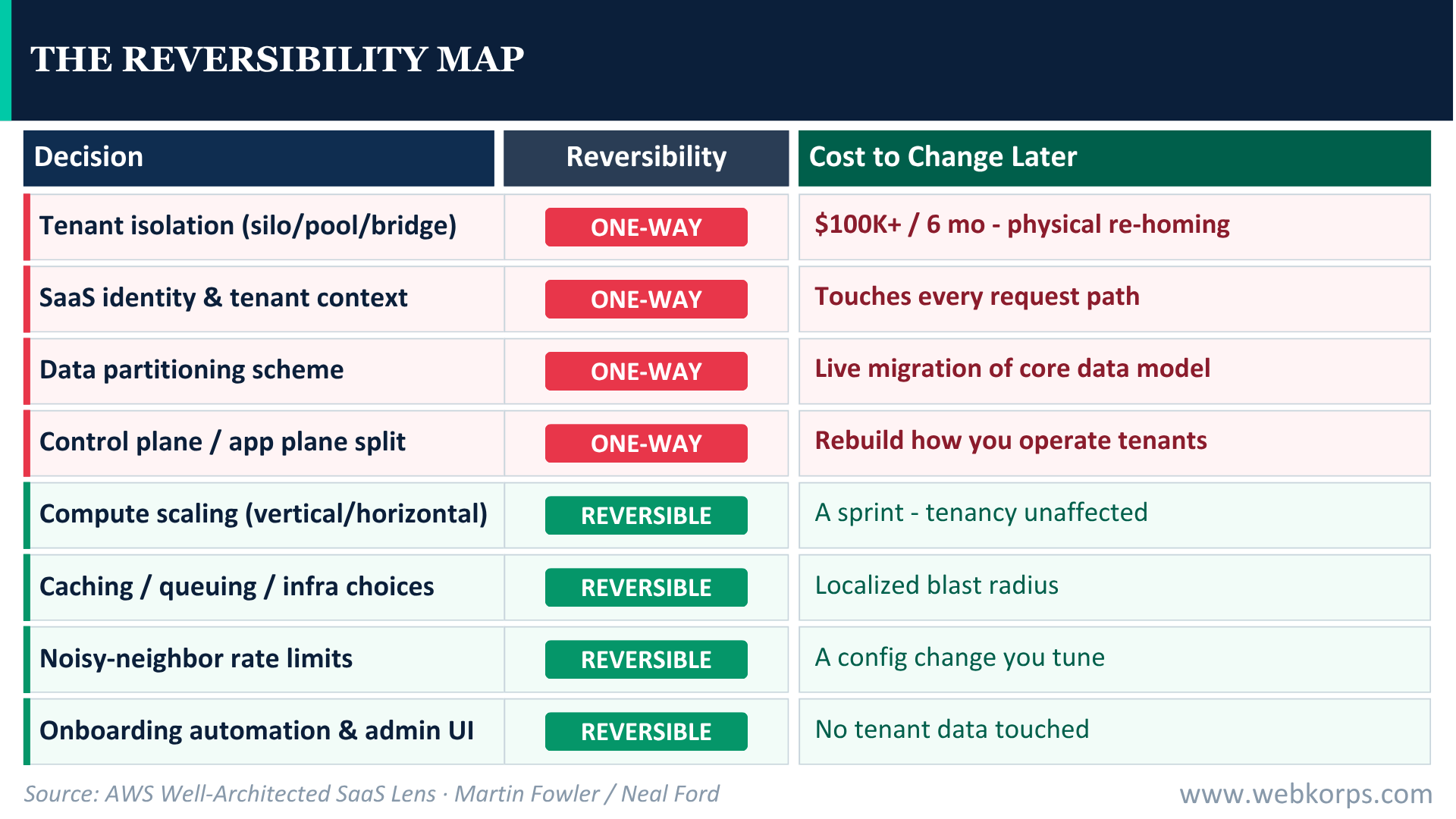
Here is the entire decision landscape on one page, sorted by the only axis that matters at the bottom of the funnel, when you’re about to commit. Spend thirty minutes on the reversible decisions. Spend thirty days with an experienced SaaS architect on the irreversible ones.
| Decision | Reversibility | Cost to Change Later |
|---|---|---|
| Tenant isolation (silo/pool/bridge) | One-way door | $100K+ / 6 months, physical data re-homing |
| SaaS identity & tenant context | One-way door | Touches every request path in the system |
| Data partitioning scheme | One-way door | Live migration of the core data model |
| Control plane/app plane split | One-way door | Rebuild how the company operates tenants |
| Compute scaling (vertical/horizontal) | Reversible | A sprint, tenancy model is unaffected |
| Caching/queuing / infra choices | Reversible | Localized blast radius, swap as needed |
| Noisy-neighbor rate limits | Reversible | A config change you tune continuously |
| Onboarding automation & admin UI | Reversible | Rebuildable without touching tenant data |
Also read: From Pilot to Production: A Practical AI Operationalization Framework
How Webkorps Builds Multi-Tenant SaaS for Evolution
The companies that get burned by multi-tenancy aren’t the ones who picked the ‘wrong’ model. They’re the ones who picked a fixed model, who treated an irreversible decision as a 30-minute stack-planning checkbox, and discovered the one-way door only when an enterprise contract was on the far side of it. Webkorps builds multi-tenant SaaS the way the AWS Well-Architected SaaS Lens and evolutionary architecture both prescribe: get the four one-way doors right, and keep everything else cheap to change.
What that looks like when we architect a platform:
- Tenant isolation designed for promotion: we build the pooled foundation and the path to siloed enterprise tiers from day one, so a data-residency clause is a tier upgrade, not a rebuild
- SaaS identity as a first-class layer: tenant context fused into authentication and carried through shared middleware, isolation enforced in one place, not remembered in a thousand
- Partitioning with governance built in: RLS and tenant-context enforcement designed so that no query path can silently leak across the boundary
- A real control plane from the start: onboarding, metering, and tenant-aware operations as architecture, the single pane of glass that keeps your costs logarithmic
- Aligned to the standard: AWS Well-Architected SaaS Lens principles, ISO 27001, and CMMI Level 3 delivery, across backend, cloud, and DevOps
Also read: What HIPAA-Compliant AI Actually Looks Like in Production
Build the One-Way Doors Like You Can Never Walk Back Through Them
The CTO whose enterprise deal died didn’t lose it in the security review. He lost it three years earlier, in the thirty minutes he spent choosing a tenancy model without knowing he was standing in a doorway that only opened one way. That is the real lesson of multi-tenant SaaS architecture, and it’s the one the ‘here are three models’ guides never quite say out loud: the models aren’t the hard part. Knowing which choices you can revisit and which you can’t, that is the architecture.
Fowler’s definition gives you the entire mental model you need. Architecture is the decisions that are hard to change. In multi-tenant SaaS, four decisions are hard to change: tenant isolation, SaaS identity, data partitioning, and the control plane. The AWS Well-Architected SaaS Lens gives you the blueprint for each. Spend your attention there. Defer, simplify, and stay flexible on everything else. Design the one-way doors for the company you’re becoming, not just the one you are this quarter.
Do that, and multi-tenancy delivers exactly what it promises: 60–80% lower infrastructure cost, a logarithmic scaling curve, and the freedom to say yes to the enterprise logo when it finally knocks. Skip it, and you’ll write the most expensive migration of your career, the one you could have avoided in an afternoon, if you’d known which afternoon mattered.
| Get the Irreversible Decisions Right the First Time |
| Webkorps designs and builds multi-tenant SaaS platforms architected for evolution, tenant isolation, SaaS identity, data partitioning, and the control plane, aligned to the AWS Well-Architected SaaS Lens. ISO 27001 certified. CMMI Level 3. 250+ developers across 30+ countries. Book a free multi-tenant architecture review before you write the migration you can’t afford. |
| Book a Multi-Tenant Architecture Review |
Frequently Asked Questions
Q: What is multi-tenant SaaS architecture?
Multi-tenant SaaS architecture is a design where a single application instance serves multiple customers (tenants) from shared infrastructure, with each tenant’s data logically or physically isolated. It’s the foundation of SaaS economics: because tenants share compute and storage, adding customer number 1,000 costs a fraction of customer number 10, delivering 60–80% lower infrastructure cost than single-tenant deployments. The core architectural choice is how much tenants share, captured in the AWS SaaS Lens silo, pool, and bridge models.
Q: What is the difference between silo, pool, and bridge models?
In the silo model, each tenant gets dedicated resources (a separate database or full stack), maximum isolation, highest cost. In the pool model, all tenants share one application and database, with the boundary enforced logically through row-level security, maximum efficiency, and the classic SaaS cost curve. The bridge model is a deliberate mix: some components are pooled, others siloed based on compliance or noisy-neighbor risk. Most mature mid-market SaaS lands on a bridge, often via tier-based isolation where enterprise tiers are promoted from pool to silo.
Q: Can you change your multi-tenant architecture later?
Some parts, yes; the foundational parts, not cheaply. Compute scaling, caching, rate limits, and onboarding automation are reversible; change them in a sprint. But four decisions are one-way doors: tenant isolation (silo/pool/bridge), SaaS identity, data partitioning, and the control-plane split. Changing any of these means physically re-homing data, touching every request path, or rebuilding how you operate tenants, typically a $100K+, six-month migration with a worst-case failure mode of exposing one tenant’s data to another. Design these four for evolution from the start.
Q: What is SaaS identity, and why does it matter?
SaaS identity is the fusion of user identity with tenant identity. In a normal app, authentication tells you who the user is; in SaaS, you also need to know which tenant they belong to, and that tenant context must flow through every layer on every request. The AWS SaaS Lens treats it as foundational. Get it right, and isolation is enforced in one place (your token and middleware); get it wrong, and every developer must manually pass and check the tenant context everywhere, forever, making it one of the hardest decisions to reverse.
Q: How does row-level security work in multi-tenant SaaS?
Row-level security (RLS) enforces the tenant boundary inside a pooled database. You enable RLS on each tenant table, create a policy that filters rows by tenant_id = current_setting('app.current_tenant'), and set that tenant context on every request from your SaaS identity layer. The critical discipline: forgetting to set the context on even one request path, a background job, an admin endpoint, a new microservice — can leak cross-tenant data. RLS is powerful, but it’s only as strong as your least disciplined query path.
Q: How much does it cost to change a multi-tenant SaaS architecture?
Changing a reversible decision (scaling, caching, rate limits) costs a sprint. Changing an irreversible one costs far more: industry analyses in 2026 put the typical cost of switching tenancy models or partitioning schemes at $100K+ and six months, because it requires migrating live production data, rewriting the data model the whole application depends on, and doing it without downtime or a single mis-routed row. This is why founders should spend real architectural time, not 30 minutes, on the four one-way doors before building.